It's far from easy to copy the "national team"'s homework.
Author | Huang Yida
Editor | Zhang Fan
Two years later, A-share investors are hearing a familiar voice again: "Is the '924 rally' coming back?"
On November 2, the People's Bank of China, the State Administration of Financial Regulation, and the China Securities Regulatory Commission joined forces again to roll out a series of policy measures to stabilize the capital market, including launching a new round of swap facility operations for securities, fund, and insurance companies, converting the share repurchase and increase relending program into a long-term institutional arrangement, and cutting the relending interest rate from 1.25% to 1%.
Meanwhile, the China Securities Regulatory Commission announced plans to optimize the rules for share repurchases of listed companies, further relax repurchase conditions, and push the 18 newly raised active ETFs to speed up position building to provide incremental capital support for the market. The investment trends of "national team" funds such as China New Holding and China Chengtong Holdings Group have once again attracted market attention, which further strengthened investors' expectation that the "national team" will enter the market during the market downturn.
More critically, the above measures easily remind investors of the policy press conference on September 24, 2024. At that time, Pan Gongsheng, Governor of the People's Bank of China, made it clear when introducing the first 500-billion-yuan swap facility that if the implementation effect is good, another 500 billion yuan can be launched, and even a third 500 billion yuan. This statement, which is close to "unlimited ammunition", greatly boosted investor confidence. Subsequently, the A-share market started a sharp rise, giving birth to the impressive "924 market rally".
However, compared with the policy intensity at that time, the statement of the central bank this round is significantly more moderate, and the policy focus is more on the optimization and implementation of existing tools. On November 3, the central bank launched a 100-billion-yuan swap facility operation, with clear policy support but a relatively restrained pace. To a certain extent, after experiencing the sharp rise of the market in a short period in the last round, the regulatory authority may pay more attention to the rhythm of market repair, stabilizing investor confidence while avoiding short-term emotional overheating.
So, does the entry of the national team mean that the A-share market has hit the bottom? Can this "924 market rally" be repeated?
Historical Review: How did the national team perform when buying the dip?
Over the past nearly 20 years, "national team" funds such as Central Huijin Investment and China Securities Finance Corporation have entered the market many times during the sharp adjustment of the A-share market. From the historical performance, the buying time point of the national team is often close to the phased bottom of the market, and with the entry of national team funds, the A-share market has rebounded to varying degrees in most cases. Although the national team did not accurately buy the lowest point every time, its medium and long-term performance has proved that it has extremely strong timing ability.
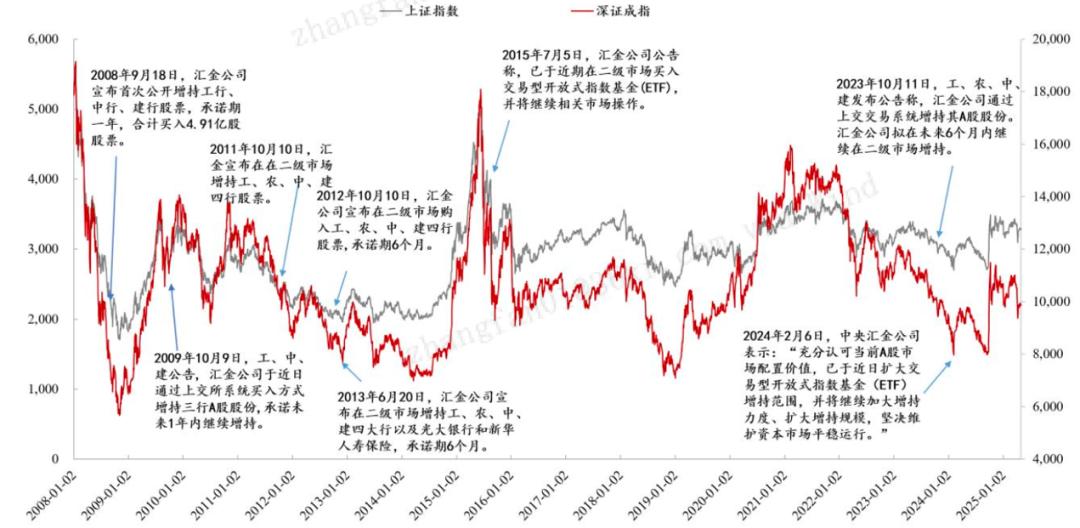
Figure: The entry of the national team and the performance of the A-share market index in the past two decades; Source: West China Securities, 36Kr
In 2008, the global financial crisis continued to spread. After the A-share market experienced a sharp decline for nearly a year, market sentiment had been extremely depressed. In September of the same year, Central Huijin announced that it would increase its holdings of Industrial and Commercial Bank of China, Bank of China, and China Construction Bank, and promised to continue increasing its holdings in the next year.
After that, the Shanghai Composite Index continued to fall, and hit a phased low of 1665 points at the end of October. With the shift of domestic monetary policy to easing, the stimulus of the four-trillion-yuan investment plan, and the gradual recovery and stability of the global financial market, the A-share market started a sharp rebound. By August 2009, the Shanghai Composite Index rebounded to a maximum intraday level of 3478 points, rising by more than 100% cumulatively from the previous low.
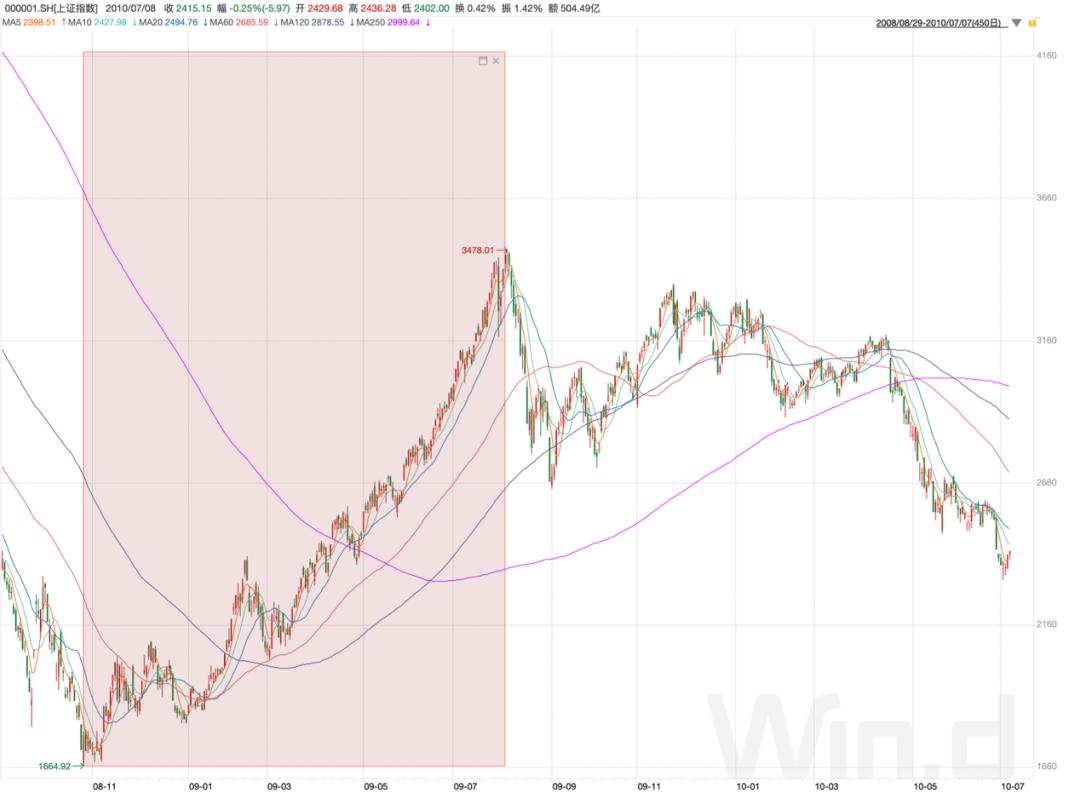
Figure: Performance of the Shanghai Composite Index from 2008 to 2010; Source: Wind, 36Kr
From 2011 to 2013, the A-share market experienced another long-lasting market adjustment.
During this period, in the face of the pressure of slowing economic growth, the shift of monetary policy to tightening and the impact of the European debt crisis, Central Huijin announced in October 2011 that it would increase its holdings of stocks of the four major banks: Industrial and Commercial Bank of China, Agricultural Bank of China, Bank of China, and China Construction Bank. In October 2012, Huijin once again announced that it would increase its holdings of the four major banks, and promised to continue buying in the next six months. However, these two increases in holdings failed to immediately reverse the downward trend of the market. It was not until December 2012 that the Shanghai Composite Index staged a phased rebound, but the strength was relatively limited.
In June 2013, the liquidity of the domestic market tightened suddenly, and the A-share market saw a sharp decline and adjustment. Huijin announced in late June that it would increase its holdings of bank stocks and insurance stocks. While the national team entered the market, the tight situation of market capital gradually eased. The Shanghai Composite Index bottomed out near 1849 points (June 25), and then started a V-shaped rebound. By the phased high point in September of that year, the index rose by 15% cumulatively.
The 2015 stock market crash can be said to be the most representative case of large-scale entry of the national team.
In June of the same year, the Shanghai Composite Index fell rapidly after standing at the historical phased high of 5178 points, investor panic spread rapidly, and concentrated selling triggered a market stampede. In July, Huijin announced that it had bought relevant ETF products in the secondary market and would continue relevant operations, and institutions such as China Securities Finance Corporation also took measures to stabilize the market one after another.
After the national team entered the market, the A-share market did not immediately end the decline, and even saw another sharp adjustment in August of that year, and did not really hit the bottom until January 2016. With continuous deleveraging, the pressure on market liquidity eased significantly, and the A-share market gradually returned to stability. From the counterattack of the market index to the phased high in late January 2018, the Shanghai Composite Index rebounded by about 34% cumulatively from the low point in early 2016.
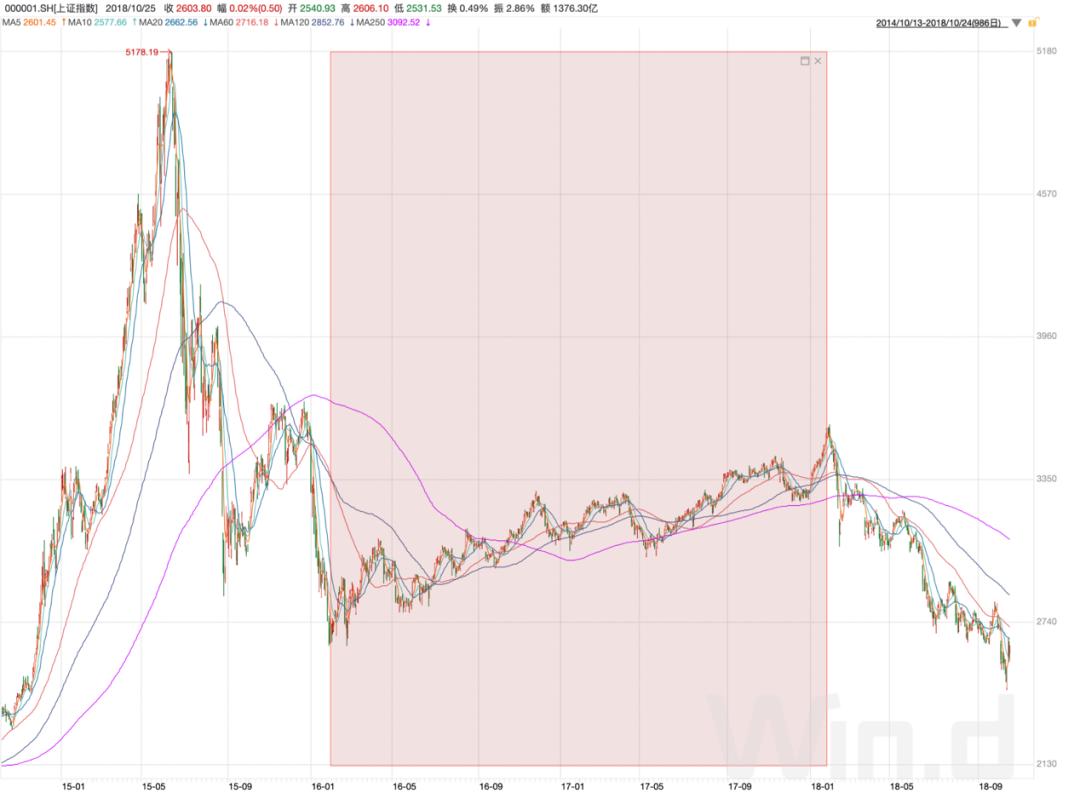
Figure: Performance of the Shanghai Composite Index from 2015 to 2018; Source: Wind, 36Kr
The latest typical entry of the national team took place between 2023 and 2024. In October 2023, Huijin announced that it would increase its holdings of the four major banks and planned to continue increasing its holdings in the next six months. In February 2024, Huijin further announced that it would expand the scope of ETF holdings increase and increase the intensity of holdings increase. At that time, the A-share market had experienced a long period of adjustment, and market valuation and investor sentiment were both at the low levels of the past 10 years. After that, the Shanghai Composite Index staged a small rebound from February to May 2024.
Although the market adjusted again later, on September 24, the People's Bank of China, the State Administration of Financial Regulation, and the China Securities Regulatory Commission jointly launched a package of financial policies. The market's expectations for the liquidity environment and economic prospects improved significantly, and investor confidence recovered rapidly, pushing the A-share market to usher in a rapid rise. By October 8, the Shanghai Composite Index touched the highest intraday level of 3674 points, rebounding by 36% cumulatively from the September low, and the trading volume also refreshed the historical high at that time.
Judging from the timing of the national team's entry each time, although it may not buy at the lowest point of the market, it is mostly in the stage of deep adjustment of the A-share market and extremely depressed investor sentiment. Even if the market index continues to fall after entry, with the gradual improvement of the market environment, a relatively considerable rebound will often come later. It can be seen that the national team's ability to buy the dip is mainly reflected in its ability to seize the investment opportunities brought by the deep market adjustment and its ability to withstand large fluctuations.
02 Advantages of the national team: Buy at low levels and hold positions firmly
First, deep market adjustment is often accompanied by irrational selling, which provides reasonable buying opportunities for the national team.
In the late stage of deep adjustment of the A-share market, panic selling that exceeds the change of fundamentals often appears. The fall of asset prices aggravates investors' anxiety, and stop-loss and leveraged position unwinding push prices to continue to fall, thus forming a negative feedback loop, which is exactly what happened in the 2015 stock market crash.
In the above trading environment, the overall market valuation is compressed rapidly, and there is a large area of mispriced assets. The national team provides buying support for the market when sentiment is most panicked and the risk premium is high, so the overall holding cost during this period is relatively low. With the continuous release of favorable factors such as policies and liquidity, passive selling weakens and market expectations improve, and the previously excessively compressed valuation will have room for repair.
The national team's dip-buying operations every time exactly reflect Buffett's classic investment philosophy: "Be fearful when others are greedy, and be greedy when others are fearful."
Second, the more prominent advantage of the national team lies in its long-term holding capacity, which is also the core point that ordinary investors find most difficult to replicate.
It is common sense that the market will rebound after excessive decline, but the real difficulty is to bear the pain of continued decline after buying. Even if the valuation is cheap enough, investors will still be affected by floating losses, position constraints, leverage, emotional pressure and other factors. Especially at the moment when the market continues to fall without major positive news and the rebound seems far away, investors can easily doubt their original judgment.
Looking at the national team, it not only undertakes the policy function of stabilizing the market, can maintain continuous investment when the market fluctuates greatly, and has relatively stable liability side. Even if there is a floating loss after entry, the determination of the national team enables it to span a relatively long cycle. After the national team entered the market in July 2015, the market experienced two rounds of deep decline, which just shows that compared with buying at the lowest point, having sufficient funds and firm determination is more important.
Third, the entry of the national team often cooperates with the improvement of the policy environment, which further increases the possibility of market rebound.
The national team's direct purchase of stocks or ETFs is mainly intended to absorb selling pressure, ease short-term liquidity pressure, and send policy signals of stabilizing the market to the market. However, according to historical experience, market rebound often requires the continuous release of major positive news, which are mainly divided into the following three categories:
1. Liquidity improvement, typical examples include interest rate and reserve requirement cuts in 2008, and the gradual easing of leverage pressure after 2015;
2. Policy support, such as the large-scale investment plan in 2008 and the combined policy package in September 2024;
3. Easing of the external environment, such as risk appetite repair after the 2008 global financial crisis.
In terms of rhythm, as a policy tool to stabilize the market, the national team usually enters the market when the market needs support, and the above favorable factors often gradually emerge after the national team enters the market. From Central Huijin's announcement of increasing holdings in 2008 to the market rebound in 2009, and from the expansion of ETF holdings in February 2024 to the policy shift in September, we can all see this process of entering the market first to stabilize the market and then waiting for the release of positive news.
With stable capital sources and strong holding capacity, the national team can withstand market fluctuations before the policy takes effect, and wait for the investment returns brought by market rebound.
Therefore, the entry of the national team provides an important investment signal for investors, and the key factors that really determine the strength and sustainability of the rebound are the improvement expectations of liquidity, policy environment and fundamentals. Therefore, the most worthy point for ordinary investors to learn from the national team's dip-buying behavior is that when the market is extremely panicked, leave enough time for your judgment to be verified, and strong determination can make this potential return have the opportunity to be converted into final investment gains.
*Disclaimer:
The content of this article only represents the author's opinion.
Markets have risks, and investment requires caution. Under no circumstances shall the information or opinions expressed in this article constitute investment advice to anyone. Before deciding to invest, if necessary, investors must consult professionals and make decisions cautiously. We have no intention of providing underwriting services or any services that can only be engaged in by holding specific qualifications or licenses for all trading parties.