The race for AI Agents, the next zero-sum game among tech giants
Around the Start of Winter, the competition among major tech giants in the agent track has suddenly heated up.
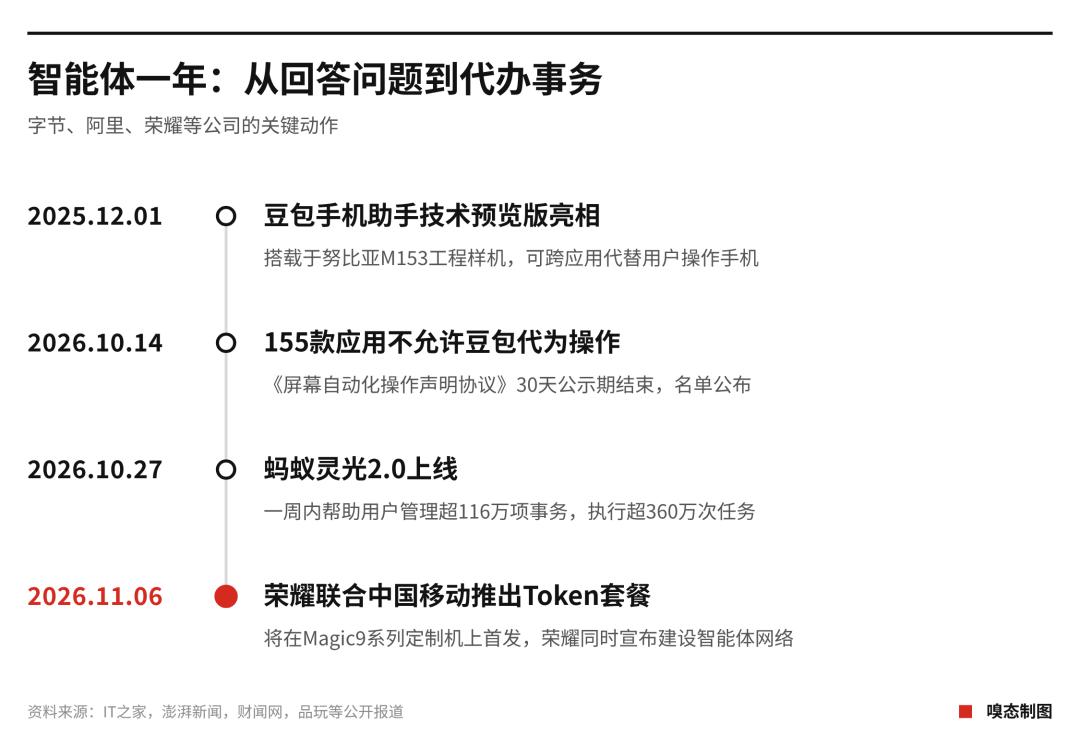
On November 6, George Zhao, CEO of Honor, announced in Guangzhou that Honor will build an agent service network in partnership with China Mobile and other partners, and plans to launch AI Token packages on the Magic9 series of smartphones.
A day earlier, Ant Group released the one-week performance report of the Lingguang 2.0 platform. According to the data disclosed by Ant Group, Lingguang has helped users manage more than 1.16 million affairs, completed over 3.6 million cumulative task executions, and integrated with more than 40 external services including DingTalk, Feishu and Hello.
Both companies are committed to pushing AI into practical implementation, while ByteDance has taken a more aggressive approach and encountered more tangible resistance.
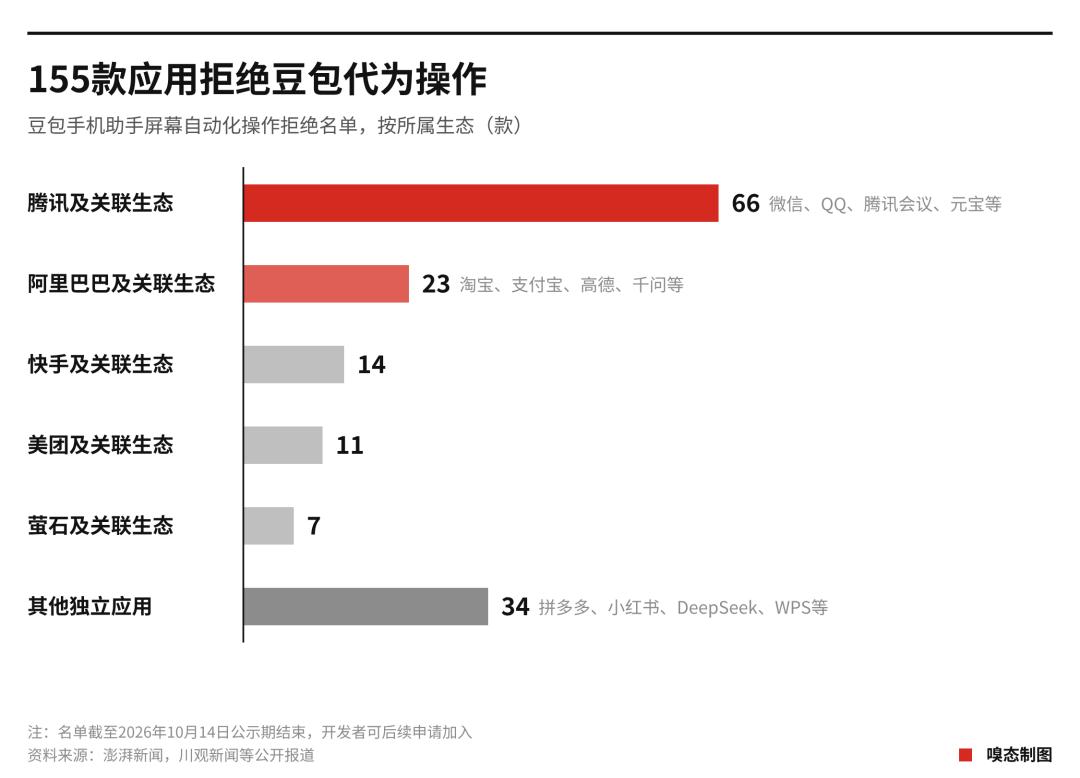
At the end of 2025, the Nubia engineering prototype equipped with the Doubao mobile assistant was unveiled. Doubao can identify screen content and try to operate the mobile phone on behalf of users. In October this year, the screen automatic operation rejection list announced by Doubao mobile assistant already included 155 applications, including commonly used software such as WeChat, Taobao, Meituan and Xiaohongshu. Users can use these apps normally on their own, but Doubao cannot arbitrarily operate them on their behalf.
In this context, the arms race of large models has quietly shifted its battlefield. As the gap in answering daily questions is no longer widening, the industry's focus has rapidly shifted to tool invocation, long-link fulfillment and system permissions.
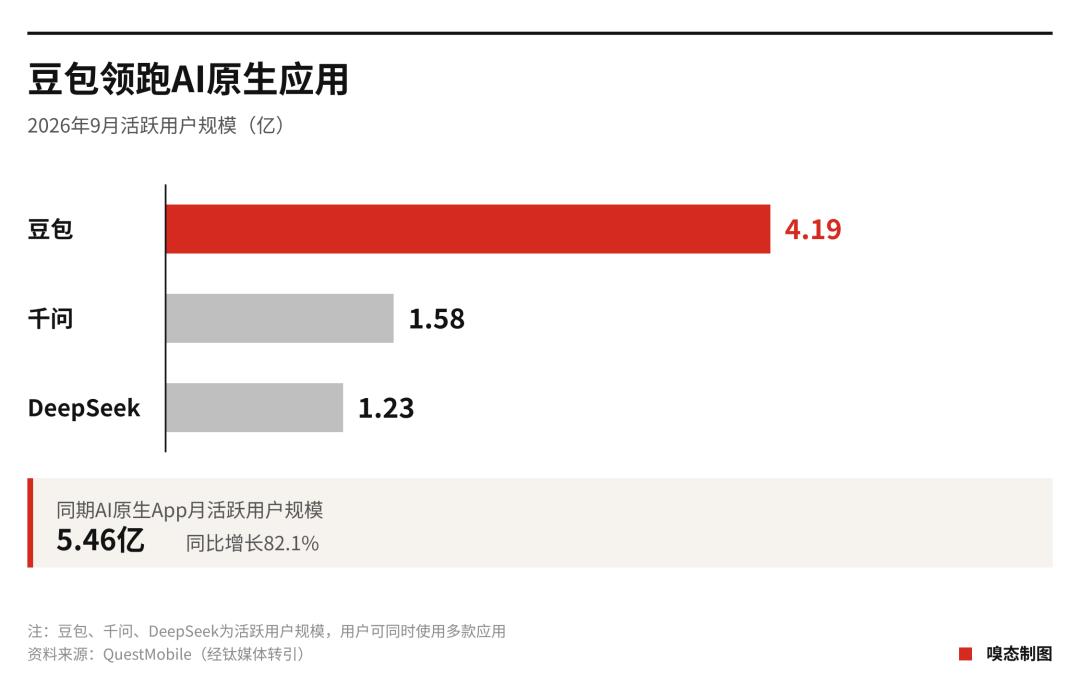
According to QuestMobile data, as of September 2026, the monthly active users of domestic AI-native applications have climbed to 546 million, and the number of terminal system-level AI users has crossed the threshold of 780 million.
The user base is large enough, but the rules of the game are being rewritten. In the existing landscape, major Chinese internet giants have each occupied their own territories relying on search, social networking, e-commerce and algorithmic recommendation. At the same time, they are facing a new round of benefit redistribution.
Battle for Entrance
The landscape of China's internet over the past two decades is essentially a process of competing for the right to distribute user demands.
The boundaries of each company's territory are very clear. Baidu guards the search box, Alibaba manages commodity transactions, Tencent locks in the social relationship network, and ByteDance continuously divides users' time through algorithmic information feeds. Each of them has built high walls, steadily collecting profits in their respective domains, and has coexisted peacefully for many years.
This smoothly operating commercial system did not begin to show cracks in its original tacit understanding and balance until generative AI and agents were gradually rolled out.
The path to find information and handle affairs has suddenly shortened. Users no longer need to browse web pages one by one in search engines, but are accustomed to directly sending a sentence to Doubao, Qianwen or DeepSeek. Turning to models for help has become a muscle memory for users.
The data from QuestMobile is very intuitive: in September this year, the monthly active users of Doubao exceeded 419 million, that of Qianwen reached 158 million, and DeepSeek also climbed to 123 million. Judging solely by user volume, Doubao has indeed pulled ahead among domestic AI-native products.
However, scale does not directly equal victory. The larger the user base, the more obvious the sense of anxiety on ByteDance's side.
A person opens Doubao dozens of times a day to write several documents and modify two emails, which seems to show extremely high stickiness, but the lively interactions in the dialog box will not generate cash flow out of thin air. After users let Doubao work out a clear travel itinerary, they still have to jump out of the app interface when choosing hotels and booking air tickets, and the orders and handling fees eventually go to OTA platforms such as Ctrip and Fliggy.
Although ByteDance has built a huge e-commerce and local life business ecosystem on Douyin, Doubao, as an independent AI application, faces a wide variety of real user demands, and its own business is far from being able to cover all these scenarios.
This is where the real ambition of the Doubao mobile assistant lies. ByteDance does not want to be just a talkative AI that only answers questions. It wants agents to directly reach into the operating system. By identifying the mobile phone screen and simulating human clicks, all the operations that users originally had to do on Meituan, Ctrip and Taobao to compare prices and jump between apps can be fully delegated to Doubao. To put it bluntly, ByteDance is urgently trying to cross boundaries to intercept traffic, attempting to turn its AI into the universal remote control for all apps, and securing a position at the very front end where users make payment decisions.
Alibaba's hidden cards and mindset are completely different.
Taobao, Tmall, Amap, Fliggy and Ele.me form a complete commercial fulfillment network covering physical e-commerce and local life. For Qianwen, even if it only plays a trivial wake-up entrance on the C-end, as long as users generate consumption demands, the orders will most likely eventually fall steadily into Alibaba's own commercial flywheel. Alibaba's real challenge is not to seek external services, but to coordinate old and new interests. Taobao has long earned substantial profits from merchant bidding search, recommendation exposure and ad slots, while Qianwen is committed to helping users reduce the time spent on comparison and selection. Once users fully rely on agents to make decisions, the original commercial logic of making money from display volume will inevitably face in-depth restructuring.
Tencent's choice shows a different kind of composure and restraint.
WeChat has precipitated not only a huge social relationship chain, but also a decentralized service base built by mini-programs. People have long been accustomed to chatting, handling affairs and making payments within WeChat. For Tencent, there is no need to aggressively build a cross-app plug-in like ByteDance to pry into other platforms' interfaces. As long as agents are quietly embedded in chat boxes, Moments and enterprise collaboration systems to hold its own moat, it will be difficult for others to break in. The only thing Tencent needs to carefully weigh is how much operation permission it should grant to agents, and which core links must be firmly kept under WeChat's control.
Of course, there is another force that cannot be ignored in this game, which is the mobile phone manufacturers that hold the hardware terminals. Compared with third-party software, mobile phone manufacturers naturally have the dominant power over the underlying system. With features like wake-free operation, cross-app scheduling and all-day hardware-level perception, Honor's launch of the agent service network in partnership with China Mobile essentially aims to use the first touch point of hardware devices to intercept users' AI entrance on the system desktop.
The positions of these major tech giants at the entrance are completely determined by their accumulated assets over the years. ByteDance is eager to expand outward to find implementation scenarios, Alibaba is busy restructuring its transaction fulfillment system with AI, Tencent carefully protects the order of its existing ecosystem, and mobile phone manufacturers strive to hold the physical throat of their devices.
The battle for entrance thus diverges into two completely different practical paths. One path is that independent AI applications strive to become an all-powerful super hub through dialogue interaction; the other is that super apps and mobile operating systems rely on their existing territories to quietly sink AI capabilities into infrastructure.
In the short term, the user scale on the software side is easier to generate momentum on the rankings, but in the long run, the party that can make users confidently hand over deep permissions and be the first to be awakened in daily life will have the confidence to set the rules for the next generation.
Battle for Ecosystem
The "155-app rejection list" that caused Doubao to hit a wall has laid bare the cruel reality in the process of agent implementation: no matter how smart the model is, it cannot move an inch without platforms opening up data and interfaces.
Booking a flight ticket requires querying flights, checking prices, filling in identity information, and finally completing payment. The whole process involves multiple systems. If one link cannot obtain the necessary data or operation permission, the task may be interrupted. Even if AI can accurately understand user requirements, it may not be able to complete the actual operation.
The problem is that most of the services that agents need to call are held by other internet companies.
The commercial model of the mobile internet has long been built on the cornerstone of "manually using apps". People open Taobao to find products, select merchants on Meituan, and choose hotels on Ctrip. Platforms influence user choices through recommendations and advertisements, and merchants are willing to pay corresponding fees to obtain traffic and orders.
Agents may change the original transaction process.
For example, when a user plans to buy a computer and tells AI the budget and configuration requirements, AI can query the prices, after-sales services and delivery conditions of different platforms to help users complete the comparison. Users save the trouble of repeatedly browsing product pages, and the opportunities for platforms to display advertisements and recommend products may also decrease accordingly.
For ByteDance, the more tasks Doubao can complete on behalf of users, the more access it will have to more consumption demands. For platforms such as Taobao and Meituan, allowing AI from other companies to directly operate their services also means that the original user entrance and product recommendation mechanism may be affected.
The interests of the two sides are not completely aligned. Companies that provide agents hope to connect more services and grasp the demands raised by users; platforms that own products and transaction systems need to consider how much their original commercial revenue will be affected after opening up services.
Of course, platforms' rejection of automated operations also stems from security considerations.
WeChat and Alipay store a large amount of personal information, involving identity authentication, fund transactions and account security. The agent's ability to identify the screen and simulate clicks brings convenience to users, but also increases the risk of misoperation and information leakage. When users authorize AI to handle affairs, it does not mean that third-party software can operate platform accounts without restrictions.
Therefore, platforms' restrictions on automated operations involve not only anti-fraud and account security, but also commercial interests that need to be weighed. It cannot be simply assumed that major tech giants reject agents just to protect their own traffic.
This has led to two uncompromising construction paths: one is the "external breakthrough" represented by Doubao, which tries to formulate operation protocols and force the cross-app operation to run by simulating human behavior; the other is the secure closed-loop path adopted by Ant's Lingguang, WeChat Mini Programs and Alibaba's Qianwen, which carefully connects services through official API interfaces within the mutually recognized commercial and security framework.
More interestingly, all major tech giants have generally fallen into a dual role in the competition. They all hope that their own agents can get access to external software, but are extremely cautious about opening up their own core assets. WeChat will not open its social and transaction interfaces to competitors without bottom line, and Taobao must also weigh whether external AI proxy operations will erode its original traffic dividends.
Every company hopes that its own agent can connect to more software in the external ecosystem, but they need to weigh repeatedly when opening up their core businesses. At this stage, agents have completely got rid of the self-indulgence of algorithm optimization, and stepped into the highly sensitive interest zone among major tech giants.
How far the interfaces should be opened, how to verify user privacy across ends, who will take responsibility for bad debts or misoperations, and how to split the revenue, all these issues require repeated negotiations at the table. Even if model vendors push their reasoning capabilities to the extreme, they cannot shake the moats that other platforms have built for more than a decade. To put it another way, even if users trust a certain agent 100%, the task will still break down halfway if the opposite platform does not grant access.
Even if all parties really sit down and sign an agreement, there is still a huge computing power bill hanging in the background. Every time an agent completes a long-link task for a user, it consumes real money on computing power. The more frequent the calls, the heavier the server cost burden. Smooth operation is one thing, but being able to balance the books and make profits is another critical threshold for survival.
Battle for Operational Efficiency
Agents can not only respond to user demands, but also connect services between platforms. However, when we shift our focus from personal mobile phones to enterprise-level collaboration, the battlefield shifts from competing for attention to stricter operational benefit accounting.
Individual users are willing to let AI plan itineraries, but they may not be willing to pay separately for each operation; when enterprises purchase software, they calculate the clear human resource input-output ratio in black and white.
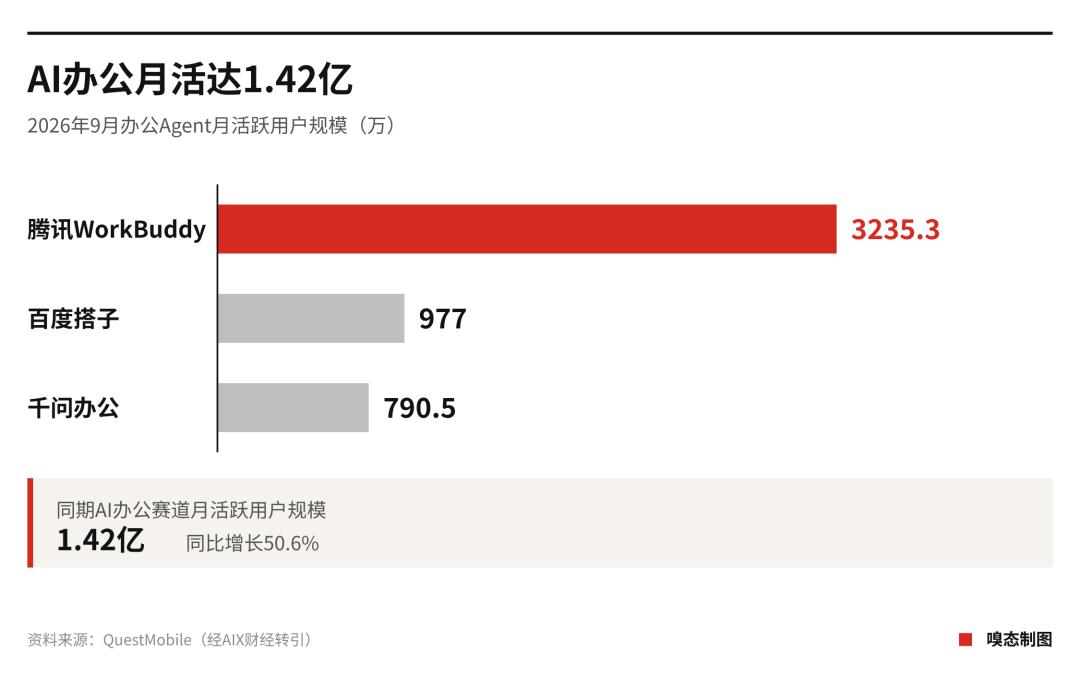
According to QuestMobile data, the monthly active users of AI office applications in China have climbed to 142 million in September this year. Tencent has launched WeCom and WorkBuddy, Alibaba relies on DingTalk and Qianwen Office, and ByteDance builds its knowledge base on Feishu. All three companies are leveraging their existing infrastructure to try to let agents take over approval, reimbursement and cross-departmental collaboration.
What major tech giants value is not only the immediate tool subscriptions, but also turning AI into an irreplaceable underlying infrastructure for enterprises, so as to reasonably push up the subsequent migration cost.
But when it comes to actual implementation inside enterprises, the reality is far more trivial and strict than generating a document.
Processing a reimbursement form needs to circulate among employees, business supervisors, finance staff and cashiers; signing a contract requires checking counterparty qualifications, payment terms and seal usage permissions item by item. If agents want to complete tasks on behalf of people, they need to access various scattered business databases, and ensure that every step of operation does not exceed authority or make mistakes.
Business owners calculate accounts in a very realistic and straightforward way. What they want are certain results and clear attribution of responsibilities. If data cleaning that originally required three people can be done by one person with AI, and the saved labor costs can be recorded in the financial statements, enterprises will be willing to pay for it; if it only generates a document full of platitudes that still needs to be rewritten manually, the so-called efficiency improvement is just an unclear ambiguous account.
This has precisely put a new cost constraint on software vendors.
Traditional SaaS software charges by account and by year, with marginal cost approaching zero. Agents have completely subverted this profit model. Every time a cross-system task is processed, the large model and tools need to be called repeatedly in the background, and computing power and Tokens are continuously consumed with real money. The more frequent the task execution, the heavier the reasoning cost borne by the service provider. Customers want to pay a fixed fee for stable services, but vendors have to secretly calculate whether high-frequency calls will break through the profit bottom line. Honor's trial of Token packages on mobile phones is exactly an exploration of how to fight against this cost black hole.
Looking back at this agent battle spanning the consumer end and the industrial end, the chips of each major tech giant still come from their original business foundation. ByteDance holds a huge number of AI-native users, Alibaba occupies a deep transaction and fulfillment network, Tencent firmly guards its national-level social and collaboration relationships, and mobile phone manufacturers occupy the first touch point of system hardware.
However, holding the entrance does not mean being able to complete the task, and being able to complete the task does not mean being able to make a profit.
The commercial balance established in the mobile internet era has been broken. A task may receive demands from one company's AI, be provided with services by another company's platform, and finally complete settlement and fulfillment on a third-party channel. Users only care whether the matter is handled properly, while major tech giants need to weigh permissions, computing power and revenue