360,000 "middle-aged women" purchased 5.2 billion yuan worth of JNBY products in one year.
Author | Xie Yunzi
Editor | Zhang Fan
In 2026, when the entire consumer industry is collectively going through a harsh winter, JNBY Group has unexpectedly reached its peak.
On October 20, JNBY closed at HK$23.2, hitting its all-time high of HK$23.66 since its listing on the same day, with a cumulative increase of over 29% since the start of the year.
The latest financial report released by the company underpins its stock price performance.
In the 2026 fiscal year ending June 30, JNBY recorded revenue of 6.046 billion yuan, up 9.0% year on year; net profit attributable to shareholders stood at 997 million yuan, up 11.7% year on year; gross margin reached 66.6%, and net margin hit 16.5%.
According to a report by SPDB International, from July after the end of FY2026 to the present, JNBY's total transaction value has maintained sustained high single-digit growth, and the transaction value growth during the National Day Golden Week even exceeded 10%.
Zoom the comparison dimension to the entire industry.
Although JNBY is not in the same league as Anta Sports, Bosideng and HLA, it has led the entire industry since the beginning of this year in terms of stock price and performance growth.
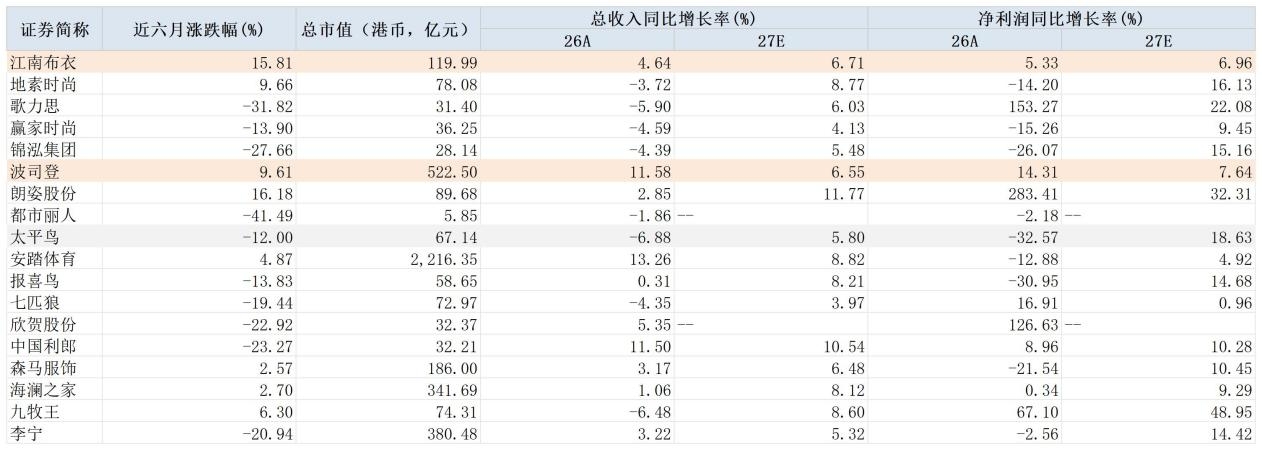
Table data from Wind; statistics as of November 5, 2026
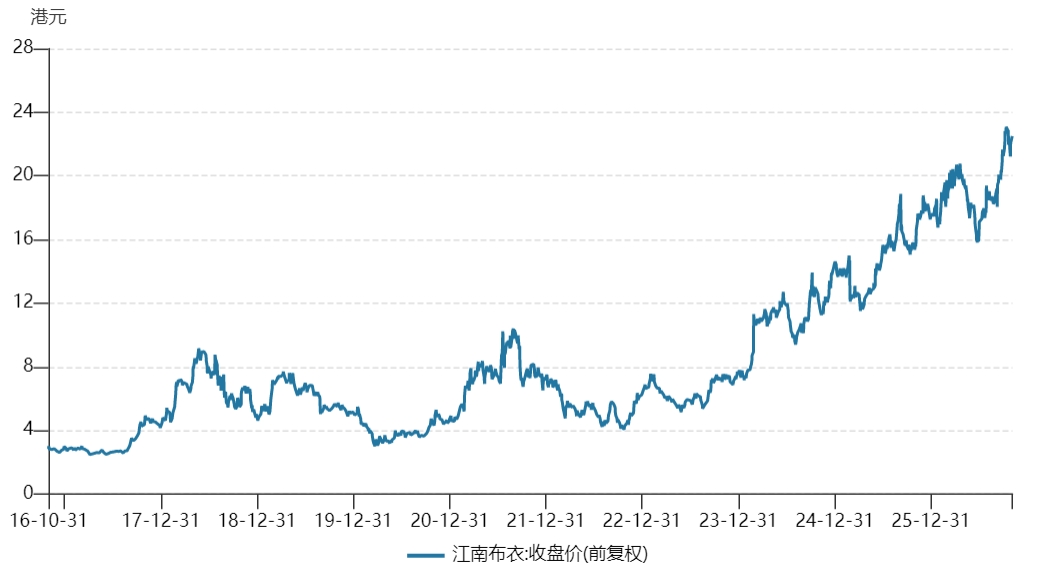
Screenshot from Wind
The "small yet beautiful" company has achieved overtaking, which is somewhat counterintuitive.
In the era of consumption stratification, non-essential consumption is generally mired in anxiety; with outdoor trends dominating the market, traditional fashion brands are mostly trapped in growth dilemmas.
From the perspective of consumer perception, JNBY is still associated with two labels: one is that its design is "somewhat exaggerated and hard to understand", and the other is the "controversial children's clothing" scandal five years ago. These form the first layer of public "filter" for the brand.
Being criticized and making profits happen to the same company at the same time, which seems contradictory but is actually the result of user screening — JNBY does not need to be liked by everyone, it only needs its existing fans to keep purchasing its products.
Who is paying for JNBY?
In 1994, Li Lin and her husband Wu Jian started their clothing business in Hangzhou, and later shifted to independent design.
Independent analyst Tang Xiaotang recalled that at the beginning of its establishment, JNBY took the "anti-traditional" route, featuring designs that are "humanistic, natural and emphasize tailoring", and its early users were mostly intellectuals from cultural and media sectors.
This genetic trait has continued to this day. The loose silhouettes, natural colors, and textured fabrics such as cotton and linen endow JNBY with a certain degree of recognition in shopping malls — it does not rely on eye-catching logos. Consumers buy clothes that "look exactly like JNBY", not a certain seasonal hit item.
In the latest financial report, JNBY defines its target customers as modern women aged 25 to 40, emphasizing that they are highly curious and good at discovering surprises and poetry in ordinary life. This is the official positioning, which is not equivalent to the real portrait of its members.
Another term circulating on social platforms may be more appropriate — "middle-aged women". This term generally refers to women over 30 years old who have stable spending power and dress to please themselves.
A long-time fan told 36Kr that JNBY's designs were very unique at the very beginning, "some bold color combinations look great on the body", but "the design quality is inconsistent from time to time".
In her perception, most people who buy this brand are "women living in first- and second-tier cities, working in public institutions or established enterprises, with certain consumption power". "When they visit shopping malls, they do not necessarily go to the luxury zone, but they also look down on brands like Langzi and Eifini, thinking that those brands lack design sense or are too youthful."
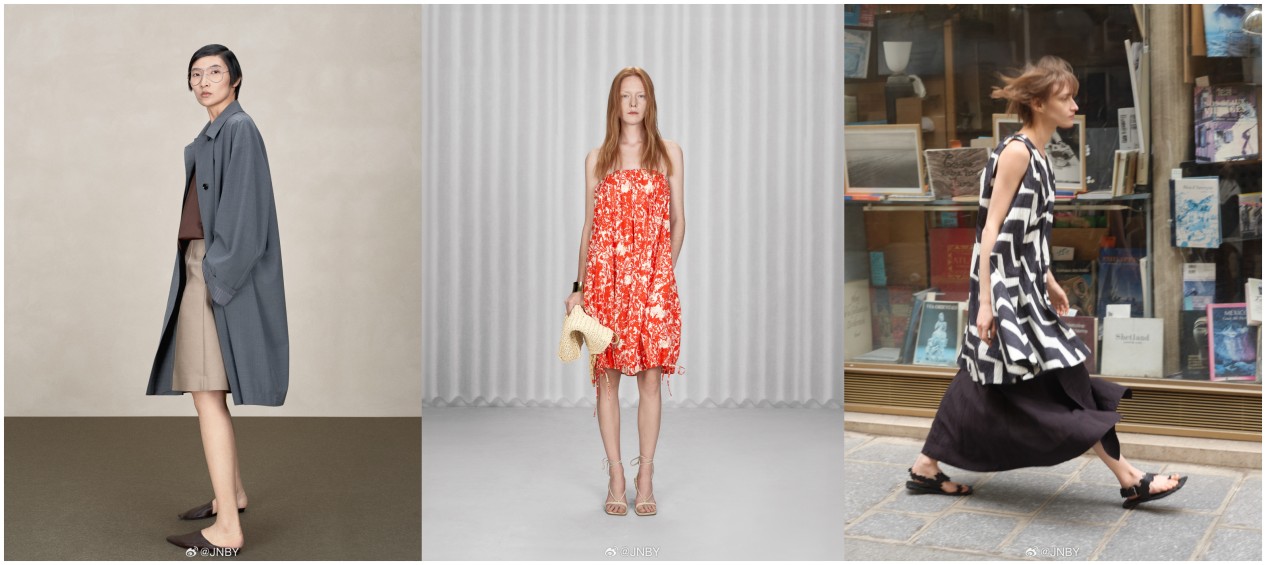
JNBY 2026 spring and summer new collection; photo from official Weibo account
Of course, the small-scale sample is not enough to represent all members.
The July report from Soochow Securities shows that JNBY's main price range is 500 to 2000 yuan, lower than Dazzle Fashion's 1000 to 4000 yuan. None of these women's clothing brands are cheap, but they allow consumers even in lower-tier cities to buy clothing that does not fully follow the public taste, different from fast fashion and sports styles.
The purchasing power of this group of users is finally reflected in the financial report data.
Calculated based on JNBY's retail scale in FY2026, the combined contribution from first- and second-tier cities accounts for 52.3%, and cities at third-tier and below contribute 47.7%. This at least shows that the distribution of JNBY's consumer groups across cities is relatively balanced. What is more critical than the member portrait is repurchase rate.
In FY2026, JNBY had more than 610,000 active member accounts. Compared with the 1.9 million active users disclosed by Youngor in 2021, this figure is not large, but the purchasing power is very strong.
During the reporting period, the retail sales contributed by JNBY members accounted for more than 80% of the total; high-value members who spent more than 5,000 yuan per year exceeded 360,000, contributing 5.2 billion yuan in retail sales, accounting for more than 60% of the total offline channel retail sales. Roughly converted, the per capita consumption of this group of high-value members in FY2026 exceeded 14,400 yuan, which is the real core user base of the company.
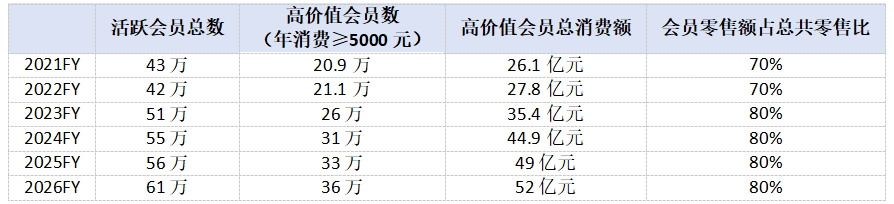
36Kr makes the table based on public data
Ten-year free repair service and "One Box" program
For clothing brands, design is responsible for attracting the first batch of users. But the "natural, minimalist, poetic" concept that JNBY advocates is always a metaphysical expression, and consumer perception varies from person to person.
Not only JNBY, peers' definitions of their own styles are mostly abstract labels.
Peacebird positions itself as "enjoying quality fashion" and does not emphasize a fixed designer language; Dazzle is more inclined to urban trends, and Soochow Securities summarizes its design as "patterns, decorations and asymmetry", which the official calls "aesthetics of contradictions and conflicts".
However, positioning differences are not equivalent to distinct brand recognition.
After the pandemic, consumers pay more attention to stability and universality, and the new autumn and winter products of various brands this year also show a certain convergence. On social platforms such as Xiaohongshu, some users have complained that JNBY's style is getting more and more conservative, and "looks too much like boring office wear".
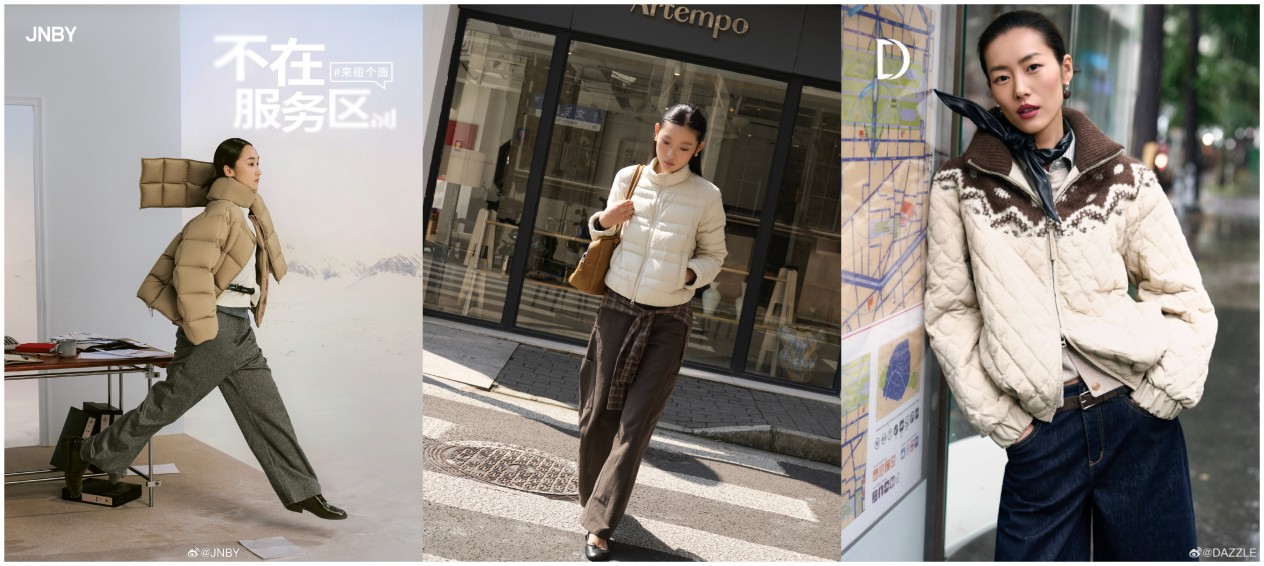
From left to right: autumn and winter new collections of JNBY, Peacebird and DAZZLE
When unique style is no longer a competitive advantage, the key to retaining users falls on operational capacity.
JNBY's membership system mainly has two tiers: Silver Card and Gold Card, with rights including "exclusive discounts, birthday privileges, laundry and care benefits, ten-year repair service" and so on.
In the past, this kind of "butler-style" service mostly existed in luxury brands, and the warranty period for ready-to-wear products was basically within 1 year. In the mid-to-high-end women's clothing track, JNBY's membership service is absolutely a rare choice.
While helping members reduce the cost of laundry and care, JNBY also saves decision-making costs for consumers, especially professional women who do not have time to go shopping.
21st Century Business Review once reported that JNBY spent two or three years polishing a set of algorithms, in which the "online data insight dashboard" adds preference labels such as "material, silhouette, color" for members. Shopping guides will actively recommend products according to these labels.
According to Huang Sheng, CMO of the company, the recommendation hit rate of this system reaches 70%; the advertising delivery efficiency based on member labels is also considerable — in the fashion women's clothing sector on Tencent's platform, "invest 1 yuan and earn 7 yuan", and the ROI is second only to UR and UNIQLO.
What is more perceptible than labels is the "BOX+ More Than A Box" program.
Public information shows that at JNBY, users only need to pay 399 yuan per year to receive 6 sets of pre-matched clothing combinations. They can try them on for free, keep the ones they like, and return the unsuitable ones.
In addition, for Gold Card members, JNBY also specially launches a customized "1-on-1" stylist service.
At this point, the private domain closed loop has been completed — design is responsible for screening users, and service is responsible for retaining them. Tencent Smart Retail also disclosed that JNBY's enterprise WeChat community penetration rate reaches 35%, which is at the leading level in the industry.
Net increase of only 1 store per year
In contrast to the elaborate member service, the offline store expansion is almost "stingy".
In FY2026, the total number of JNBY's global stores was 2118, with a net increase of only 1 throughout the year. This does not mean that the channel development is stagnant: in the middle of FY2026, the total number of the company's stores once reached 2163, and the net decrease was 45 in the second half of the fiscal year. While adjusting store layout, the channel structure is also changing.
Globally, the number of JNBY's self-operated stores increased by 9 to 501 for the whole year, and the number of distributor stores decreased by 8 to 1617. During the reporting period, self-operated revenue increased by 10.7% year on year, and distribution revenue only increased by 1.3%; in FY2025, self-operated revenue decreased by 6.2% and distribution revenue increased by 9.6%.
The ebb and flow between the two years may reflect the company's current channel trade-offs.

36Kr makes the table based on financial report data
Apart from store layout, the company is also extremely meticulous about its inventory management.
JNBY has no exclusive online SKUs, and all offline stores across the country share "one unified inventory pool" with online channels, reducing missing sizes, stockouts and local unsalable inventory. In the retail industry, the integration of online and offline is an important part of digital transformation, and JNBY has directly calculated the benefits brought by this measure.
In FY2026, the inventory sharing and allocation system brought an incremental retail sales of 1.405 billion yuan to JNBY, up 23.6% year on year. This part of growth comes from the re-matching of existing goods and channels, rather than simple store expansion.
In the same period, JNBY's online revenue increased by 20.5%, and offline channels still contributed about 76% of the total revenue. Online channels are responsible for continuously reaching users and allocating goods, while physical stores continue to provide services such as fitting, fabric perception and styling matching.
It can be seen that JNBY is not stopping expansion, but carrying out selective expansion: closing inefficient stores, investing resources in high-end shopping malls and high-quality locations to upgrade store experience. It does not focus on the number of stores, but on whether new stores can bring incremental revenue and whether existing stores can generate sustainable returns.
This choice is also built on the recognition of its investment attraction value by shopping mall operators.
"JNBY has always been a heavyweight brand that shopping malls are eager to introduce, and any shopping mall that wants to develop retail business will contact it."
According to Du Bin, Secretary-General of the Brand Professional Committee of Shanghai Shopping Mall Association, JNBY's in-store sales are relatively stable, and this stability is even more precious after the pandemic. "Since 2026, any brand that keeps opening new stores will be valued by shopping malls."
Only focusing on fixed business, the growth ceiling is in sight
However, JNBY's growth anxiety has not disappeared.
Tang Xiaotang's judgment points to a longer-term trend. He believes that the size of JNBY's core customer group is basically fixed, has touched the growth ceiling, and there is no space for large-scale customer expansion in the follow-up. Compared with before the pandemic, the company's revenue growth rate in recent years has slowed down significantly.
