Why are even small electric two-wheelers no longer selling well?
In this cycle of receding consumerism, "pragmatic daily-life consumers" refer to people who care about every meal, every plant and tree around them, and embody a down-to-earth and cost-conscious mindset.
In tangible daily life, two-wheeled electric vehicles are the most perfect rigid demand in the transportation sector. They require no parking fees, help avoid morning peak crowds, and can cover a full week of commuting with electricity costing just a few yuan. Whether you are rushing to the wet market for fresh produce, picking up and dropping off children at school, or a delivery rider traveling hundreds of kilometers a day, two-wheeled vehicles are the most durable and cost-effective productivity tools.
However, this "absolute rigid demand" market, underpinned by the largest and most pragmatic group of people, is not thriving at all.
According to data from AVC (Ovi Cloud), in the first three quarters of 2026, domestic sales of electric two-wheelers in China reached 48.378 million units, down 4.8% year on year. Among them, domestic sales in the first half of the year stood at 28.252 million units, down 12.6% year on year. Boosted by the summer vacation and the Mid-Autumn school opening season in the third quarter, sales rose 9% year on year, showing signs of recovery.
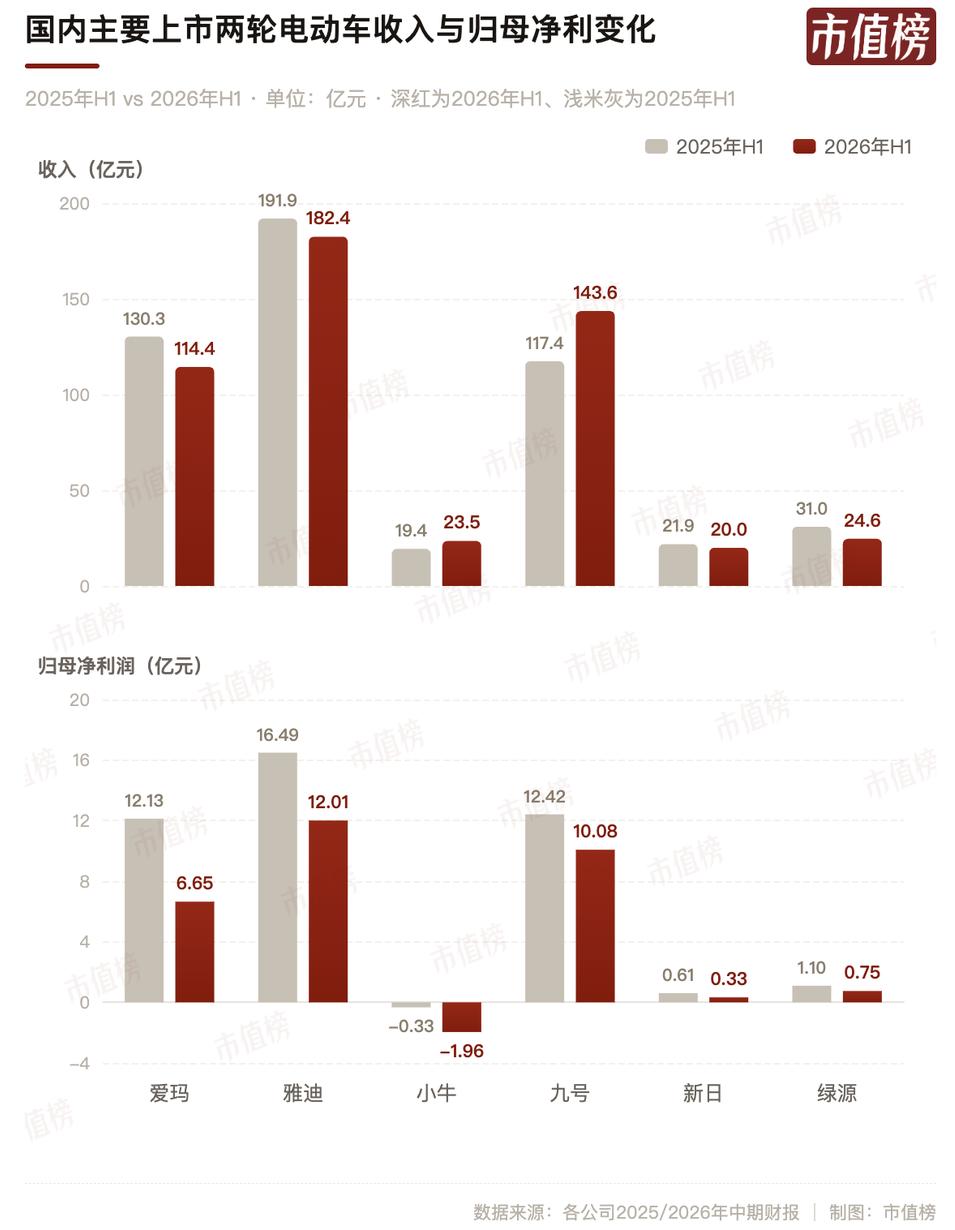
Enterprises operating in this industry are feeling the chill: Yadea, Aima, Ninebot, Niu Technologies, Luyuan, and Sunra have all experienced net profit declines without exception.
So, is this total volume contraction a short-term cyclical pain, or a trend of permanent shift in the industry's growth logic? In the contraction channel, is the decline evenly distributed? If "pragmatic daily-life consumers" are even reluctant to buy new vehicles, what real incremental opportunities are left in this industry?
I. Why are affordable small electric two-wheelers not selling well?
The sales decline in 2026 stems from multiple factors, including endogenous and policy-related drivers, as well as short-term impacts and long-term trends.
First, the endogenous expansion of the two-wheeled electric vehicle industry has hit a bottleneck, so the business logic has shifted from "incremental expansion" to "stock replacement".
In 2025, the domestic ownership of two-wheeled electric vehicles reached 450 million units, meaning roughly 1 out of every 3 people owns one. The sufficiently large ownership base, on the one hand, indicates that vehicle replacement demand is stable enough, and on the other hand, means the growth model driven by new users has reached its end.
Data shows that the proportion of stock replacement demand in total sales has risen from about 62% in 2021 to about 67% in 2025. For every 10 vehicles sold in the industry, nearly 7 are replacement purchases, leaving only one third of demand coming from new buyers.
And the pace of vehicle replacement can be adjusted earlier or later.
Second, the pace of vehicle replacement was affected by the trade-in policy, which led to a certain degree of demand overdraft in 2026.
In 2025, domestic sales of two-wheeled electric vehicles hit a phased high of 58.767 million units, mainly driven by trade-in activities: the annual trade-in volume of electric bicycles exceeded 12.5 million units, and the number of old vehicles eliminated and renewed was more than 9 times that of 2024.
Subsidies reduced the cost of vehicle replacement, and also prompted a number of old vehicles that could still be used for a period of time to enter the scrapping and renewal process in advance.
In 2026, electric bicycles are no longer included in the unified national trade-in subsidy scope, and local subsidies in some regions have also been adjusted. Consumers' actual expenditure on replacing vehicles has increased, making their decision-making naturally more cautious.
For a market where 70% of sales come from replacement, policies not only affect whether consumers buy vehicles, but also when they buy them. The concentrated replacement purchases in 2025 coupled with the subsidy decline in 2026 have led to a situation where demand cannot be sustained smoothly.
Third, the new national standard has brought adjustments on both the supply and demand sides, affecting consumer decision-making.
In September 2025, the new national standard for electric bicycles was officially implemented, with strengthened requirements for battery safety, fire resistance, charger protection, tamper resistance and other aspects.
On the supply side, the new standard means that links such as product design, component procurement and production manufacturing need to be adjusted, and distribution channels have also gone through the process of clearing old model inventory, launching new models and digesting new inventory.
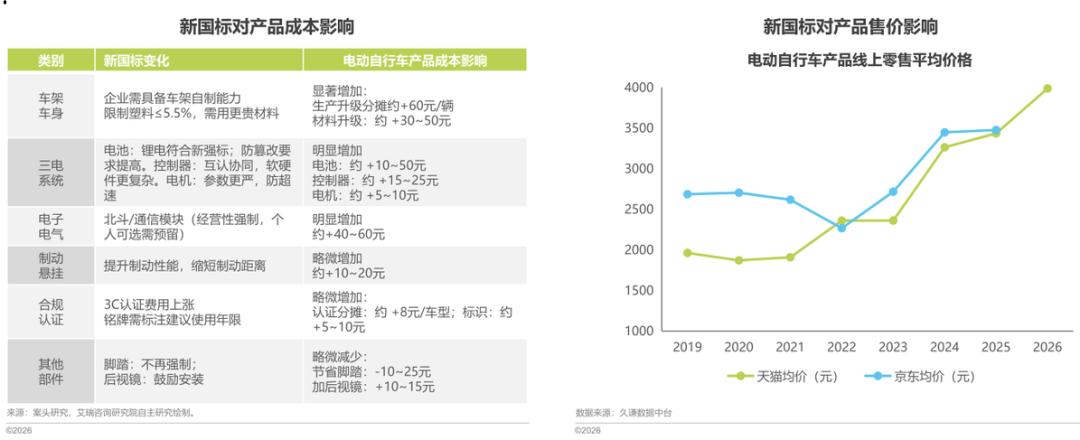
After the new national standard raised the requirements, the manufacturing cost per vehicle increased accordingly. The number of 3C testing items rose from 38 to 112, and the testing fees also increased, jointly pushing up the terminal selling price. According to media reports, for the same model, the price of the new national standard version is generally 300 to 600 yuan higher than that of the old national standard version.
The stock market determines the ceiling of growth rate, concentrated replacement purchases disrupt the rhythm of demand, and the transition of the new national standard adds chaos during the transition period. The three factors together affected the 2026 market.
However, the total volume decline does not mean that all enterprises are declining at the same pace. Facing the same round of adjustment, some enterprises have seen a significant drop in sales of their main products, while others have achieved revenue growth through category expansion. The decline across the industry is not uniform.
II. Category Migration and Enterprise Differentiation
The entire two-wheeled electric vehicle industry is not declining across the board. Traditional electric bicycles are shrinking sharply, while electric motorcycles / light electric motorcycles (with speeds above 50km/h and between 25-50km/h respectively) are growing against the trend.
Why can electric motorcycles absorb the released demand?
On the one hand, the new national standard has set clear restrictions on performance indicators such as the speed of electric bicycles. The 25km/h speed limit and tamper-proof requirements have squeezed the rigid demand of delivery riders and people with long-distance commuting needs.
Delivery riders are exactly the group that brands need to win over. In commercial scenarios, two-wheeled vehicles travel hundreds of kilometers per day, and their replacement cycle is much shorter than that in household scenarios. The advantages of electric motorcycles in battery life, load capacity and battery swapping adaptation meet their rigid demand that "vehicles are productivity tools".
On the other hand, price inversion has occurred. The compliance cost of the new national standard has pushed the terminal selling price of many new electric bicycle models above 3500 yuan, while the price of entry-level electric motorcycles has dropped to the 3000-yuan range. With the same budget, electric motorcycles have advantages in speed, battery life and load capacity, so demand naturally shifts to electric motorcycles.
As a result, electric motorcycles are no longer a niche category, and have become a core variable that reshapes the revenue trajectory of listed companies.
In the process of this large-scale category migration, Ninebot and Niu Technologies took the lead in achieving revenue growth.
In the first half of 2026, Ninebot's total revenue reached 14.36 billion yuan, up 22.3% year on year, of which the revenue from two-wheeled electric vehicles was 7.493 billion yuan, up 9.8% year on year.
According to research report data, the proportion of Ninebot's electric motorcycle sales rose from 51% in the first half of 2025 to over 90% in the first half of 2026. In the third quarter, the proportion of electric motorcycles remained at a high level, which was an important driving force for the growth of its two-wheeled electric vehicle business.
Ninebot's growth against the trend does not simply rely on its past "intelligent label".
It is still positioned as "young, high-end and intelligent" in public perception, and its real leverage lies in the outward extension of brand momentum and the downward expansion of channels and pricing to lower-tier markets.
On the one hand, Ninebot continues to use features such as keyless unlocking, OTA upgrades and systematic intelligent interaction to consolidate young users' recognition of "intelligent electric motorcycles".
On the other hand, Ninebot voluntarily lowered its "high-end brand" stance, launched a number of affordable electric motorcycles with a starting price of around 3500 yuan, and used 11500 stores covering more than 2200 counties and townships to capture the sinking market demand that overflows from new national standard electric bicycles, whose consumers are sensitive to both performance and price.
In short, brand momentum is responsible for "making people want to buy", and channels and pricing are responsible for "making vehicles accessible and affordable".
Niu Technologies' path is more focused.
For a long time, Niu Technologies has positioned itself as a high-end brand, but as consumers become more cost-conscious, Niu's ASP (average selling price) has already started to decline.
The category shift has instead provided Niu Technologies with a window of opportunity.
In the first half of 2026, Niu Technologies' revenue reached 2.35 billion yuan, up 21.3% year on year, with total vehicle sales of 696300 units, up 25.82% year on year. In the second quarter, electric motorcycle sales accounted for 60% of its sales in China.
Different from Ninebot's channel expansion, by the middle of 2026, Niu Technologies had less than 5000 stores, with a net increase of only dozens of stores. It can be said that Niu Technologies' revenue growth is almost entirely driven by the category shift to electric motorcycles.
The cumulative sales of the Speed family (models such as NX and FX), which focus on battery swapping and space practicality, have reached nearly 320000 units. It has equipped its 4000-yuan price range products with configurations that were rarely seen at the same price point in the past, such as TFT color screens, 40L large under-seat storage buckets, and swappable battery architecture.
The "dual battery swapping compatibility" of the FX Speed series and the large under-seat storage design of the NX Speed series allow riders to no longer modify the seat bucket or place the battery on the footrest, breaking the old stereotype that "no one rides Niu vehicles for food delivery", and quickly gaining popularity among rider groups.
In contrast, traditional giants such as Yadea and Aima are not slow in category shifting, but their hedging effect is much weaker.
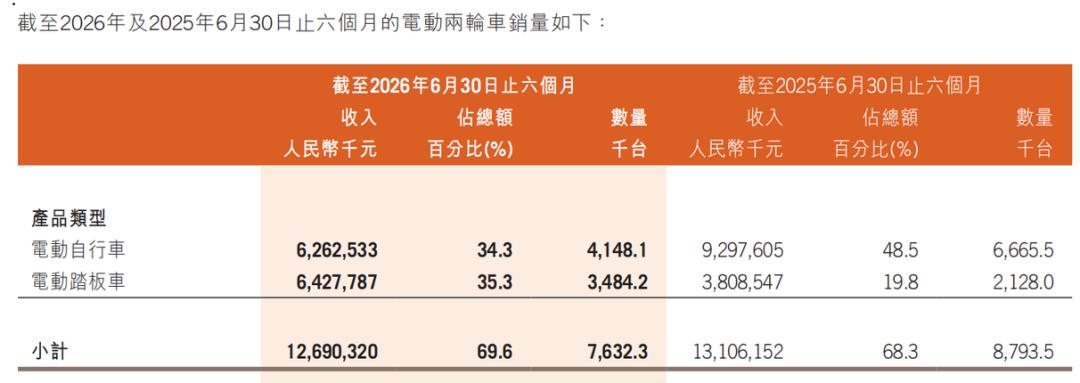
In the first half of 2026, Yadea's electric scooter sales reached 3.4842 million units, up 63.7% year on year, and its revenue share surpassed that of electric bicycles for the first time, becoming the largest category.
But the problem is that Yadea's electric bicycle user base is shrinking too fast, down 37.8% year on year. Electric scooters have filled part of the gap, but cannot make up for the overall shortfall.
To this end, Yadea spent 1.02 billion yuan in cash to acquire Jinjian Technology, a well-known cost-effective brand in the rider community, trying to directly purchase a delivery rider traffic entrance to optimize its product structure.
Aima is also not slow in category shifting. Last November, during the market adjustment period before the full implementation of the new national standard, Aima launched a commercial sub-brand "Mahe".
In the first half of this year, Aima's electric motorcycle sales reached 2.125 million units, a sharp increase of 86.5% year on year, but it still cannot hedge the 46.7% sales decline of electric bicycles, which eventually led to a 12.82% drop in revenue in the first three quarters.
The phenomenon that "one category's growth cannot hedge another category's decline" also appears in second-tier brands such as Luyuan and Sunra. In the first half of 2026, the revenue of the two decreased by 20.4% and 8.64% respectively. If only looking at the electric two-wheeler business, the decline rates are 16.8% and 6.2% respectively.
III. Revenue Differentiation: Why Are Profits Generally Under Pressure?
The revenue trends of several enterprises are differentiated, but the profit trends are converging.
Yadea's revenue only decreased by 5.0% in the first half of the year, but its attributable net profit dropped by 27.2%; Aima's revenue in the first three quarters decreased by 12.82%, its attributable net profit dropped by 42.1%, and its non-recurring profit deducted net profit dropped by 47.18%; Ninebot's revenue in the first three quarters increased by 19.32%, but its attributable net profit decreased by 24.4%; Niu Technologies' revenue in the first half of the year increased by 21.3%, but it recorded a net loss of 196 million yuan, with the loss expanding significantly.
Why is the performance on the profit side weaker no matter how many vehicles are sold?
First, the rise in compliance costs and the reverse impact of scale effect have pushed up unit costs, but in the stock replacement market, the pressure on the cost side has not been smoothly transmitted downstream.
As mentioned earlier, the new national standard has increased the number of 3C testing items, required plastic parts to be replaced with metal parts, added compliance configurations such as BeiDou modules, and raw materials such as aluminum, copper and iron are rising in price, which directly pushes up manufacturing costs.
As a result, in April 2026, leading brands successively issued price increase notices, with increases ranging from 100 yuan to 400 yuan. However, due to weak terminal demand, inventory began to accumulate. By the "618" shopping festival, price increases quickly turned into price cuts: conventional models saw price reductions of 400 to 800 yuan, and some models had a maximum price cut of 1500 yuan.
At the same time, the decline in sales will bring the "reverse impact of scale effect".
The manufacturing industry pays attention to "operating rate" (i.e. capacity utilization). The decline in sales means that huge factories, production lines and distribution channels cannot operate at full capacity, and the depreciation of production lines, personnel expenses and channel maintenance costs are allocated to fewer vehicles, further pushing up the manufacturing cost per vehicle.
Second, the product structure is shifting towards "low-price high-volume sales".
In order to capture the large amount of rigid demand overflowing from new national standard electric bicycles, manufacturers are promoting entry-level electric motorcycles with low prices and high sales volume.
As mentioned earlier, the price of entry-level electric motorcycles has been pushed down to the 3000-yuan range, and even inverted with the price of electric bicycles after price increases. Ninebot's electric motorcycle sales proportion soared from 51% to over 90%, and its average selling price per vehicle in Q2 decreased by 10.79% year on year; Niu Technologies' electric motorcycle sales in Q2 accounted for 60% of its sales in China, and its revenue per vehicle decreased by 8.6% to 3029 yuan.
Rising costs and changes in product structure have put pressure on the gross profit margin of electric two