The teen who once had his fill of gaming went on to build a trillion-dollar business behemoth.
"A new hardware giant will emerge in the intelligent era, and I do not shy away from saying that Cambricon aims to become this leader."
On October 26, Chen Tianshi, the chairman and general manager of the hitherto low-profile Cambricon, appeared at the company's performance briefing, where he publicly denied the rumor that the company's chip shipments would exceed one million units next year.
Chen Tianshi, 41 years old this year, rarely gives interviews, but market attention to him and Cambricon has never faded. A week ago, the news that Chen Tianshi had topped the list of the richest people in Jiangxi once again became a hot topic. On October 27, the 2026 Hurun Rich List was released. Chen Tianshi ranked 10th on the list with a fortune of 205 billion yuan, with his wealth increasing by about 25 billion yuan year on year. He once again retained the title of the richest person in Jiangxi, and he is the youngest among the top 10 on the list (the same age as Liang Wenfeng). In June this year, Cambricon's share price once reached 1,620 yuan per share, and its total market value once exceeded 1 trillion yuan. As of November 6, 2026, Cambricon's total market value exceeded 500 billion yuan.
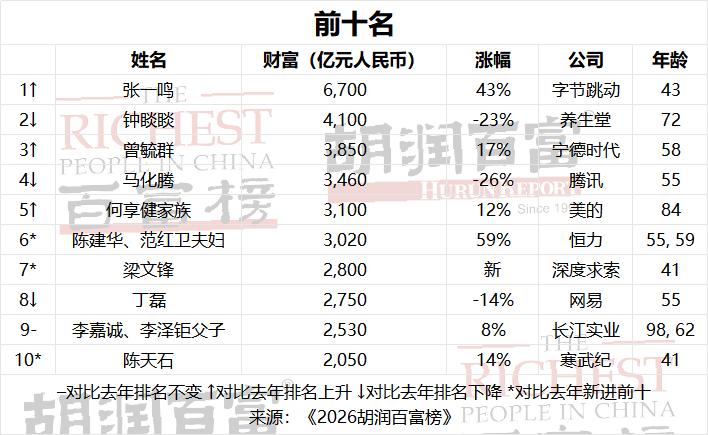
Source: Hurun Rich List official WeChat public account
Chen Tianshi is a native of Nanchang, Jiangxi. He was admitted to the Special Class for the Young of the University of Science and Technology of China at the age of 16, obtained his doctorate at the age of 25, and joined the Institute of Computing Technology of the Chinese Academy of Sciences after graduation. He and his elder brother Chen Yunqi jointly led the team to carry out research in the interdisciplinary field of artificial intelligence and computer architecture. In 2016, 31-year-old Chen Tianshi founded Cambricon.
The outside world likes to label Chen Tianshi with titles such as "genius youth" and "the first person of Chinese AI chips", but his real experience is far more complex than those legendary labels — during his undergraduate years, he was regarded as a "poor student" because he loved to play; when pursuing his doctorate, he and his brother worked around the clock in the laboratory at the Institute of Computing Technology, CAS, and developed the first domestic AI chip; after starting his business, he lost Huawei, his largest customer, the company continued to make losses, core technical backbones left the company, and Cambricon was included in the export control "Entity List". At the lowest point, Cambricon's share price once shrank by 80%. It was not until the demand for computing power exploded that Cambricon ushered in a turning point.
Behind this lies the arduous journey of a scientist-entrepreneur transforming technical ideals into commercial practice.
"Child Prodigy"
Chen Tianshi himself probably does not like the label of "child prodigy", and he will try his best to downplay the outside world's perception of "geniuses" and "child prodigies" in the Special Class for the Young of the University of Science and Technology of China.
In 2015, during an interactive exchange with netizens on The Paper's Ask section, he told a netizen who hoped to make his child "extraordinarily talented": "Diligence is the most critical, and talent is secondary; diligence may not change talent, but it can change life. Life is a protracted war, not a timed intelligence quiz." He rarely talks about talent, and talks more about another phrase — "sticking to one's post and making achievements in a little-regarded field".
In his view, the terms "child prodigy" and "genius" are false descriptions, and everyone is just an ordinary person. The Special Class for the Young of USTC cannot certify child prodigies, it only looks for seedlings suitable for engaging in scientific research work.
Chen Tianshi was admitted to the Special Class for the Young of USTC under the influence of his parents and elder brother. His parents adopted an education method of "fishing by letting the water out", cultivating their curiosity and ability to acquire knowledge from an early age.
Chen Tianshi and his elder brother Chen Yunqi are two years apart. They graduated from the Special Class for the Young of USTC one after another, and then entered the Institute of Computing Technology of the Chinese Academy of Sciences one after another, with similar growth trajectories. Chen Yunqi once joked: "Chen Tianshi has never been convinced by me. He thinks 'we play together every day, you are no smarter than me, if you can get into the special class for the young, so can I', and every step after that is the same."
Guided by their parents, the two brothers dreamed of becoming scientists from an early age. Chen Yunqi was admitted to the Special Class for the Young of USTC at the age of 14. After entering university, he told Chen Tianshi that he could play video games in college, which gave Chen Tianshi some motivation. At the age of 16, Chen Tianshi was also admitted to the Special Class for the Young of USTC.
During his undergraduate years, Chen Tianshi could not be called a "top student". He loved to play and was obsessed with video games. In his sophomore year, he took a course covering optics and atomic physics, with optics taught in the first half of the semester and atomic physics in the second half. Chen Tianshi did not attend a single class, and did not even dare to take the mid-term exam. When the final exam came, Chen Tianshi, who could not hold on anymore, took the initiative to find the teacher and asked if he could get a chance to retake the exam. The teacher, a considerate elderly lady, made an exception and let him take the exam alone in her office, and he finally got a total score of more than 70 points.
Someone once asked Chen Tianshi, "What did college life teach you?" He replied, "College life let me play to my heart's content, and made me want to do some really interesting research work."
After graduating with a bachelor's degree, Chen Tianshi continued his studies at USTC to pursue a postgraduate degree (and later directly pursued a doctoral degree). During his postgraduate studies, he switched to the field of computer science and met two tutors who influenced his whole life: Academician Chen Guoliang and Professor Yao Xin.
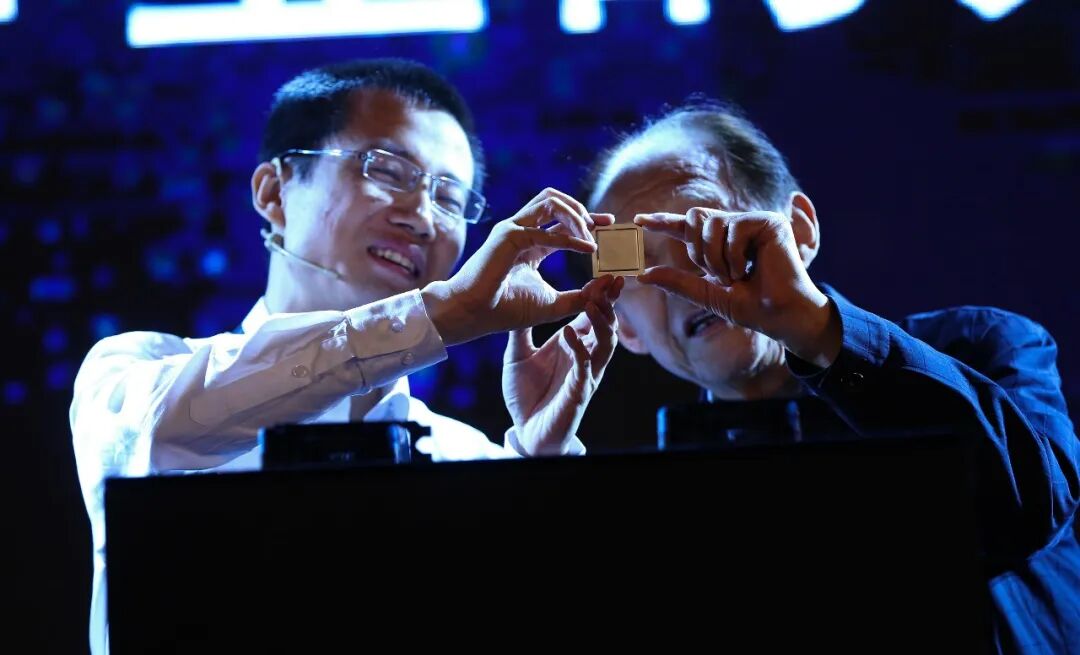
Chen Tianshi, Chairman of Cambricon (left), Chen Guoliang, Academician of the Chinese Academy of Sciences and Professor of the University of Science and Technology of China (right) Source: Visual China
"They did not dislike my poor grades and gave me the opportunity to pursue a doctorate." Chen Tianshi recalled that the two tutors adopted encouraging teaching methods, giving students great autonomy to choose interesting topics to work on. In 2010, Chen Tianshi, the former "problem student", graduated with a doctorate and followed in the footsteps of his brother Chen Yunqi to join the Institute of Computing Technology of the Chinese Academy of Sciences.
"The Nichest of Niche Fields"
The two brothers reunited and discussed what kind of research they should do whenever they had time. The elder brother studied chips, while the younger brother focused on artificial intelligence. After much discussion, they finally determined that two things were "very interesting": one was to use AI to assist in the design of processor chips, and the other was to develop AI chips.
At that time, AI chips were "the nichest of niche fields". At that time, AlphaGo had not defeated Lee Sedol, and NVIDIA was just a byword for "gaming graphics cards". No one knew what kind of sparks "AI + chips" would create.
At the end of 2010, in a report within the Institute of Computing Technology, Chen Yunqi and Chen Tianshi first reported their idea of developing AI chips to the leaders. They described a scenario: People have long said that one day machines will replace humans to drive cars, but if the robot driving the car is not fast enough in pattern recognition, there is no reason at all to let the machine drive — by the time it recognizes the lights or pedestrians on the road ahead, the car has already crashed. Therefore, it must have strong in-vehicle computing capability. This popular analogy impressed the leaders.
Even so, this idea was still very difficult to understand. Chen Yunqi once revealed in an interview that more than one student advised them not to engage in such ethereal things, saying "Professor Chen, why don't you lead us to do something less non-mainstream?" Chen Yunqi fully understood the students: at that time, this project could not even apply for a project fund of 200,000 yuan, and some students even did a survey, finding that there were no similar papers or work in the international community at all.
The two brothers plunged into a 30-square-meter "small dark room" laboratory at the CAS Institute of Computing Technology. They often sat in front of the computer to work right after breakfast, and did not realize they were hungry until it was night. Staying up late was a common occurrence, and when tired, they would take a quick nap on a folding bed. They successively proposed a series of AI-based processor R&D technologies, and submitted papers many times to the "Oscar" of the industry — the top academic conference on computer architecture, but all of them were rejected.
2014 was a harvest year for the two brothers. At the top international academic conference ASPLOS held in March 2014, their work with their partner Olivier Temam, visiting researcher at the Institute of Computing Technology, "DianNao: a small-scale high-throughput machine learning accelerator" won the Best Paper Award. In December of the same year, "DaDianNao: a machine learning supercomputer" won the Best Paper Award at MICRO, another top academic conference in the field of processor architecture.
It is reported that the deep learning processor direction pioneered by DianNao and DaDianNao in the international community has become the mainstream of international computer architecture research. The two papers soon received thousands of citations, with scholars from hundreds of scientific research institutions in dozens of countries around the world citing them. Among them, NVIDIA is one of the institutions with the largest number of citations. The journal Science published an article evaluating this work as the "pioneer" and "leader" of deep learning processors.
The two brothers realized that they had blazed a trail that no one had ever set foot in before.
In 2015, with the support of the Strategic Priority Research Program of the Chinese Academy of Sciences and the Institute of Computing Technology of CAS, the world's first dedicated deep learning processor prototype chip "Cambricon", led by the two brothers, was successfully taped out for the first time. With the prototype chip, they began to think about turning it into a real product.
Source: AI generated
When going for fundraising, Chen Tianshi and his team ran into obstacles. Some people complained that their "PPT was poorly made", and while complaining, they lectured him: "Young man, you won't get any financing like this." Many others were worried that this technology would not be industrialized so quickly. Later, iFLYTEK, which came from the same academic background, gave them a hand.
In the spring of 2016, AlphaGo developed by Google became famous after winning a battle, and AI quickly set off a wave around the world. In March of the same year, with the support of the Institute of Computing Technology and venture capital institutions, Chen Tianshi and Chen Yunqi founded Cambricon. However, Chen Yunqi did not take a position at Cambricon. He remained at the Institute of Computing Technology of CAS, only "worked part-time as a favor for more than half a year" when the company was first founded, and then devoted himself to research.
It coincided with Huawei's planning for its next-generation Kirin 970 chip. When they noticed Cambricon Technology's AI chips, the two sides hit it off immediately. In 2017, Huawei released its first mobile AI chip Kirin 970, which was equipped with the Cambricon 1A processor, and was put into large-scale commercial use in the Huawei Mate 10 mobile phone, making Cambricon rise to fame overnight. In 2018, Huawei Kirin 980 cooperated with Cambricon again, carrying Cambricon's second-generation IP product "1H".
In July 2020, Cambricon was listed on the Sci-Tech Innovation Board, becoming the first domestic AI chip stock, with its market value exceeding 100 billion yuan on the first day of listing. From officially submitting the prospectus to officially ringing the listing bell, Cambricon only took 116 days.
From 8 Years of Losses to the "King of Cambricon"
The crisis came very quickly.
Cambricon relied heavily on Huawei in its early days. From 2017 to 2019, the revenue of Cambricon's terminal intelligent processor IP licensing business mainly came from two products, Cambricon 1A and Cambricon 1H, accounting for 98.95%, 99.69% and 15.49% of the main business revenue respectively. Among them, the sales amount of IP licensing to Huawei HiSilicon accounted for 100.00%, 97.94% and 92.56% of Cambricon's IP licensing business sales revenue.
In October 2018, Huawei announced its "Da Vinci Plan" to the outside world, releasing two AI chips, Ascend 910 and Ascend 310, at once. In 2019, Huawei's new mobile phone chips fully adopted Huawei's self-developed AI module, which caused Cambricon's revenue from Huawei HiSilicon in 2019 to drop sharply to 63.8443 million yuan, a year-on-year decrease of nearly half.
With the terminal IP licensing business frustrated, Chen Tianshi shifted Cambricon's business focus to intelligent computing cluster systems and cloud-side AI chips. Since 2019, the main revenue source of Cambricon has become the intelligent computing cluster system. Until 2023, the intelligent computing cluster system was Cambricon's largest product. In that year, the company's intelligent computing cluster system contributed 605 million yuan in revenue, accounting for 85% of the total revenue.
For as long as 8 years, Cambricon continued to make losses, mainly due to huge R&D investment. At the lowest point, Chen Tianshi instead increased his heavy investment in R&D. Financial reports show that from 2017 to 2024, Cambricon lost a total of 5.417 billion yuan, and its R&D expenses reached 6.574 billion yuan.
In 2022, Liang Jun, core technical backbone and CTO of Cambricon, left his post "due to differences with the company". At the end of that year, Cambricon was included in the export control "Entity List" by the United States.
Cambricon's share price kept falling in the low ebb. In April 2022, it once fell to 30.36 yuan per share, a drop of more than 80% compared with the previous high. In 2