GPT-6.1 Sol participates in live brain surgery! Three rounds of positioning, each round more accurate than the previous one.
In mouse brain surgery, what often challenges the operator is a detail before needle insertion: locating several extremely critical anatomical landmarks on the skull. These points seem insignificant, but they determine how the subsequent surgical coordinates are calculated. A slight deviation in position may prevent the needle from accurately reaching the predetermined brain region.
Now, AI has also begun to learn this operation.
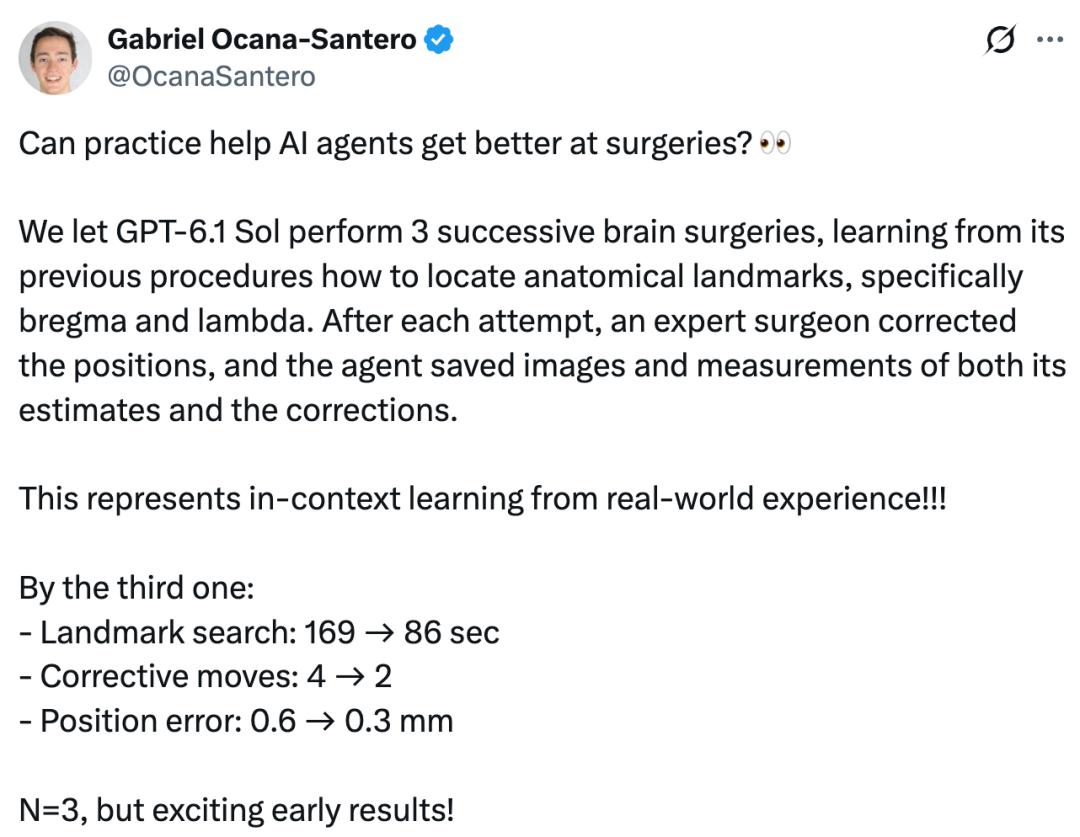
Recently, Gabriel Ocana-Santero, co-founder and CEO of biotech startup Exin Therapeutics, shared a set of experimental results: the team had GPT-6.1 Sol continuously participate in three rounds of mouse brain surgery positioning.
After each operation, a professional surgeon would correct the model's positioning results, and the model would save its own images, measurement data and expert correction records for reference in the next round of operations.
The results are quite interesting.
By the third operation, the time GPT-6.1 Sol spent finding anatomical landmarks was shortened from 169 seconds to 86 seconds, the number of required correction actions was reduced from 4 to 2, and the positioning error also dropped from 0.6 mm to 0.3 mm.
Ocana-Santero calls this process In-context Learning based on real-world experience.
It should be noted that this set of data only includes 3 operations, and there is still a long way to go to prove that AI has mastered stable surgical capabilities. However, it demonstrates a noteworthy change: AI has begun to bring observations from real operations and expert feedback into the next round of tasks, gradually accumulating experience.
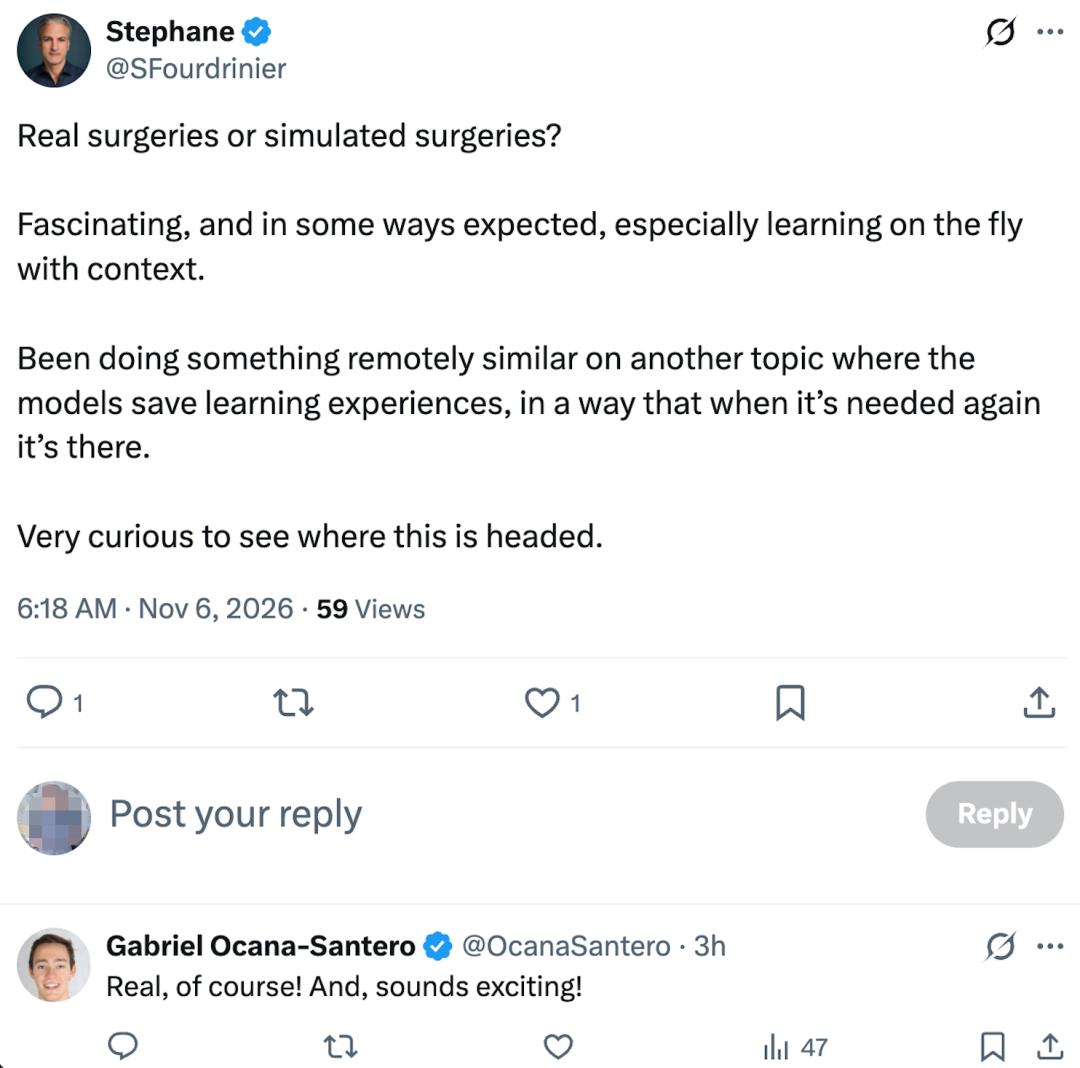
This experiment also raises a noteworthy question: Is this a real surgery or a demonstration in a simulated environment?
X user Stephane directly asked Ocana-Santero for confirmation in the comments, and the latter explicitly responded that it was a real surgery. Stephane later said that this method of combining context and accumulating experience instantly during execution is very interesting. He also revealed that he is exploring a similar mechanism in another field: letting the model save the experience gained in each task, so that it can be directly called when encountering related problems again.
Find two points on the skull first
to accurately locate the brain
To understand this experiment, you must first know two names that often appear in neuroscience experiments: Bregma and Lambda.
They are not the nerve nuclei inside the brain, but two anatomical landmark points on the surface of the mouse skull.
Bregma is located at the intersection of the sagittal suture and the coronal suture, while Lambda is located at the intersection of the sagittal suture and the lambdoid suture. Researchers usually take Bregma as the reference origin of stereotaxic coordinates, and then combine with landmarks such as Lambda to calibrate the position and tilt degree of the skull.
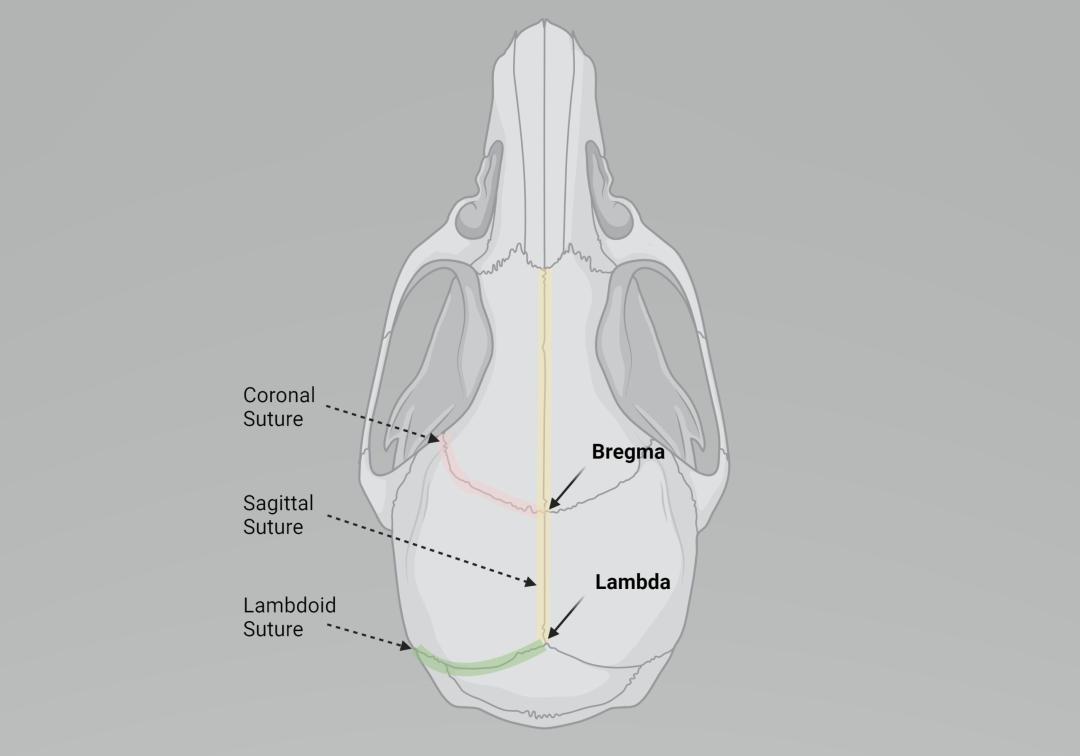
Image source: https://www.jove.com/t/67381/an-immunocompetent-murine-model-for-laser-interstitial-thermal
Why are these two points so important? This is because many experiments on the mouse brain require stereotaxic equipment to accurately deliver injection needles, electrodes or other experimental instruments to the designated brain region.
Researchers first need to find the reference points on the skull, then combine with the brain atlas to convert the target brain region into coordinates in the three directions of anteroposterior, left-right and depth, and finally hand them over to the equipment for execution. The whole process seems to be just finding several intersections, but in fact it needs to process visual recognition, spatial positioning and coordinate calibration at the same time.
The sutures on the skull are not always clearly distinguishable. There are also anatomical differences between individual mice, and the head fixation angle and horizontal calibration will affect the final coordinates. Relevant studies have even specifically discussed the Bregma positioning errors caused by different measurement methods.
For researchers who are new to this type of experiment, accurately finding the landmark points and completing head calibration is itself a basic skill that requires repeated practice.
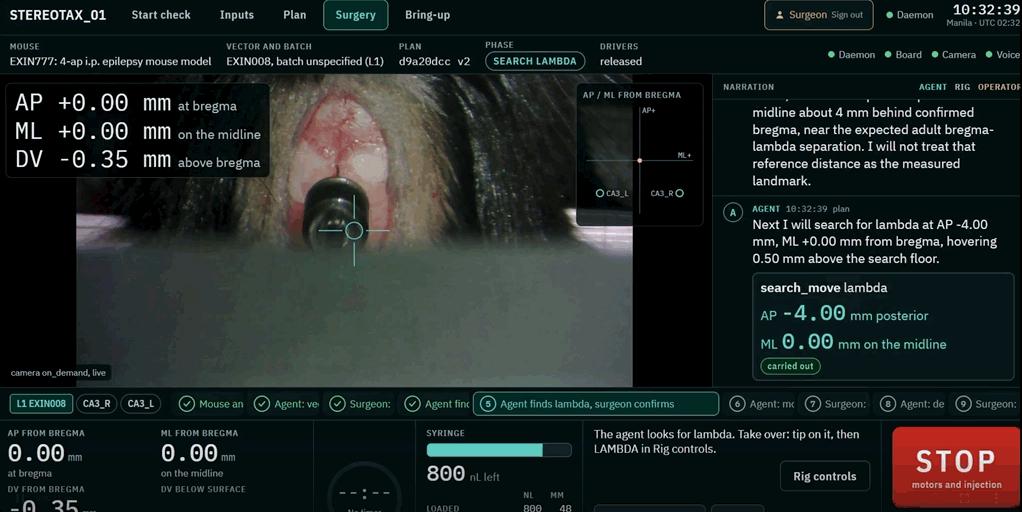
In this experiment, what GPT-6.1 Sol needs to complete is one of the key links. It needs to judge the positions of Bregma and Lambda based on the experimental images and give its own positioning results. The expert surgeon then checks these positions and corrects inaccurate judgments.
After each operation, the model will save its own estimated images and measurement results, as well as the data corrected by experts. This information becomes the experience that can be used in the next round of operations.
From 169 seconds to 86 seconds
AI begins to accumulate operational experience
The most interesting part of this experiment is that GPT-6.1 Sol does not simply clear the previous operation records after each task. The model retains the images and measurement data from previous operations, and records the correction results given by experts. In this way, the model can refer to previous judgments and corrections in subsequent operations, and gradually improve its positioning performance.
All three indicators have improved: the search time has been shortened by nearly half, the number of correction actions has been reduced by half, and the positioning error has also been directly halved.

This experiment adopts the idea of in-context learning.
Traditional model training usually requires adjusting model parameters through training data and optimization algorithms, so that the model can acquire new capabilities in subsequent tasks. The mechanism disclosed in this experiment focuses on accumulating and utilizing actual operation records. The model saves previous images, measurement results and expert feedback for use in subsequent operations.
At present, the team has not disclosed how this set of experience records is specifically connected to the model, and whether it involves the update of the underlying model weights. Therefore, it cannot be described that GPT-6.1 Sol has completed autonomous training or parameter-level self-evolution through three surgeries.
However, from the perspective of experimental ideas, this method has enabled AI to have a capability that is closer to human practical learning: try first, then accept correction, and then continue to operate with the experience from the last time. For biomedical research that requires a large number of repeated experiments, this capability has practical significance.
From letting AI perform brain injections
to letting it accumulate experimental experience on its own
This is not the first time Exin Therapeutics has exposed AI to real mouse brain surgery.
On October 28, Ocana-Santero disclosed a more remarkable experiment. At that time, the team prepared 19 gene therapy vectors, an epilepsy model mouse, and a set of motorized stereotaxic surgical equipment with a camera for the AI agent, with the goal of finding a treatment plan that can reduce epileptic seizures.
AI needs to first read relevant research materials, select gene therapy vectors from candidate solutions, then determine which area of the brain to inject, and the specific injection coordinates. Then it observes the surgical area through the camera, controls the robotic arm and injection needle on the equipment to complete the injection operation.
The entire process injected 250 nanoliters of therapeutic vector.
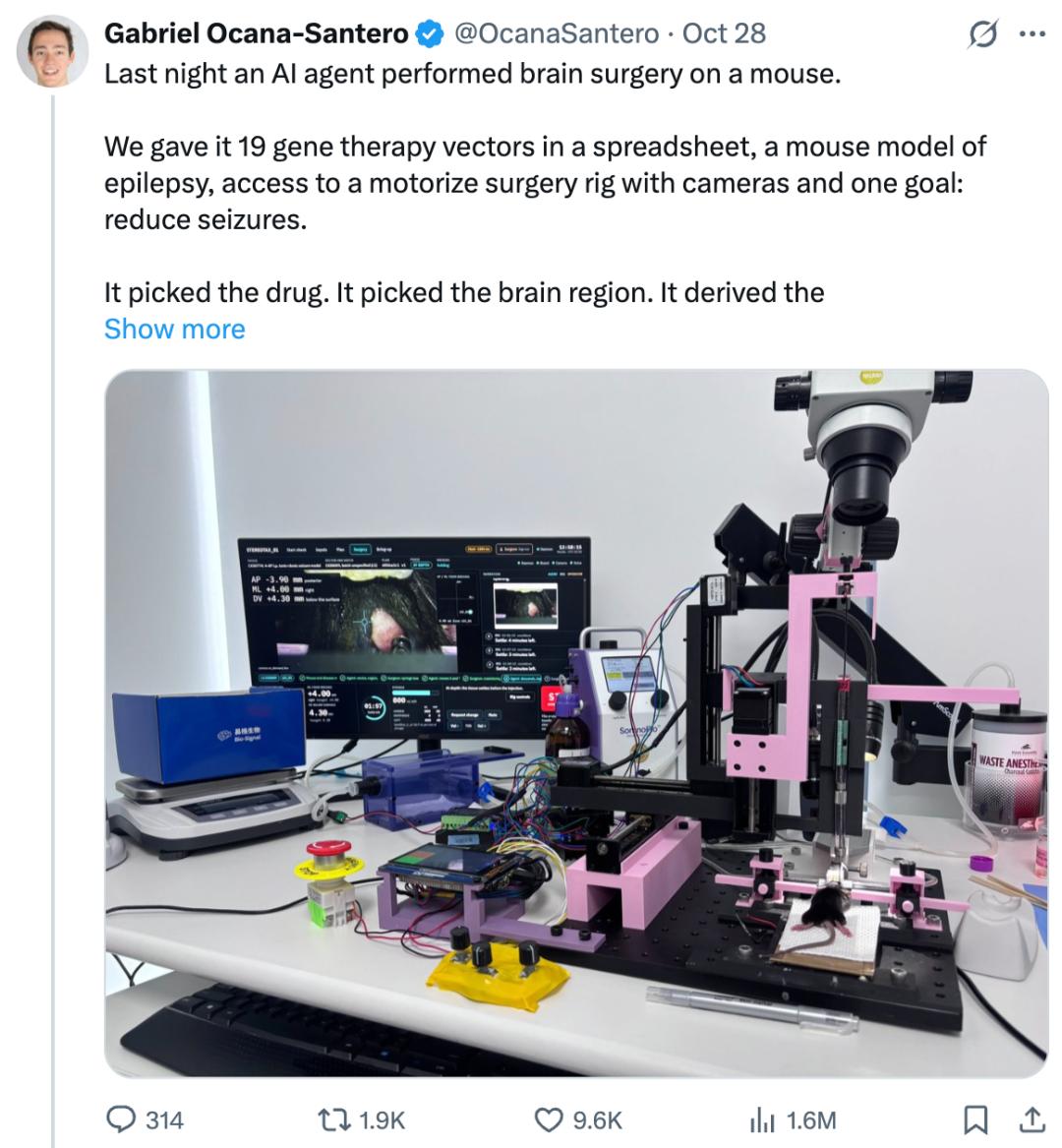
This experiment has a noteworthy difference: traditional surgical robots usually have human doctors determine the surgical plan, and then the robot executes the specific actions. In this experiment, AI also participated in the selection of treatment plans and brain regions.
However, the whole process is not unsupervised. A licensed veterinary surgeon is responsible for incising the scalp, performing craniotomy and suturing, and supervising key operations. The team also set up unavoidable operation restrictions, human approval mechanisms for key steps, and physical emergency stop devices that can directly cut off the motor power.
When the equipment coordinates were abnormal once, the AI identified the position problem and refused to continue moving the needle. Finally, the researchers fixed the fault by manually modifying the equipment control code.
On October 31, Ocana-Santero announced further experiments:
Claude Sonnet 5, GPT-6.1 Sol and Grok 4.7 respectively participated in mouse brain experiments under the same goal. The three models received the same 19 candidate gene therapy vectors and the same experimental goals, but chose different brain regions, treatment mechanisms and plans. For example, Claude chose the entorhinal cortex, GPT chose the hippocampus, and Grok chose the somatosensory cortex.
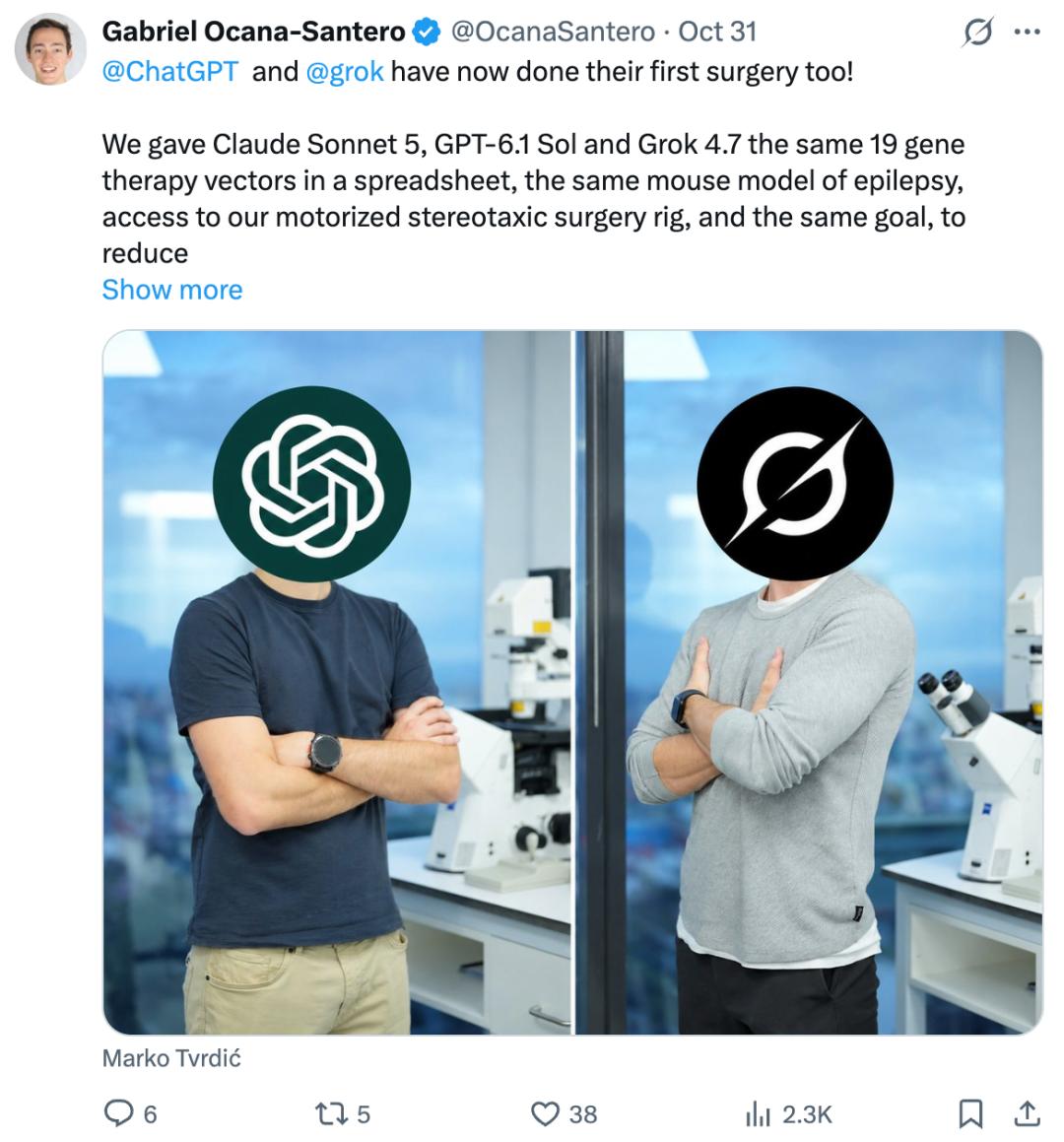
This shows that even when facing the same scientific problem, different models may give different experimental paths based on their respective knowledge reasoning. Which plan is more effective needs to be verified by subsequent experiments.
From initially letting AI choose treatment plans and control injection equipment, to now letting it improve positioning performance through continuous operations and expert feedback, Exin is trying to integrate AI into a more complete experimental process.
This article is from the WeChat official account Ji Qi Zhixin (ID: almosthuman2014), author: focusing on AI and bioscience, published with authorization from 36Kr.