Fudan alumni are on a phenomenal winning streak: They have secured Meta's top strategic leader.

Author | Li Bingzhi
Editor | Wu Ren
Source | thecapital.cn
A 14-year veteran who worked alongside Mark Zuckerberg has switched jobs. His new employer is an AI unicorn founded by Lin Qiao, an Fudan University alumna.
On November 7, Dave Wehner, Meta's Chief Strategy Officer and former Chief Financial Officer, confirmed that he will leave Meta to join AI startup Fireworks as Chief Financial Officer (CFO). The co-founder and CEO of this company is none other than Lin Qiao, former Senior Engineering Director at Meta.
One used to manage Meta's finances, the other once led the AI infrastructure team at Meta, and now the two former colleagues have come together again.
Founded only four years ago, Fireworks completed a $15.05 billion financing round this past July, with a valuation reaching $17.5 billion (approximately RMB 1.17 trillion), nearly 32 times its valuation two years ago. Its investor roster includes HSG, NVIDIA, AMD and other backers. According to foreign media reports, Fireworks is planning to launch a new round of financing, targeting a valuation of $30-40 billion.
Wehner's career move has once again put Fireworks in the spotlight. What exactly makes this company so appealing?
Zuckerberg's 14-year veteran comes to work for his former colleague
Wehner's career change came as somewhat of a surprise.
In November 2012, Wehner joined Meta, which was then called Facebook, as Vice President of Corporate Finance and Business Planning. In June 2014, he was promoted to CFO, a position he held for more than eight years. It was not until November 2022 that he stepped down as CFO to become Meta's first Chief Strategy Officer, in charge of corporate strategy and business development.
Wehner was involved in several of Meta's major transformations over the years. From the rise of the mobile advertising business, to Facebook's rebranding to Meta and its heavy bet on the metaverse, to the shift of AI as the new investment priority, he has always been at the core of the company's management team.
Before joining Facebook, Wehner worked at investment bank Allen & Company for nearly a decade, and later served as CFO of social game company Zynga.
However, Wehner does not have a formal finance background. He earned his bachelor's degree in chemistry from Georgetown University, and later obtained a master's degree in applied physics from Stanford University. Eventually he embarked on a career in finance, working his way up from investment banking to CFO of a Silicon Valley tech giant.
Now, this long-serving veteran of Meta's management team has chosen to join an AI startup.
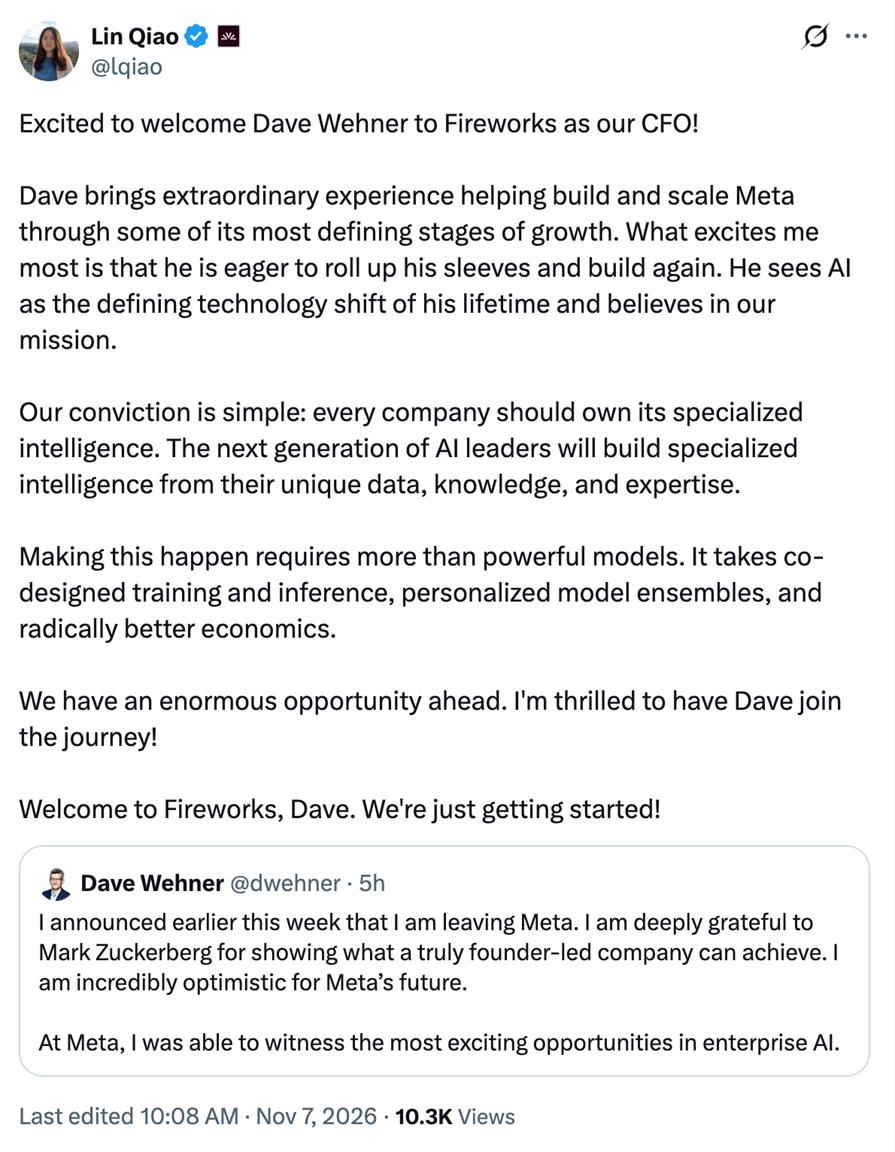
Wehner thanked Mark Zuckerberg on X for showing him what a founder-led company can achieve over his 14 years at Meta. Speaking about his next stop at Fireworks, he said he has known Lin Qiao for a long time and has always respected her greatly. As he got to know the team better, he grew more and more optimistic about the company's development prospects.
Lin Qiao later posted on X to welcome her former colleague. In her view, Wehner not only has rich experience in helping Meta grow and expand, but more rarely, he is a senior executive of a large tech company who is still willing to roll up his sleeves and participate in building a company from scratch.
The connection between Fireworks and Meta goes far beyond that.
Sheryl Sandberg, Meta's former Chief Operating Officer, is also an early individual investor in Fireworks. Another notable figure is Alexandr Wang, founder of Scale AI — he participated in Fireworks' financing back in 2024, then joined Meta in June 2025, and now serves as Chief AI Officer, leading the Meta Superintelligence Labs and responsible for cutting-edge AI model R&D.
Moreover, as disclosed by investment firm Index Ventures this past July, Meta itself is one of Fireworks' enterprise customers.
Now, Lin Qiao has welcomed another heavyweight former Meta colleague, Dave Wehner.
For a fast-expanding AI startup already valued at $17.5 billion, Wehner's arrival could not be timelier. Large-scale computing power procurement, long-term customer contracts, cash flow arrangement, and future capital market transactions that Fireworks may engage in are all areas he is very familiar with.
The addition of a CFO with experience running large public companies has also sparked IPO speculations. However, as of now, Fireworks has not announced any listing plans.
Fudan alumna built a $17.5 billion unicorn in four years
Lin Qiao grew up in China. Her father was a mechanical engineer who designed large cargo ships. When she was a child, she often stayed in her father's office, flipping through ship design drawings on his desk and studying their mechanical structures.
Later, Lin Qiao chose to study computer science. She is a 1993 alumna of the Fudan University Department of Computer Science, completed both her bachelor's and master's degrees at Fudan, then went to the University of California, Santa Barbara for further studies, and obtained her PhD in computer science in 2006.
After graduation, Lin Qiao worked at IBM and LinkedIn in sequence. In 2015, she joined Facebook and worked there for seven years, during which she served as Senior Engineering Director, responsible for the development and deployment of technologies including PyTorch and AI compilers, leading an engineering team of more than 300 people.
In an interview with Unite.AI, Lin Qiao said bluntly that tech giants like Meta have abundant technical talents and computing resources to build their own AI infrastructure, but many enterprises do not have such conditions. For them, even with high-performance large models, how to truly apply them to business, make them run fast and stably, and keep costs under control remains a difficult problem.
Lin Qiao saw a business opportunity in this pain point.
In 2022, Lin Qiao left Meta and co-founded Fireworks with six other co-founders. The founding team is mainly from tech companies including Meta and Google, including two Chinese co-founders: Benny Chen, former Meta engineer, and Chenyu Zhao, former Google engineer. They targeted the large model inference market, hoping to leverage their accumulated technical capabilities to help more enterprises deploy and run AI models quickly and at low cost.
For example, if an enterprise wants to integrate AI into its customer service system, building the entire infrastructure from scratch would require solving a series of problems such as computing resources, model deployment and system maintenance. Fireworks provides an off-the-shelf service platform, where enterprises can access large models on the platform via API, the call interface between software programs, and customize and optimize the models according to their own business needs.
Enterprises do not need to build a large technical team from scratch to integrate AI into their own products. Fireworks generates revenue through services such as model calls and dedicated computing power deployment.
Capital soon flooded in.
In the early stage of its founding, Fireworks secured $25 million in financing led by Benchmark. In July 2024, the company announced it had raised $52 million in a financing round led by HSG, reaching a valuation of $552 million, with NVIDIA, AMD and other parties participating in the investment.
In October 2025, Fireworks announced the completion of a $250 million Series C financing round, co-led by Lightspeed Venture Partners, Index Ventures and Evantic, pushing its valuation to $4 billion.
In July 2026, the company announced it had closed a $15.05 billion Series D financing round, with a valuation of $17.5 billion, co-led by Atreides Management, Index Ventures and TCV, with existing shareholders including NVIDIA continuing to participate.
With such a high valuation, can revenue keep up?
In October 2025, Fireworks disclosed that its annualized revenue run rate had exceeded $280 million; by July 2026, that figure had surpassed $1 billion, and the platform processes more than 40 trillion Tokens every day.
Fireworks' customers cover multiple industries. Companies including Uber, Shopify, Samsung, Notion, as well as AI programming tool Cursor and legal AI firm Harvey, are all its clients.
As its customer base grows larger, ensuring the speed and stability of model operation has become a problem that Fireworks needs to solve. In addition to independent R&D, the company also supplements its technical capabilities through acquisitions and external partnerships.
This past March, Fireworks announced the acquisition of game server technology company Hathora. Gamers hate lags, and so do AI users. Hathora excels at scheduling computing resources around the world to minimize latency, and its technology can be used to improve the efficiency and stability of AI inference.
At the same time, Fireworks has established partnerships with a number of chip and cloud computing giants. Back in 2024, Fireworks was already a partner of NVIDIA and AMD, and the two companies also participated in its early financing rounds. Since then, Fireworks has signed a multi-year strategic cooperation agreement with AMD, deepened its cooperation with AWS (Amazon Web Services), and integrated with Microsoft's AI cloud service platform Foundry.
On November 3, Fireworks held its Forge conference in San Francisco, where NVIDIA CEO Jensen Huang and Lin Qiao shared the stage for a discussion. On the same day, the two sides announced further expansion of their partnership, planning to leverage NVIDIA's next-generation computing platform to scale up Fireworks' computing power in Europe starting from 2027.
During the conference, Lin Qiao said bluntly: "Costs are getting out of control." She pointed out that the high cost of AI usage is putting pressure on enterprise expansion, and businesses even need massive amounts of financing to support their growth.
Jensen Huang said: "The idea that everyone should rely on general intelligence does not make sense." In his view, closed-source cutting-edge models have their value, but specialized intelligence is equally important. Enterprises can use open models, combined with their own industry knowledge and tools, to build AI capabilities that better meet actual business needs.
This aligns perfectly with the direction Fireworks is betting on. Lin Qiao hopes to solve the cost pain points faced by enterprises when using AI, while enabling them to customize models according to their own needs.
According to foreign media reports, Fireworks plans to launch a new round of financing, targeting a valuation of $30-40 billion. However, this financing plan is only disclosed by the media and has not been officially implemented yet.
AI inference, the new capital battlefield
The rise of Fireworks coincided with a shift in the AI industry.
In the past few years, the market was most focused on who could train more powerful models. Now, as AI is integrated into the daily operations of more enterprises, another calculation is becoming increasingly important: how much does it cost every time a model is used?
According to forecasts released by Gartner this past August, spending on inference in the global AI-optimized IaaS (Infrastructure as a Service) market is expected to reach $23.3 billion in 2026, surpassing training spending of $19 billion for the first time, accounting for 55% of total spending in this market.
This has brought a group of companies in the AI industry chain into the spotlight.
To put it simply, companies including NVIDIA, AMD and Huawei Ascend provide underlying chips; OpenAI, Anthropic, Google, as well as domestic players including DeepSeek, Alibaba and Moonshot AI develop large models; AI infrastructure companies such as Fireworks, Wuwen Xinqiong and SiliconFlow provide services including model deployment and inference optimization, enabling models to run efficiently on different computing resources.
Cloud computing giants including Microsoft, Amazon Web Services (AWS), Alibaba Cloud and Volcano Engine are also providing large model calling and deployment services. To compete with these giants, independent platforms ultimately have to rely on higher efficiency, lower costs, and compatibility with different models and chips, giving enterprises more choices and reducing their dependence on a single technology supplier.
Chinese enterprises are also accelerating their layout in this track.
This year, SiliconFlow has raised nearly RMB 2.9 billion in total financing, reaching a valuation of RMB 7.74 billion after its financing in June, and has submitted a listing application to the Hong Kong Stock Exchange.
This company was founded by Yuan Jinhui in 2023. He shares many similarities with Lin Qiao in terms of technical background. Lin Qiao was responsible for PyTorch-related R&D at Meta, while Yuan Jinhui founded OneFlow Technology and developed the deep learning framework OneFlow. Both of them have in-depth experience in underlying AI software, and later set their sights on large model inference services.
SiliconFlow rose to wide public attention during the 2025 Spring Festival. Back then, DeepSeek-R1 became a hit quickly, but open-sourcing the model does not mean enterprises can run it directly in an efficient and stable manner. On February 1, SiliconFlow partnered with Huawei Cloud to deploy DeepSeek-R1 and V3 on Huawei Ascend computing power, with Huawei Cloud providing the computing power and SiliconFlow responsible for model deployment and inference optimization, allowing developers to call the models directly through the SiliconCloud platform.
Enabling large models to run efficiently on different chips is exactly one of SiliconFlow's core business priorities. In addition to Huawei Ascend, its platform also supports chips from multiple vendors including NVIDIA, AMD, Moore Threads and MetaX.
Wuwen Xinqiong, a Tsinghua-affiliated AI infrastructure enterprise, has also made layouts for multi-chip adaptation. This past October, the company announced the completion of RMB 2.3 billion in Series C financing, bringing its total financing to RMB 4.3 billion. Its platform already supports 16 mainstream chips, and improves the utilization efficiency of different chips through computing power scheduling and technical optimization. According to a Bloomberg report, the company has confidentially submitted its listing application to the Hong Kong Stock Exchange, planning to go public in the first half of 2027, but this has not yet been officially confirmed.
At the same time, Chinese large models are also becoming an important source of models for overseas platforms. According to Fireworks' official website, its platform has integrated models developed by Chinese teams including DeepSeek, Tongyi Qianwen, Kimi and Zhipu GLM. Chinese enterprises develop models, overseas platforms are responsible for deployment and optimization, and global customers use them through interfaces, creating a new commercialization path for Chinese models to go global.
For these inference platforms, more customers and higher call volumes certainly mean more revenue opportunities, but what ultimately determines the long-term viability of the business is the ability to continuously reduce costs and improve efficiency.
From this perspective, Wehner's decision to join Fireworks may have another layer of meaning: an AI company valued at $17.5 billion needs not only technological breakthroughs, but also someone to make the numbers add up between computing power investment, business growth and profitability.
Conclusion
"The river is wide with calm tides, the sails are fully raised with favorable winds."
Lin Qiao's father was a mechanical engineer who designed large cargo ships. Years later, she started a different kind of infrastructure business in Silicon Valley, removing the barriers of computing power and deployment for large models, and bringing AI to more enterprises.
In four years, Fireworks has reached a valuation of $17.5 billion, and now it has welcomed Meta veteran Dave Wehner. From large models to a global computing power network, technology and capital are crossing the ocean, and a new waterway belonging to the AI era is gradually coming into clear view.
Cover image source: Fireworks official website