Baidu has revised its search box for the third time.
In January 2000, an unassuming office in Zhongguancun, Beijing.
31-year-old Robin Li sat in front of the computer, with a rather rough search box displayed on the screen. Before that, he had developed search engines in Silicon Valley and held a patent for hyperlink analysis. At that time, the Chinese search market was almost dominated by overseas technologies. Robin Li wanted to build a self-owned search box for the Chinese internet, so he brought the technology back to China.
Search back then was very simple: type in a few words, and you would get a row of blue links. Relying on this technology, Baidu grew into the gateway to the Chinese internet.
26 years have passed. On October 30, Baidu Search held a product upgrade briefing in Beijing. The product manager of the new-generation Baidu Search said on stage, Search is evolving from "one query, one response" to "one task, one complete delivery".
To put it in plain terms: opening Baidu is no longer about "finding something", but about "getting things done". When parents search for school admission, it will calculate comprehensively based on the child's grades, address and boarding preferences; if you are planning to spend the Chinese New Year in Sanya, it will generate itineraries and budgets, and push you notifications when hotel prices drop, helping you save 2100 yuan for a 5-night stay.
This is the third time Baidu has adjusted the underlying logic of its search box. No matter how the first two iterations were modified, they never really removed the action of "clicking links after searching". This time, Baidu is determined to break that pattern.
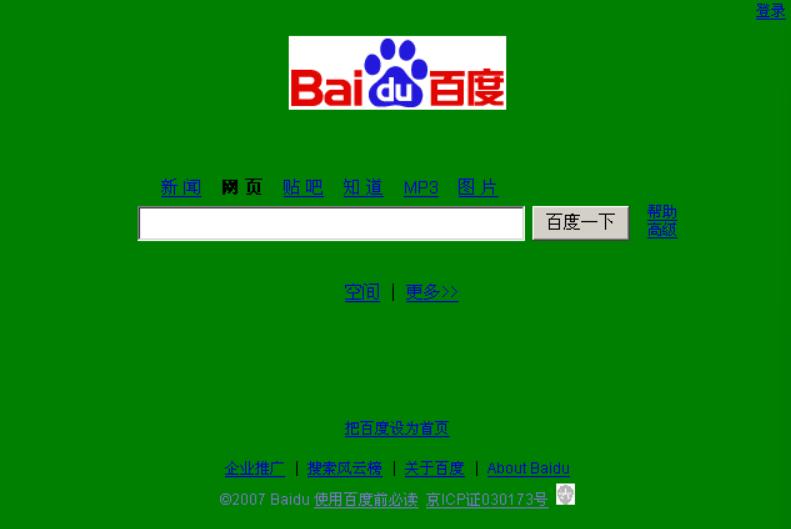
Figure | Back in that era, the homepage of Baidu Search still had the "Tieba" section and MP3 search entry
Three Major Overhauls
In October 2001, Baidu Search officially entered the daily life of the Chinese public. Before that, it was just like the active singer Li Ronghao, a "behind-the-scenes producer" that supplied songs to well-known singers including Joker Xue and A-Lin.
At that time, Baidu was responsible for providing search technology for web portals such as Sina and Sohu. In March 2002, many netizens clicked the search button on Sina as usual, but the page failed to load. Instead, a line of red text popped up: "Sina has overdue payment, Baidu service suspended. For better search results, please log in to www.baidu.com."
Later, the young man admitted that it was an impulsive move out of "youthful indiscretion". But after that night, a large number of Chinese netizens learned the name of Baidu for the first time.
However, it was not this "surprise attack" that turned Baidu into a mass consumer brand, but the inherent product strength of its product itself. Before that, the most widely used search tool for Chinese people was a thick corporate yellow page. Baidu's hyperlink technology made the corporate yellow page a thing of the past, and itself seized a critical historical position in the market.

Figure | From corporate yellow pages, to search, to social media, to AI, the way people access information has been constantly changing
In 2011, ten years after its founding, Baidu launched the "New Baidu Homepage" with the slogan "One Person, One World". This was the first major overhaul of search after ten years of Baidu's establishment.
Four modules including navigation notifications, real-time hot topics, applications and trending content were placed under the search box, and users could see personalized content after logging in.
Baidu's idea was to turn the search box from "a place to enter keywords" into "an entry for personal services".
The reason for launching "personalized search" was the rise of social media. Sina Weibo was booming, Renren was highly active, and Xiaohongshu, which posed the biggest threat to Baidu Search before the emergence of large models, was also founded in 2013. Users spent more and more time "browsing" and "seeing what others are talking about" instead of "searching". The search box was still in use, but the time users stayed on Baidu was getting shorter and shorter.
Behind any reform, there is always the leader who senses a crisis. Under the impact of social media, the behavior of "search" for information acquisition no longer holds a dominant position.
By 2017, Baidu started the second major overhaul of the search box. In January of that year, Qi Lu joined Baidu, and Baidu identified "AI and information feed" as its main business track.
The underlying logic of search began to loosen again, shifting from pure "people looking for information" to two-way distribution of "search + recommendation". In simple terms, users no longer only see what they searched for, but are also pushed content that they "may be interested in". It has to be said that this was a new feature pioneered by Toutiao, and the rapidly growing market proved that Baidu made the right choice.
Baidu also followed this trend. The appearance of its search box did not change, but the logic behind it was updated. The revenue structure also changed accordingly, and information feed advertising became the new growth engine.
Baidu's third major overhaul of the search box started this year. Two things forced Baidu to take action again: users are leaving, and revenue is decreasing.
In the second quarter of 2026, the monthly active users of Baidu App reached 644 million, 91 million less than the same period last year. Online marketing revenue was 13.1 billion yuan, down 19% year-on-year. Morgan Stanley predicts that the year-on-year decline in Baidu's core advertising revenue in the third quarter will expand to 22%, after falling by 19% in the second quarter.
This wave of crisis was not brought by social media or recommendation algorithms, but by AI. Overseas, the search query volume of ChatGPT has reached about 20% of Google's. Domestically, Doubao has around 500 million monthly active users, while DeepSeek and Qwen have 158 million and 122 million respectively. All of them are aggressively seizing users who once belonged to search engines.
Search is still in use, but the profit efficiency is getting lower and lower. Baidu has no choice but to reform.
Showdown
On October 30, Baidu Search released its latest search capabilities. Many users who hadn't opened the Baidu Search App for a long time felt a little unfamiliar with the interface the moment they opened it.
Baidu Search has evolved into a huge Agent. Its function has shifted from "one query, one response" to "one task, one complete delivery". In other words, it used to give you a bunch of search links for you to summarize by yourself, but now it directly helps you solve your needs and handle the problem.
If a user wants to travel to Sanya during the Spring Festival, they can directly search for "how to have fun in Sanya during the Spring Festival". In the past, a bunch of travel notes and strategy links would pop up, and users needed to browse and summarize the strategies by themselves.
Now it will give you a five-day itinerary with a budget. You can also set up "hotel price tracking", and it will keep sending you reminders whenever there is a price change. This function can also be applied to stock market position monitoring.
In the past, when students did exercises, Baidu Search would directly give them the answers. Now, in addition to presenting the answers directly, it can also break down problem-solving ideas and steps in various forms including images, charts and texts, which is quite like using a TAL AI learning tablet.
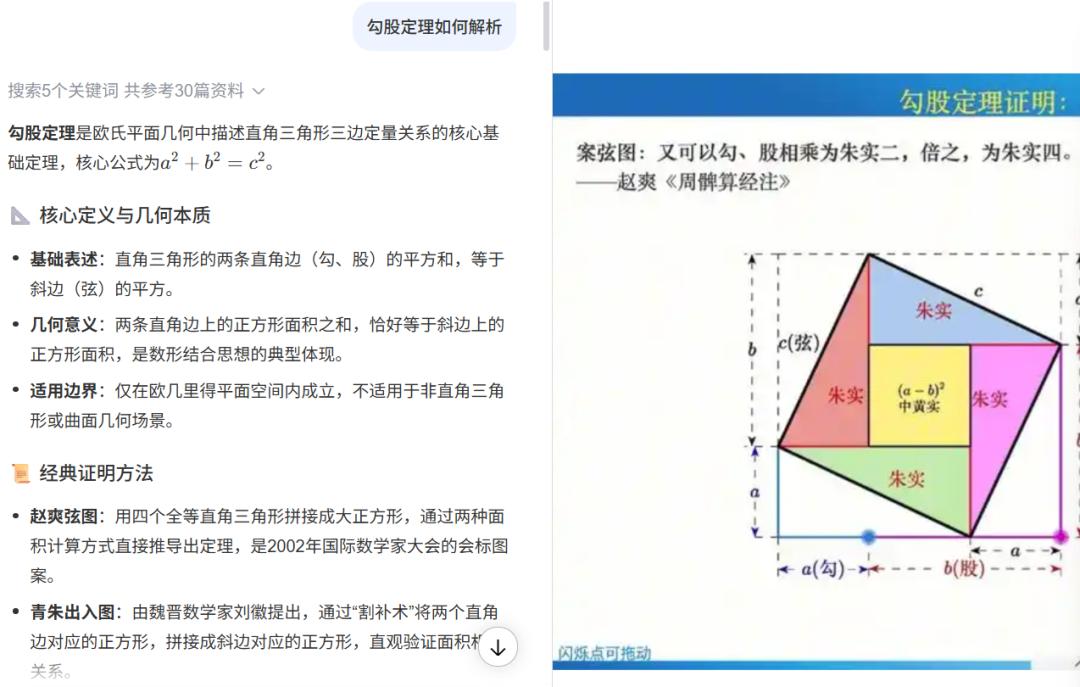
Figure | How to interpret the Pythagorean theorem
In terms of GUI (Graphical User Interface), the scenario coverage of the search page's GUI has increased by 5 times, with access to more than 5 billion authoritative data resources from government affairs, people's livelihood, the central bank and other institutions, covering more than 20 industries.
The previous GUI was designed to "make the answer clear", where users could see text, mixed text and images, and links; the current GUI tries to "let the data speak for itself", where you can see charts, comparison views and interactive data modules. It enables complex data to be "visible, comparable and interactive", and opens up the ecosystem, allowing authoritative professional data institutions and partners to co-create.
The younger generation of product managers also introduced that the underlying architecture of Baidu Search is also changing. The content layer gathers more than 80 languages and hundreds of billions of indexes, with the data credibility rate increased by more than 50%. The engine layer drives the model to recursively self-evolve through the closed loop of "retrieval - feedback - retraining", and the iteration efficiency is increased by more than 80%.
In plain terms: the more you use it, the smarter it gets.
Baidu allows the younger generation to carry out such radical reforms on the search box, as the saying goes: behind the reform are challenges and crises.
According to data from QuestMobile, in the first half of 2026, traffic accelerated to concentrate on independent AI-native applications. The ERNIE App faces many competitors in terms of monthly active users. Baidu must complete the upgrade in its most familiar entry, otherwise even the usage habits of its existing users may be eroded.
From an industry perspective, in fact, all competitors have different positioning strategies in the search field.
Baidu is carrying out intergenerational upgrades in the old entry, betting on "search is task". The common point between Doubao and Qwen is that they do not define themselves as search tools, but take the form of AI assistants to undertake various needs of users.
When a user asks "how to have fun in Sanya during the Spring Festival" in Doubao, what they get is not a list of links, but a conversational planning suggestion. This overlaps with what Baidu Search is doing, but the product mindsets are completely different: one is "I have a question, let's talk to an AI", the other is "I'll search to see what I can get directly".
Doubao's advantage lies in ByteDance's traffic pool and scenario coverage, while Qwen's growth rate is extremely impressive. Their search capabilities are hidden in the dialogue, rather than presented as an explicit "search box".
This means that while Baidu is optimizing the GUI and visualization of the search page, Doubao and Qwen's GUI optimization direction may be more inclined to the fluency of dialogue experience and the naturalness of task closed loop, rather than the information density of the search result page.
Battle for Entrance
This time, Baidu's young team made a move on the pricing of AI APIs during the transformation of search, which has drawn widespread industry attention.
Baidu has lowered the price of its search AI API to 4.9 yuan per thousand requests, which is clearly lower than DeepSeek's search API (DeepSeek's search API is priced at 5 yuan per thousand successful requests). The 10-cent price difference can be ignored in commercial narratives, but in pricing psychology, this 10-cent difference sends a clear signal: I am targeting you.
For Baidu Search, the AI API plays the role of turning Baidu Search's capabilities from "a function for people to use in the Baidu App" into "an infrastructure that external developers and AI applications can call".
We can use a kitchen as an analogy: Baidu Search itself is a huge "central kitchen" that used to only sell finished dishes in its own restaurants (Baidu App). Now it has turned its back-end capabilities into standard interfaces (search AI APIs), so that small restaurants, takeaway platforms, and even home kitchens outside can place orders, and integrate the capability of "search the entire web and provide answers" into their own products.
At this moment, Baidu Search's team set such a price for the AI API, which is certainly not to fight a price war with DeepSeek. What they are actually targeting is the call volume. To put it bluntly, they are willing to sacrifice a little profit in exchange for call volume.
Call volume is very important for models. Every real retrieval and user feedback will be precipitated as training signals, flowing back to the "retrieval - feedback - retraining" closed loop. Low pricing is essentially buying data backflow, buying ecological niches, and buying the position of that "invisible search layer" in other people's applications.
Do not underestimate this step. This means that Baidu is gradually changing the logic of its "profit model". In the past, Baidu Search was accustomed to advertising, clicks and traffic monetization, but now Baidu Search begins to compete in search capabilities, whose logic is completely different from the business it has been doing for the past 26 years.
Google is doing similar things, but in a different way.
In May 2026, at the Google I/O Conference, the search business ushered in its biggest overhaul in 25 years. The search box was redesigned to support text, images, videos, files and even Chrome tabs as input, with the underlying model replaced by Gemini 3.5 Flash.
The core of its design is the "Search Agent": it runs 24 hours in the background, continuously scanning blogs, news, financial data and sports information, and pushes notifications to you as soon as the conditions you care about change. For tasks like booking restaurants and housekeeping services, search will directly summarize the prices and availability, and can even make calls to merchants on behalf of users.
It seems that both Baidu and Google, the two search giants, are doing the same thing, but in fact Google's sense of crisis is different from Baidu's. Baidu's advertising revenue is falling, while Google's search advertising is still growing, albeit at a slower pace.
In the third quarter of 2026, Google's search advertising revenue reached 63.35 billion US dollars, a year-on-year increase of 12%, which was lower than expected, and the growth rate has been declining all the way from 19% in the first quarter. Google's Chief Business Officer admitted that although the query volume of AI mode is growing rapidly, the "monetization level is relatively low", which dragged down the growth rate of search revenue.
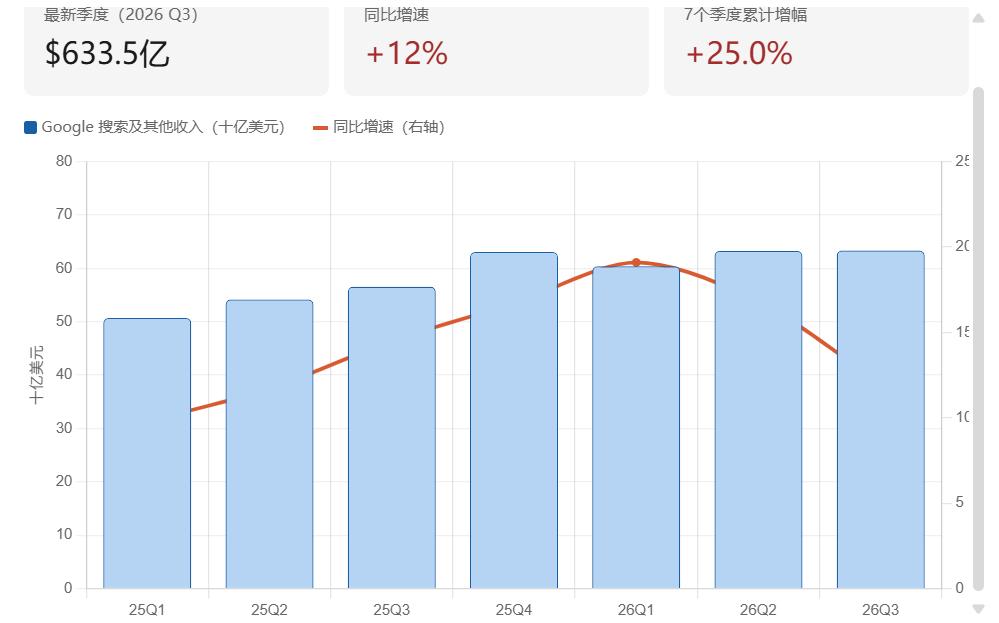
Google Search Advertising Chart. Several notable points:
- Overall steady upward trend
: Over 7 quarters, the revenue rose from about 50.7 billion US dollars to 63.35 billion US dollars, with a cumulative increase of about 25%.
- Significant slowdown in Q3 2026
: The year-on-year growth rate dropped from 16.8% in the previous quarter to 12%, which was lower than market expectations (64.96 billion US dollars). Google's management explained that it was mainly dragged down by factors such as exchange rates, retail advertisers being affected by trade policies, the advance release of World Cup advertising in Q2, and the low monetization rate of AI mode queries — which was also the main reason why the