Do both Unitree and HSG no longer want to make efforts on their own?
At the end of October, Unitree Robotics, in partnership with HSG, announced the joint launch of the "ShanYu · Venture Program", which focuses on discovering and investing in early-stage startups in the fields of embodied intelligence, robot applications and their upstream and downstream key technologies, as well as other cutting-edge hard technology sectors.
At a time when hard technology has become the definite main track for global capital, it is no longer a new thing for technology enterprises to enter the VC sector.
Incomplete statistics show that Agibot, Starsea, Zizhangliang, Galaxy Universal, Exdyn Robotics, DeepSeek, and Zhifang have successively deployed industrial investment, and even Agibot has previously joined hands with GL Ventures. Tying up upstream and downstream resources through capital and securing positions on technical routes has almost become the standard practice for leading players.
However, this move by Unitree appears far more meaningful when viewed in combination with its newly released Q3 financial report.
Data shows that Unitree's Q3 revenue reached 665 million yuan, up 69.93% year on year; its attributable net profit stood at 113 million yuan, down 17.37% year on year; its non-recurring profit-deducted net profit was 105 million yuan, down 17.42% year on year.
The deviation between revenue and profit is driven by the explosive growth of cost input. Its R&D investment in the first three quarters reached 263 million yuan, up 191.48% year on year. Among the figures, the R&D investment in the single third quarter hit 127 million yuan, up 249.58% year on year, accounting for 19.10% of the revenue of that quarter.
Selling expenses also increased from 76.0085 million yuan in the same period of the previous year to about 230 million yuan. For Unitree, the pressure in the future may continue to rise, and it is no longer realistic to rely solely on its own resources to push forward all businesses. The enterprise must team up with top-tier capital to find new allies, so as to share part of the subsequent costs and risks.
A second growth curve, or the start of "united efforts" led by leading players?
In fact, Unitree's revenue growth rate has gradually slowed down since 2026.
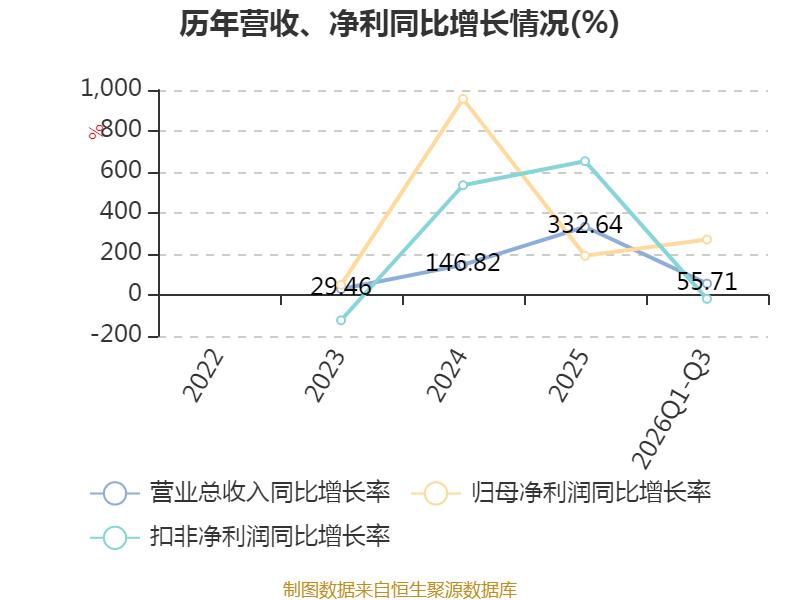
Statistics show that from 2023 to 2025, Unitree Robotics recorded revenue of 159 million yuan, 393 million yuan and 1.699 billion yuan respectively, with a compound annual revenue growth rate of 226.78% in three years. In the first three quarters of 2026, Unitree's accumulated revenue reached 1.817 billion yuan, with the growth rate slowing down to 55.71%.
More importantly, Unitree's profit model so far is very single, mainly relying on the sales of robot hardware. According to Unitree's prospectus, the enterprise's main revenue comes from hardware sales, among which the sales of humanoid robots, quadruped robots and robot components account for as high as 98.64% of Unitree's total revenue.
However, as the consumer market "cools down", it remains unknown whether this model can withstand shocks in the future. At present, the leasing industry, which once supported half of the robot sales market, is collapsing at an accelerated pace. It is reported that the daily rent of the basic version of Unitree G1 robot has dropped to less than 2000 yuan, while the rent of quadruped robot dogs has fallen below 500 yuan.
From Unitree's perspective, the value of its inventory is indeed on the rise.
The Q3 financial report shows that as of September 30, 2026, the value of Unitree's inventory reached 1.019 billion yuan, compared with 367 million yuan on December 31, 2025. Although this may not have a direct causal relationship with the sales side, the selling expenses that have increased to 200 million yuan seem to confirm that robots are really getting harder to sell.
At present, Unitree is in urgent need to find a second business growth curve, and investment may be a good choice.
Before Unitree, Agibot had used investment to reduce costs and improve efficiency for its main business, and at the same time reaped sufficient valuation dividends from ecological layout. According to official information from Agibot, over the past year and a half, Agibot has invested in more than 20 enterprises, and the average annualized valuation of the invested enterprises has increased by 17 times.
After global scientific and technological innovation once stagnated and the return on investment in the internet and consumer tracks shrank, embodied intelligence has become one of the most stunning boom tracks with huge wealth creation effect. Taking Unitree itself as an example, Unitree Robotics had more than 40 shareholders at the time of its listing, and early investors obtained hundreds of times of returns.
This wealth creation myth has ignited the exploration enthusiasm of the primary market, with capital searching everywhere for the next "Unitree".
And Unitree certainly also wants to be one of the sharers of the huge market cake.
At the same time, the embodied intelligence industrial chain is huge and lengthy: the upstream covers motors, sensors and chips, the midstream includes algorithms and motion control systems, and the downstream is scattered in industrial, commercial and household scenarios. For Unitree, instead of taking full responsibility for everything, it is better to transfer pressure to external entrepreneurs through investment.
This is also the main purpose of technology manufacturers to make investments. For example, Agibot launched the "Venture Program A" as early as 2024. From August 2024 to October 2026, Agibot appeared as an investor in 47 investment and financing events, most of which were concentrated on the key upstream nodes of Agibot's complete machine products.
Similarly, Starsea, in cooperation with Cathay Capital, launched the "Xingtu Program", planning to invest a total of 1 billion yuan in 5 years to invest in 100 early-stage embodied intelligence projects, covering components, data, algorithms, scenario applications... After all, the trial and error cost of full-stack self-research is too high and the risk is too great, which is the most efficient way of operation.
But does this also mean that the embodied intelligence track has officially entered the era of "united efforts" led by leading players?
It has to be admitted that the polarization of the industry is widening at an accelerated pace, and even players at the top of the pyramid cannot guarantee stable profitability.
For example, UBTECH recorded an attributable net loss of 703 million yuan in 2025, and an attributable net loss of 311 million yuan in the first half of 2026; Leju Robotics recorded an attributable net loss of 69.7794 million yuan in 2025, with the loss amount expanding compared with the previous two years; DeepMotion posted an attributable net profit of 28.684 million yuan in 2025, but turned to loss in the first half of 2026, with the attributable net loss reaching 8.8063 million yuan.
The capital tie-up between giants has further amplified this polarization effect. Originally, among 168 invested embodied intelligence enterprises in 2025, the top 10 companies obtained 13.472 billion yuan in financing, accounting for 40.95% of the total annual financing amount under this statistical caliber. By 2026, the status of the embodied intelligence track on the capital side began to decline.
In the future, orders and capital will quickly converge to a small number of upstream nodes with industrial synergy value, and startups that receive bets from leading industrial players can obtain continuous resources. Small and medium-sized teams that do not enter this united network are easily marginalized and gradually lose the opportunity for trial and error.
Even so, this is also a helpless move for the giants.
On the difficulties of forming the "ShanYu Faction"
Before cooperating with HSG, Unitree launched the "Unitree Venture Program" for entrepreneurial teams in the robotics industry. According to Wang Xingxing's statement at the "2026 World Physical AI Conference", the Unitree Venture Program received more than 200 projects in just over a month, and it hopes to incubate more than 200 high-quality enterprises in the next five years.
Up to now, this program has been upgraded, and a "ShanYu Faction" may be born in the embodied intelligence track.
Prior to this, the factions in the entire embodied intelligence sector were basically divided according to the experience background of entrepreneurs. For example, the "Eco Portrait Report of Chinese Embodied Intelligence Entrepreneurs" released by IT Juzi divides them into 9 major factions: Huawei, Microsoft, Baidu, Google, DJI, Alibaba, Tencent, ByteDance and Xiaomi.
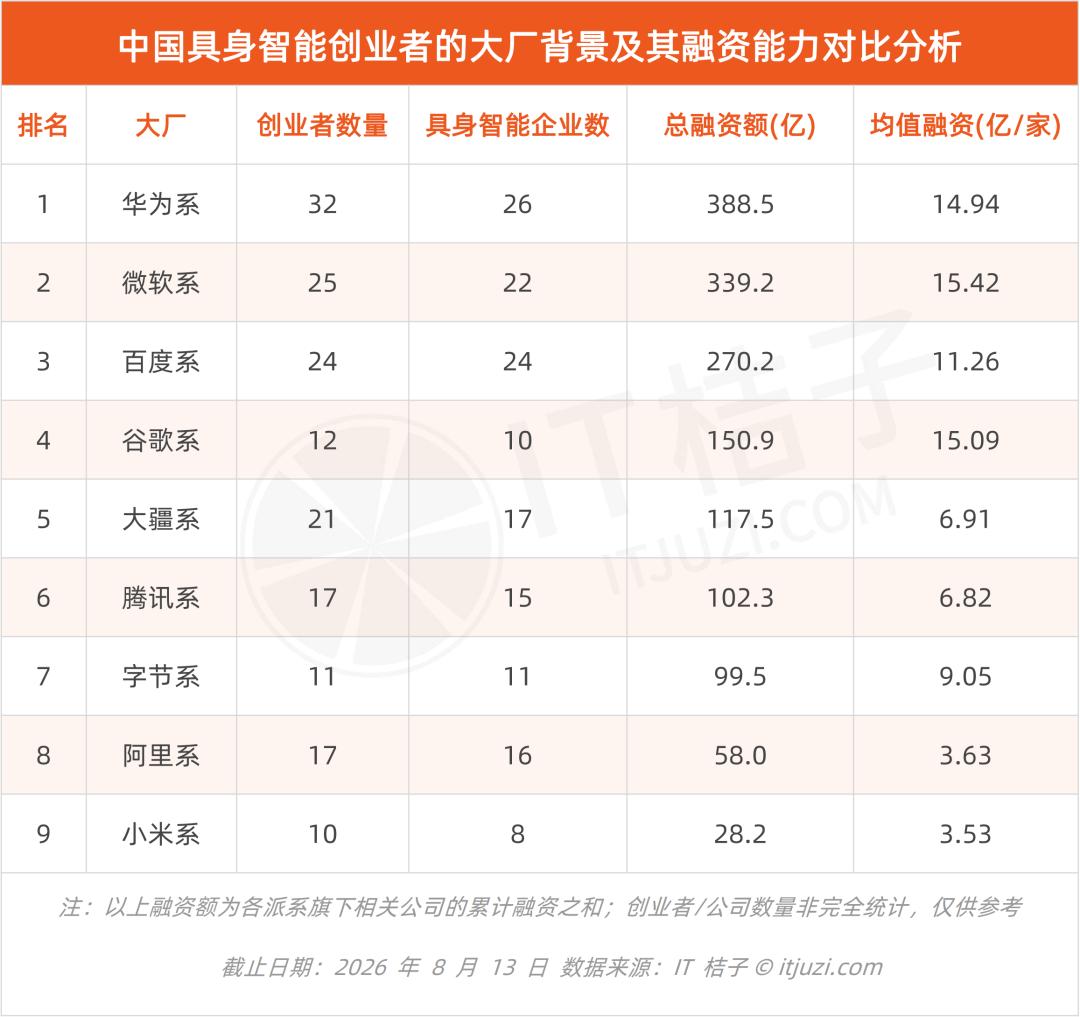
It is reported that the Huawei Faction is the faction with the highest total financing in the embodied intelligence track. As of August 13, 2026, 26 enterprises under this faction have raised a total of 38.85 billion yuan. This division method that categorizes a startup into a certain faction based on which large factory the founder and core team of the startup come from essentially reflects talent spillover, alumni network and technical habits behind it.
However, Unitree and HSG may create an industrial faction, which takes leading complete machine or embodied large model manufacturers as hubs, sets up special industrial investment programs in cooperation with capital, incubates upstream and downstream projects, and ties up orders and test platforms... In addition to the ShanYu Faction, there are also the Agibot Faction and the Xingtu Faction in China's embodied intelligence track.
At present, the Agibot Faction already has star players. In February 2026, Agibot participated in the over 800 million yuan Pre-B round financing of NeuroEx. According to disclosure, NeuroEx's shipments in the first half of the year accounted for about one fifth of the global shipments of high-computing robot chips in the same period, ranking second in the world after NVIDIA.
The ShanYu Faction is still in its initial stage, and there is no standard answer yet for who will become the rising star in this new faction.
But one thing is certain, high-quality projects in the embodied intelligence track are being rapidly depleted, and good investment targets are getting fewer and fewer.
The ebb of capital popularity first exposed the shrinkage of project supply. According to statistics from IT Juzi, 33 financing events took place in the embodied intelligence track in October 2026, with a total amount of 10.105 billion yuan, while there were 60 events worth 11.028 billion yuan in September, with the number of transactions almost halved. Compared with the peak of popularity in June, when there were 55 events worth 30.892 billion yuan, the gap is even more obvious.
It is reported that new money in the primary market is tightening, and valuation collapse has also appeared in the old stock trading in the secondary market.
According to the report of "Tencent Tech", before August, the old stocks of some leading robot companies could find buyers at about a 10% discount, while recently, 50% discount quotations even appeared in some transactions. According to Securities Times, in the past two months, the transfer quotation of old stocks of some embodied intelligence companies is concentrated at 65% to 80% of the previous round of valuation, and the sold targets include leading enterprises.
Behind the valuation inversion is that the track has entered a cycle of large-scale market clearing. In the past two years, a large number of robot companies including Zhicheng Dynamics, Dark Horse Robotics, CloudMinds, LongHui Medical, and Cone Robotics have gone bankrupt one after another, including star projects incubated by industrial leaders and supported by well-known investment institutions and industry giants.
When a large number of mid-tier projects collapse one after another, the choices left for Unitree and HSG are naturally getting fewer and fewer.
During the previous industry boom period, a large number of talents left big factories to start businesses, and they could easily get angel investment with just a set of prototype. Now capital has bid farewell to the previous PPT narrative, the threshold for entrepreneurship has been raised sharply, and hard-core teams have become scarce. This has also laid the first difficulty for the ShanYu Faction.
In the new faction competition, no one expected the awkward situation of "even a clever housewife cannot cook a meal without rice".
In the AI era, are VCs increasingly dependent on industrial players?
A curious question: as a top-tier capital, why doesn't HSG bet on the embodied intelligence track alone, but chooses to team up with Unitree?
Entering 2026, HSG has paid more attention to the AI track. As of August 6, 2026, HSG has completed a new round of fundraising with a scale of about 10 billion US dollars. According to reports, this "ammunition" will be mainly bet on artificial intelligence, marking that this veteran venture capital has officially entered a new stage with AI as the core.
The primary market for embodied intelligence has also become completely lively, with US dollar funds, RMB venture capital, national-level sci-tech innovation funds, industrial strategic investment... endless participants. But traditional financial VCs have obviously lost their usual ease in the new round of hard technology cycle.
Taking the mobile internet era as an example, the judgment logic of financial VCs basically only needs to look at the team, the business model, and user growth. The data can be verified quickly, and expansion can be completed by burning money. Often a demo and a growth curve are enough to support the investment committee's decision.
But it is different in the hard technology era, especially when the quality of various entrepreneurial projects in the current embodied intelligence track is uneven. Even top-tier institutions like HSG can hardly encounter high-quality projects easily. From 2025 to 2026, HSG participated in four consecutive rounds of investment in the same embodied intelligence enterprise Wujie Dynamics.
It is reported that HSG teamed up with Unitree to build a dual-track decision-making mechanism of "engineers + investors". In this division of labor, Unitree is responsible for engineering-side judgment, and HSG gives full play to its capabilities on the capital side. At the same time, Unitree provides technology and scenarios, and HSG provides funds.
However, does this also mean that traditional financial VCs will further increase their dependence on industrial players in the AI era?
In fact, in May this year, Securities Times pointed out that the advantages of CVC had never been amplified in the previous generation of manufacturing, mobile internet, and even the currently hot chip semiconductor track. But in the AI and robotics track, only corporate venture capital (CVC) that brings scenarios, demands and engineer teams can achieve that.
Compared with financial VCs, the biggest "trump card" of CVC in the investment process is orders and scenarios, which is almost a dimensionality reduction strike for traditional financial VCs. According to the report released by Xiniu Data, behind almost all leading startups in the current AI and embodied intelligence fields, there are different types of industrial capitals, and mainstream CVCs in the market basically hold more than 3 leading projects each.
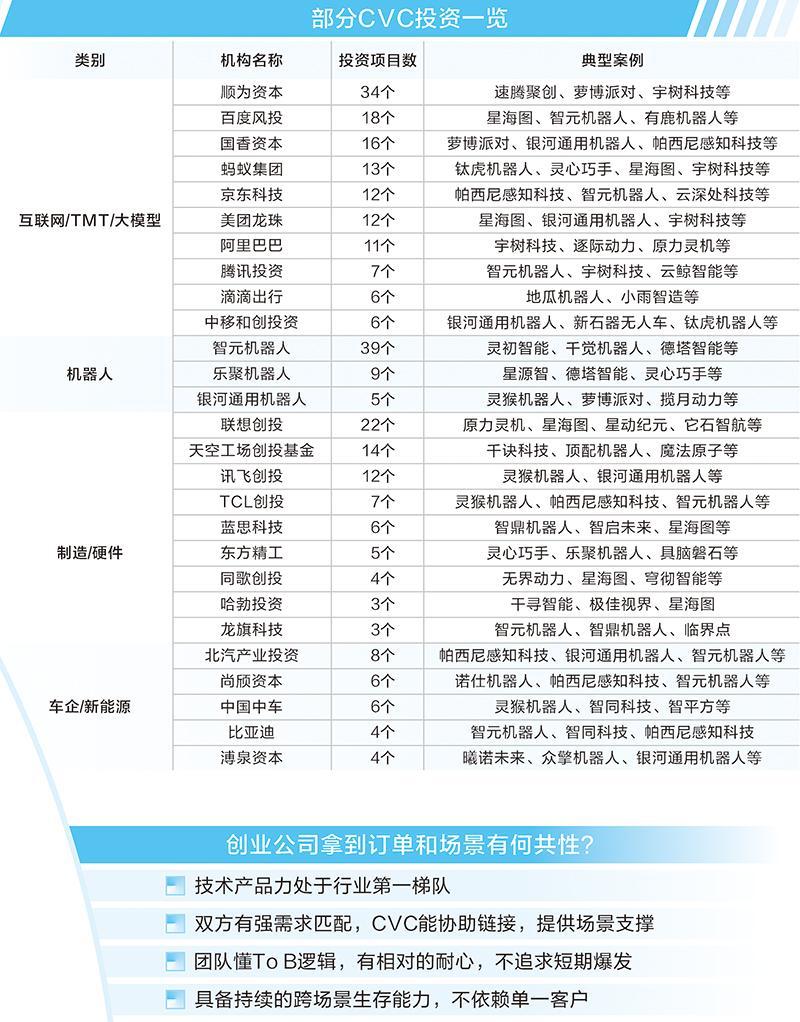
At present, internet giants, hardware manufacturing giants, car companies, and leading robot enterprises have all entered the market. This team is still expanding. According to the sorting out by Securities Times reporters, since the beginning of this year, many top-tier technology companies such as Changxin Memory, GigaDevice, and JCET have successively deployed primary market investments, becoming the new favored LPs (limited partners) in the market.
The entry of more and more hard-core technology enterprises will squeeze traditional financial VCs like HSG from multiple aspects such as fundraising, project sourcing and pricing. After all, if high-quality projects pay more attention to industrial resources and