"Huamo of China University of Geosciences" is already a thing of the past.
"Why are you still sticking to the old outdated term 'Di Da Hua Mo'? Haven't you checked the latest vehicle deployment data?"
At the end of last month, after I finished attending the X7 Ultra launch event held by Xinxin Hangtu in Suzhou, I was exchanging views with a group of friends in my regular smart car enthusiast group. Someone suddenly cut in with this remark, targeting the "Di Da Hua Mo" label for top intelligent driving suppliers that had been mentioned repeatedly in the discussion.
This comment hits the nail on the head. After all, we are approaching the end of 2026 now, and using this industry catchphrase that first emerged three years ago to discuss current market conditions is a typical case of marking the boat to find the sword.
The so-called "Di Da Hua Mo" is an abbreviation, or a nickname, that began to circulate in the industry in 2023. It combines the four leading intelligent driving suppliers that were closest to the first-tier camp at that time, taking one character from the Chinese name of each: Horizon Robotics, DJI Automotive, Huawei, and Momenta. No official organization ever formally released this nickname, but it made perfect sense at that point in time: Horizon Robotics represented the chip-focused camp, DJI Automotive (now Zhuoyu) represented the cost-focused camp, Huawei represented the full-stack camp, and Momenta represented the algorithm-focused camp, with each of the four occupying its own distinct market position. This nickname was never officially used by any institution, but it was valid at that time: chip-focused Horizon Robotics, cost-focused DJI Automotive (now Zhuoyu), full-stack Huawei, and algorithm-focused Momenta, each held its own stronghold.
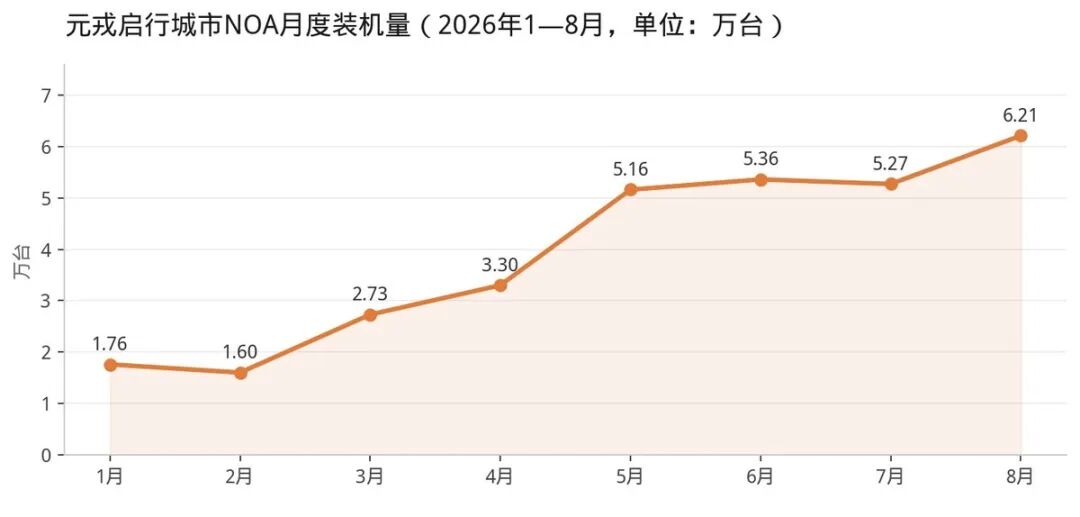
Of course, looking at it three years later, the explanatory power of this four-character nickname is no longer sufficient. For example, the deployment data emphasized by that group member: in August this year, DeepRoute, which was once outside the "Big Four", deployed 62,100 units, surpassing Momenta's 61,300 units, ranking second in monthly supplier deployment volume, right after Huawei's 68,600 units. Similarly, Qcraft has already exceeded a cumulative 1 million units of assisted driving deployment.
The banner atop the city wall changes hands
The reason why labels like "Di Da Hua Mo" are so deeply rooted in people's minds is that back in 2023, the four companies were roughly balanced in customer coverage, mass production scale, and technical completeness. However, this balance was torn apart by two combined forces starting from last year.
One force comes from the route adjustment within original equipment manufacturers (OEMs). According to statistics from S Auto Research, the NOA (Navigation on Autopilot) installation volume for domestic passenger vehicles in the first half of 2026 reached 3.21 million units, with a penetration rate of 37.4%. Among this total, in-house development by OEMs accounts for 70.9%, and third-party algorithm solutions account for 29.1%, meaning in-house development is still the fundamental base of the industry. But even with in-house development, OEMs have begun to configure suppliers separately by brand, vehicle model, and even price range. Single-supplier binding has shifted from a way to reduce integration costs to a risk for bargaining power and supply chain security. With more designated procurement windows opening up, new players have gained opportunities to jump the queue. The rise of Qcraft and DeepRoute can largely be explained by this trend.
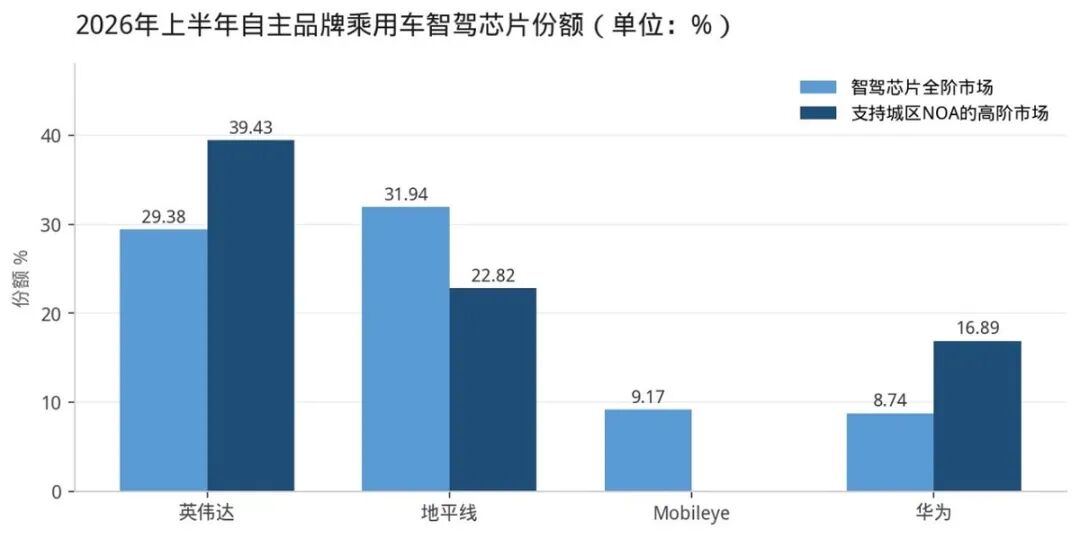
The other force comes from the maturity of technical supply. End-to-end technology, VLA (Vision-Language-Action), and world models mean that urban NOA no longer has only one development path. As for Horizon Robotics' Journey 6M, and the X7 series co-defined by Momenta and its affiliate Xinxin Hangtu, they have partially got rid of previous dependence on NVIDIA platforms, while further driving down hardware costs to lower levels.
If we take the monthly deployment data from this summer as the standard, the most prominent new entrant among domestic leading intelligent driving suppliers is undoubtedly DeepRoute. Founded in 2019 and headquartered in Shenzhen, this company ranked 8th in the industry with 17,600 urban NOA installations in January this year, and rose to 2nd place in August with 62,100 units, only 6,500 units behind the top-ranked Huawei. By September, Momenta pulled away again with 98,400 units, and the ranking shuffled once more.
The incremental growth of DeepRoute over the past year mainly comes from new vehicles under the Great Wall Motors system and Leapmotor. A total of 25 vehicle models had installations in August, with the largest single model accounting for 14.8%. As of September, the cumulative number of mass-produced vehicles equipped with its urban NOA solution has exceeded 550,000 units, with cooperating brands covering Wey, Tank, Haval, and Ora under Great Wall Motors, as well as Galaxy under Geely, and Leapmotor.
Qcraft represents a different scenario. As of January this year, the deployment volume of its Qraft Chasing Wind solution in the passenger vehicle sector exceeded 1 million units. For many people who do not follow this field closely, it has almost silently become the second intelligent driving solution provider in China to achieve million-level deliveries.
The hardware fulcrum that drove Qcraft's takeoff is the Journey 6M chip released by Horizon Robotics in April 2024 and put into large-scale mass production in February 2025. With a single-chip computing power of 128 TOPS, it can support urban NOA solutions. In April 2025, Qcraft launched a safe and interpretable end-to-end urban NOA solution based on a single Journey 6M chip. This solution was officially deployed in vehicles on January 21, 2026, along with the rollout of Li Auto AD Pro 4.0, and was first equipped on the smart upgraded version of the Li Auto L series.
According to the third-party NOA panorama report from S Auto Research, based on cumulative installation volume, in the overall third-party NOA market from 2022 to the first half of 2026, Momenta accounts for 27.8%, Qcraft accounts for 26.3%, and Huawei Hi and HiPlus together account for 14.0%, making Qcraft rank second among third-party suppliers. By price range, Qcraft takes the leading position in the 0-150,000 RMB, 250,000-350,000 RMB, and 350,000-500,000 RMB segments with shares of 33.4%, 28.8%, and 32.4% respectively, and ranks second in the 150,000-250,000 RMB segment with a 19.3% share.
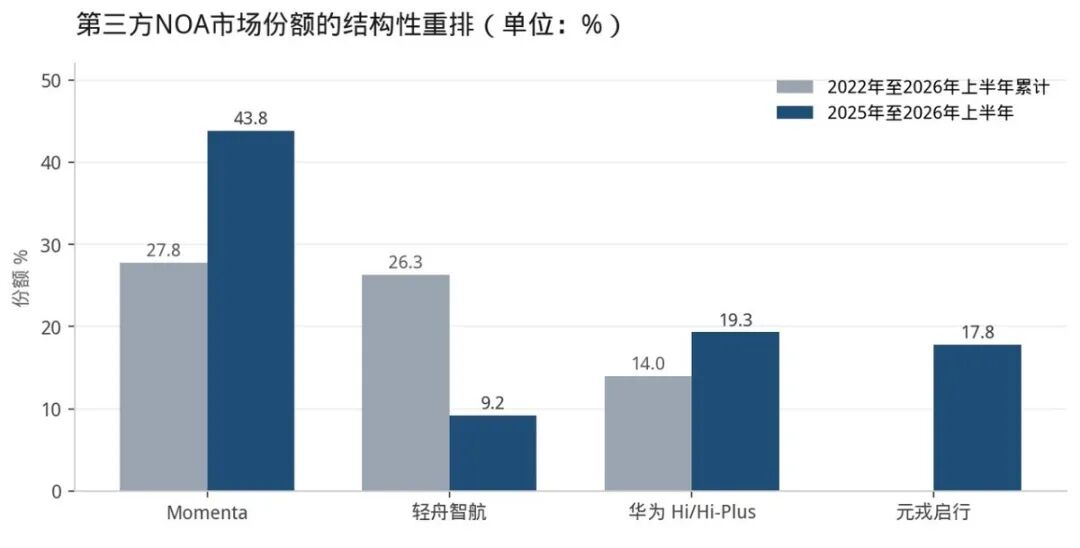
When these sets of figures are put together, the denominator is the easiest part to misread. The 26.3% share is based on the total volume of third-party algorithm solutions, not the entire industry. In the same period, third-party solutions only account for 29.1% of the total domestic NOA installation volume, and this set of figures includes highway NOA, representing a cumulative value of four and a half years. If we only look at the current urban NOA market from 2025 to the first half of 2026, Qcraft's share drops to 9.2%, ranking fourth, while Momenta takes first place with 43.8%, Huawei second with 19.3%, and DeepRoute third with 17.8%. For the same set of enterprises tracked by the same institution, the ranking flips completely when the time window is changed.
When assisted driving has become a common configuration for vehicles priced at 100,000 RMB or even lower, and NOA functions are trending toward popularization from being exclusive to models priced above 300,000 RMB, to clarify the exact ranking of enterprises in the industry, we must be clear about which standards and metrics we use, which is far from something that a four-character nickname from three years ago can explain.
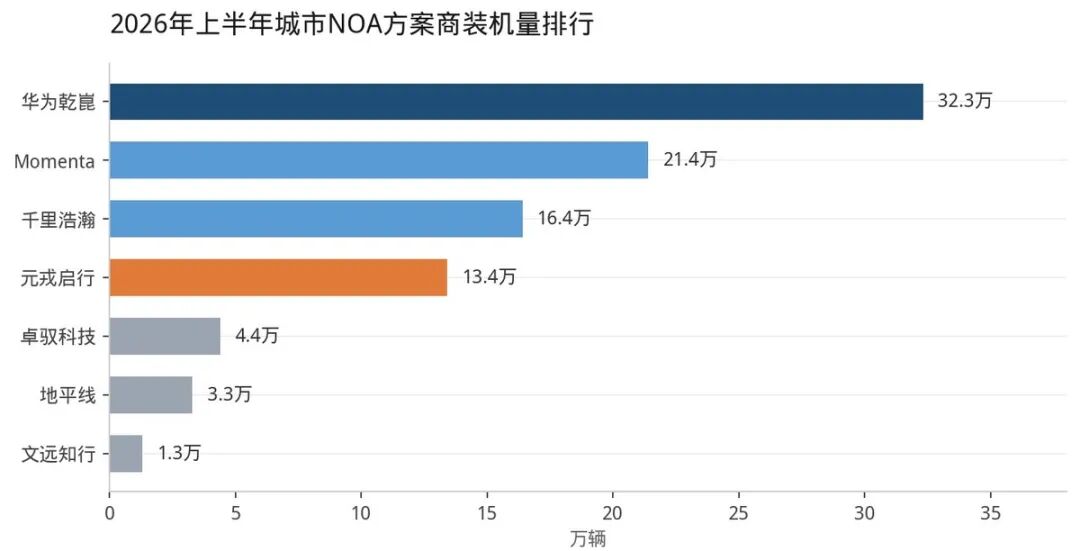
In particular, there is another type of player: those backed by OEM groups. For example, Qianli Haohan recorded a total deployment volume of 164,000 units in the first half of this year, ranking third among solution providers. It is backed by the Geely system, which is indeed not the same as pure third-party suppliers. However, Qianli Technology has always positioned itself as an independent smart vehicle solution provider, and the Yiche ranking also includes it in the third-party category. This ambiguous identity is in itself one of the reasons why the ranking is hard to determine.
Every advantage has its corresponding disadvantage
Looking at the six companies mentioned above: Huawei, Momenta, Zhuoyu, DeepRoute, Qcraft, and Horizon Robotics, what is really interesting is not their rankings, but their current capabilities and boundaries.
First of all, it is clear that the Huawei system is still the largest in overall scale for now and for some time to come. INVO disclosed in July 2026 that the total deployment volume of Qiankun Intelligent Driving has exceeded 1.9 million units, with a cumulative assisted driving mileage of 12.8 billion kilometers. It took 44 months to reach the first 1 million units, and only 12 months for the second. Jin Yizhi presented many data comparisons at the press conference: an average Chinese driver experiences a serious collision every 1.8 million kilometers, while after enabling Qiankun ADS, this figure is extended to 8.872 million kilometers.
The shortcomings of the Huawei system are equally obvious. Jin Yizhi has repeatedly emphasized at multiple press conferences that INVO only acts as an "electronic screw", which clearly shows that the psychological defense line of the "soul theory" still exists, and the number of OEMs willing to deeply bind with Huawei is limited. In addition, to maintain its market position, its continuous R&D investment is also extremely large, with special R&D investment reaching 18 billion RMB in 2026.
Momenta initially took a different path, focusing on algorithms and software, which directly avoids the "soul" issue that makes most OEMs uneasy, and achieved a very good start as a result. As of the end of June this year, it has established mass production cooperation with 26 global OEMs, with 321,000 new installations added in the first half of the year, a year-on-year increase of 83.7%. Its customer list includes Toyota, Volkswagen, General Motors, Mercedes-Benz, BMW, Hyundai Kia, and Honda. Its revenue in the first half of the year was 1.602 billion RMB, a year-on-year increase of 75.9%. After excluding stock-based compensation expenses, its gross margin reached 75%, and its adjusted net loss narrowed to 14.097 million RMB.
Although it started and established its position based on pure software, under the unpredictable industry changes in recent years, further vertical integration to pursue a better market position is almost the choice of every strong enterprise.
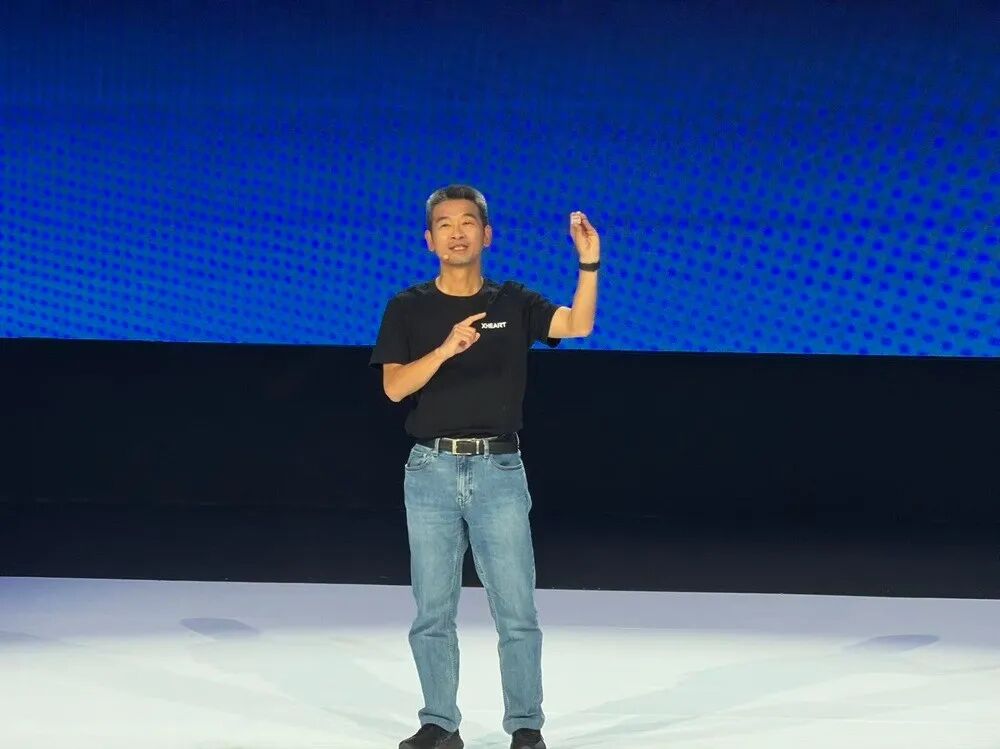
Figure | It is also a necessity of the situation for software companies to get involved in hardware development
In March this year, the X7 chip from its affiliate Xinxin Hangtu made its mass production debut on the SAIC Volkswagen ID.ERA 9X. By the press conference held in Suzhou on October 29, the X7 series had shipped more than 200,000 units cumulatively in 8 months of mass production, equipped on 10 mass-produced vehicle models. The models showcased at the event also included the all-new generation IM LS6, the all-new Cadillac XT5 PHEV, Chery Fengyun A9L and Fengyun T11, Roewe Jiayue 07, and SAIC MG07. The X7 Ultra released at the same event officially claims to have a large model computing power of 700 TOPS, with an NPU utilization rate of 98.7%.
The line in Momenta's prospectus is very realistic: customers' cost-cutting measures often lead to increasing downward pressure on pricing, and the top market share does not equal top discourse power.
As for the changes of Zhuoyu, it best illustrates that enterprises can remove negative labels and completely reverse their industry position through unremitting efforts. Frankly speaking, back in 2023~2024, the author's personal view of Zhuoyu, which was still called DJI Automotive at that time, was relatively negative. I had test-driven several vehicle models equipped with its solutions, and the on-road driving experience feedback was mediocre.
The changes actually started at the end of 2024. In November of that year, the interpretable end-to-end algorithm of Xingcheng Intelligent Driving, based on Qualcomm SA8650P with 100 TOPS of computing power, realized map-free urban navigation that can be driven across the whole country, and made its debut on the Hongqi Tiangong 08.
The actual on-road performance of the initial version was rather limited, but its version iteration efficiency is very high. At the 2026 Beijing Auto Show on April 24, 2026, Zhuoyu released a native multi-modal foundation model, and simultaneously launched the highly perceptive end-to-end 4.0. This model has been pushed over-the-air (OTA) to vehicles equipped with Qualcomm 8650 and 8775 chips since April, and its overall performance can be described as completely transformed.
What is particularly rare is that Zhuoyu's rapid progress within two years is still based on binocular vision enhancement and engineering efficiency. The subsequently released native multi-modal foundation model MFM incorporates rules such as inertia, friction, and collision cost into pre-training, with the goal of zero-data cross-region migration.
Of course, this did not come without cost. There are reports that Zhuoyu deleted seven years of accumulated rule codes in October 2024, fully shifting to end-to-end development with a decisive attitude, which meant its entire technology stack was essentially remade. Its 44,000 units of deployment in the first half of 2026 ranked fifth, and a lot of market window opportunities were missed.
An interesting point is that the "low-cost" label that DJI Automotive, the predecessor of Zhuoyu, was once pasted with, now falls on Qcraft. This enterprise has bet on the cost performance of medium-computing-power solutions, claiming that it can deliver experience close to 256 TOPS performance with a 128 TOPS chip. This has allowed