The huge bubble in the robotics sector is bursting: IPO access has been closed, and backdoor listing has been completely blocked.
I have recently observed that the huge bubble in the humanoid robot sector is bursting.
First and foremost, the most fatal blow comes from the IPO channel. Whether it is A-share or Hong Kong stock IPO, most robot companies are fully aware that the window for such listings has been almost completely closed.
Secondly, companies that plan to go public through backdoor listings can forget about that idea — it is almost impossible to pull off now.
Once the exit channels are shut down, the difficulty of securing financing will increase exponentially. The boom seen at the start of this year, where companies could complete a new financing round every 3 months and raise 1 billion yuan per round, will hardly ever return.
The IPO channel is narrowing rapidly
I believe everyone is already aware that the regulator has recently sent out a strong signal regarding its attitude towards IPOs.
On November 3, foreign media reported that the China Securities Regulatory Commission (CSRC) had required large brokerages and banks to slow down their IPO business in a closed-door meeting, continue to advance projects that are already under review, and temporarily stop accepting new IPO applications.
This signal has almost reached a consensus in the robotics industry: no robot-related enterprise can expect to rush through an IPO quickly any more.
The Hong Kong stock market is not a safe haven either. Domestic enterprises seeking to list in Hong Kong need to go through the CSRC's overseas listing filing procedures and be audited by the Hong Kong Stock Exchange at the same time. Changing the listing location does not mean they can circumvent the Chinese mainland's regulatory requirements.
In addition, there is another path: going public through a reverse takeover of a listed shell company.
For many people, this was originally an exit method that had high hopes placed on it. But now it turns out that this path is also very difficult to take.
Unitree Robotics is a case worth observing. Unitree previously obtained control of SWEComposites through acquisition, and was once regarded by the market as a typical sample of capitalization.
However, in October 2025, the announcement of SWEComposites stated that Unitree has no plan or arrangement for a backdoor listing within the next three years.
Even leading enterprises like Unitree are encountering difficulties in backdoor listings, so other enterprises can hardly expect to achieve this in the short term.
Capital begins to retreat, discounted sales of old shares are a clear signal
Recently, a number of institutions are selling old shares of robot companies at a discount. I fully understand this mindset.
Over the past 10 years, many investors poured money into Industry A and failed to get returns; they poured money into Industry B and still failed to make profits.
This year, they finally saw the robotics industry boom, thinking that they could exit and recoup their capital 2 to 3 years after investing, but they ended up facing the closure of exit channels again.
What does this indicate? Chasing the rising trend and dumping assets when prices fall never leads to a good ending: this applies to retail investors, and even more so to equity investors. Only by staying one step ahead in cognition before the price fluctuations occur can you make money from investment.
If you enter the market only after seeing the robotics industry become hot, you will easily get trapped in the bubble.
On October 29, Securities Times disclosed that in the past two months, old share transfers have frequently occurred in the embodied intelligence track, with quotations generally only 65% to 80% of the valuation of the previous round.
But the problem is that old shares are not easy to sell now. Everyone knows that it is difficult to exit, and everyone has started to cut losses by selling at low prices. Who will take over your shares?
The old shares of robot companies were estimated to be easy to sell in the first half of this year.
Statistics from iiMedia Research show that in the first half of 2026, there were 172 financing events themed on embodied intelligence in China, with a total financing amount of 109.174 billion yuan. The valuations of many leading enterprises have exceeded 20 billion yuan.
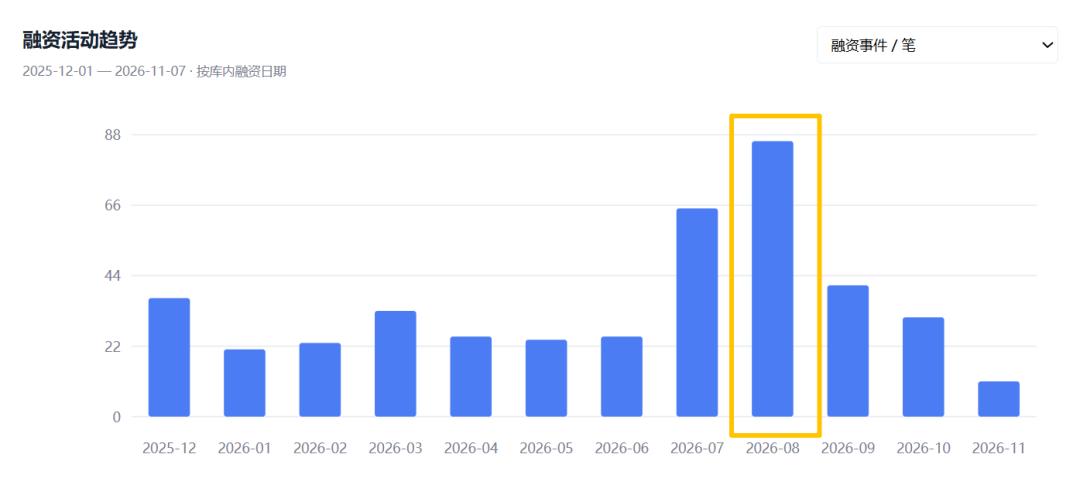
Since September this year, old shares have definitely become very difficult to sell. According to the Pencil Data Pro database (as shown in the figure below), the financing heat of robotics/embodied intelligence has dropped sharply since September this year.
Many entrepreneurs are betting their entire careers
Who faces the greatest risk in this round of bubble? The answer is undoubtedly the entrepreneurs, as they are staking everything they have.
This round of financing is different from the wave 10 years ago. The financing wave 10 years ago might be real venture capital: if a startup failed, as long as the funds were spent properly, the investors would accept the loss as part of the game.
Many financing deals for robotics enterprises include performance bet agreements (with joint and several liabilities for the enterprise or individual founders): if the company goes bankrupt, many founders have to pay out of their own pockets to repurchase the equity held by investors.
Nowadays, almost every financing round for robotics enterprises starts at 1 billion yuan. How many entrepreneurs can afford to pay 1 billion yuan out of their own pockets? How many properties do they have to sell to raise that sum?
From what I have observed, many entrepreneurs are still immersed in the pleasure brought by the bubble, forgetting the frugality culture that startups should adhere to, and spending money lavishly.
I learned that during the boom in the first half of this year, some entrepreneurs were willing to spend 300,000 or 500,000 yuan to publish a single soft article for capital operation promotion. As a media, we ourselves are beneficiaries of this behavior, but I still have to point out: these extravagant behaviors are just like a prodigal son spending his father's money without feeling the pain — whose money is it? It's the investors' money.
In the next stage, the industry will go through a cruel selection process.
Enterprises that have already obtained financing should cherish the dividend brought by the funds they hold. They should no longer focus their main energy on the next round of financing, valuation improvement and capital operations, but spend the funds on product R&D, customer delivery, technology iteration and commercialization.
Otherwise, if they try to take other paths, the enterprise will only end up dying.
Of course, there are also a number of down-to-earth robot companies in the industry, with annual revenue of 100 million to 200 million yuan and a valuation of only about 2 billion yuan. When the capital bubble exists, they seem to be at a disadvantage: other companies raise hundreds of millions of yuan in financing while they only raise tens of millions; other companies have valuations of tens of billions of yuan while theirs may only be over 1 billion yuan.
But when the bubble bursts, the situation will be reversed.
Less financing means lower capital consumption; a lower valuation means less demanding performance expectations and less pressure on the team; a solid business foundation means that even if the capital market no longer provides funds, the enterprise still has a chance to survive.
In the end, I have no doubt about the long-term value of the humanoid robot industry. But a promising future for the industry does not mean every single enterprise in it has a future.
The bursting of the bubble is not scary. What is scary is that some enterprises have never thought about how to keep operating when capital no longer provides continuous funding.
This article does not constitute any investment advice.
This article is from the WeChat Official Account "Pencil News" (ID: pencilnews), written by Pencil News, and published with authorization from 36Kr.