Young people who refuse to be held hostage by face-saving pressure have defied the "old fogey assets"
No one is willing to pay for vanity projects, and the "old elite economy" has also collapsed.
The term "old elite" has gained rising popularity in the past two years, and the so-called old elite assets that were once regarded as hard currency for value preservation have also been re-examined. The so-called old elite assets refer to a basket of targets including high-end Baijiu, Swiss watches, jadeite and jade, mahogany furniture, calligraphy and paintings by famous artists, aged Pu'er tea, etc. They share the same circulation logic: "scarce, resellable, and inheritable", thus becoming a tacit pass in social circles. For a long time in the past, backed by circle consensus, personal connections and value preservation expectations, the value of old elite assets has been pushed higher all the way. Countless people queued up to buy watches at a premium, hoarded Baijiu for long-term holding, and spent heavily on purchasing mahogany, taking it for granted that buying means value appreciation. Now the market trend has quietly reversed: the pending orders for watches on second-hand platforms are piling up, mahogany recyclers are generally lowering purchase prices, and the circulating volume of high-end Baijiu is facing increasing selling pressure. A large number of these assets have collectively fallen into the deadlock of "high nominal price with no actual transaction". This does not mean that the old elite assets themselves have lost their value, but that the underlying consensus supporting their premium has collapsed.
Old elite assets: each category is facing a worse situation than the last
The prosperity of old elite assets is rooted in a clear period of economic growth.
At that stage, "resource allocation" was highly tied to personal connection networks. Dinner parties, tea gatherings and business social events were the core scenarios to get connection opportunities and exchange resources, and decent appearance in front of others was the admission ticket. Valuable physical goods that can be identified at a glance, such as Moutai, luxury watches, Pu'er tea, jadeite and mahogany, naturally became the most intuitive status symbols. Their practical value was not important, and the social value was the core.
High-end Baijiu is not necessarily for drinking, but more as hard currency for gifting and smoothing personal relationships; luxury watches have broken away from the timekeeping function and become a circle status mark on the wrist; mahogany furniture, jadeite pendants and calligraphy and painting collections are the display of family wealth in the living room.
They form a high-threshold verification mechanism. Without too much introduction, people can judge whether the other party is in the same resource pool just by their outfit.
When the market was hot, wealth stories could be seen everywhere.
Popular luxury watches were out of stock at brand counters, and you could earn hundreds of thousands of yuan just by reselling them in the second-hand market; after buying a set of mahogany furniture worth more than 100,000 yuan, people in the circle took it for granted that it would appreciate the next year; Feitian Moutai was hoarded in batches as a financial target, with distributors and retail investors locking positions together waiting for price rises.
Ordinary jadeite rough stones bought for thousands of yuan, and antique calligraphy and paintings purchased for hundreds of yuan, after repeated hype by live streaming rooms and cultural relics experts, were labeled as works by famous masters, handed-down treasures and bargains, and were priced at hundreds of thousands or even millions of yuan.
In this passing-the-parcel game, everyone was convinced that there would always be a next buyer to take over the goods in their hands.
But after the economic downturn, this social system quickly failed. A watch, a bottle of Baijiu, or a set of mahogany furniture can hardly act as hard currency for resource exchange any more, and the once sought-after collections have collectively encountered a liquidity crisis.
The jadeite market is extremely differentiated. Except for a very small number of top-level glass-type and imperial green jadeite that can still maintain high prices in the auction market, the mainstream mid-range waxy-type and bean-type jadeite continue to weaken. The quotation for the same product varies several times among different stores, and the recycling price is often lower than the purchase price. The cooling of the luxury watch market is equally striking. The price of Rolex in the secondary market has been falling all the way, and the value of popular models has also plummeted sharply. For example, the Green Gold Daytona that sold for 1.2 million yuan at its peak is now priced at about 420,000 yuan, and the "Panda Daytona" has also dropped from 400,000 yuan to around 190,000 yuan.
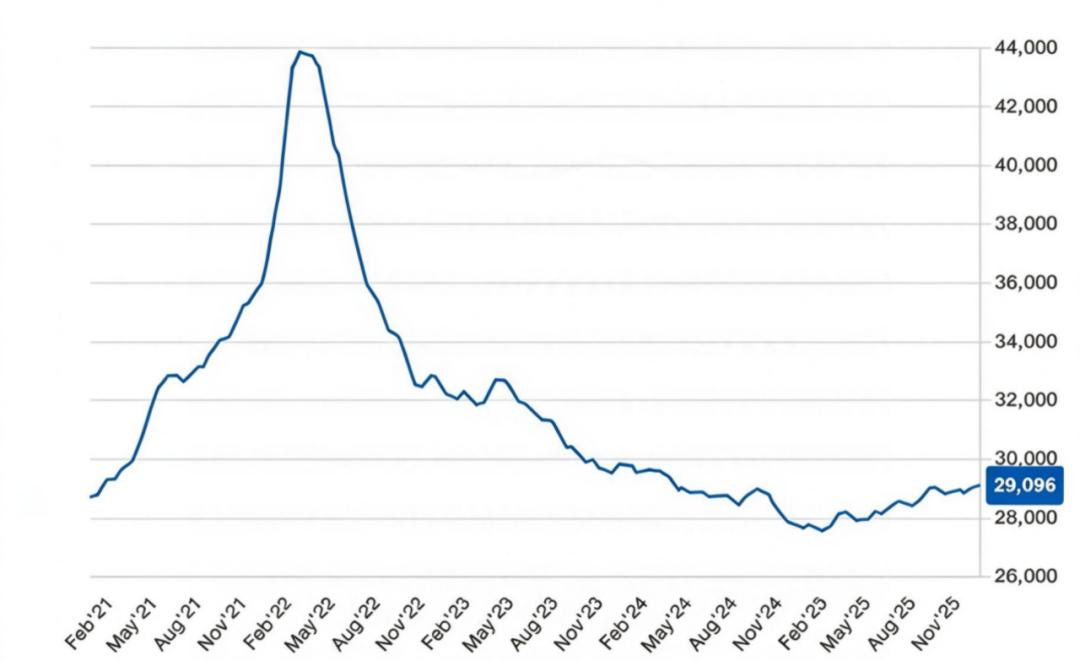
Rolex secondary market price index (denominated in USD), data source: WatchCharts
Second-hand watch dealers no longer sweep the market. Even if they lower their quotations, they still worry that the goods will be unsalable in their hands, so they simply refuse to accept unpopular models directly, and are extremely cautious in selecting goods.
The miserable situation of mahogany furniture is also obvious to all. On social platforms, some people posted that the mahogany furniture they bought for 120,000 yuan when they got married now only sells for 3,000 yuan in the second-hand market, and the recycling price is less than one-tenth of the original price.
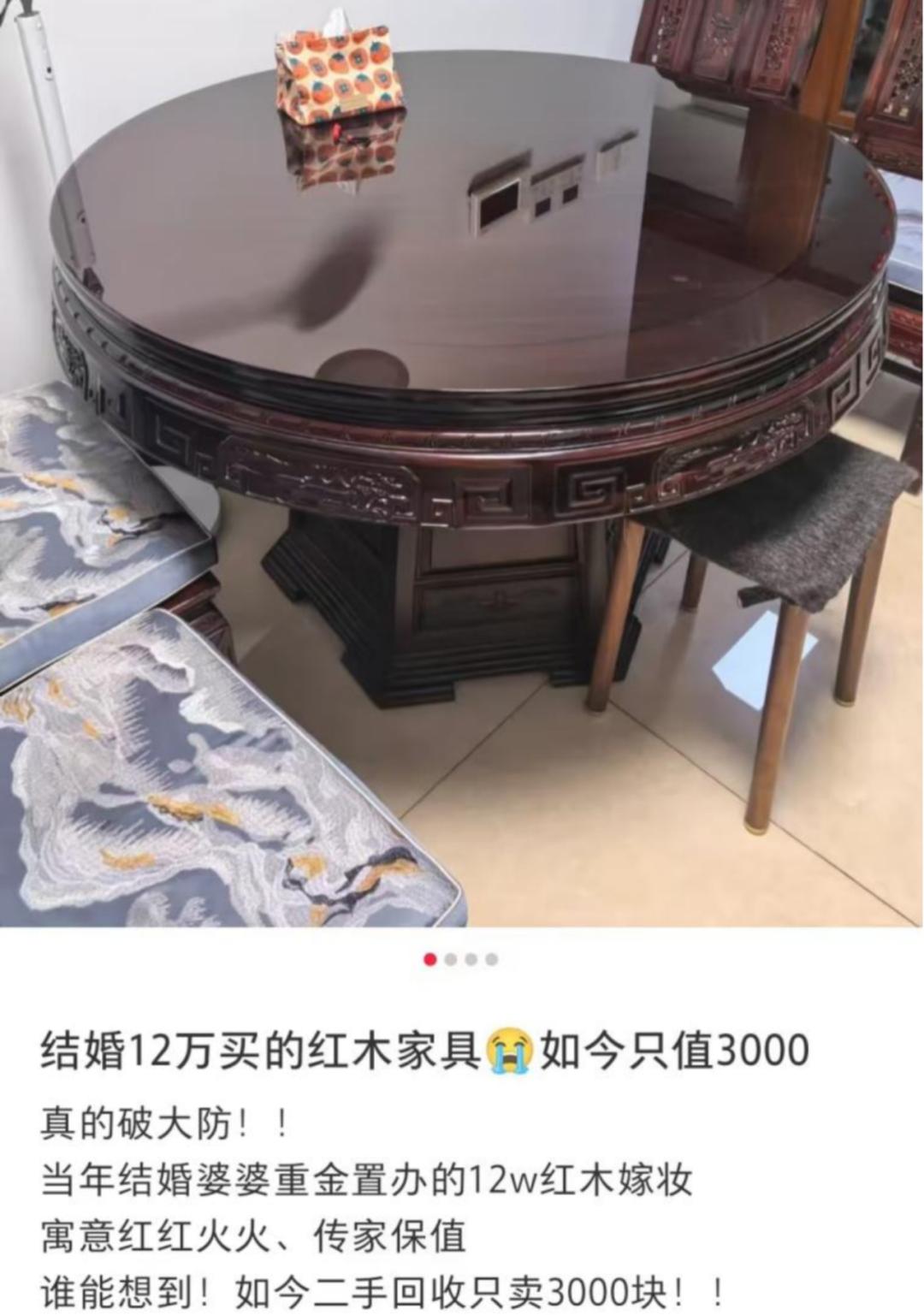
The mahogany furniture bought for 120,000 yuan is only sold for 3,000 yuan in second-hand recycling, image source: Xiaohongshu
The starting bid for a Dalbergia cochinchinensis sofa was 240,000 yuan, and after multiple rounds of price reduction to 102,000 yuan, it still failed to be sold; the 1+2+3 sofa made of Burmese rosewood sold for more than 100,000 yuan at its most expensive time, but now it can only be sold for 40,000 yuan; the price of ordinary new material small-leaved red sandalwood furniture has also dropped by 30%.
Not to mention high-end Baijiu. Taking bulk Feitian Moutai as an example, its ex-factory price has been falling from the peak of 3170 yuan in 2021. It was still around 2700 yuan in early 2024, broke through the 1499-yuan guidance price at the end of 2025, and now falls in the range of 1545-1550 yuan, with the group purchase price on some e-commerce platforms as low as 1399 yuan. Even if the price drops to the bottom, the goods still can't be sold. Moutai's 2025 liquor inventory soared to 340,000 tons, with a value of 61.427 billion yuan, and the inventory turnover days extended to 1399.15 days.
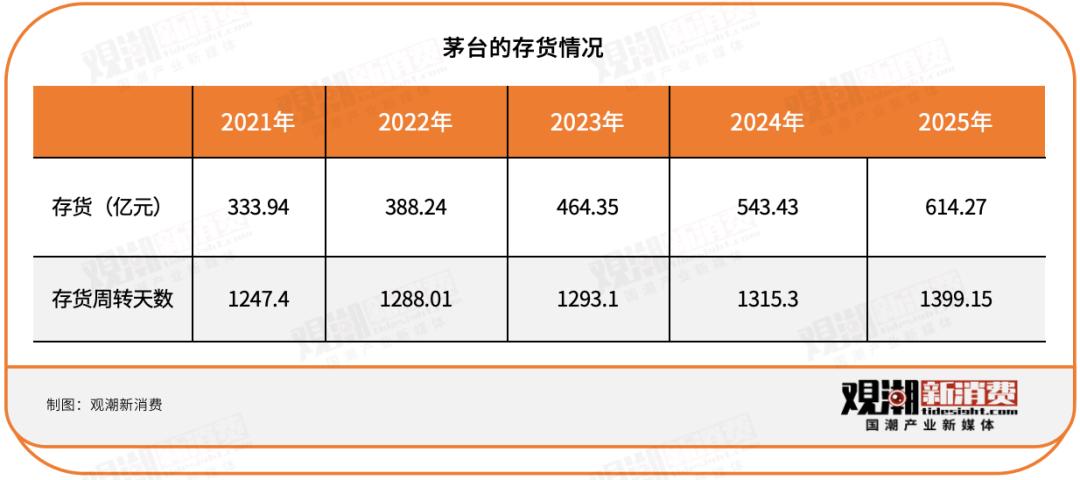
Moutai's inventory status
Antique calligraphy and paintings and aged Pu'er tea are difficult to form a stable and fair second-hand pricing due to problems such as high threshold of authenticity identification, disputes over appearance and ownership, and their value preservation aura has long faded.
Essentially, old elite assets are intergenerational relay assets. They do not need endogenous returns, but only a steady stream of consensus.
To put it plainly, as long as there are continuous people who recognize them and are willing to pay for the social premium, the price of the goods can be stabilized.
However, the biggest variable at present is that the next generation refuses to take over. They can't understand this set of status language, and are unwilling to bear the high purchase cost and realization risk.
Once the consensus chain breaks, the foam of old elite assets loses its support, the liquidity crisis follows, and the market naturally cools down.
Showing off cars and watches is outdated, new rich people start to show off physical fitness
The core of old elite assets is the value bought to show to others, while the consumption logic of the new generation is to prioritize satisfying themselves. Data from the "2025 Gen Z Emotional Consumption Report" shows that more than 90% of young people value emotional value, and 56.3% of young people are willing to pay for happiness and interests, an increase of 16.2 percentage points compared with 2024. For them, spending money is to seek self-identity inward, rather than please anyone outward, which is also an important reason for the vigorous development of trendy figures and niche interest peripherals in the past two years.
Not only ordinary people are uninterested, but young new rich people who have accumulated wealth through new technologies such as the Internet and new quality production are also not interested in objects for others to watch, and instead bet on health assets that are invisible but continuously act on themselves.
The "Hurun 2026 Best of the Best" report mentions that high-net-worth people with an average age of 36 plan to reduce their annual expenditure on material consumption such as watches and jewelry by 10%, increase service experience consumption by 12%, and their willingness to spend on "health and wellness" has risen to the second place in consumption categories for the first time.
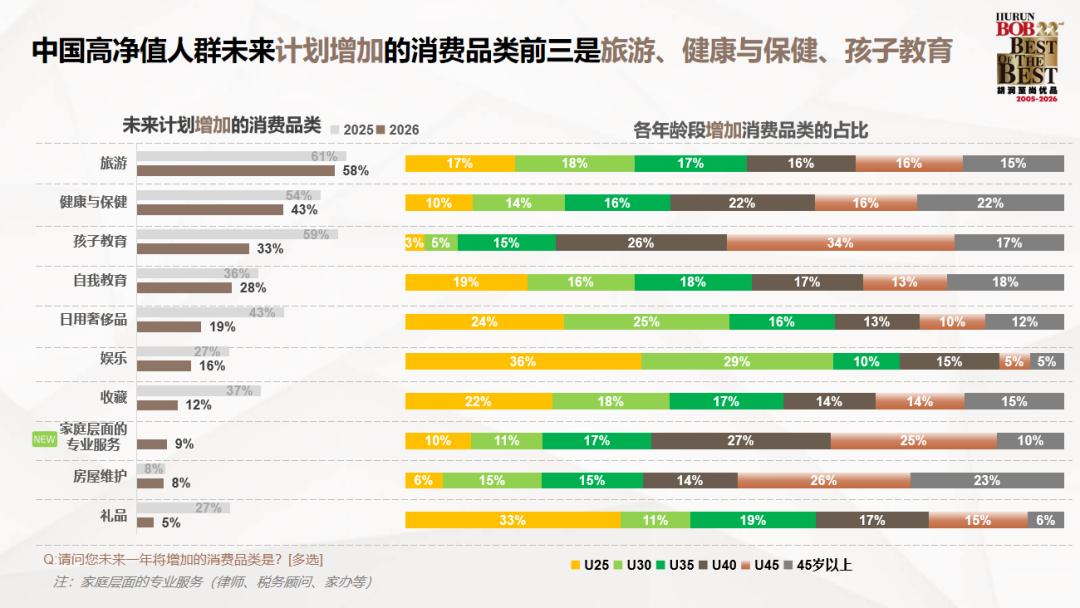
Health and wellness ranks second in consumption willingness, image source: Hurun Report
This trend also accelerates the implementation of the sleep economy and longevity stack from concept to daily practice.
Smart sleep systems, hyperbaric oxygen chambers, hot and cold therapy equipment, and biometric monitoring kits are gradually entering the living rooms of the new rich in a family-oriented form, becoming fixed investments for long-term health management.
Eight Sleep sells its AI mattress with a starting price of 20,000 yuan, and its Pod series has accumulated sales exceeding 500 million US dollars; Rlab, the leading domestic brand, has seen its orders for carbon fiber hyperbaric oxygen chamber series surge 370% year-on-year in the past year, with online consultation volume increasing by more than 350% simultaneously.
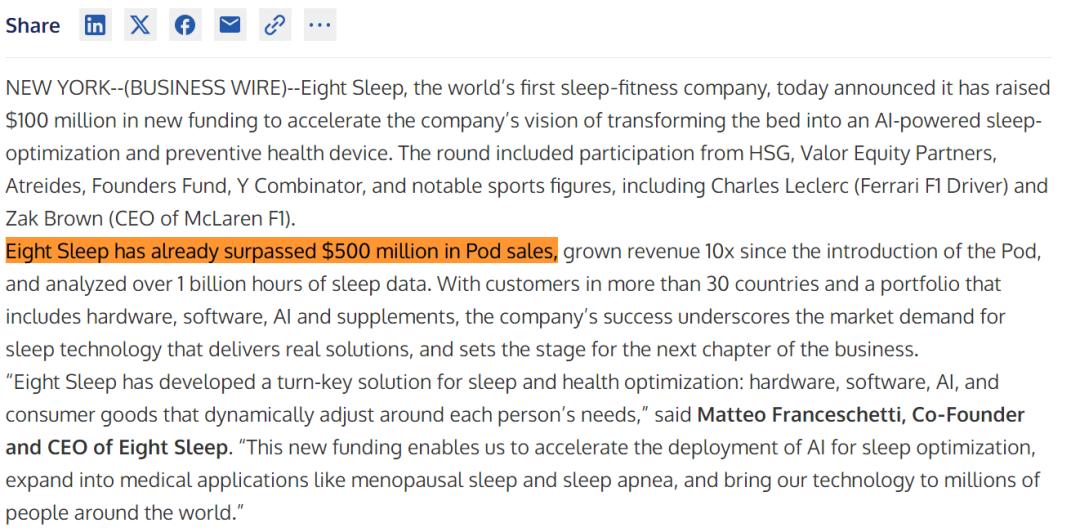
Pod series cumulative sales exceeded 500 million US dollars, image source: businesswire
At the same time, outdoor and extreme sports are also becoming increasingly popular in the new rich circle. Opening social media, there are significantly more young new rich people posting cross-country race certificates, triathlon medals and HYROX event updates.
The registration fee threshold for such events is much higher than that of ordinary road runs: the cross-country race costs about 1,000 yuan, the full-distance triathlon often starts at 3,000 yuan, and a single HYROX event also costs 600 to 700 yuan.
This threshold gathers people who are willing to pay for physical fitness certification into the same circle, and a quantifiable and verifiable physical fitness score has thus become a new proof of identity.
The shift from showing off cars, watches and financial resources to showing off certificates and physical fitness has directly driven the explosion of professional outdoor equipment. Taking running shoes as an example, Saucony, known as the "Rolls-Royce of running shoes", has entered the shoe cabinets of the middle class, and sold 1 billion yuan in China in one year.
HOKA, an outdoor running shoe brand focusing on thick cushioning, recorded a 23.6% year-on-year increase in global sales to 2.233 billion US dollars in fiscal year 2025, and China is regarded by it as the core growth engine of its international business.
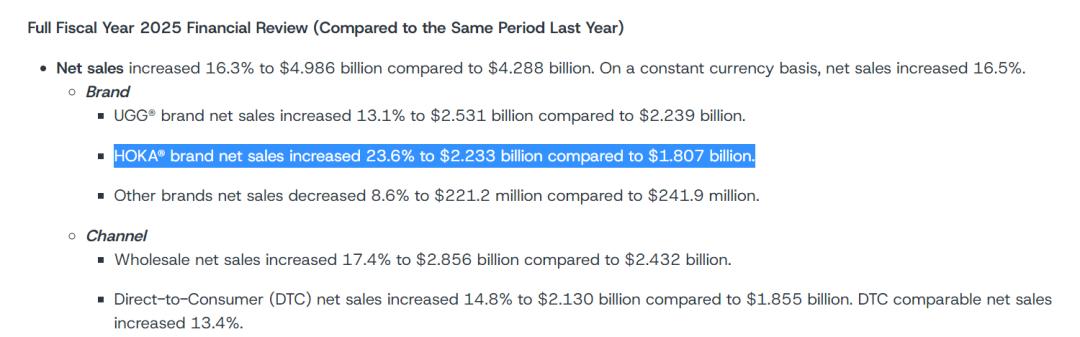
HOKA's sales growth in fiscal year 2025, image source: Deckers FY2025 Performance Briefing
Compared with commodities that naturally have identity symbols such as Baijiu and luxury watches, the physical capital accumulated through sleep care and continuous training is more attractive and more cycle-resistant. Behind the switch of consumption preferences and status symbols is a mild asset risk aversion. Physical collections will depreciate and may be unsalable in the second-hand market at any time, but physical fitness, sleep status and physical foundation are on your own body, cannot be resold, and cannot be shorted, which is obviously safer.
However, the cooling of the old elite asset market is far more than just that this generation of young people do not buy it.
The information gap has been eliminated, and old elite assets can no longer defraud money
The old elite economy can no longer move forward, mostly because the information gap that supported high premiums in the past no longer exists.
In the early days, the market was relatively closed, and merchants held information advantages, repeatedly rendering marketing terms such as scarce unique items, exclusive resources, pure handmade by masters, and overseas origin, packaging vague concepts into high-priced assets that can resist inflation and be inherited.
Now with the developed Internet, traceability materials, identification tutorials, industry analysis and raw material popularization are widely available, and the carefully woven scarcity story can hardly justify itself anymore.
Swiss watches are a typical example. Many people think that "Swiss Made" means fully produced in Switzerland, but its legal definition itself reserves an information gap: as long as 60% of the manufacturing cost occurs in Switzerland, it can be labeled as this, and the remaining 40% of the manufacturing cost can be placed overseas.
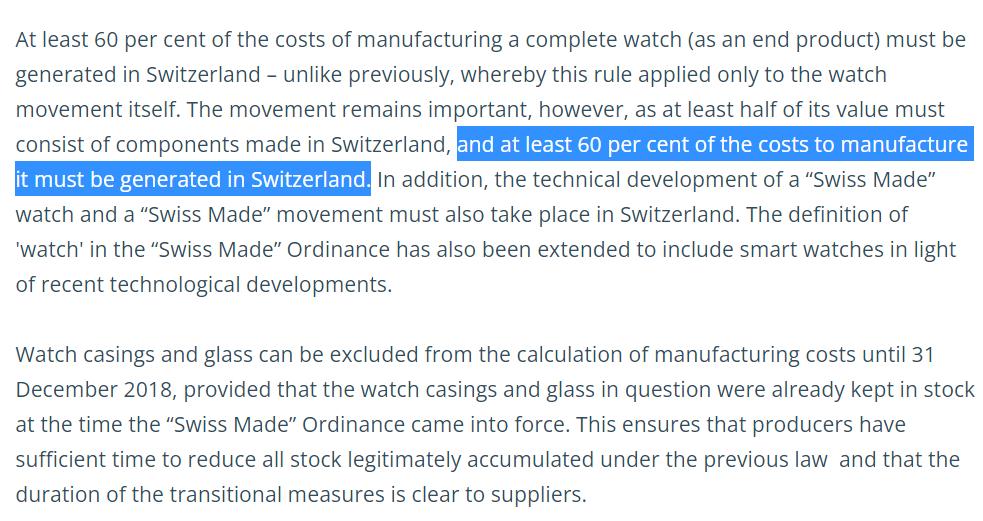
Production cost regulations for Swiss watches, image source: Swiss Federal Institute of Intellectual Property IGE
In China, Shenzhen, Dandong and Dongguan control more than 60% of the global production capacity of mechanical watch movements and spare parts. For many Swiss watches, the case is cut in Shenzhen, the dial is