The mini-game sector sees a dramatic twist: the broader market rises by 30%, while costs have quintupled.
Also in October 2026, the fates of mini-game market participants vary drastically.
The team of Dameng Longtu resumed work ahead of schedule in the middle of the month. Their new title Fire at the Doomsday, launched in August, has entered the top 10 of mini-game revenue rankings in September, and the mobile version is scheduled for public beta on November 6. The conversion cycle for a new product with 100-million-level revenue targeting high ARPU value and long-term operation has been shortened to less than three months.
At the same time, the Zhixin team, which has developed multiple products with monthly revenue exceeding millions in the past two years, is moving out of its office building in Shenzhen.
Due to the sharp rise in user acquisition costs on the SLG track, this "fairly well-known" R&D outsourcing team can no longer meet the needs of top clients. "There is not enough differentiation in themes, gameplay and commercialization, and the iteration speed and vertical specialization are also unsatisfactory." With these regretful comments, the dozen members went separate ways: some submitted resumes to large game companies, some contacted peers in Chengdu, and prepared to transform into mini-game development within the ecosystem of top-tier products.
In the first half of 2026, the revenue growth of China's domestic mini-game market exceeded 35%, but the user acquisition cost of some categories skyrocketed by more than 400%, and the validity period of marketing materials dropped from half a month or 10 days to less than 5 days.
The market is changing rapidly. Some players soar to success, while others are crushed silently.
01. Two-way Growth
Mini-games have completed a rare scale leap in the past 5 years, and entered a fully competitive stage of steady growth.
According to data from the China Game Industry Committee, the revenue of domestic mini-games in the first half of 2026 was about 31.657 billion yuan. The annual scale is estimated to exceed 60 billion yuan, and the growth rate is roughly the same as that of 2025, around 35%.
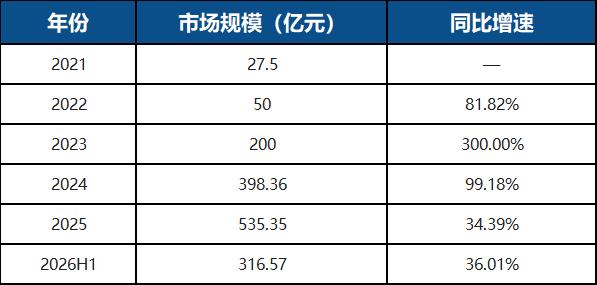
According to more ideal estimates (such as data from Douyin), the MAU of domestic mini-games reached 600 million in 2025, which is expected to catch up with the scale of mobile game users in 2026, and quickly grow into another 100-billion-yuan market.
Better news is that under this steady growth trend, sources from Tencent said that WeChat mini-games are also seeing double growth in DAU and ARPU. In the first half of the year, the overall market revenue increased by 20%, ARPU increased by 25%, and the year-on-year growth of top traffic groups exceeded 60%.
The total volume and depth of the whole market are both improving.
But another fact is that the growth rate of cost and competition intensity is even more rapid here. According to Zhi Huan, who has worked at Tencent Advertising and a top-tier mini-game company in Guangzhou successively, the most fundamental change in the current mini-game market lies in the "source".
On the one hand, taking the WeChat ecosystem as an example, the overlap rate between mini-game users and app game users has approached 60%, which means that the mini-game market has completely bid farewell to the incremental competition of "letting people who seldom play games enter the game with low thresholds in life-oriented applications", and entered the stock period of competing for users with mobile games that have higher quality, larger cash flow and more mature operation.
On the other hand, despite such a high overlap rate, nearly 70% of new users of current mini-game products still come from paid placement, "there is almost no organic traffic and so-called brand loyalty traffic" — if you do not pay for user acquisition, your product can hardly be seen.
This makes the war for traffic and user experience even more brutal.
Combining information from Tencent Advertising, Hot Engine, and AppGrowing data, in 2025, China's domestic mini-game user acquisition market has seen changes with a growth rate far higher than the overall market revenue growth.
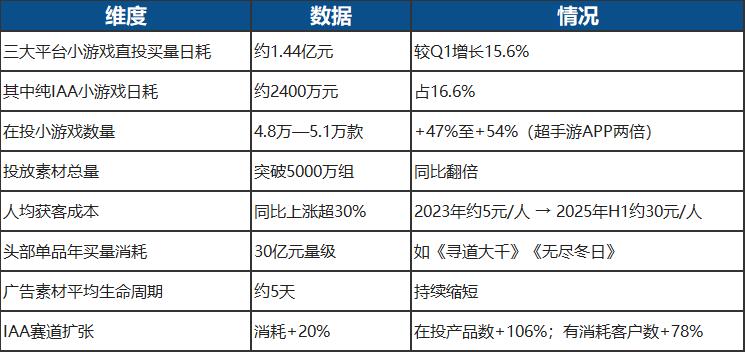
According to data from Ocean Engine, by the end of 2025, the CPM of popular tower defense-like products during the year rose to between 35 yuan and 45 yuan, while the paid conversion CVR was only about 0.5%, which translates to a conversion cost of 416 yuan to 900 yuan per paying user. In the crowded SLG track during the same period, the conversion cost per paying user of some top mobile game products was as high as about 4,000 yuan.
Another background is that the IAA and hybrid monetization revenue commonly used by mini-games depends on the prosperity of the advertising market. In the summer vacation of 2026, CPM pressure once caused a revenue trough for developers; if the macro advertising budget shrinks, the drop of incentive ad eCPM will directly erode monetization efficiency.
At the same time, the average life cycle of a single marketing material is rapidly shortening to less than five days, which means even though the placement is more expensive and the traffic is more "volatile", you still have to buy more traffic. This makes the total amount of in-use materials grow by more than 120% throughout the year. Judging from current AppGrowing data and predictions of many practitioners, there will be a more staggering figure in 2026.
As Zhi Huan put it, "The quality of traffic is basically unchanged now. When Tencent and ByteDance together account for nearly 99% of the market share, we have no choice over the commodity (traffic) and its price." Taking a top-tier product he was in charge of at that time as an example, when the monthly revenue in the middle stage of operation reached tens of millions of yuan, after deducting the high user acquisition cost, the real profit margin "can rarely exceed 8%". "AI advertising can offset part of the cost, but most of the time we cannot escape the cycle of profit compression and increased user acquisition investment."
Not to mention small and medium-sized teams, "if the categories are similar, that level of placement can hardly get any exposure in our massive marketing bombardment."
02. New "Must-dos"
By the end of 2026, the worse living environment has put forward new survival rules for all participants. Lin Fan from Eagame refers to these requirements as "things that must be discovered and complied with".
First, pursue more diversified layouts. Specifically, due to users' habit of using multiple accounts at the same time, manufacturers need to transform to multi-terminal and multi-channel operations.
Taking a top-tier WeChat mini-game as an example, the most obvious change in the first half of 2026 is low opening frequency but long game duration. "The time of mature mini-game users has shifted from starting a single product in fragmented time to playing multiple products for a long time", which is very similar to the situation of mobile games.
At the same time, according to Hot Engine data, among the top 20 new games by revenue in 2025, 22.9% of the revenue was contributed by the corresponding mini-game versions, but only 35% of the top new games launched the mini-game version synchronously — multi-terminal distribution is required by both users and enterprises.
Even within the mini-game ecosystem, there are new successful cases of occupying positions in traffic channels other than WeChat and Douyin: for example, Kuaishou's mini-game revenue sharing was nearly 100 million yuan in 2025, which is regarded by some practitioners as a high-quality test site for running IAA products; the Hongmeng ecosystem of Huawei and its accompanying support program must be participated in; vivo also announced at its developer conference that the average reservation number of new mini-games on its platform has increased by more than 114%.
Multi-line operations is the general trend.
Second, iterate categories, and use more complex combinations to pursue innovation and differentiation.
An obvious change is that although the turnover rate of the bestseller lists for mini-games in the WeChat and Douyin ecosystems has declined in 2026, for example, there is only one new product in the top 50 of WeChat mini-games in September, a large number of innovative products with combined gameplay continue to emerge in the 50-100 ranking range.
Most of these products choose one element that has been verified by the market among the three elements of theme, gameplay and commercial structure, and combine and match it with the other two completely different elements.
For example, in the 1v1 asynchronous competition category, after City Occupation Master, there comes Wenhao's Animal Link and Elite Legion. Their core gameplay is similar, but the themes, commercialization models and channel choices are different.
In addition, among the female-oriented products that were named by WeChat Mini-Games at the end of October as "having an exposure ratio of 60% within the year", gameplay of "growing flowers", casual AVG and even SLG, paired with themes such as urban life, workplace, palace fighting and pan-two-dimensional, as well as multiple monetization modes such as IAA and IAP, have squeezed into the mid-tier market.
The team of The Arrow Can Turn, Changsha Zhise, believes that under this trend, manufacturers need to completely change the traditional logic of fast short-term development for mini-games, and shift to refined operation. After accurately identifying the user characteristics of different channels, they need to quickly and targeted polish the product experience and commercialization rhythm, and balance retention and LTV growth.
This is also related to the third point — the transformation of commercialization goals.
According to data from the China Game Industry Committee, in the first half of 2026, the in-app purchase revenue of mini-games reached 21.137 billion yuan, a year-on-year increase of 38.12%, which is faster than the 31.94% growth of ad monetization revenue. Compared with the fact that the proportion of in-app purchases was less than 40% in 2022, the structure has completely reversed in three years.
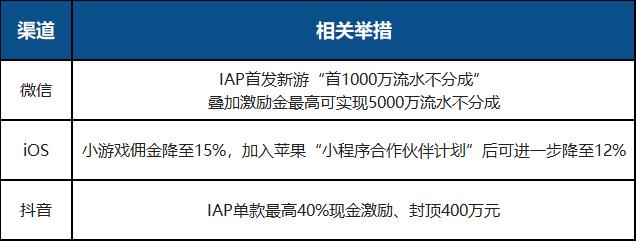
With the implementation of incentive policies from multiple channels such as WeChat, Apple and Douyin, in the longer term, focusing on tapping the depth of ARPU will become a must for more teams.
Under this goal orientation, Zhise has extended its user observation cycle to 60 and 90 days. It customizes multiple versions of materials in the early stage to test the effect, and regularly checks the changes of longer-term retention, game duration, IPU and penetration rate, to lock more nodes of user habit changes and data attenuation, dynamically adjust the supply of a certain type of content for a certain type of user demand, so as to tap the monetization potential of different types of users.
For example, if data monitoring shows that some players have the characteristics of slow rhythm and long thinking time, it generally means that such users have stronger willingness to contribute to IPU. The team will specially adjust the observation duration for such users, reasonably increase the difficulty of levels. After optimization, the stable IPU increased by about 25%, retention increased by 2%, and game duration increased by nearly 5%.
Finally, it is still about user acquisition, but we need to be more brave to try new things, such as AI.
According to DataEye data, in the first half of 2026, the daily user acquisition consumption of the three major mini-game platforms WeChat, Douyin and Kuaishou was about 179 million yuan, a year-on-year increase of 26%. What is more worth recording than the total volume is the change of material production methods: the proportion of AI-generated materials has reached 46%, almost the same as conventional video materials (about 48%), and real-person shooting only accounts for 6%.
The current industry consensus is "AI generation + manual fine-tuning" — pure AI materials without optimization will instead push up traffic costs, because users have formed the ability to recognize AI content.
At the same time, the analysis and positioning capabilities brought by AI technology enable the placement strategy to be further layered and refined. During the year, the consumption proportion of ROI bidding for first-day payment has exceeded 65%, and the ROI of top products using RTA real-time targeting can be increased by more than 30%. In the same period, the consumption of WeChat's intelligent placement increased by about 140% year-on-year, and its share rose to 55%. User acquisition has shifted from "manually stacking budgets" to "algorithm-driven gameplay". The placement threshold for small and medium-sized teams has been systematically lowered, and at the same time, the industrialization capability of materials may become a new watershed.
03. There is Still Room for Development
On the last day of October, Alay, who just left the WeChat mini-game R&D team, has already found an apartment in Chengdu, preparing to try "another route".
This time, the goal of this group of "nomads" is to avoid markets like Shenzhen, WeChat and Douyin, and move to Chengdu and "low-cost battlefields" such as Peacekeeping Elite, to develop gameplay & maps within the mature product ecosystem, just like the team of Daixiaofan.
In November a year ago, the team's work Pill Cultivation in Peacekeeping Elite's "Oasis Genesis" achieved a monthly revenue of over 20 million yuan. According to the revenue sharing rule of Peacekeeping Elite at that time (20% sharing for revenue exceeding 5 million yuan), the monthly revenue of this "map" is likely to exceed 100 million yuan. Here, the art and engine assets are all ready-made, and the user acquisition cost is zero.
Backing on the flagship long-running games of giants and becoming a community of interests with the giants is also a viable path.
Also in the second half of the year, Fanzi and Zhi Huan, who are still taking the industry test in large companies, also have new paths to choose from.
In 2026, the scenario complementary model of "manhua drama + mini-game" has become a new way to acquire users and improve retention. The main content of manhua drama is responsible for user acquisition and extending usage duration, while mini-games undertake the interactive depth and ad monetization. By the end of the year, Tencent Huolong Manhua has built a "otome universe" matrix, and launched 13 gamified manhua dramas intensively; ByteDance's ecosystem also entered the market with an "interactive space square".
With more large companies entering the market and the first appearance of the "interactive drama" category in the filing announcement at the end of September, mini-games are likely to find a longer-term and effective incremental method, or another derivative form.
Before the overall market grows into a real 100-billion-yuan market, people who do not want to quit have a place to take shelter, and can explore while being pushed forward by the industry rules. This industry is still full of charm.