122 Days, Team Size More Than Doubled, Behind the Scenes of Nike's First Local Original Collection | Exclusive Interview
For a long time, the most widely praised "localization" of Nike in China was almost exclusively reflected in its advertisements.
On August 18, 2008, Liu Xiang withdrew from the competition at the National Stadium (Bird's Nest) due to injury. The next day, Nike published a new advertisement in newspapers: "Love sports, even if it breaks your heart." During the 2020 Spring Festival, Wieden+Kennedy Shanghai shot a short film for Nike: an aunt and her niece pushed and shoved over a red envelope, turning the casual tussle in the living room all the way into a physical showdown. People remembered the Chinese-style human relationships depicted in the advertisement, but few could recall which specific apparel Nike was selling in China back then.
Last month, the sportswear giant launched its first collection designed entirely by local teams in China, as a response to external doubts about the company's innovation speed and capability.
"The Chinese market is a place that continuously inspires new ideas and product creation. The unique characteristics of Chinese consumers present a great opportunity for Nike to further invest in local consumer insights," Flavia Cervantes, Vice President of Local Product Creation for Nike Greater China, who is in charge of this collection, told 36Kr.
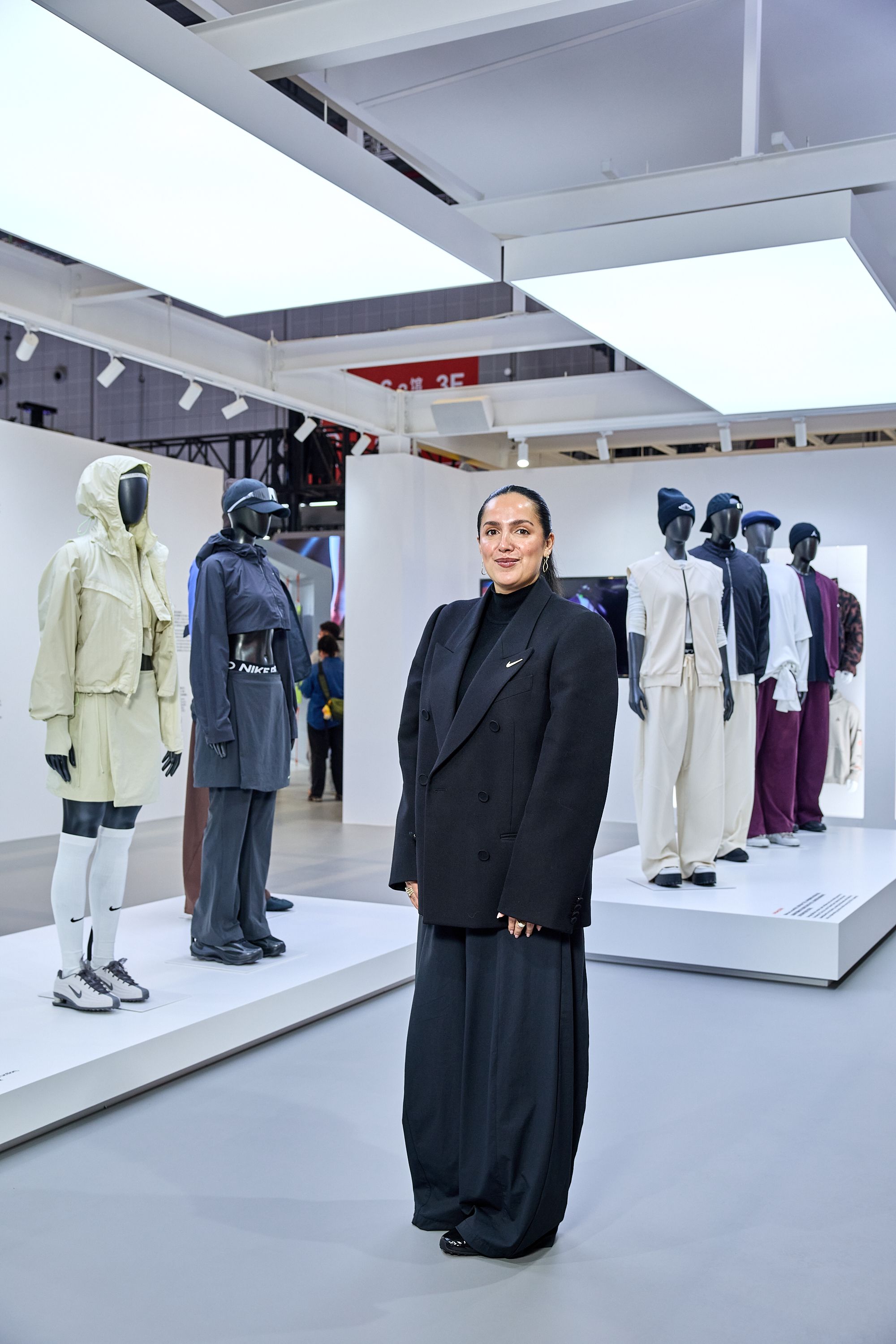
Flavia Cervantes, Vice President of Local Product Creation for Nike Greater China
Before joining Nike, Cervantes worked in luxury fashion and lifestyle brands for about a decade. At Nike, she first served in the global product innovation team, and later joined Express Lane, the local product team for the Europe, Middle East and Africa (EMEA) region.
The history of this team dates back to around 2017: Nike rolled out the "Consumer Direct Offense" strategy, and successively set up Express Lane in North America, Western Europe and China, with the mission to "quickly create, update and deliver products in response to consumer demands", aiming to cut the product development cycle in half.
2017 was also the peak of sneaker culture, when Nike almost dominated the market, and its "The Ten" collaboration with Off-White was released that very year. Retro releases and co-branded products were selling hot all over the world, and Express Lane focused more on "updates": replacing materials and colorways on existing shoe silhouettes to drive sell-outs. The Shanghai-based Express Lane also needed to serve Shanghai, Seoul and Tokyo at the same time, acting more like a rapid response center for East Asia rather than a team dedicated to designing products exclusively for China. In those years, most of Nike's "China-exclusive" products were limited Spring Festival editions with red-gold colorways and embroidery, rarely making changes to the silhouettes themselves.
But according to Cervantes, everything is different from the past now.
"We are investing a lot of resources to expand the team," Cervantes said, the size of the team has "more than doubled". A more significant change lies in its functions: the team has added capabilities and positions that did not exist before, and all processes from material and fabric selection to silhouette design and product line construction are completed in Shanghai.
The speed has also improved. According to The Wall Street Journal, it usually takes about 18 months for a new Nike product to go from development to market, and the development cycle for some footwear categories is even longer. But the first local original collection only took 122 days, which Cervantes said is "very likely the fastest collection in Nike's history". As for the pace in the future, she declined to give spoilers, only saying that the number of collections to be launched in a year will be "more than three".
The first collection is divided into two lines, the Nike Manifold series and the Jordan Rise series, consisting of apparel only. The designs are dominated by solid colors, speaking through silhouettes, tailoring and layering, far more restrained than Nike's previous products with Chinese elements: a set of detachable and stackable skirt-pants can be worn in three different ways; some outerwear adopts a three-in-one design to adapt to seasonal transitions and different occasions. The team also developed five new fabrics specifically for the Chinese market.
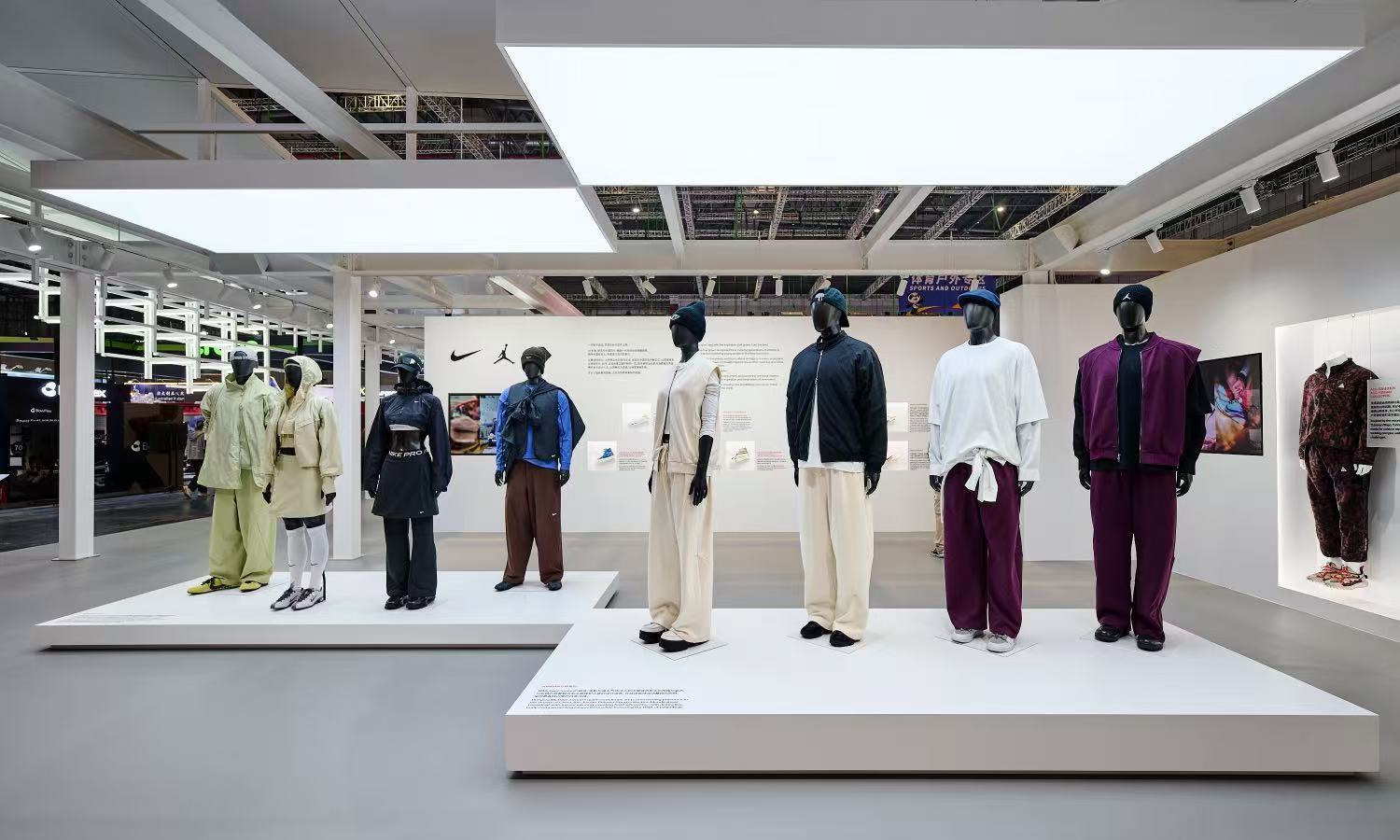
Nike showcased its first season of local original collection at this year's China International Import Expo | Source: the brand
The first batch of products leans towards the lifestyle category, which is exactly the segment in athletic footwear and apparel that is most driven by trends and most vulnerable to falling into discount promotions. Cervantes said that the subsequent expansion will cover professional sports scenarios, achieve unified design "from head to toe", and footwear products will also be included.
"When we talk about launching new products quickly, we are not chasing trends, nor are we pursuing speed for speed's sake." In Cervantes' view, catching up with trends is only the first step. Continuously delivering good products and making young people "come back to us again and again" is Nike's real goal. To this end, the team is also exploring what the "consistency" of products belonging to the Chinese market should be.
The so-called consistency means that consumers can recognize your brand before even seeing the logo. In 1982, the Air Force 1 designed by Bruce Kilgore was launched as a basketball shoe, which was supposed to be discontinued after one or two seasons as usual; three retailers in Baltimore kept restocking Nike for this pair of shoes, so it returned to the shelves in 1984. In the following 40 years, Nike barely modified its shoe silhouette, only changing colorways and launching co-branded collaborations year after year, turning the plain white AF1 into a street staple.
In 1987, inspired by the exposed structure of the Centre Pompidou in Paris, Tinker Hatfield, who graduated with an architecture major, opened a window on the midsole of Air Max 1 to make the air cushion "visible"; in the subsequent generations of updates to the Air Max family, that window has always remained. These shoes did not chase trends, but in the end, trends always circled back to them.
And the initial vitality of classics often comes from the place closest to consumers. The reason why AF1 could return to shelves back then was not the judgment of the headquarters, but the demand from the streets of Baltimore. Cervantes' team also wants to start from this point: the hobbies of team members themselves form a material library, some colleagues join cross-country running and hiking groups, many are runners themselves, and some are artists and creators. She has been in China for two months, and is deeply impressed by the professional level of consumers on Xiaohongshu when they disassemble products and discuss details.
"What we really want to achieve is to see our own products being examined and presented in this way: they can solve problems, are well-matched, and carry the kind of innovation that only Nike can offer."
The first batch of original collections was sold in limited quantities only at some offline stores. When asked whether there will be exclusive stores similar to ACG, Cervantes said that the local original collection will be an important part of Nike's new retail concept, and did not disclose the online distribution arrangements.
However, as we learned, Nike will focus on offline channels for a long time in the future, with the goal of reshaping the premium image of the brand. From January 1, 2027, the Nike online stores operated by Topsports and Pou Sheng on e-commerce platforms will also cease operations.
"But what we want most is this face-to-face experience, so that consumers can see with their own eyes and feel with their own hands what different things we have done," Cervantes concluded.