It has just been revealed that OpenAI has closed a $11 billion funding round, and its CFO stated that the company will continue to build data centers.
Has OpenAI's much-touted financing finally reached a phased milestone?
Just now, Bloomberg cited people familiar with the matter as saying that OpenAI has completed the first close of its new round of financing, with a scale of about 11 billion US dollars, and the corresponding company valuation for this round of financing is 1.25 trillion US dollars.
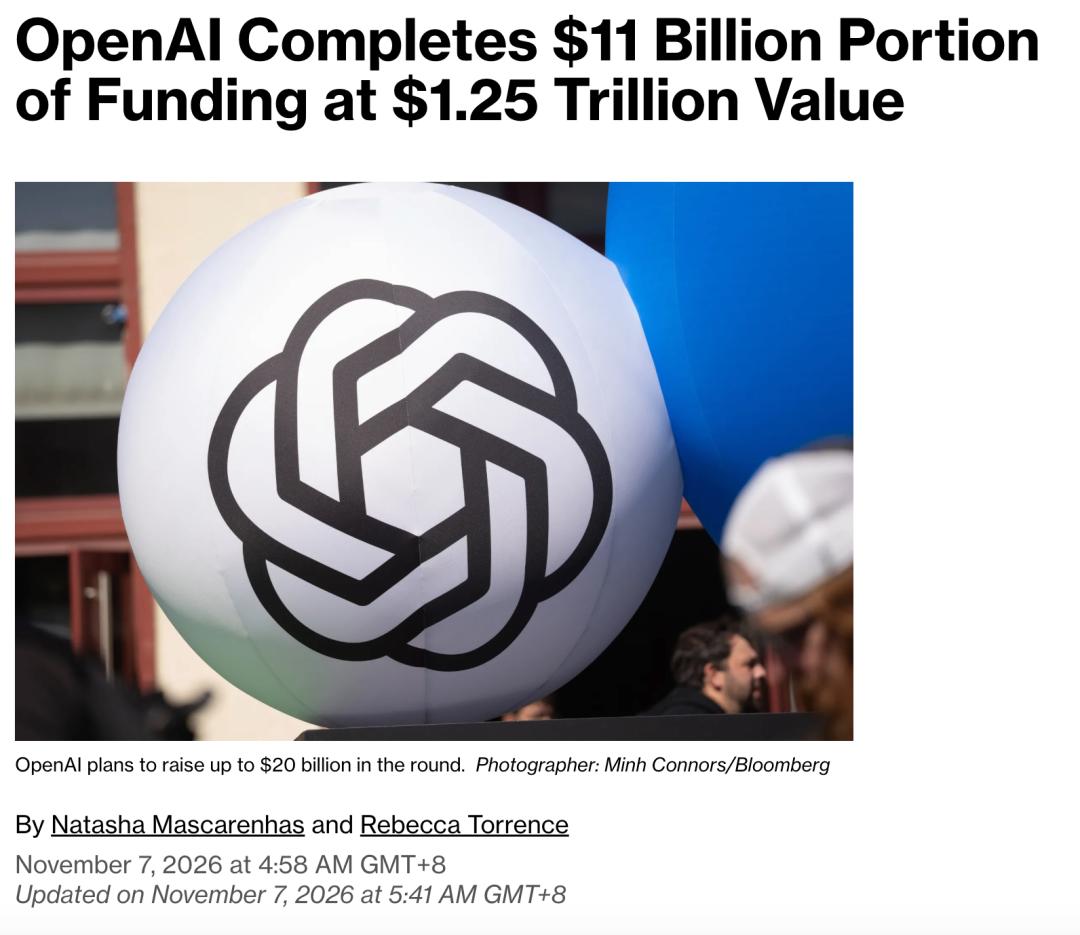
Bloomberg disclosed that the funds were transferred to the company on Friday, and the remaining part is expected to be completed in the coming weeks, when the total amount of the whole round of financing may reach 20 billion US dollars. OpenAI declined to comment. That is to say, 11 billion US dollars is the part that has been reportedly completed, while 20 billion US dollars is still the total possible scale.
At the end of September, foreign media reported that OpenAI hoped to raise at least 30 billion US dollars, seeking a pre-money valuation of about 1.4 trillion US dollars. This sum is regarded as a transitional financing after the postponement of its IPO, which will continue to provide financial support for the company before it goes public.
By the end of October, the Financial Times reported that OpenAI had cut its financing target by about 10 billion US dollars to around 20 billion US dollars, and the target valuation also dropped from 1.4 trillion US dollars to 1.25 trillion US dollars. Reuters quoted sources as saying that some investors had reduced their planned investment amount, and the first close was not expected to reach the adjusted 20 billion US dollar target at one time.
The 11 billion US dollars that has been implemented this time is of course a huge sum of money, but there is still a considerable gap from the scale originally envisioned by OpenAI. At the same time, the financing is still in progress, and the amount of the first close cannot be directly taken as the final result of the whole round of financing.
Participants are also gradually emerging. Bloomberg's latest report mentioned that Coatue and T. Rowe Price participated in the first close; other investors in this round include SoftBank, HSG, Founders Fund and Andreessen Horowitz, and a consortium composed of UAE investors has also joined. OpenAI is also working with investment banks to raise funds from high-net-worth individuals and retail investors.
With the downward adjustment of this round of fundraising target, the focus of the market has naturally fallen on a more practical question: where will the money to support these figures be earned back?
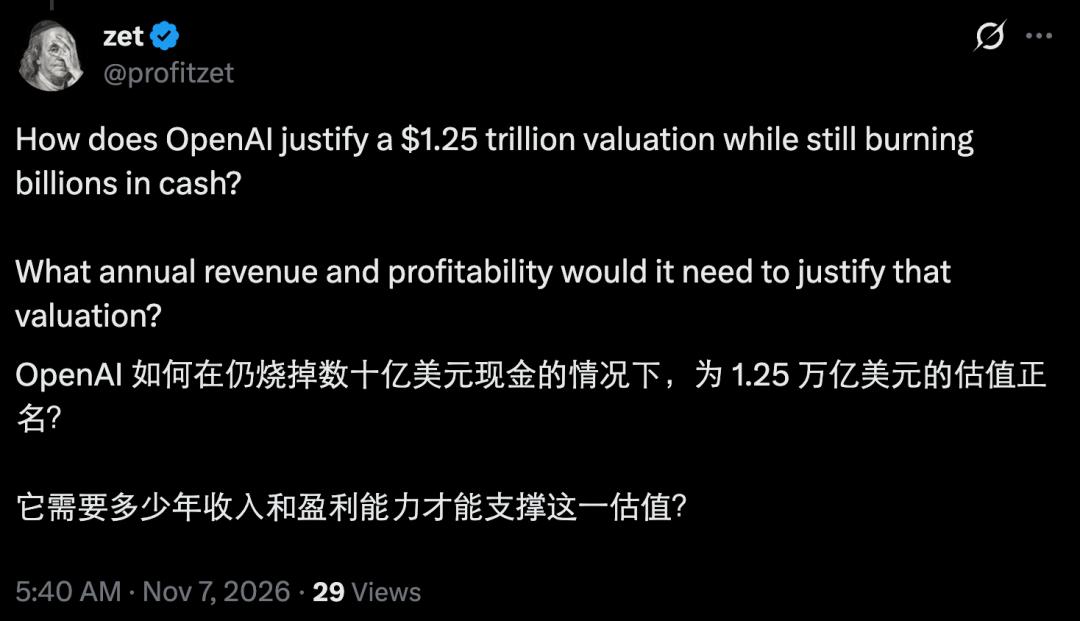
The response given by OpenAI's management is that demand still exists and investment must continue.
On November 6, Sarah Friar, Chief Financial Officer of OpenAI, was interviewed at the Citi TMT Leadership Summit held in California. Talking about the pressure faced by data centers after the US midterm elections, she said that the company still needs to continue investing to meet customer demand; it not only relies on the previously established cooperative relationships with large cloud service providers, but also means that more financing will be carried out in the following period.
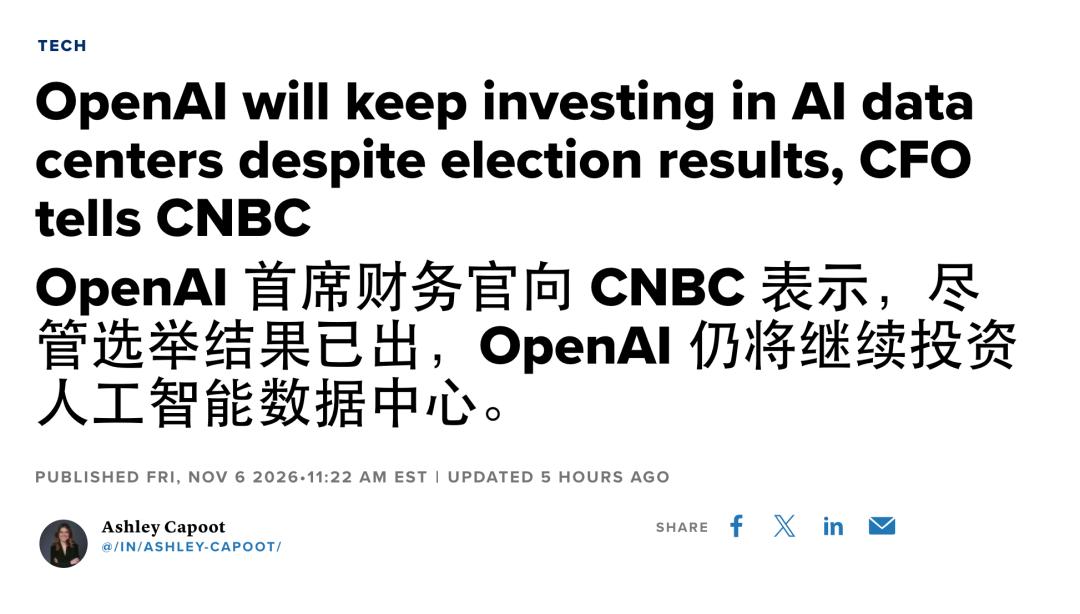
She also said a very CFO-style line: "A good CFO always raises money when they can." She made it clear that this round of financing is still ongoing, and emphasized that AI demand is real.
The background of this statement is that data center construction has become a controversial issue in local politics in the United States.
According to the Ballotpedia analysis cited by CNBC and its supplementary statistics, among the 41 local ballot measures involving 10 states in this midterm election, 40 results tended to restrict data center construction or reject measures supporting development. The concerns of residents are very specific, including rising electricity bills, environmental impacts, and employment pressure brought by AI.
For OpenAI, these controversies are directly related to whether the computing power can be implemented as planned. Financing can support expansion, but data centers ultimately have to be built in specific communities and connected to the local power grid.
On November 5, OpenAI announced a series of commitments that are planned to apply to data centers owned and operated by the company in the future: covering all costs of power supply, soliciting community opinions, disclosing construction plans, and stopping signing non-disclosure agreements with public officials when discussing future site selection. The company also put forward policy suggestions, hoping to promote similar requirements to become law.
Friar said in the interview that if the election means that the outside world will pay more attention to the relationship between data centers and communities, OpenAI will continue to enter communities and build trust. She does not believe that the election results have fundamentally changed the company's business.
She also revealed that OpenAI is still studying the possibility of going public in 2027. It is reported that the company has secretly submitted its prospectus documents to the U.S. Securities and Exchange Commission in June this year. However, considering an IPO in 2027 does not mean that the listing time has been confirmed.
This makes the current financing progress more noteworthy: under the circumstance that the listing time has not been finalized and infrastructure investment still needs to continue, how much room for maneuver the new capital can bring to OpenAI and whether the follow-up funds can be in place as expected remain to be seen.
Next, the most noteworthy thing to track for this round of financing is whether it can finally reach about 20 billion US dollars, and how the company converts its continuously invested computing power into revenue and profitability that can support a trillion-dollar valuation.
Reference links:
https://www.bloomberg.com/news/articles/2026-11-06/openai-completes-11-billion-portion-of-funding-at-1-25-trillion-value
https://www.cnbc.com/2026/11/06/open-ai-data-centers-election.html
This article is from WeChat Official Account "Synced", published with authorization from 36Kr.