Mango prices have skyrocketed, Li Na
No one expected, "See You Later Friend" would blow up like this.
This friendship variety show launched by Mango TV in October was previously criticized for its guests not being A-list enough before premiere, but by its third week on air, not only were viewers totally hooked, even stock investors started shouting the name "Li Na".
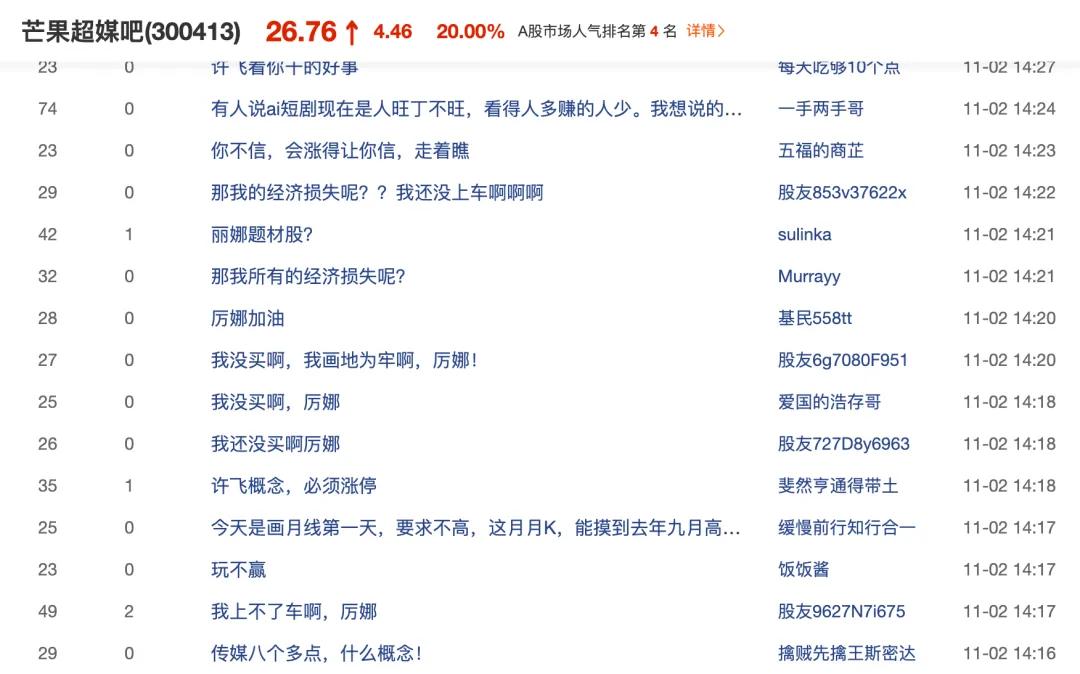
On November 2, Mango Super Media directly hit a 20% limit-up, and continued to rise in the following three trading days. As of the close on November 5, its share price stood at 32.78 yuan, up nearly 50% in four trading days from 22.30 yuan on October 30. It has risen by nearly 50% cumulatively in four trading days.
Investors who missed this market trend simply moved lines from the show into stock forums: "What about all my economic losses? I haven't gotten on the bus yet!" "I didn't buy the stock, I trapped myself here on purpose, Li Na."
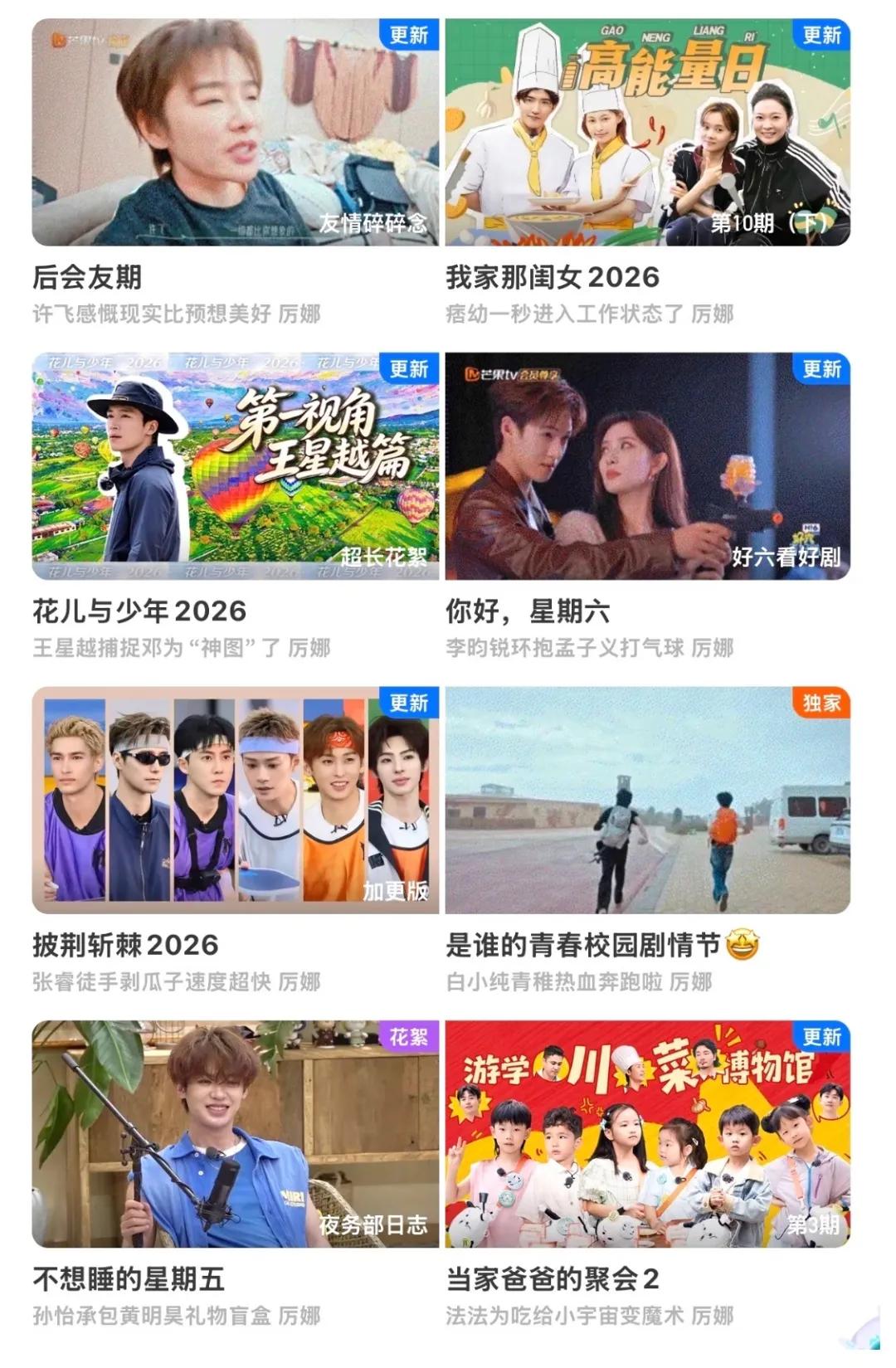
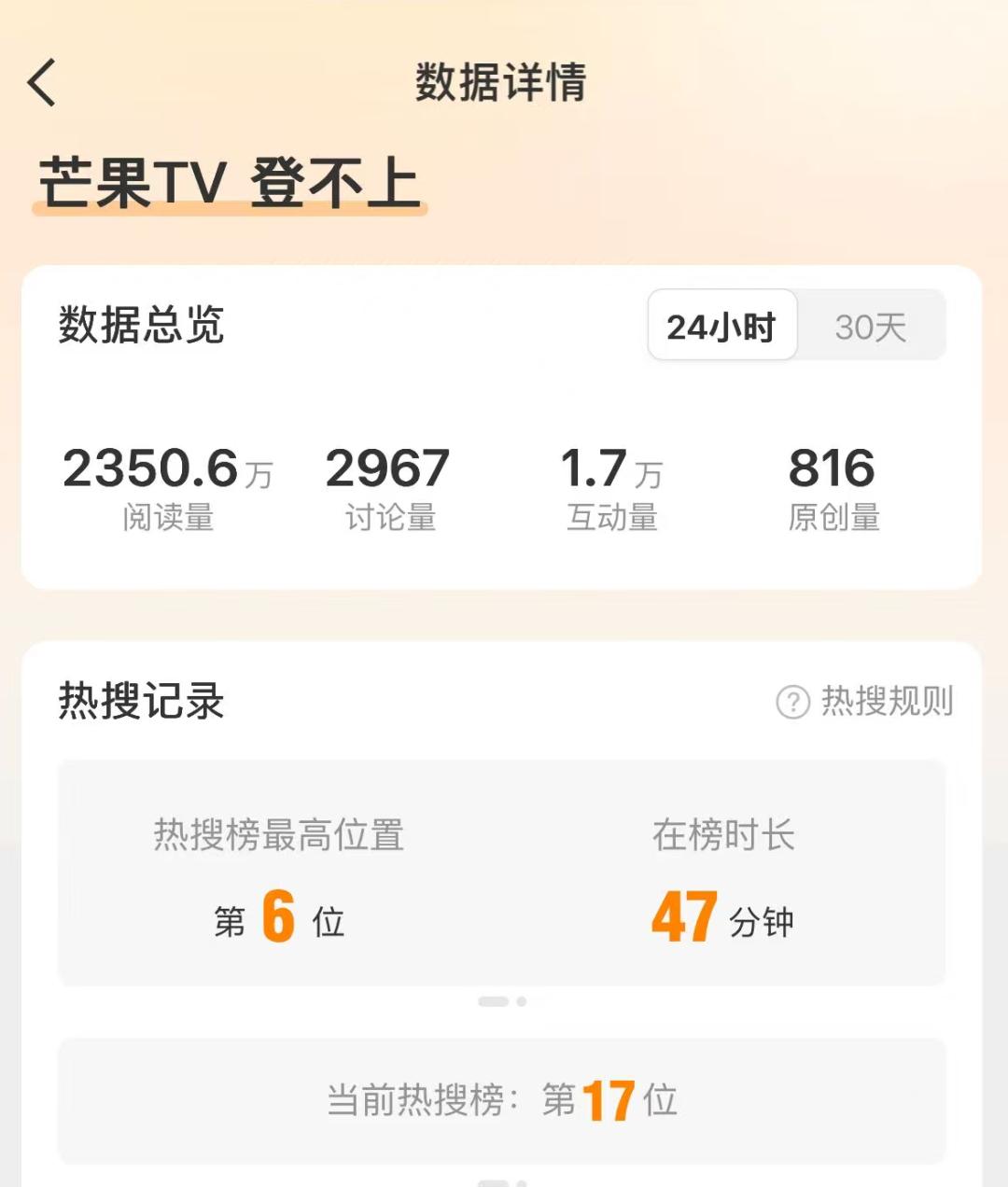
Mango TV itself did not stay idle. Some netizens found that the platform added the two characters "Li Na" behind the introduction of some programs, using it as a punctuation mark. On the day the new episode was launched on November 5, Mango TV also experienced login anomalies, and the topic "Cannot log in to Mango TV" topped Weibo's hot search list.
Audiences are chasing the show, brands are rushing to ride its popularity, investors are eager to get on board, and the platform has also joined this meme carnival. But when you flip through the newly released third-quarter report of Mango Super Media, the atmosphere is not so enthusiastic.
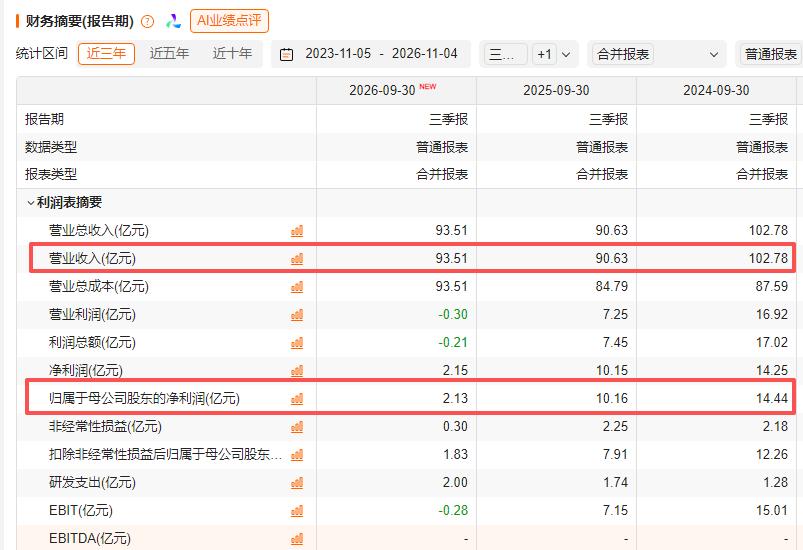
In the first three quarters of 2026, Mango Super Media achieved revenue of 9.351 billion yuan, a year-on-year increase of 3.18%; its attributable net profit dropped from 1.016 billion yuan in the same period of last year to 213 million yuan, a sharp year-on-year drop of 79.01%.
Of course, "See You Later Friend" only premiered in October, so it has not had time to deliver results in the financial report of the first three quarters. The problem is, Mango has no shortage of hit shows this year.
Programs are getting more and more popular, but profits are getting thinner and thinner. Has Mango only made the audience happy, or has it already found a more profitable new way?
From Sisters Who Make Waves to See You Later Friend, Mango has had hits all year round
How popular is "See You Later Friend"?
According to Yunhe Data, on the first day of the show's launch on October 22, the effective playback market share of the full episode reached 34.9%, topping the list of hit new variety shows. After the latest episode (Part 1) was launched on October 29, the figure rose to 74.3%, and even rushed to 77.1% the next day, becoming the first new variety show in 2026 with a market share exceeding 70%. When the new episode was updated on November 5, the influx of traffic even crashed the platform's server.
A more intuitive change happened in people's shopping carts.
In the show, the famous scene where the guest covered their face and cried wrapped in a 999 Ganmaoling blanket went viral wildly. Third-party data shows that the number of viewers in the 999 Ganmaoling Douyin live stream once exceeded 200,000, several times higher than usual. The brand took the opportunity to launch the limited-edition sofa blanket of the same style from the show, priced at 69 yuan after coupons, triggering a buying spree.
Brands that did not directly sponsor the show also got a share of the traffic dividend. Juewei Duck Neck signed Li Na as its "Fresh Promoter"; Yuan's Cloud Dumplings launched a set meal of the same style, and the sales of Douyin group purchases quickly exceeded 70,000 copies; a small NAYUKI cake that flashed across the screen in the show was also sold out in many stores.
Interestingly, this was not a widely favored program before its premiere.
What really made the show break through the circle was the conversation between Li Na and Xu Fei in the cliff cabin. The two were contestants of "Super Girl" in 2006, who used to be close, then parted ways due to misunderstandings. Li Na wanted to clarify the "economic losses" in her career, while Xu Fei kept asking about the "estrangement" on the emotional level.
The two failed to align their knots, which instead gave expressions such as "life-giving literature" and "trapping oneself in a self-made prison" space to be deconstructed and spread. The audience suddenly found that the story of friendship breakdown is more addictive than love disputes.
What is more rare is that this happened when the overall variety show market is under pressure. According to Yunhe Data, in the third quarter of 2026, the effective playback of the top 20 variety shows across the network decreased by 17% year-on-year, and the number of new domestic seasonal variety shows released decreased by 27 year-on-year.
But under such market conditions, Mango still keeps producing hits — "Sisters Who Make Waves 2026" and "Who's the Murderer Season 11" stayed at the top in the first half of the year, and "Viva La Romance 2026" and "The Inn 2026" successively sparked topic heat.
The hit of "See You Later Friend" once again proved to advertisers: The content attention of long videos can still drive consumption.
Mango's ambition goes far beyond variety shows.
Real people talk about emotional knots, AI shoots long dramas
The last time Mango excited the capital market so much this year was because an AI-generated monkey.
On August 31, the AI drama "Later Journey to the West" premiered on Hunan TV and Mango TV. No real actors participated in the work, and all the pictures and character performances were generated by AI. On the premiere day, Mango Super Media hit a 20% limit-up, and hit another limit-up the next day, with a cumulative increase of about 44% in two days, and its market value increased by about 11.65 billion yuan.
Behind the excitement of the capital market, "Later Journey to the West" let the long video industry see a long-awaited thing: Finally, there is a chance to make a long drama without spending so much money.
Cai Huaijun, Chairman of Mango Super Media, revealed that the total cost of "Later Journey to the West" has been reduced to a fraction of that of similar S-level real-person dramas; for the 30-episode full season with 40 minutes per episode, compared with traditional 3D animation, the cycle from planning to launch has been compressed by 70%.
The commercialization of "Later Journey to the West" was also quickly realized. According to the disclosure of brokerage research reports, The total network-wide spread volume of the drama exceeded 4 billion times, it was on the hot search list more than 300 times, and it obtained exclusive naming from Xiuzheng Pharmaceutical and advertising cooperation such as Dinggui Umbilical Plaster. Characters such as Sun Xiaosheng have also been developed into plush peripherals and put on sale one after another.
Cai Huaijun also revealed that this drama brought a group of new users to the platform, and the performance of attracting new users, especially male users, exceeded expectations.
This benefits from Mango's long-term technical accumulation. Mango set up its AI team in 2019, established the "AIGC Innovative Content Center" in the first half of 2026, and launched a dedicated channel. The self-developed "Mango Lingchuang" platform has integrated more than 40 models, supporting more than 3900 business projects.
In addition to AI long dramas, Mango's micro-short dramas are also exploding. The 2026 interim report shows that in the first half of the year, the "Big Mango Project" launched 2647 micro-short dramas, a year-on-year increase of 124.51%; The average daily active users of the short drama channel increased by 104% year-on-year.
"See You Later Friend" and "Later Journey to the West" seem to have different production directions, but they point to the same thing: It is necessary to not only make hits, but also find cheaper ways to make hits.
However, the excitement on the program list ultimately has to be reflected by profits.
There is no shortage of hits, but membership revenue has decreased by more than 500 million yuan
Mango's programs are really lively this year, but its operation is not easy.
In the first three quarters of 2026, Mango Super Media's revenue was 9.351 billion yuan, a year-on-year increase of 3.18%; its attributable net profit dropped from 1.016 billion yuan in the same period of last year to 213 million yuan, a decrease of nearly 80%.
Revenue increased by nearly 300 million yuan, but profit decreased by 800 million yuan.
Where exactly did the lost profits go? The first is membership business. In the first half of 2026, Mango TV's membership revenue was 1.933 billion yuan, 563 million yuan less than 2.496 billion yuan in the same period of last year.
Although advertising revenue (1.684 billion yuan) increased by 6.11% year-on-year, operator business (845 million yuan) increased by about 5.6%; overseas business daily active users increased by 123%, it still cannot fill the gap left by the membership business, resulting in a year-on-year decrease of 8.61% in the total revenue of the internet video business in the first half of the year.
Then, why can the group's total revenue grow while video revenue decreases? The answer lies in e-commerce.
In the first half of the year, Mango's content e-commerce business revenue was about 1.1 billion yuan, a year-on-year increase of 146.35%, an increase of about 650 million yuan over the same period of last year.
In comparison, the group's total revenue only increased by about 230 million yuan in the same period. In other words, the extra revenue on Mango's books is largely supported by e-commerce.
However, the e-commerce business has "thin profit". In the first half of the year, the gross profit margin of the content e-commerce business was only 6.16%, far lower than the 23.54% of the internet video business. Moreover, the gross profit margin of e-commerce has dropped sharply by 12.42 percentage points year-on-year, falling into the awkward situation of "revenue increased by an additional 650 million yuan, but gross profit earned more than 10 million yuan less".
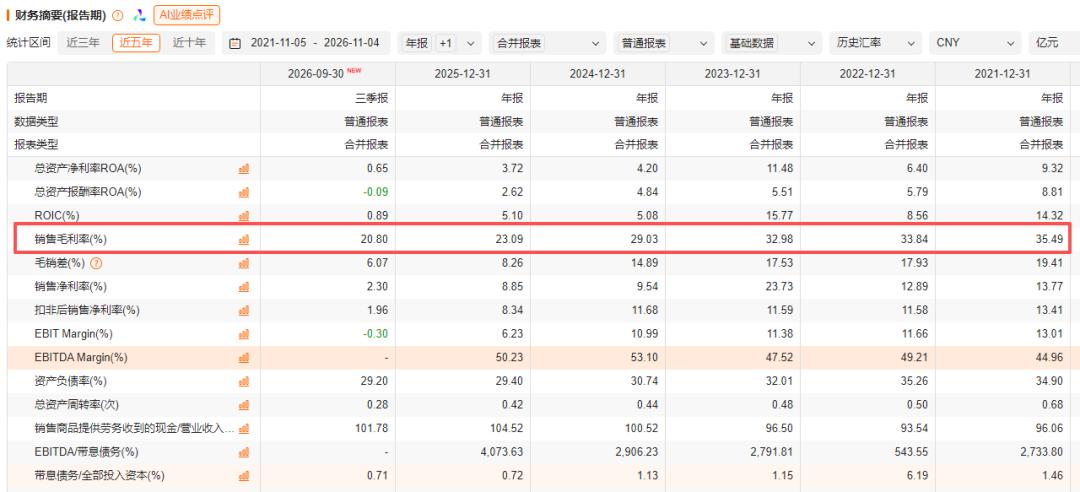
The double drag of video and e-commerce has led to continued pressure on the company's comprehensive gross profit margin: it dropped from 35.49% in 2021 to 23.09% in 2025, and further fell to about 20.8% in the first three quarters of this year.
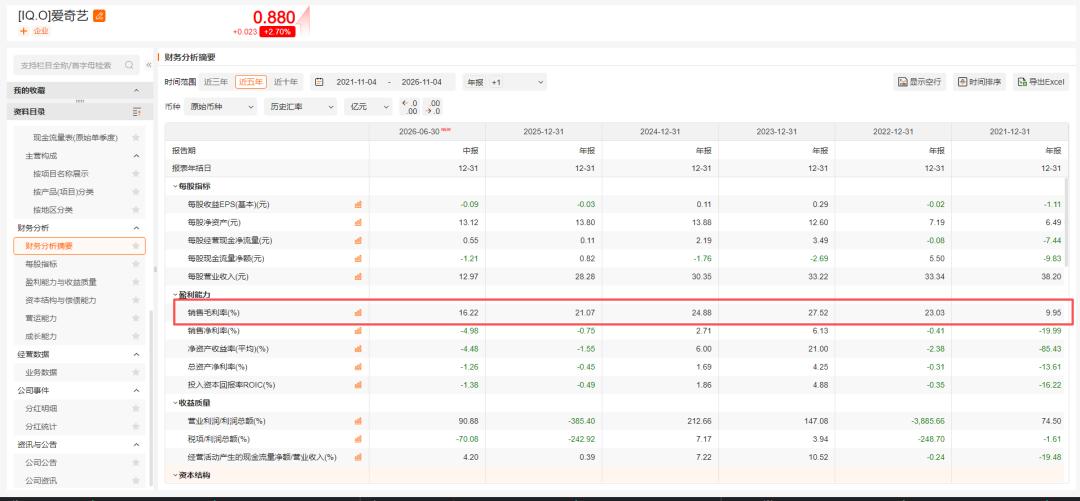
Mango is not the only one that finds it harder to make money. iQiyi, which also takes long video as its core business, saw its gross profit margin drop from 27.52% in 2023 to about 16.22% in the first half of 2026.
On the other hand, Bilibili has taken the opposite curve, with its comprehensive gross profit margin reaching about 37.2% in the first half of 2026, continuing to rise in recent years.
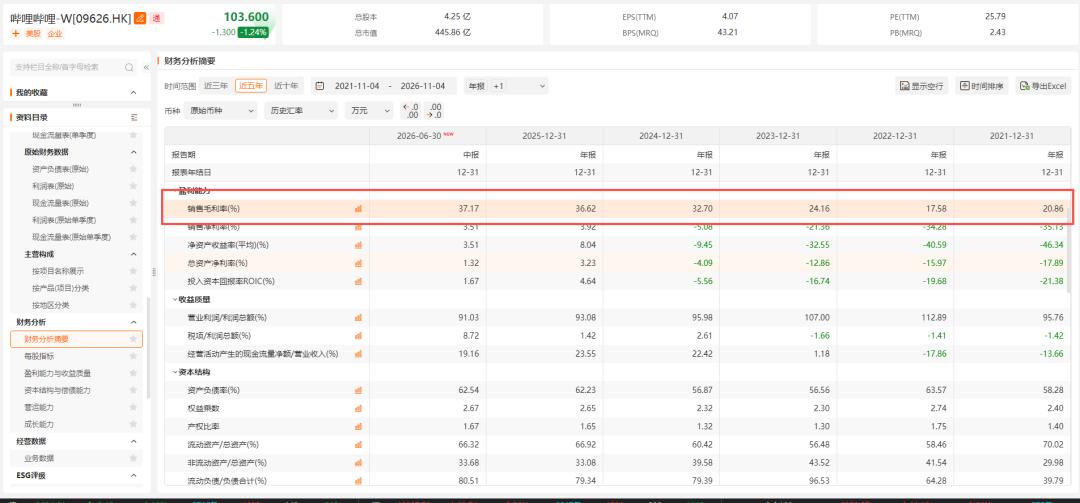
This differentiation shows that the traditional long video copyright model with heavy assets and high investment is facing severe challenges. At a time when short videos and live broadcasts are continuously diverting users' time, the risk of betting on big stars and big productions is getting higher and higher.
This is also the reason why Mango has to "lighten its burden".
This year's "See You Later Friend" and "Later Journey to the West" just give two different solutions.
"See You Later Friend" does not have a luxurious top star lineup, but it made countless audiences hooked by a conversation between old friends that happened 20 years ago; "Later Journey to the West" uses AI to reduce the production cost of long dramas to a fraction of similar big productions.
The era of competing for audiences with big productions and high investment may have passed. For video platforms, the competition in the future is not only about whether they can make hits, but also about who can continuously produce works that audiences are willing to watch with less money and faster speed.
Audiences can be hooked by the line "trapping myself in a self-made prison", and investors can carnival for an AI monkey. But how popular a show can be and how much money a platform can make are two different things after all.
Mango has only won the first battle in this tough battle of lightening its burden.