Monthly active users are nearly 40% of Hongguo's, is Green Bubble really a success this time?
Everyone complains about the Red Fruit short drama platform, yet everyone wants to replicate its success.
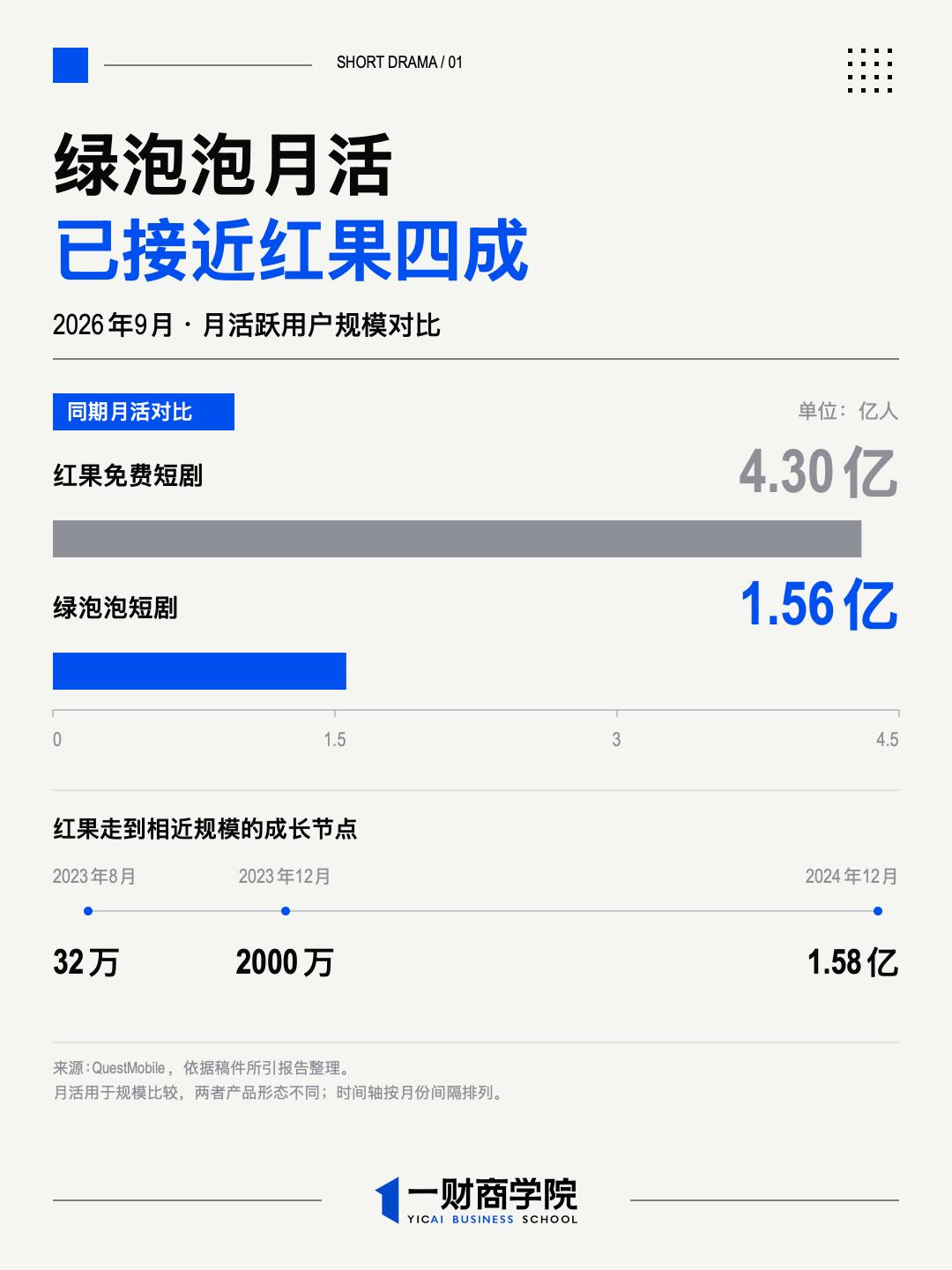
While Red Fruit Short Drama has sparked heated discussions with per capita daily usage exceeding two and a half hours, Green Bubble Short Drama has been quietly gaining traction, with its monthly active users in September reaching nearly 40% of that of Red Fruit.
In August 2023, Red Fruit, an independent app under ByteDance, was officially launched, with only 320,000 monthly active users in the launch month. It then saw explosive growth, exceeding 20 million by the end of 2023, 50 million in March 2024, and hitting 158 million in December 2024.
In terms of growth speed, Green Bubble Short Drama has even outpaced Red Fruit in its early days.
Following Red Fruit's path, Green Bubble achieves twice the result with half the effort
Tencent is by no means a newcomer in the short drama track.
The early exploration was mainly led by PCG (Platform and Content Group), focusing on high-quality short dramas attached to the long video membership system; in January 2025, it launched the "Mars Short Drama Club" (later renamed "Mars Drama Watch") through WeChat Mini Programs, converting paid short dramas on the platform to the "watch ads to unlock for free" model.
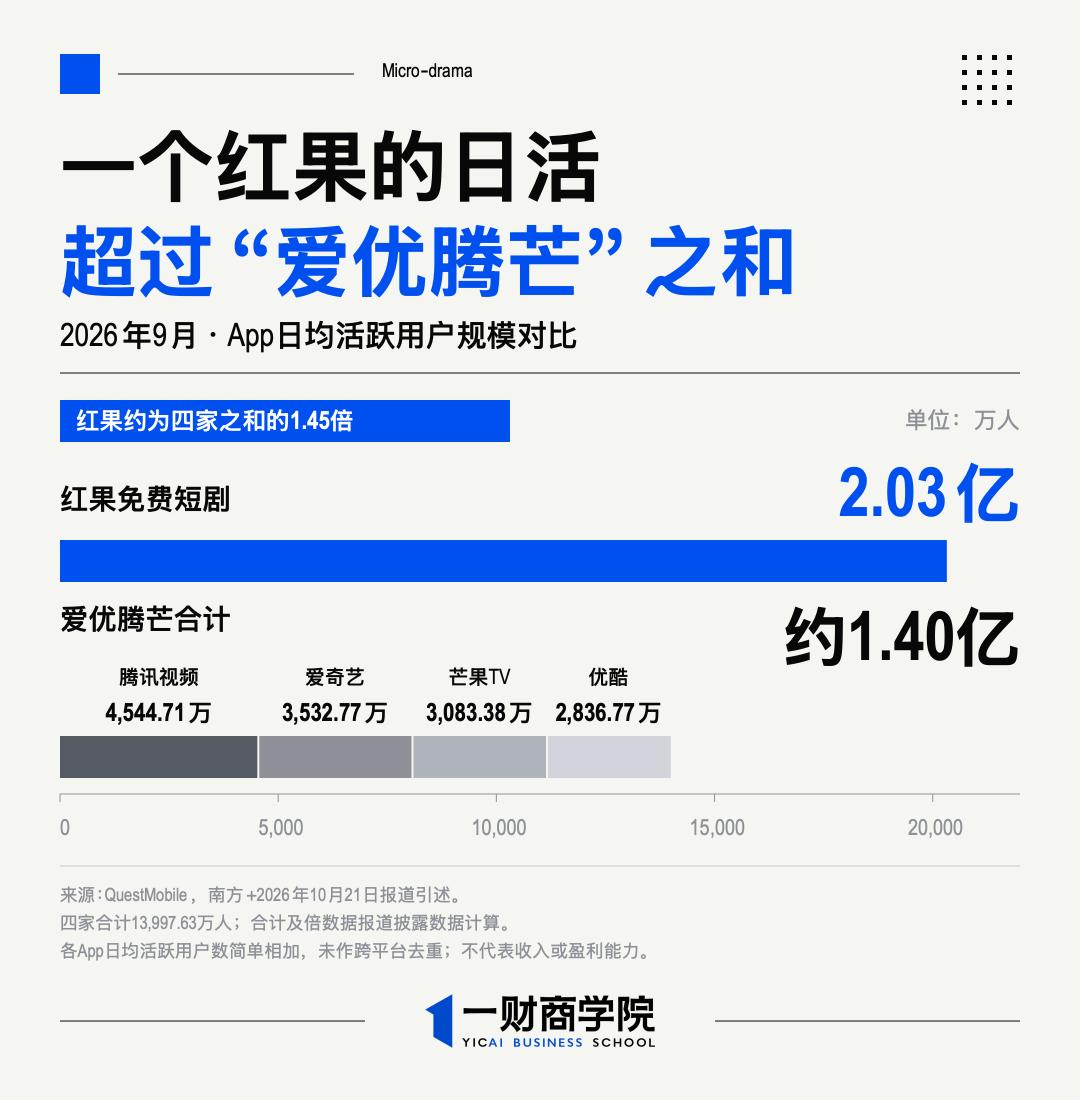
However, these two attempts were deeply rooted in the long video operation logic, neither receiving traffic tilt from core entrances nor blocking Red Fruit's offensive in the sinking market — as of September 2026, the daily active users of Red Fruit Short Drama exceeded 200 million, surpassing the sum of daily active users of the four major long video platforms iQiyi, Tencent Video, Youku and Mango TV.
Different from the previous short drama attempts led by the long video team, public reports show that Green Bubble is led by the WeChat team, integrating short drama content and viewing demands based on the WeChat ecosystem.
Previously, WeChat only acted as "infrastructure provider" in the short drama track, that is, mounting short drama clips through the Channels to divert traffic for thousands of third-party paid short drama mini-programs and charging access fees; it was not until June 2025 that it launched the official "Short Drama" mini-program for the first time, trying to aggregate third-party episodes, but it only served as a lightweight entrance in the initial stage with limited public attention.
The real turning point came in July 2026 — WeChat officially renamed and upgraded this official "Short Drama" mini-program to "Green Bubble Short Drama", and launched the gray test in August. When it received concentrated media attention in late September, its monthly active users that month had approached 40% of Red Fruit's.
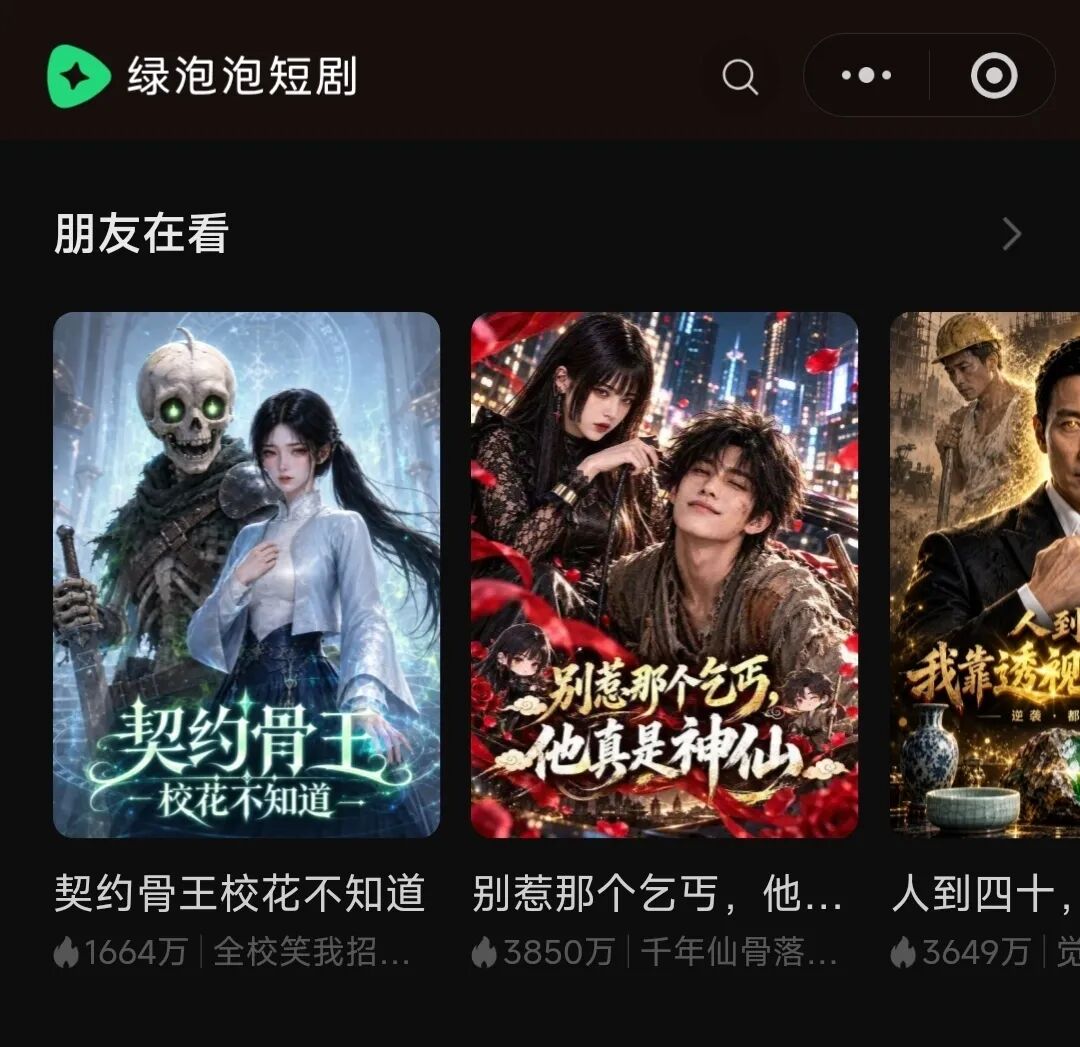
Different from the previous tentative steps in the short drama business, this time WeChat has given Green Bubble the same ecosystem treatment as WeChat Channels, equipping it with entrance access, social recommendation and cross-scenario traffic diversion: the most prominent position on the homepage after login shows "What Friends Are Watching" to make recommendations based on social connection chains; the app can be minimized to a floating window hanging at the corner of the screen, so that replying to messages and watching dramas do not interrupt each other, and drama clips on Channels can jump directly to Green Bubble Short Drama.
The reason why Tencent began to increase investment in short dramas at the ecosystem level this year is most likely due to huge changes in the industry. Since the beginning of this year, the short drama industry has further accelerated, and from the industry perspective, the short drama market has ushered in two inflection points:
1. User awareness of free short dramas has been fully cultivated.
According to QuestMobile data, as of May 2026, the user scale of independent short drama apps led by Red Fruit Short Drama (with 356 million monthly active users in May) reached 402 million, while the user scale of WeChat short drama mini-program channels was as high as 508 million. In the past, these more than 500 million users within WeChat were not settled in official products, but scattered in dozens of independent third-party theater mini-programs; Green Bubble undertakes the already educated market demand.
2. The supply of short dramas has seen an order-of-magnitude change.
In terms of launch volume, the supply of short dramas has seen an order-of-magnitude change. Data shows that 33,000 micro short dramas were launched nationwide in 2025, and 490,000 have been launched in the first 9 months of 2026 alone. A key driving force behind this supply boom is that AI has changed the production mode of short dramas. Generative tools reduce the dependence of some works on actors, on-site shooting and traditional production resources, enabling small teams to produce dramas in batches. After the story and core script are completed, the subsequent production of some batch-produced comic dramas can be completed through automated processes, achieving the efficiency of one person producing one drama per day.
Behind these inflection points, Red Fruit Short Drama, which covers nearly 90% of short drama app users, has made outstanding contributions. Red Fruit Short Drama has made the free short drama model the mainstream of the industry, and its long-term support and revenue sharing have also enabled the short drama industry to form high-quality large-scale supply.
Whether it is the demand awareness or the supply system, Green Bubble is facing a fully educated market.
Following ByteDance's proven path has become the consensus of all major platforms
From Channels and WeChat Shop to Green Bubble, Tencent's major platform moves in recent years have followed a similar path: re-run the content business that has been verified by the market.
WeChat Channels has become an important growth driver for Tencent's advertising business. According to Tencent's latest financial results for the second quarter of 2026, the total user usage time of Channels in the same quarter increased by more than 20% year-on-year. At the same time, the ad load rate of Channels, that is, the frequency at which users see ads when scrolling through videos, is still far below the average level of the short video industry. This means that with the growth of user viewing volume and the gradual increase in ad display frequency, Channels still has room to further release advertising revenue.
WeChat Shop has also achieved high growth. The 2026 WeChat Open Class PRO revealed that in 2025, the global cross-scenario sales volume of WeChat Shop more than doubled year-on-year, and the number of monthly active selling merchants reached 1.7 times that of the same period last year.
It is not only WeChat that has made efforts to develop short video and short drama apps. Meituan, Pinduoduo and Taobao have also successively added short drama pages in their apps. Following ByteDance's proven path has become the consensus of all major platforms.
The reason lies in ByteDance's ability to continuously launch new products, quickly conduct trial and error and implement large-scale operations: it opens multiple fronts at the same time for one direction, uses A/B tests to quantify retention, user acquisition and monetization, invests more resources in successful products, and the team that fails will immediately switch to the next line. This mechanism of rapid iteration, multi-line operation and letting data screen products allows ByteDance to create hit apps in batches. As a result, ByteDance was once dubbed the "App Factory" by the outside world.
But in fact, the hardest part of this strategy to replicate is not the methodology, but the core traffic distribution base — Douyin.
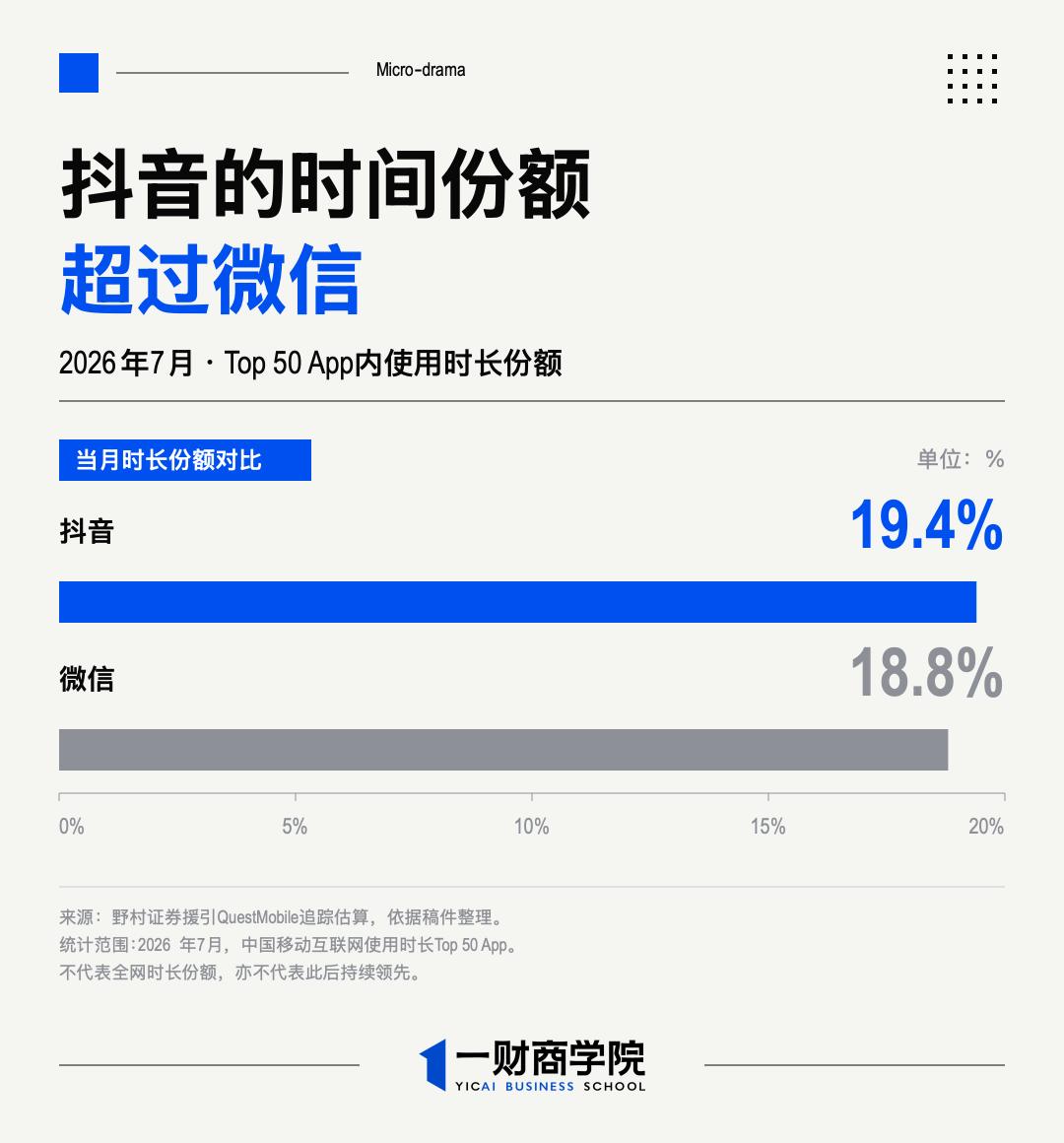
According to data cited by Nomura Securities from QuestMobile, in July 2026, among the top 50 apps by mobile internet usage duration in China, Douyin accounted for 19.4% of the total usage duration, surpassing WeChat's 18.8% for the first time and becoming the app with the highest total usage duration that month.
Tencent also tried to use the horse racing mechanism to build independent apps to replicate Douyin's miracle. According to media statistics, Tencent has launched about 15 short video products in total, 8 of which were launched intensively in 2018 alone. Weishi once obtained the entrance of WeChat Moments and large-scale subsidies, but the results were not optimistic.
Although WeChat has long ranked first in the list of app user usage duration before being overtaken by Douyin this year, it was far inferior to Douyin in terms of information flow distribution opportunities before the birth of Channels. On Douyin, users swipe up hundreds of times every day, and these actions provide ByteDance with abundant opportunities for traffic distribution and testing.
But WeChat also has its own advantages: a huge user base, high-frequency social interactions, and content dissemination centered on acquaintance relationships. For Tencent, a smoother path is to meet users' already mature demands in the WeChat scenario.
ByteDance is responsible for user education, and it also gradually matures the content supply and monetization methods; Tencent uses its own entrances, relationship chains and mini-program system to lower the threshold for these businesses to reach users again.
Conclusion
When the total usage duration of Douyin ecosystem apps historically surpassed WeChat, plus Red Fruit, which has a daily usage duration of more than 2 hours, attacking from the flank, WeChat, which once believed in the "use it and leave" philosophy, has to face this battle for user time head-on.
This article is from the WeChat official account "Yicai Business School", author: Xu Ming, authorized for release by 36Kr.