Is FSD rebranded as TAD in Europe? Even Tesla can no longer make arbitrary unsubstantiated boasts.
Tesla's FSD is getting renamed in Europe.
According to foreign media reports, the Netherlands Vehicle Authority (RDW) has approved multiple updates to Tesla's FSD system in the country, including reducing the offset value of maximum speed exceeding the speed limit to less than 10%, and renaming the system to TAD (Tesla Assisted Driving).
At present, Tesla's Supervised FSD (the current TAD) has been approved for use in 10 European countries, but there is still a certain distance before it can be used across the entire European Union. In the global market, only a small number of countries or regions allow the use of Tesla's FSD.
For Tesla, when will its expected goal of full self-driving be achieved? For users, is Tesla's model of charging for activation first and then waiting for local approval reasonable? Today, Dianchetong (ID: dianchetong233) will discuss this issue.
FSD renamed TAD in Europe, aligning with the naming convention of the Chinese market?
TAD stands for Tesla Assisted Driving, while the full name of FSD is Full Self-Driving. This renaming move by Tesla reminds people of the naming regulation for autonomous driving in the Chinese market: from various scattered descriptions such as autonomous driving, driverless driving, L3 autonomous driving, quasi-L3 autonomous driving, and high-level intelligent driving, all are uniformly renamed as "intelligent assisted driving" to avoid misleading consumers.
The current renaming of Tesla's FSD is only limited to the European market, and it is a compromise made by Tesla to enable FSD to be deployed across the European Union.
In fact, as early as April this year, the Netherlands Vehicle Authority had already issued a type approval for Tesla's FSD Supervised. According to EU rules, other member states can choose to directly recognize this approval without separate additional reviews.
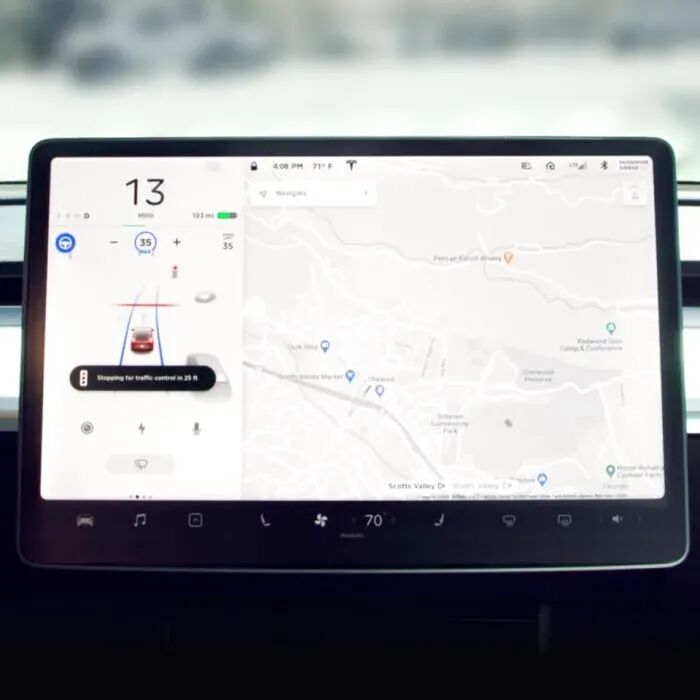
(Image source: Tesla)
Up to now, in addition to the Netherlands itself, EU member states including Lithuania, Estonia, Denmark, Belgium, Slovenia, Czechia, Croatia, Slovakia, and Latvia have all recognized this approval, which means that Tesla's FSD Supervised can be deployed and used in these countries.
It is worth noting that the Netherlands Vehicle Authority also clearly stated during the certification that Tesla's FSD Supervised is not autonomous driving, and drivers are still responsible for their actions when using the function.
However, Tesla's plan to promote the deployment of FSD in Europe is not limited to these ten existing countries. It expects FSD to be fully rolled out across the EU as soon as possible, which is why Tesla did not take the UN R171 route of the United Nations, but chose the new technology exemption route in the EU's whole-vehicle regulations.
Here is a brief introduction to the differences between these two routes. UN R171 is an international regulation for L2 level combined driving assistance functions issued by the United Nations World Forum for Harmonization of Vehicle Regulations. If UN R171 certification is obtained, all signatory countries of this regulation including the European Union will recognize the certification.
But the shortcoming of this route is also obvious: UN R171 has not yet adapted to some scenarios of urban NOA, such as complex intersections, roundabouts, and unmarked roads. It is expected to take another 1-2 years to officially incorporate these scenarios into the regulation. For an intelligent driving solution like Tesla's FSD that already has urban NOA capabilities, this pace is obviously relatively lagging.
The new technology exemption route under the EU's whole-vehicle regulations chosen by Tesla allows the function to be fully deployed relatively quickly, but such exemptions are not only limited in duration (up to 18 months at most), but also need to be recognized and approved by each EU member state separately to be used. To use it across the entire EU, it needs to be voted on by all EU member states, with at least 15 countries voting in favor, and the total population of these countries accounting for more than 65% of the total EU population.
So, what does this have to do with the aforementioned renaming of Tesla's FSD in the EU?
Precisely because Tesla is taking the new technology exemption route, it must strive for as many favorable votes as possible to get the FSD function deployed in the EU region. The condition put forward by Germany is that FSD must be renamed in Europe, and the speed limit offset when using FSD cannot exceed 10% of the road speed limit.
Therefore, in October, Tesla first renamed Supervised FSD to TAD on its European official website, and this month Tesla also formally submitted the corresponding change application to the Netherlands Vehicle Authority and got it approved.
At present, in addition to the ten countries mentioned earlier and Germany, Italy also stated at the end of October that it supports the full EU approval of Tesla's FSD (namely TAD). The total population of these countries accounts for about 45% of the EU's total population. Among the remaining EU member states, France and Spain clearly stated that this matter belongs to the EU-level jurisdiction and will not give separate recognition, while Sweden explicitly opposed the speed limit offset function of FSD, and will not recognize it unless Tesla cancels this capability.
Therefore, whether Tesla's FSD can be officially deployed across the EU will not be known until the vote in December.
In the view of Dianchetong (ID: dianchetong233), Germany's requirement for Tesla to rename FSD to TAD within the EU is consistent with the actual situation of Tesla's current technological development. After all, FSD stands for Full Self-Driving. Even with the "Supervised" suffix added later, it will still inevitably lead consumers to regard it as autonomous driving rather than assisted driving.
After renaming to TAD, users can clearly recognize from the name that this function is only assisted driving, not autonomous driving in the true sense. This specification follows the same logic as China's earlier unification of so-called "autonomous driving" and "intelligent driving" into assisted driving. The purpose is to let users clearly understand the boundary of the assisted driving capability they are using, avoid treating it as real autonomous driving, and prevent unnecessary safety hazards on road traffic.
At present, although Tesla's FSD has not been deployed in the Chinese market for the time being, Tesla has also changed the Chinese translation of FSD to "Tesla Assisted Driving" on its Chinese official website.
Charging before activation: will Tesla's FSD model collapse?
In addition to the renaming in the European market, another piece of news about FSD this week is the complaint filed against it by South Korea's consumer protection agency.
According to Reuters, Tesla has been selling the FSD function in the South Korean market at a price of 9.043 million won (about 44,900 RMB). However, among Tesla vehicles delivered in South Korea, only models produced in the United States are allowed to use the FSD function, accounting for about 20% of the total. Tesla has not previously applied for FSD certification for Tesla vehicles produced at its Shanghai factory, which means that some consumers cannot use the FSD function even after paying to activate it.
Therefore, the organization has now filed a complaint with the Korea Fair Trade Commission, demanding that Tesla be prohibited from selling the FSD function to consumers who have purchased vehicles that cannot use the FSD function.
In fact, only a small number of countries around the world allow the use of Tesla's FSD function, and even in the whole of Asia, only South Korea allows this function. In other countries, even if the FSD function cannot be used currently, Tesla still allows paid activation of this function locally.
For example, in China, Tesla charges 64,000 RMB for FSD, but after consumers pay to activate the function, they can only use the 32,000 RMB "Enhanced Assisted Driving" (EAP) function, which includes assisted navigation driving, assisted lane change, assisted parking, smart summon, as well as free active cruise control and lane keeping assist.
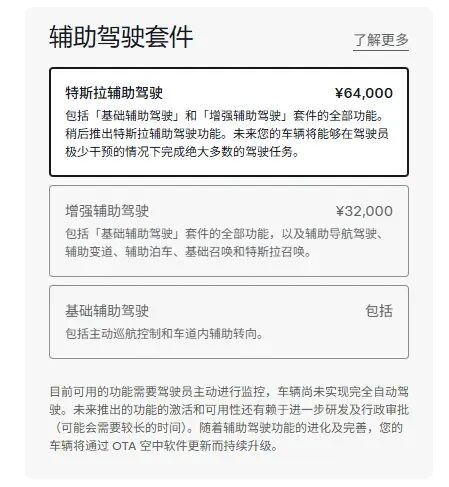
(Image source: Tesla)
In the view of Dianchetong (ID: dianchetong233), this behavior of Tesla is nothing more than transferring the uncertainty of whether FSD can pass the approval of the host country and be successfully activated to the users who pay for the function. No matter whether FSD can be deployed and activated or not, Tesla has already received the fees paid by users, while users have to bear the risk of wasting money because FSD cannot be activated for a long time. The risk responsibilities borne by both parties are completely unequal.
In the intelligent driving industry, cases of paying first and then waiting for approval are quite rare.
In the domestic Chinese market, many car companies have already bound assisted driving functions with related hardware at this stage. Users can use related functions as long as they purchase models equipped with assisted driving hardware. A few manufacturers that require payment for high-level assisted driving software functions can basically ensure that the functions are available immediately after purchase. In the early stage, although the urban navigation assisted driving function of a few brands needed to wait for "city opening" to be used, it was only a problem of adaptation speed, and there was no case like Tesla where users had to wait for several years.
As for Chinese brands exporting to overseas markets, there is no situation of charging first and then waiting for push notification like Tesla. For example, Xpeng's NGP and BYD's God's Eye can only be deployed in Europe after passing certifications such as UN R171. It is still unclear whether these related software functions will be charged locally. However, neither Xpeng nor BYD has charged relevant software fees first and then waited for policy approval like Tesla.
Therefore, on the whole, Tesla's FSD model of charging first and then waiting for activation is obviously not very customer-friendly. Dianchetong (ID: dianchetong233) believes that for consumers, if they pay for a service but cannot enjoy the corresponding service, they should have the right to a refund. Therefore, Dianchetong (ID: dianchetong233) also hopes that Tesla can adjust relevant policies in the future to give consumers the choice to continue waiting or apply for a refund.
The last train of L2: can Tesla still catch up in China?
Tesla's FSD is undoubtedly a Bug-like existence in China's automotive industry.
In early 2025, Tesla rolled out the FSD function in gray scale to some Chinese car owners, allowing some vehicles to experience the performance of FSD on Chinese roads. But later, due to the introduction of relevant new regulations, Tesla suspended the push to the remaining models, and the service has not resumed to this day.
The domestic consumers and media's understanding of Tesla's assisted driving capabilities in China basically comes from these vehicles and subsequent vehicles that have been privately cracked to activate the corresponding functions.
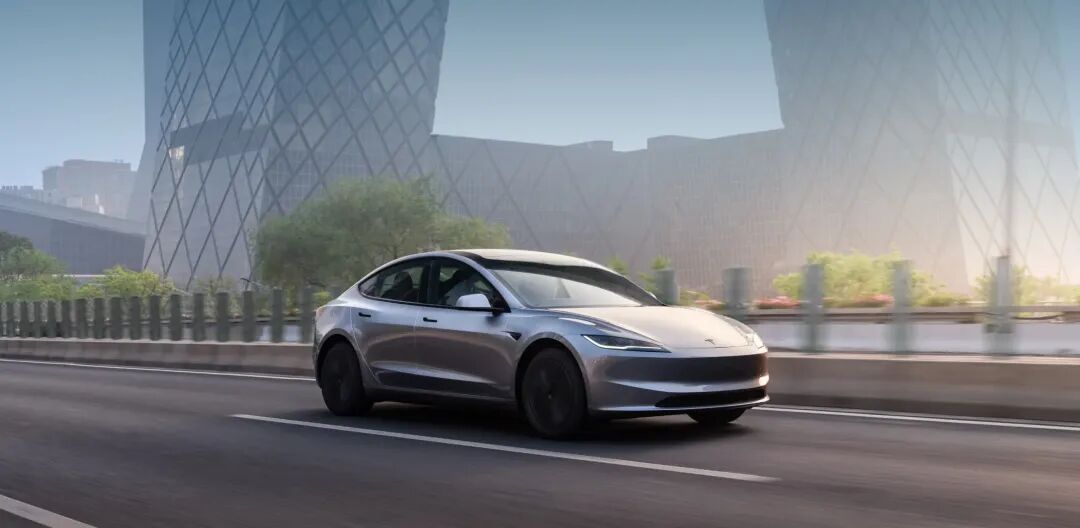
(Image source: Tesla)
Some users believe that Tesla's FSD has strong capabilities, but it is not yet familiar with China's traffic rules and road conditions. After it gets familiar with Chinese roads, its performance will naturally become more aggressive, surpassing various domestic assisted driving solutions.
But the problem is that at this stage, domestic intelligent assisted driving in China is on the eve of moving towards L3, and relevant regulations are also in the compilation process. Tesla's FSD Supervised is still at the L2 level. Even the full-capability FSD in North America has not achieved full self-driving, so its current situation in China is rather awkward.
At this stage, even if Tesla's FSD passes the corresponding certification and is approved to be rolled out in the domestic market, it is already a little late. The urban and high-speed NOA capabilities of domestic car companies have made significant progress compared with previous years, and they are also moving towards L3. Tesla no longer has the leading advantage it had in previous years.
However, there are still a group of people in China who highly recognize Tesla's assisted driving capabilities, including consumers, as well as employees of car companies and intelligent driving enterprises. Therefore, if Tesla's FSD can be deployed in China, what kind of impact will it have on China's intelligent driving enterprises? Will they choose to compete head-on with Tesla, or enter a "lying flat mode"?
The answer will not be known until FSD is officially deployed in China.
This article is from the WeChat official account "Dianchetong", author: LaterN, published with authorization from 36Kr.