Stores are mushrooming in clusters everywhere, what on earth are these 100-yuan handmade hot pot ventures actually selling?
Hot pot restaurants with per capita consumption of around 100 yuan are embracing the trend of "handmade" offerings.
Hot pot has long been a highly standardized track: similar broths, menus and workflows mean the store model can be replicated in any city with minimal risk of errors, and customers rarely end up with a bad meal no matter which outlet they visit.
However, a new batch of "handmade hot pot" outlets with per capita spending in the 100-yuan range are taking the opposite approach. Instead of pursuing standardization, they keep adding extra steps to their production process, introducing a large number of time-consuming, low-yield manual procedures. For example, they have grandmothers wrapping wontons and pounding meatballs on site, and chefs picking fresh bean sheets and slicing and preparing dishes right in front of the counter. Craftsmanship, local flavors and store personality are thus brought to the forefront.
These seemingly most inefficient actions are becoming the most prominent selling point of this group of hot pot restaurants.
"Handmade" is gaining popularity in hot pot restaurants
"It's been a long time since I've had such a sincere hot pot experience... It's no wonder there are long queues at meal times," a Shanghai consumer commented on a social platform about Laohu Gupo Handmade Hot Pot (hereinafter referred to as Laohu Gupo).
Walking into Laohu Gupo, the concept of "handmade" runs through almost the entire menu. From handmade broths and hand-rolled yanpi wontons to fresh handmade bean sheets, and dishes named after techniques such as "rolling", "stuffing" and "pounding", customers witness how the dishes are made before they even pick up their chopsticks.
According to Dianping, Laohu Gupo has a per capita consumption of around 100 yuan, focusing on southern Fujian flavors, and currently operates 6 outlets in Longyan, Xiamen and Shanghai. Scanning the store reviews, "queuing" and "getting a queue number in advance" are high-frequency terms, with many consumers reporting waiting times of over 1 hour during peak periods.
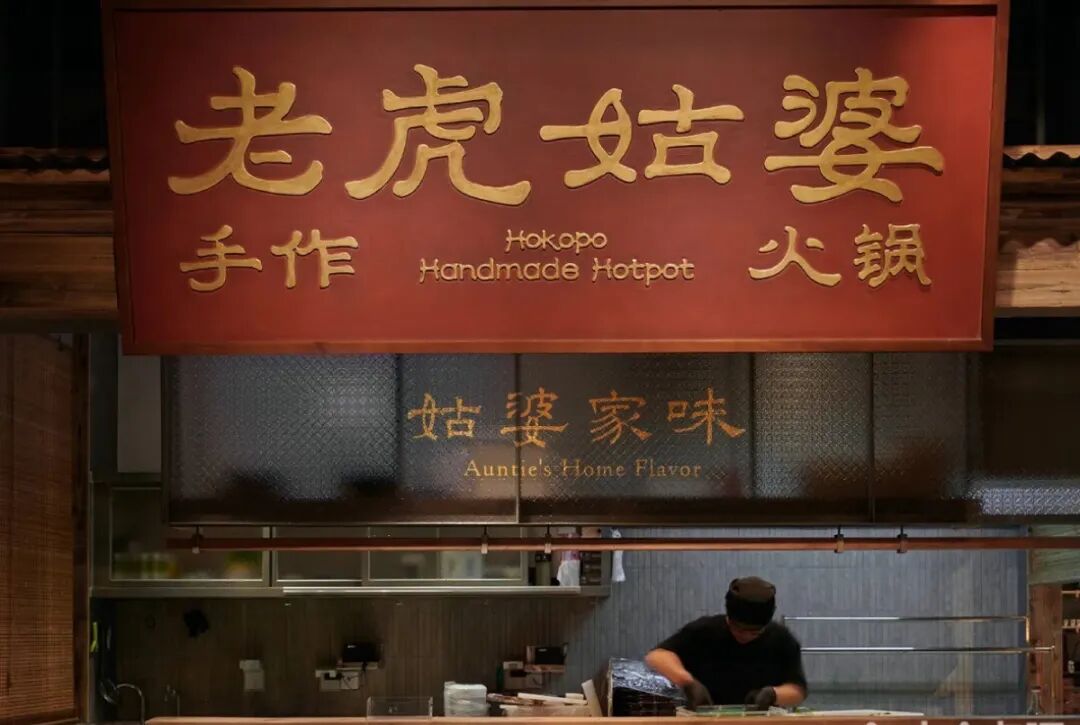
△ Image source: Laohu Gupo's Dianping store page
Laohu Gupo is not an isolated case. From south to north, "handmade hot pot" is becoming increasingly common. Pilot Handmade Dish Hot Pot in Fuzhou, Xiangyuli Handmade Hot Pot in Xi'an, Zhang Changchang Fresh Handmade Hot Pot and Shancheng Bangbangjun Handmade Hot Pot in Beijing, Hailing Mountain Wild Handmade Hot Pot and Shanhua Jiao Handmade Hot Pot in Hangzhou, most of which are single-outlet stores opened this year, have almost all put the word "handmade" on their signs within the same time window. Haowan'er, which focuses on Chaoshan flavors, has already opened 2 outlets in Suzhou and Shanghai.
New brands define themselves with "handmade", while established brands update their offerings with the same concept.
Recently, fresh beef hot pot brand Zuoting Youyuan launched a new counter-style hot pot store format in Hangzhou. While chefs slice fresh beef of the day in front of customers, the store has also added a series of freshly made products, including flame-grilled snowflake sushi, fresh grilled beef skewers, iron plate "dog-shaped" beef patties, black sesame snow ice, and fresh fruit daifuku, all made by hand on site.
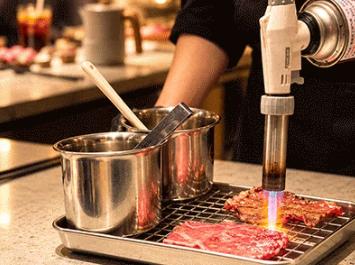
△ Image source: Zuoting Youyuan official WeChat public account
Earlier, the newly opened "Nian Shanhai Seafood Self-Selection Hot Pot" by Pupu Supermarket added a large number of open-kitchen on-site preparation stalls on the original basis, including cold dish pickling stalls, sashimi stalls, counter grilling stalls, barbecue stalls, and steamer dim sum stalls, to emphasize the handmade feel.
Creative hot pot brand Sanshan opened its first outlet in Wuxi, introducing the "counter service" model, where diners can watch the whole process of chefs handling ingredients and preparing broths at close range, and communicate face to face with the head chef about the best time to eat each dish. Wangfu Chaoshan Beef Hot Pot in Causeway Bay, Hong Kong, launched hand-pounded thin-shell meatballs...
More and more hot pot restaurants are turning their production processes, craftsmanship and on-site atmosphere into visible selling points for consumers.
From on-site slicing and pounding to local craftsmanship, handmade hot pot sells "personality"
The status of "handmade" is changing, because what is scarce has shifted.
In an era of uneven supply, "zero mistakes" was a scarce commodity, but today is an era of de-chain aesthetic preference, and these handmade hot pot restaurants are starting to use flavors, craftsmanship and personality to provide customers with a scarce experience that "you can only find here, nowhere else".
It is worth noting that the concept of handmade has also seen new changes.
The early selling points of handmade were usually on-site slicing, pounding and wrapping, focusing on letting customers see the production process. Now, brands such as Laohu Gupo and Haowan'er are not limited to the simple concept of "handmade". They also transport regional ingredients to the store, and even bring the local craftsmanship of processing these ingredients into the store, completing the whole process in front of customers.
What Laohu Gupo sells is not only southern Fujian ingredients, but also southern Fujian cooking methods. Fuding meat slices, Quanzhou hand-pounded springy cuttlefish, Jinjiang hand-pounded fist-shaped meatballs, Xiapu kelp sprouts, and Xiamen old-fashioned five-spice rolls all come from the daily diet of southern Fujian. The signature handmade yanpi wontons are even more typical: there is an old saying in eastern Fujian that "no feast is complete without yanpi", where pork is first pounded into paste and then rolled into thin skin, wrapped with meat filling, making it a "meat wrapped in meat" meat wonton.
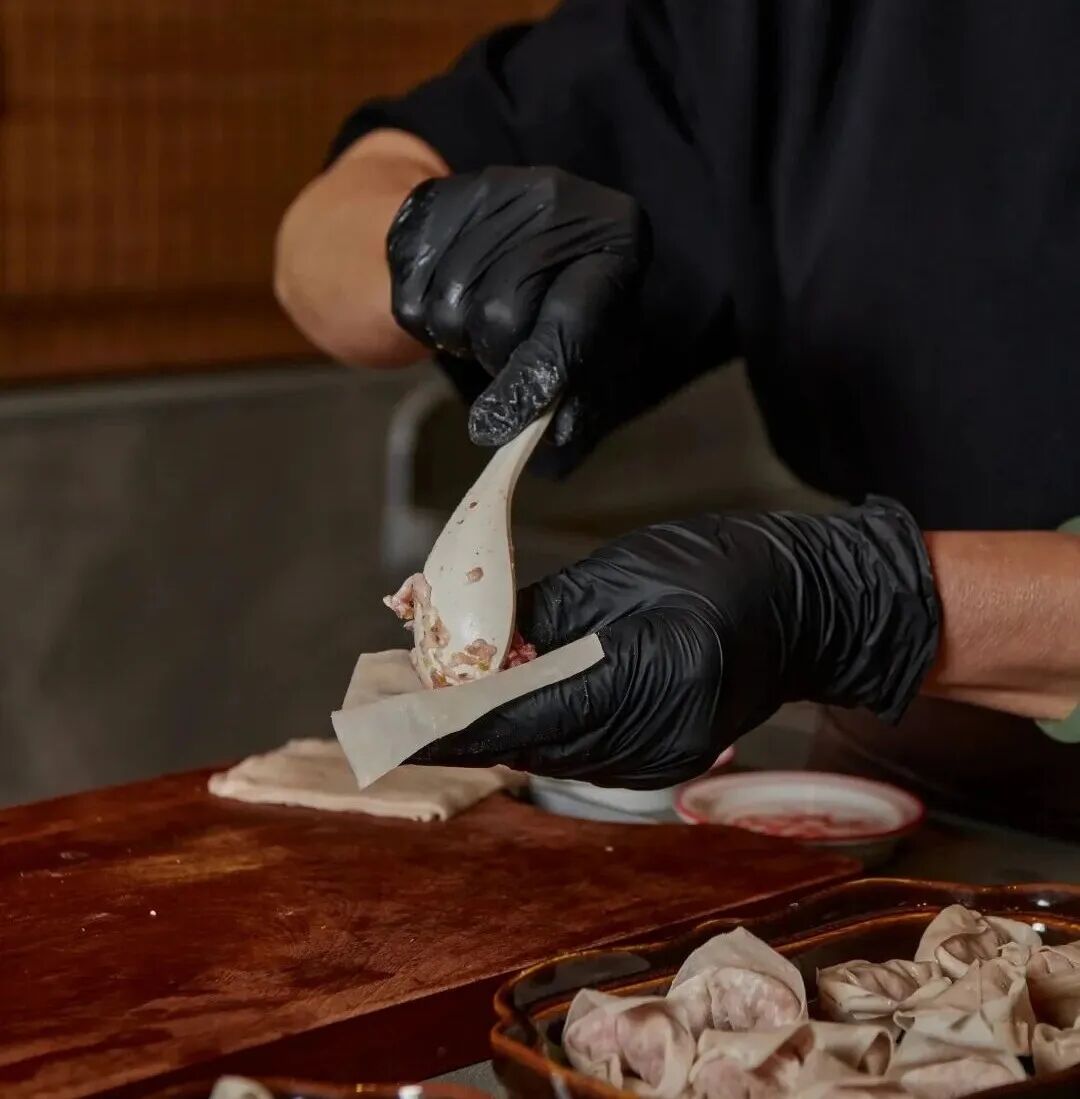
△ Image source: Laohu Gupo official Xiaohongshu account
Haowan'er follows the same path, but with Chaoshan as its location. The brand does not dilute ready-made satay sauce with water, but mixes it manually according to old recipes and stir-fries it on site in the store every day. In addition, according to official information, the hand-pounded beef meatballs go through the full process of selecting meat, pounding meat, stirring and slapping, squeezing and shaping into balls; mackerel skin dumplings are manually rolled and wrapped, with thin skin that is translucent; raw marinated dishes are prepared with freshly mixed marinade and marinated on site by chefs.
Fuzhou Pilot Handmade Dish Hot Pot creates product memory points through shrimp paste noodle pulling: wrapping shrimp paste into noodles, and pulling the noodles on site in front of customers.
All these practices have one thing in common: they all take time, and this period of time cannot be compressed.
Laohu Gupo's handmade fresh bean sheets are made from ancient stone-ground soy milk, produced and picked on site every day, with only 20 sheets produced per hour, and customers can watch the chef pull out the bean sheets with their own eyes; the beef bones for Haowan'er's satay pot are slowly simmered for 4 hours to make the base broth, and the hand-pounded meatballs and pastes are repeatedly pounded more than 1000 times by the grandmother in the store with a 3-jin heavy iron hammer.
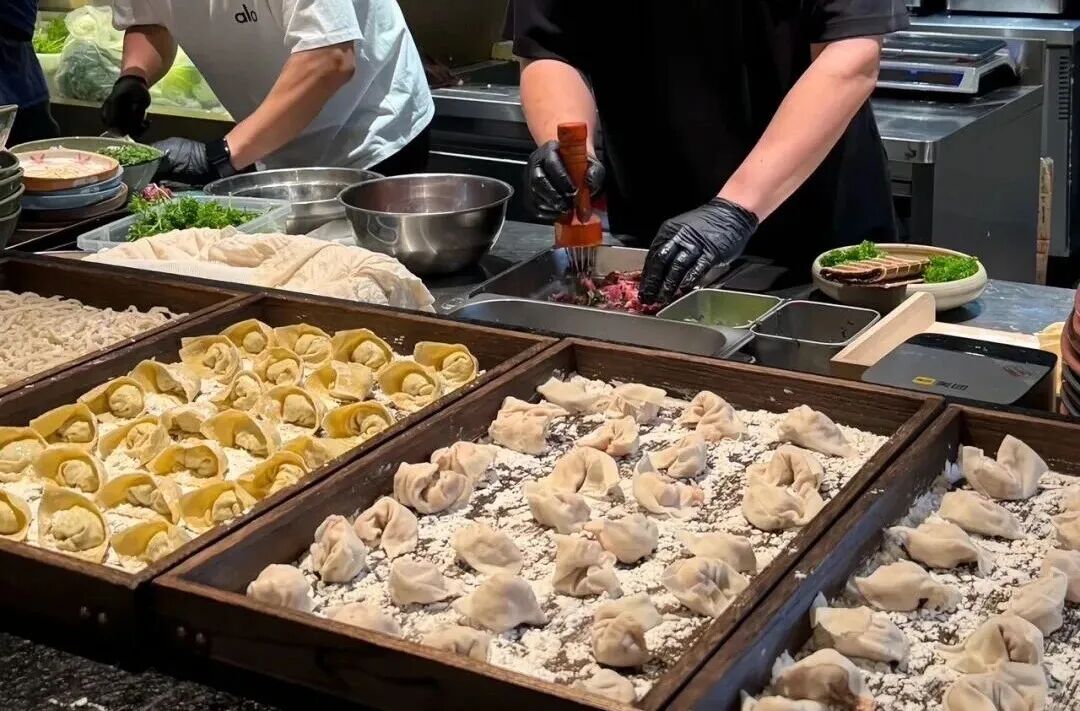
△ Image source: Haowan'er official Xiaohongshu account
Personalization is not only reflected on the menu, but also in the store space.
In the past, the open kitchens in hot pot restaurants mostly served to display ingredients and enhance the perception of hygiene. Now, some brands are further moving the production process in front of consumers, making the space itself part of the experience.
The counter service model introduced by Zuoting Youyuan and Sanshan adds bar seats, where diners can watch chefs handle ingredients and prepare broths, and even confirm with the head chef the best eating time for each ingredient. Consumers no longer just sit at the table waiting for dishes to be served, but watch at close range how ingredients are processed and how dishes are made.
Beyond products and space, some brands are also trying to give their outlets a more distinct "personality".
For example, Laohu Gupo replicates the entire space as a street-side stove shop in southern Fujian, creating the atmosphere of old southern Fujian streets and alleys through simple furnishings and warm lighting, highlighting the down-to-earth and cozy vibe of a grandmother's kitchen; Shanhua Jiao Handmade Hot Pot follows a dark-toned new Chinese private dining route, targeting scenarios such as dates and anniversaries.
These are all part of the characteristics of handmade hot pot. They provide consumers with unique handmade products, atmosphere and interactive experience with service staff, so that the store can be remembered.
The more the front end emphasizes personality, the more the back end needs standardization
For handmade hot pot to achieve de-chain aesthetic expression, it does not mean rejecting standardization in operation.
What consumers want is a non-standard experience, while what stores need is relatively stable product output, controllable costs, and a production process that does not rely on a single person. The two logics are not contradictory, and the key lies in how brands can make both work smoothly in the same store.
The personality of handmade hot pot often comes from specific people and production processes. But people are also a relatively unstable factor in catering operations. The chef's experience, proficiency and staff turnover may all affect the final product. Once personnel change, whether the product can maintain its original standard will become a real test.
Therefore, this group of brands is also trying to incorporate the uncertainty of "people" into the system.
The most direct step is to translate those seemingly purely experience-dependent actions in the open kitchen into executable digital standards.
Actions such as grandmothers wrapping yanpi wontons on site, pounding meatballs, and rolling bean sheets are broken down into standard steps in the store: how many times the meat filling is beaten, to what extent the dough is kneaded, how many grams of filling are wrapped in each wonton — using data to replace "doing it by feel".
For example, the Haowan'er beef meatball production process mentioned earlier: select fresh yellow beef hind leg meat, with a beef content of more than 90%, then pound it with an iron hammer more than 1000 times until the muscle and fat separate naturally.
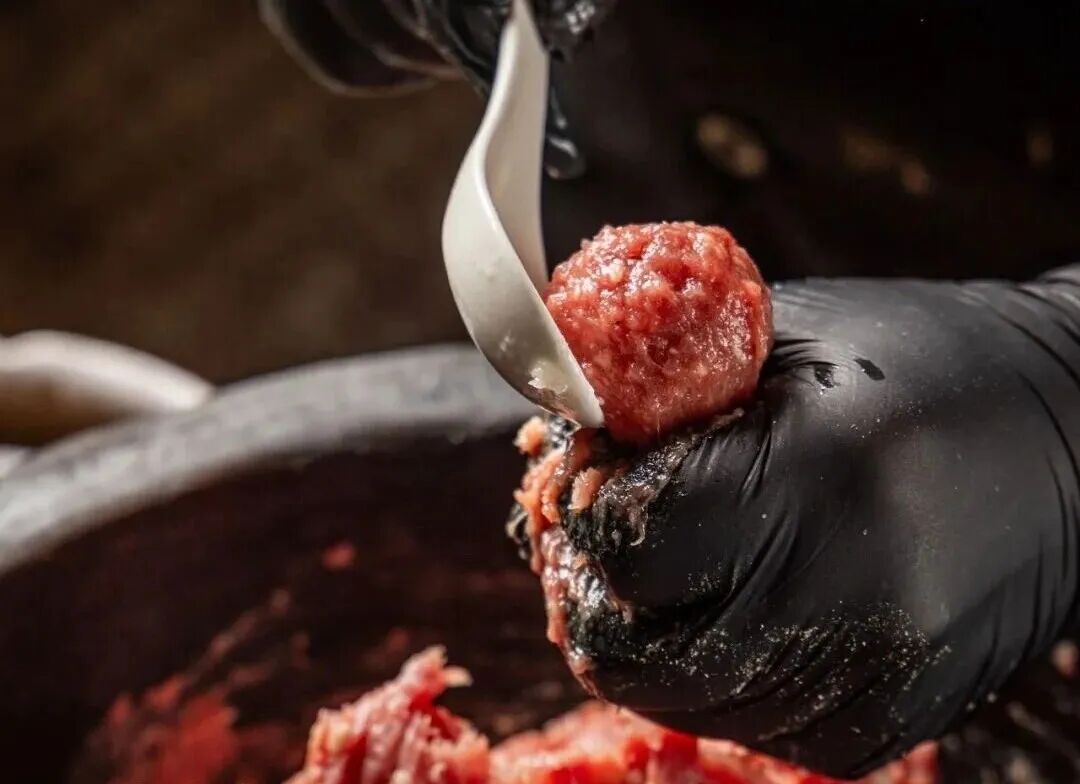
△ Image source: Haowan'er official Xiaohongshu account
This is also the common idea in catering training: break down the chef's experience into four questions — what to use, how much to use, how long to do it, and what state to reach. SOP is not to eliminate craftsmanship, but to allow craftsmanship to be passed on to the next person.
Customers cannot see any of these actions, but they determine whether that "unique experience" can be delivered stably.
Another practical test is whether handmade production can keep up with the store's operating rhythm. For example, Laohu Gupo can only make 20 fresh handmade bean sheets per hour. This limited production capacity can enhance the scarcity of the product, but it also means that the store needs to solve the balance between output and demand.
Therefore, stores are also using product structure to control the boundary of handmade: the menus of handmade hot pot restaurants such as Laohu Gupo, Haowan'er and Xiangyuli still have a large number of common hot pot ingredients such as beef, seafood and vegetables. These basic products do not need to add complicated manual procedures deliberately — the value of handmade does not lie in the more complicated the process the better, but in using limited time and manpower on products that are truly recognizable.
The more the front end emphasizes personality, the more stable the back end needs to be. Only by doing both well at the same time can handmade go beyond temporary novelty and truly become a sustainable feature of a store.
This article is from the WeChat official account "Hongcan Wang", written by the Hongcan Editorial Department, and published with authorization from 36Kr.