How did a data center storm trigger the sharp plunge of tech stocks?
Image generated by AI
Within two days, a dramatic reversal unfolded on Wall Street.
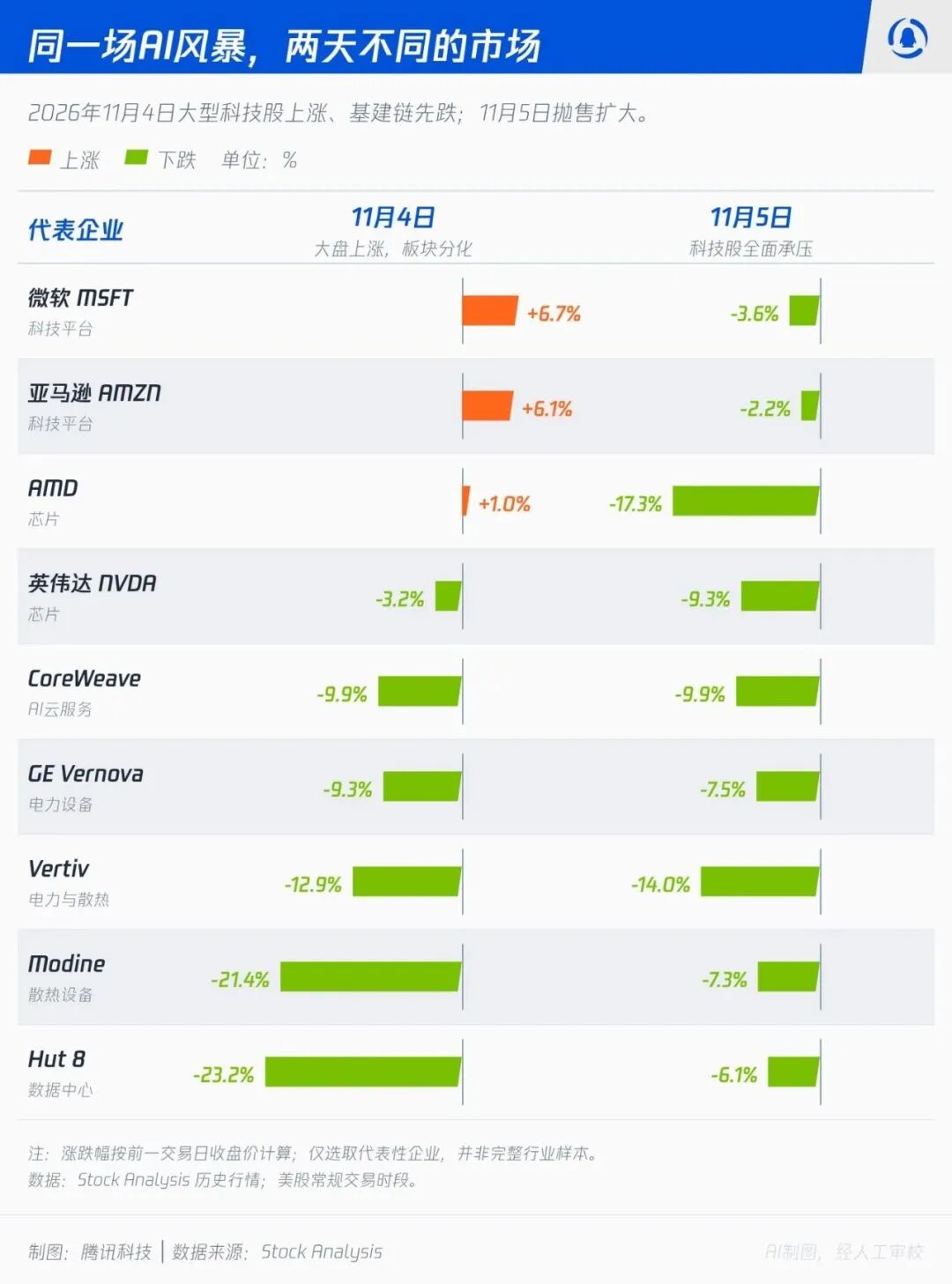
On November 4 local time in the United States, the Dow Jones Industrial Average rose by about 3%, the S&P 500 gained 1.6%, and the Nasdaq climbed 1.4%. Microsoft and Amazon rose 6.7% and 6.1% respectively, with large-cap tech stocks driving the market rebound after the US midterm elections.
However, alongside the broader market rally, a clear sell-off has emerged in the AI infrastructure sector. Data center developer Hut 8 plummeted 23.2%, cooling equipment vendor Modine fell 21.4%, power and cooling equipment supplier Vertiv dropped 12.9%, and AI cloud service provider CoreWeave slid 9.9%.
One day later, the sell-off spread rapidly.
On November 5, the Nasdaq index plunged 5.5%, the S&P 500 fell 4.4%, and the Philadelphia Semiconductor Index dropped by about 12%. AMD declined 17.3%, NVIDIA fell 9.3%, and stocks related to memory chips and AI servers suffered widespread heavy losses.
This storm actually broke out one day before the broader market crash. On November 4, the rise of large-cap tech stocks masked the collective decline of the AI infrastructure sector; on November 5, market concerns about data center construction and future capital expenditure further spread, eventually evolving into a full-scale sell-off of tech stocks.
This plunge occurred at a delicate point in time.
After the US midterm elections, the Democratic Party took control of both houses of Congress, and secured important election victories in key data center construction hubs such as Texas and Georgia. Local voters' opposition to data centers' consumption of electricity, water and the resulting rise in residents' living costs has begun to translate into more specific policy risks.
At the same time, Wall Street research institution Citrini Research released a new report *The End of the Trade (as we know it)*, arguing that the investment logic that drove the general rise of AI-related stocks over the past three years has entered a turning point.
Citrini does not doubt the continued growth of AI demand. Its main point of questioning is whether the companies that have reaped the maximum benefits from the expansion of AI capital expenditure in the past can maintain their previous stock price performance.
A storm centered on data centers has begun to spread from local policies to the financial market, changing investors' expectations for the entire AI industry chain.
01. The $15 Billion Loan
The most direct trigger for this round of sell-off is investors' re-evaluation of the construction prospects of US data centers.
In the past few years, demand for data centers has continued to grow, and power, land and grid connection resources have become increasingly scarce. From the perspective of the capital market, these bottlenecks once constituted new investment opportunities. Enterprises with power resources, construction capabilities and cooling technologies have successively obtained higher valuations.
After the US midterm elections, investors are worried that local governments may require data centers to bear more grid construction costs, clean energy investment and community compensation, and the project approval period may also be extended.
UBS estimates that about 30% of the new planned data center capacity in the United States by 2028 may be affected by potential construction restrictions. Goldman Sachs points out that states that may face policy constraints account for about 45% of the planned data center capacity in the United States, with Texas accounting for a significant proportion.
This risk exposure has already begun to appear in specific financing transactions.
On October 28, Bloomberg disclosed that the financing of a data center related to Anthropic located in Hubbard, Texas, USA encountered obstacles.
The bank group led by Morgan Stanley has arranged about $15 billion in loans for the project. As Texas suspended the construction of some new projects and assessed grid risks, the banks postponed the transaction originally planned to sell part of the debt to bond investors. As a result, banks need to hold the relevant risk assets for a longer time than originally planned.
This $15 billion loan is not a bond directly issued by Anthropic, but in such a sensitive period, it has formed a panic transmission chain. The delay in data center construction may postpone subsequent equipment procurement and rental income; if the financing arrangement cannot proceed as planned, banks and project investors will also need to re-bear the capital cost.
Citrini believes that the capital environment that supported AI infrastructure construction in the past is changing. Large technology companies can still obtain financing with strong cash flow and credit qualifications, but emerging AI cloud service providers without the guarantee of hyperscale cloud vendors may face greater financing pressure.
Previously, AI data center operators obtained financing through long-term computing power contracts, and then used debt to purchase GPUs and build computer rooms. Customers' future commitments to purchase computing power constitute an important basis for financial institutions to evaluate projects.
Long-term contracts, which were regarded by the market as future revenue guarantees in the past, have begun to be tested by both financing conditions and actual construction progress.
02. The Further Upstream, The Steeper The Fall?
The market reversal on November 4 and 5 also reflects a very special economic relationship within the AI industry.
On November 4, the stock prices of large US technology companies generally rose. Investors believe that if the expansion of data centers slows down in the future, companies such as Microsoft, Amazon and Google may reduce capital expenditures and ease the pressure on free cash flow. This may not be a bad thing.
For companies with mature cloud businesses and a large amount of existing computing power resources, the slowdown in the construction of new capacity may also increase the scarcity value of existing resources.
However, for data center developers, chip manufacturers and equipment suppliers, if a tech giant cuts its data center construction expenditure by 10 billion US dollars, the corresponding orders for chips, servers, optical communications and power equipment that were originally tied to this 10 billion US dollars may be postponed or even trigger a chain reaction.
This also explains why AI infrastructure stocks have started to fall when the broader market rose on November 4. A day later, the market further worried that if the slowdown in construction continues, it will eventually limit the future service capacity and revenue growth of large cloud vendors. Panic and sell-off spread as a result.
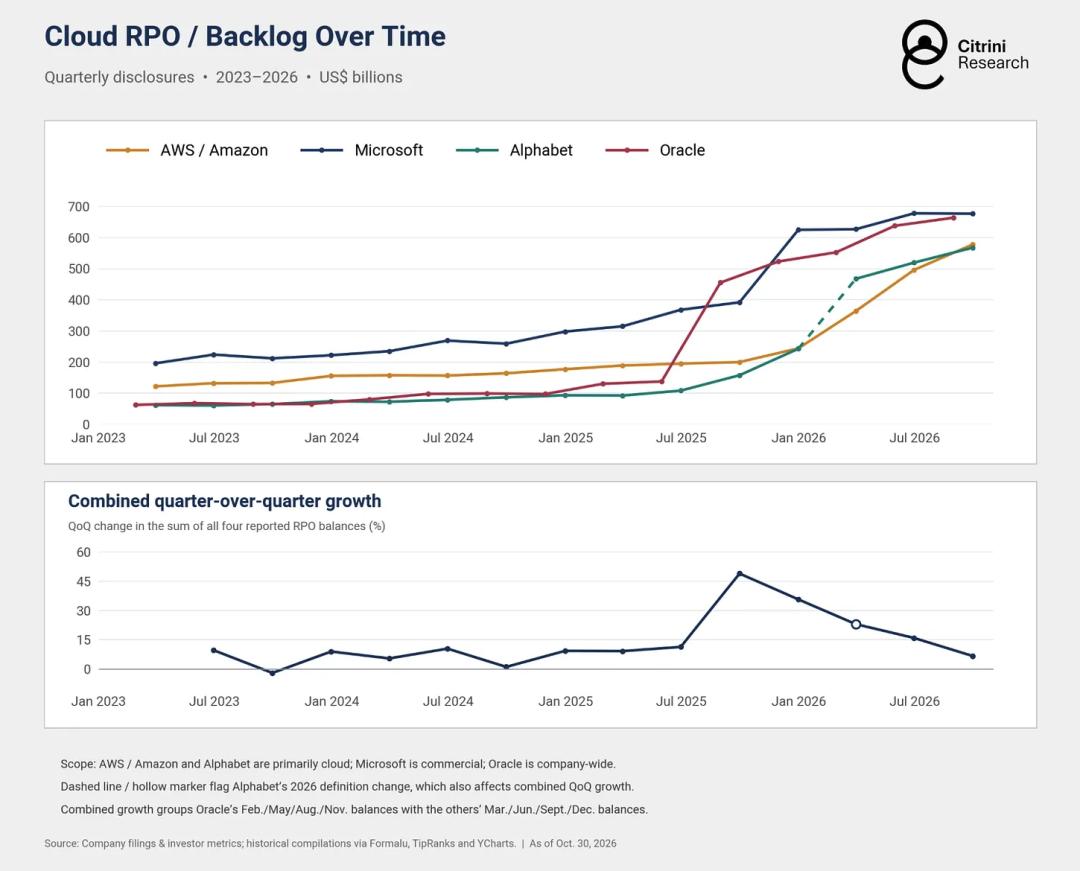
Figure: Since the second half of 2025, the scale of remaining performance obligations of the four companies has expanded significantly, but Citrini points out that their quarterly growth rate has dropped to a relatively low level in recent years, indicating that the pace of expansion of the contract backlog is slowing down.
Among them, the first to be impacted are data center developers and emerging AI cloud service providers that are highly dependent on external financing.
On November 5, CoreWeave's stock price fell by about 10%, and Nebius fell by about 15%. What is more noteworthy is that CoreWeave's 5-year credit default swap spread rose to a record high, indicating that the market's concerns about its credit risk are also rising.
Subsequently, the pressure spread to the semiconductor and storage industries.
AMD fell 17.3% in a single day, NVIDIA fell 9.3%; SanDisk fell by about 22%, and both Micron and Western Digital fell by more than 17%.
Their business structures and profitability vary greatly, but there is a common problem they need to face: can AI infrastructure investment maintain the previously expected growth rate from 2027 to 2028?
Power and cooling equipment enterprises were not spared either. GE Vernova fell 7.5% on November 5, after falling by about 9.3% the previous day.
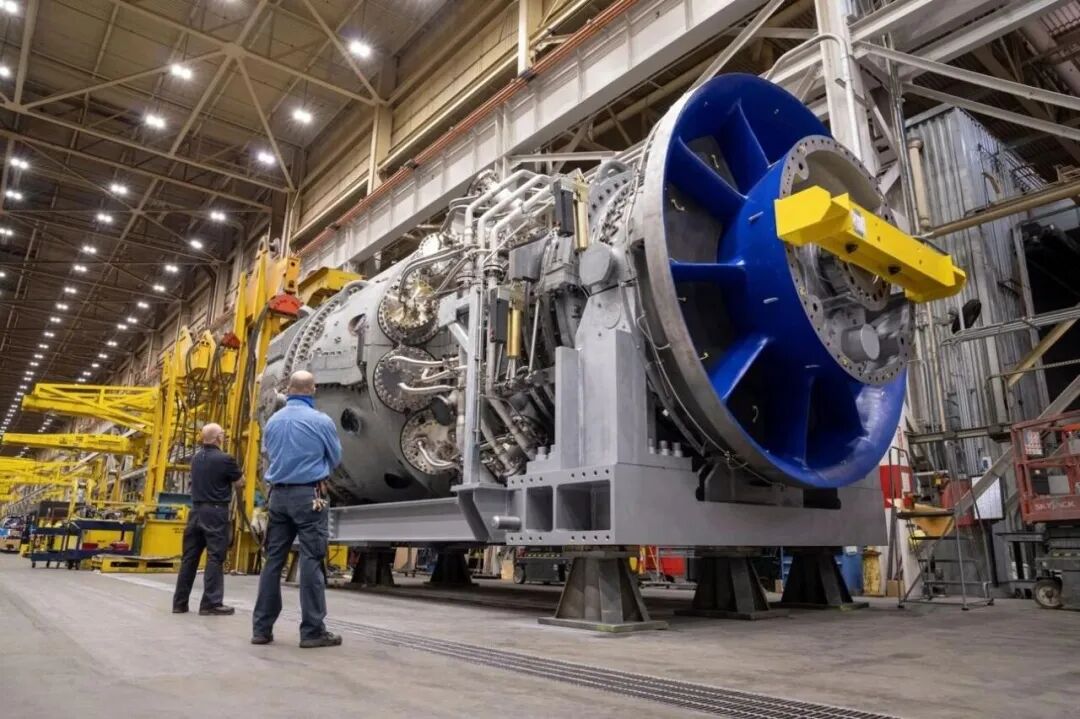
Figure: GE Vernova's gas turbine manufacturing facility in Greenville, South Carolina, USA. The expansion of AI data centers has driven demand for power equipment, while changes in construction plans may also affect suppliers' future order expectations.
What the capital market has always traded is the future, which affects the market's sensitive nerves more than the present and the past.
As a result, this round of adjustment has also shown obvious differentiation: companies that are more dependent on financing conditions and new construction projects are more vulnerable to shocks; enterprises with existing production capacity, mature business cash flow and diversified customers theoretically have stronger buffer capacity.
However, policy and construction risks are only one of the triggering factors. High valuations in the early stage, concentrated positions in tech stocks, differentiation of corporate financial reports and macro fund position reduction have also jointly amplified the decline.
03. Wall Street Divide: Is the AI Trade Over, or Is the Market Overreacting?
On November 4, Citrini Research proposed in its latest *State of the Themes* report that the most optimistic phase of the familiar AI infrastructure investment approach in the past may have passed.
This institution has built an investment portfolio around long-term themes such as AI since 2023, and once obtained high returns by holding companies that benefit from the technological revolution. But it now says that the current market environment is significantly different from that three years ago.
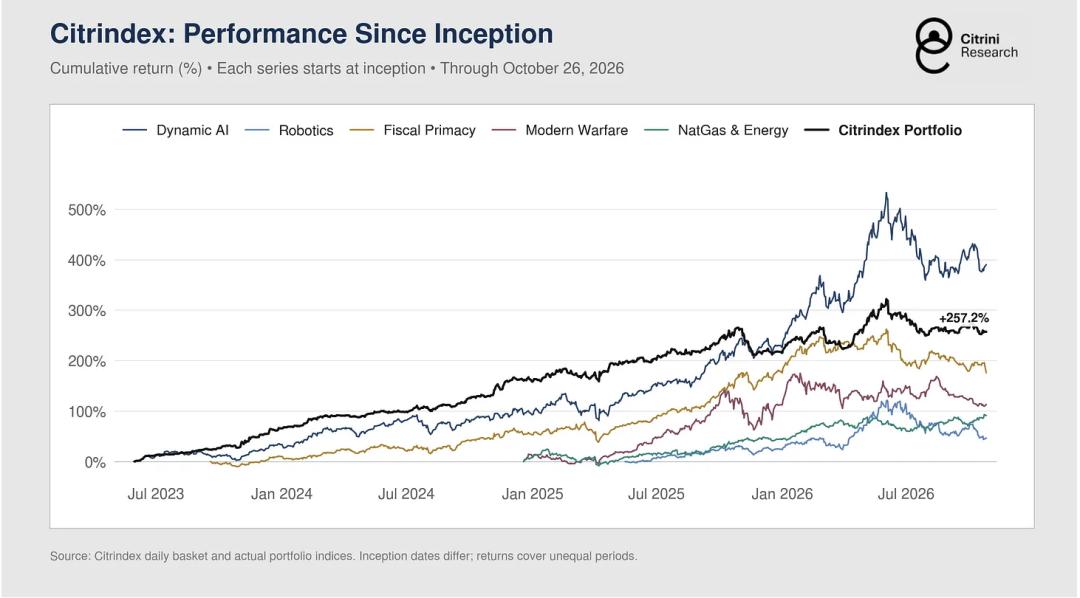
Figure: The cumulative return performance of Citrini Research's investment portfolio and its five major thematic strategies since inception. As of October 26, 2026, the cumulative return of the Citrindex actual investment portfolio is 257.2%, of which the AI thematic strategy once exceeded 500% and then fell back significantly.
In 2023, the valuations of companies such as NVIDIA were relatively low, and AI investment was just starting. As long as investors found companies that could benefit from the growth of computing power demand, they had the opportunity to share the gains from the expansion of the entire industry. The valuations of many stocks have already incorporated optimistic forecasts for the 2030 market size.
Citrini estimates that the annualized revenue of the AI ecosystem has reached at least 200 billion US dollars, while the annualized capital expenditure of large cloud vendors is approaching 1 trillion US dollars.
If capital expenditure continues to expand rapidly, the revenue of model companies and application enterprises needs to grow further to support the return on investment of the entire industrial chain.
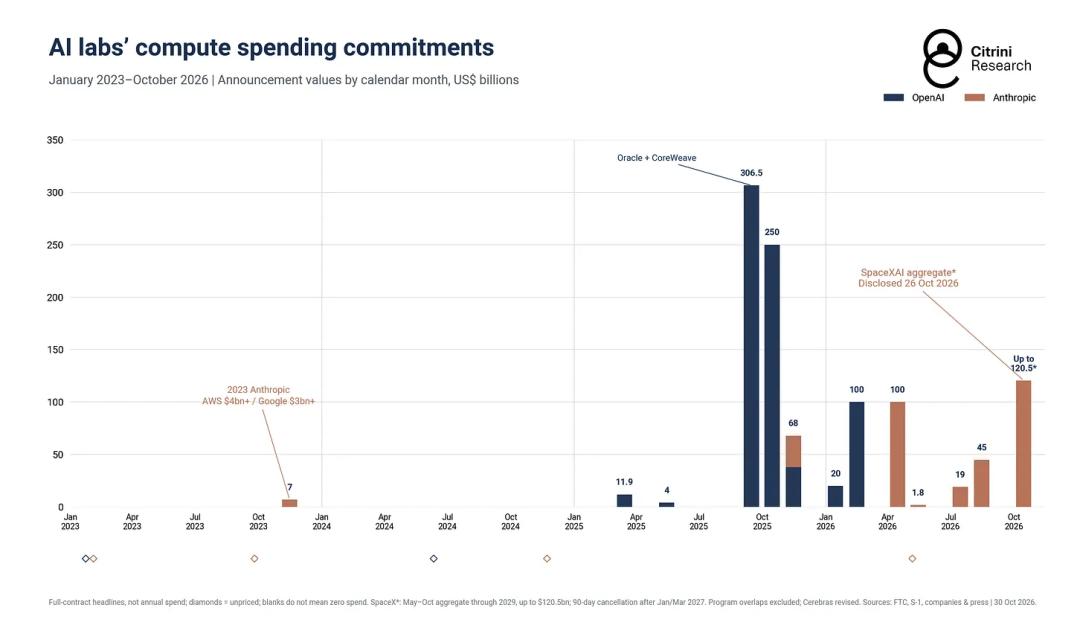
Figure: The amount of announced computing power procurement commitments of OpenAI and Anthropic counted by Citrini Research from January 2023 to October 2026. Since the second half of 2025, the two companies have disclosed significantly more large computing power contracts, among which OpenAI's highest monthly announced amount reached 3065 billion US dollars, and Anthropic's relevant commitments disclosed in October 2026 reached a maximum of 1205 billion US dollars.
Citrini predicts that the growth rate of AI capital expenditure may be approaching its peak, and it will begin to shift its investment portfolio from broadly holding high-beta AI stocks to focusing more on relative value and pair trading based on company quality.
But Wall Street has not reached a unanimous judgment. Dan Ives, who has long been bullish on tech stocks, also believes that the regulatory and approval pressures faced by data center construction may lead to an earlier peak in the future growth rate of capital expenditure. He remains bullish on AI demand, but believes that the adjustment of some semiconductor stocks may not be over yet.
Tom Lee of Fundstrat holds a relatively optimistic view. He believes that local governments need the tax revenue, jobs and investment brought by data centers, and may eventually reach a compromise with tech companies by raising construction conditions. The market may have overpriced the policy shock, and there is still much room for a rebound in tech stocks.
According to Goldman Sachs' trading observations on November 5, some institutional investors reduced their stock positions before the election to deal with uncertain risks, re-entered the market after the rise on November 4, but sold quickly when the market weakened the next day.
Goldman Sachs believes that the main selling pressure on Thursday came from macro trading products, not pure individual stock selling.
An intraday estimate from Nomura shows that leveraged ETFs may need to sell about 47 billion US dollars in stocks before the close for rebalancing, mainly involving technology and AI-related products.
Therefore, the stock price decline on November 5 may include two parts at the same time: investors' re-evaluation of the long-term return of AI, and the short-term trading impact formed by concentrated position reduction.
A single trading day's plunge is not enough to prove that the growth logic of the entire AI industry has failed.
Some investors told Tencent Technology, "AI has just started, and this trend cannot be stopped. Now the reaction and shock are so intense that most people are confused and react in a rather abnormal way, which leads to such huge fluctuations."
04. What Conditions Are Needed For The Next Reversal?
The capital expenditure of the AI industry will not stop immediately due to a stock market crash, and the construction cycle of existing projects may last for several years.
The stock market's adjustment to the future investment growth rate may precede the changes in corporate financial statements. Even if part of the 2028 construction plans are postponed, projects that have already started in 2027 will still continue to drive demand for chips, servers and power equipment.
The short-term market does not lack rebound conditions. Goldman Sachs has observed some investors refocusing on NVIDIA, TSMC, Microsoft and CoreWeave in the late trading session on November 5. Stocks whose previous sell-off was amplified by concentrated position reduction may see a rapid recovery after the capital pressure eases.
However, a technical rebound is completely different from the real repair of the industry's investment logic. Such drastic fluctuations indicate that the market has begun to doubt and deny the old logic.
The following indicators need to be closely monitored next. First is AI revenue growth. Whether model companies, cloud service providers and enterprise applications can maintain a high growth rate and gradually improve operating cash flow will determine whether huge computing power investments can obtain long-term returns. This is the source.
Second is data center delivery. Whether US local governments will really tighten approvals and how much of the planned capacity can be completed on time will affect the actual equipment procurement demand from 2027 to 2028.