With tokens sprouting up just like potatoes, Ulanqab can no longer stay under the radar.
From the City of Potatoes to the Capital of Token
Around the globe, there is hardly any other city that can make both potato and Token its core industries at the same time — but Ulanqab can.
This small grassland city has a permanent resident population of 1.557 million. Its potato planting area has long remained stable at around 4 million mu, with a total output of roughly 4.5 million tons, ranking first among all prefecture-level cities in China. Lamb Weston, one of the world's top three French fries suppliers, has both of its two factories in China set up in Ulanqab.
But recently, this city that is extremely good at growing potatoes has suddenly become a hit in Silicon Valley and Wall Street.
A report from Goldman Sachs specifically conducted research on Ulanqab, describing it as "one of the largest and fastest-growing AI computing power clusters in the Asia-Pacific region." The fact that a Wall Street investment bank wrote a research report exclusively for a small city in northern China speaks volumes in itself.
Three of the top four domestic operators in China have invested in GW-level large projects here; leading enterprises and emerging AI players including Huawei, Kuaishou, ByteDance, Alibaba, and DeepSeek have all made their layouts here. Among them, Envision Group's Xinghe project in Ulanqab is the world's largest AI computing power super single unit — covering 120,000 square meters, equivalent to 20 standard football fields, with a total planned capacity of 2GW in the park.
According to official media reports, up to now, the city has signed a total of 109 computing power center projects, with the signed rack scale exceeding 7 million units, the operating computing power scale reaching 190,000P, and the intelligent computing proportion exceeding 90%. Goldman Sachs data shows that as of June 2026, the total capacity of data centers that have been put into operation and planned in Ulanqab has reached 12.5GW, representing an expansion of more than 10 times compared with the commissioned capacity in 2025.
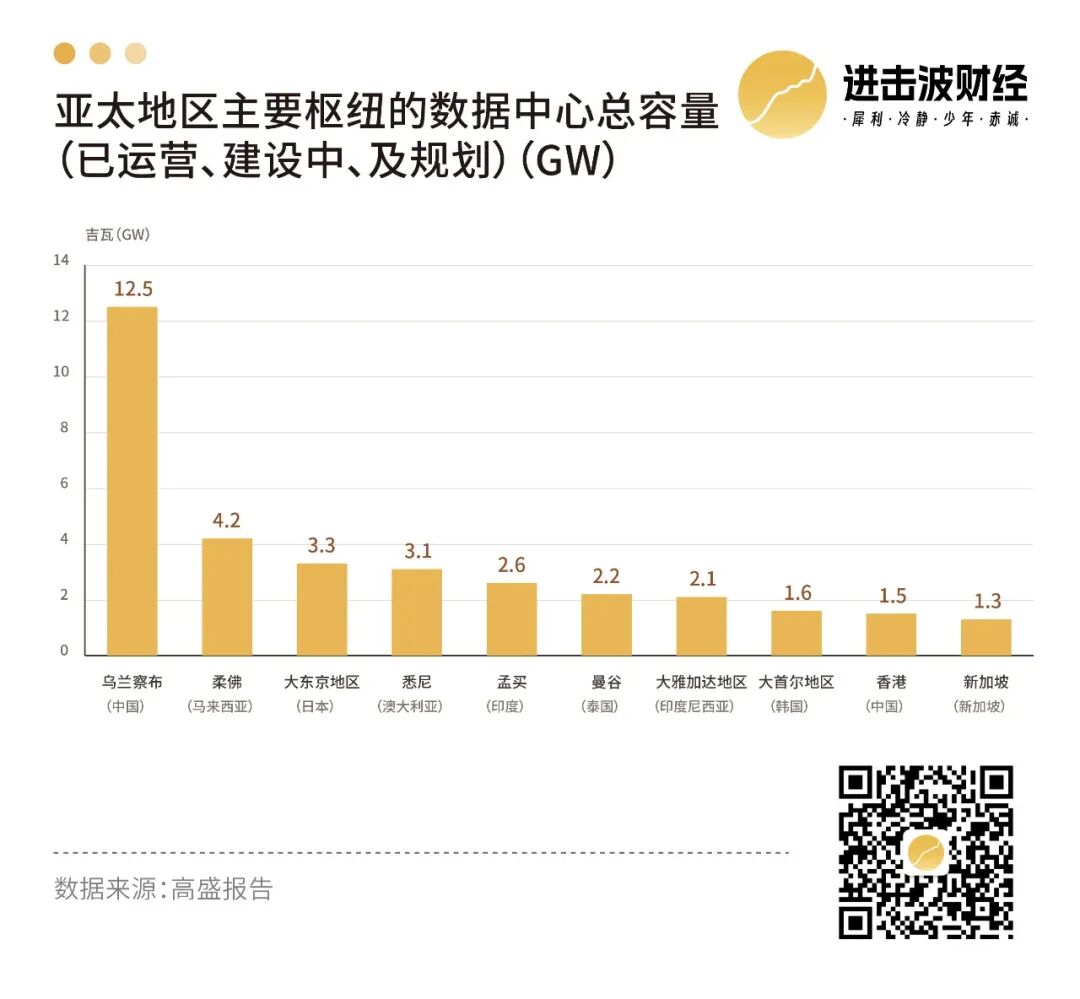
As a reference, last year Trump announced at the White House with great fanfare that OpenAI, SoftBank and Oracle would jointly invest 500 billion US dollars to launch the "Stargate" initiative, aiming to build computing power supporting facilities with a total power of 10GW in the United States.
The planned capacity of Ulanqab has exceeded the target total power of the "Stargate" initiative.
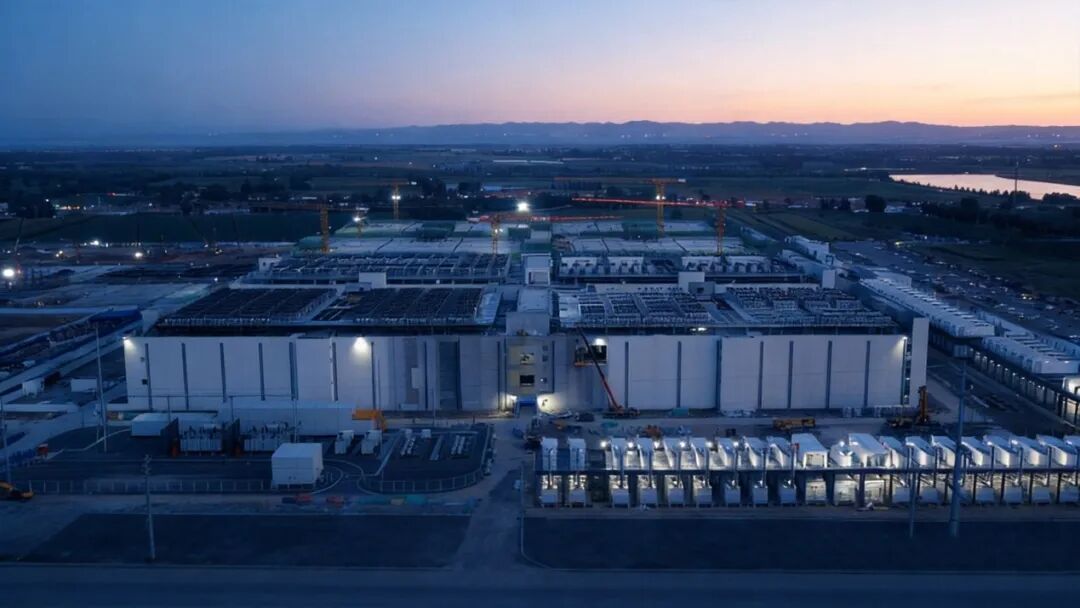
Source: Envision official website
Recently, some people have begun to call it "the cosmic center of AI". Has this grassland city really transformed into a technology city?
The End of AI Is Power, and the End of Power Is Ulanqab?
Jensen Huang divides AI into five layers, from bottom to top: energy, chips, infrastructure, models and applications.
Energy is the foundation of the AI industry, and also the physical constraint that determines how much intelligence the system can finally deliver. In the first quarter of 2026, at least 75 AI data center projects in the United States were delayed or forced to shut down, involving an investment amount as high as 130 billion US dollars; the 45 projects affected in the second quarter accounted for more than half of all large new projects tracked by AI intelligence firms.
A large part of what held them back was electricity.
The latest research from Morgan Stanley shows that data centers in the United States are facing an increasingly severe power shortage, and by 2028, US data centers may face a power supply gap of about 32GW.
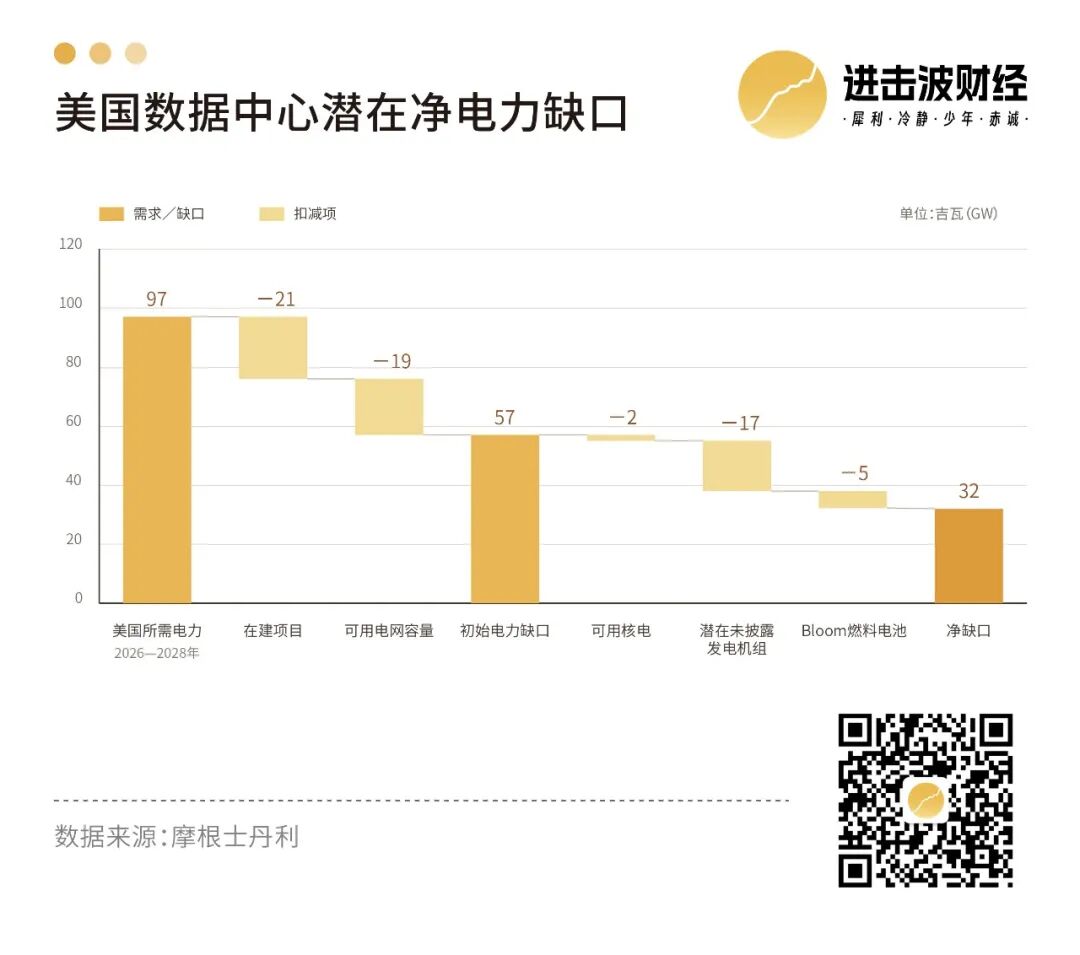
Essentially, AI data centers are factories that convert electricity into computing power. Power is input at one end of the chip, and intelligence is output at the other end. Electricity locks in its upper limit of scale, operating cost and expansion speed. That's why people no longer measure the size of data centers by the number of servers, but by the power unit "GW".
Abundant and cheap green power is exactly another local specialty of Ulanqab besides potatoes. It has three major advantages in the energy sector.
Source: CCTV News
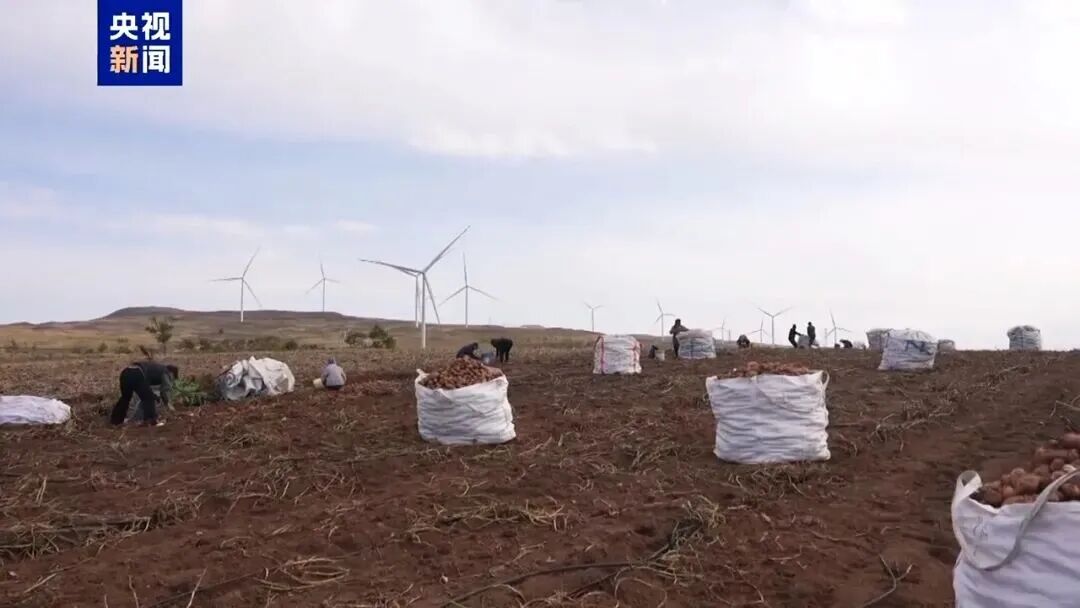
The first advantage is wind and solar resources. Among the 8760 hours in a year, the effective wind hours in Ulanqab account for 7300 hours, and there is a local saying that "there are two winds a year, each blowing for half a year"; the annual sunshine duration exceeds 3200 hours, making it a high total radiation area second only to the Qinghai-Tibet Plateau in Northwest China. Such natural endowments bring sufficient green power supply to Ulanqab — the grid-connected installed capacity of new energy is roughly equal to the installed capacity of the Three Gorges Hydropower Station, and the electricity price is only half of that in Beijing.
The second advantage is the cold climate. Servers and GPUs generate huge amounts of heat, and the power consumption of the cooling system even accounts for one third of the total power consumption. The annual average temperature in Ulanqab is only 4.3℃, and the average summer temperature is 18.8℃. Natural cold sources can be used to cool the computer rooms for nearly 10 months a year. Under the same technical conditions, it can save 20% to 30% of energy consumption.
The third and most solid advantage is the West Inner Mongolia Power Grid. The West Inner Mongolia Power Grid where Ulanqab is located is the only provincial-level independent power grid in China. Its independence is another story in history.
In 2002, the national power system reform split the State Power Corporation of China into five major power generation groups and two major power grids. At that time, the predecessor of the West Inner Mongolia Power Grid was not incorporated into the State Grid system. The explanation in public materials is generally that the State Grid was unwilling to take it over due to its small scale and heavy debt. No one expected that the national power shortage broke out in 2004, and West Inner Mongolia rose rapidly with its coal, wind and solar resources. At that time, the State Grid tried to acquire it, but the regional government was no longer willing to give it up.
As a result, the West Inner Mongolia Power Grid has become a provincial-level independent power grid in China's power system, independent of the State Grid and China Southern Power Grid. Independence means independent pricing, independent trading, and greater freedom to explore new models of direct green power connection. In July 2025, the source-grid-load-storage integration project of Ulanqab Zhongjin Data Low-Carbon Computing Power Base was connected to the grid, becoming the first data center green power direct connection source-grid-load-storage integration project in China.
The burden that no one was willing to take over in those days has become a moat that everyone envies now.
More importantly, it is located in a very strategically advantageous geographical position.
It is close enough to Beijing: the straight-line distance from Ulanqab to Beijing is only 240 kilometers, roughly the distance from Shanghai to Yangzhou, which brings high convenience for data transmission, communication and operation and maintenance; at the same time, it is far enough from Beijing: 240 kilometers away, the electricity price, land price and temperature are completely different.
Industry insiders have calculated that for a 1GW-scale data center, the annual electricity cost difference between locating it in the eastern region and the western region can reach 5 billion yuan.
This makes Ulanqab's computing power story attractive enough, but there is another side to the story.
Ulanqab, Which "Grows" Token, Has Not Yet Made Money From AI
Ulanqab once had a very successful investment promotion case, which was the introduction of Lamb Weston, one of the world's three largest French fries suppliers. Processing raw materials into semi-finished products in the production area can retain part of the added value locally.
Today's computing power development model is a replica of this logic — processing electricity into computing power and then delivering it out.
But there is the second half of the story. In the French fries value chain, the most profitable part is not potato growing and potato processing. The pricing power of KFC and McDonald's, and Lamb Weston's global procurement system jointly determine how much each link in this chain can get. The total output value of Ulanqab's potato whole industry chain is about 80 billion yuan, with an annual output of about 4.5 million tons. The output value of the whole industry chain allocated to per jin of potatoes is less than 0.9 yuan. The processing fee obtained by the production area and processing plant is the thinnest part with the least room for growth.
The structure of the computing power industry chain is highly similar to this.
In the computing power industry, core components such as GPUs, HBMs and optical modules account for 40% to 50% of the total investment, and server assembly accounts for 15% to 20%. What is really retained locally in Ulanqab is mainly land transfer fees, civil construction costs, electromechanical installation fees and daily electricity bills, adding up to 10% to 15% of the total investment. The value of one kilowatt-hour of electricity is amplified by 10 to a hundred times after it is converted into computing power, but most of the amplified profits and valuation do not belong to Ulanqab.
The attribution of tax revenue is more straightforward. After the computing power center is put into operation, most of the tax generated is uniformly handled by the parent companies of the giants registered in other regions. The tax sources retained in Ulanqab are mainly land property tax and a small amount of individual income tax from local operation and maintenance personnel. Only a very small part of the tax paid by large enterprises can go into Ulanqab's fiscal revenue.
There is also an obvious ceiling for driving employment. An ultra-large data center requires thousands of workers during the construction period, but only dozens of full-time maintenance personnel may be needed after completion. At present, the total number of direct employees in data centers across the city exceeds 15,000. For a city with a permanent resident population of about 1.5 million, this number is not small, but it seems relatively thin when placed against the 500 billion yuan investment scale.
Resources can be transformed into valuable computing power in the AI era, but if the value-added links are not located locally, the money will flow elsewhere. Local official sources admitted that the computing power industry is still in the investment period and "is still losing money".
Epilogue
Back to the question at the beginning: Has Ulanqab really become a technology city?
The answer depends on from which perspective you look at it.
Ulanqab in 2026 has indeed become a city of computing power. The 12.5GW planned capacity and the investment of more than 500 billion yuan are real figures. The fate of this small grassland city has been rewritten once.
But from "producing computing power" to "using Token", there is a complete set of ecosystem in between.
Ulanqab is not unaware of this point.
At the end of 2025, the "Three-Year Action Plan for Ulanqab to Build the 'Capital of Token' (2026-2028)" was issued, clarifying the three-level upgrading path of "Grassland Cloud Valley — Intelligent Computing City — Capital of Token". By 2028, industrial transformation will be realized and computing power services, Token trading and intelligent applications will be deployed. The core intention is to shift from "producing computing power" to "participating in Token value circulation", and engage in businesses with higher value density.
What determines the value of a potato is not only what grows out of the ground, but also who holds the brand, channels and pricing power. The same goes for computing power.
Ulanqab's Token story has only just begun.
This article is from the WeChat official account "Advance Wave Finance" (ID: jinbubo), written by Advance Wave Research Institute, and authorized for release by 36Kr.