36Kr Exclusive | A heavy-duty physical AI company has raised nearly 400 million yuan in financing within one year of its establishment. Its core members are from Huawei and Li Auto, and it has operated more than 100 vehicles.
Author | Qiao Yujie
Editor | Yuan Silai
This article is about 2800 words, with an estimated reading time of 7 minutes
Hard Krypton has learned that Shanghai EABOT Technology Co., Ltd. (EABOT, hereinafter referred to as "EABOT") has recently completed two consecutive rounds of financing totaling nearly 400 million yuan. Its investors include well-known investor Ge Weidong, Chentao Capital, Hony Capital, Zero One Auto, Xingfu Capital, Starq Fund under Falcon Investment, and other institutions.
EABOT was founded in February 2026, focusing on heavy-duty industrial physical AI, with its core business being the R&D of "Mobility + Manipulation" physical AI models for heavy-duty scenarios. At present, the company has operated more than 100 heavy trucks, covering 60 routes, which are mainly concentrated in the short-distance transfer scenarios of bulk materials within 0-300 kilometers, and has carried out real-road zero-takeover tests on complex road conditions in different regions such as Xinjiang and Inner Mongolia.
The synchronous advancement of model R&D, on-board verification and fleet operation within one year marks that EABOT's technical route has officially entered the real business scenario verification stage. At this stage, EABOT takes heavy truck autonomous driving as the entry point, and in the long term hopes to expand its technical capabilities to heavy-duty industrial scenarios such as mines, power plants and ports.

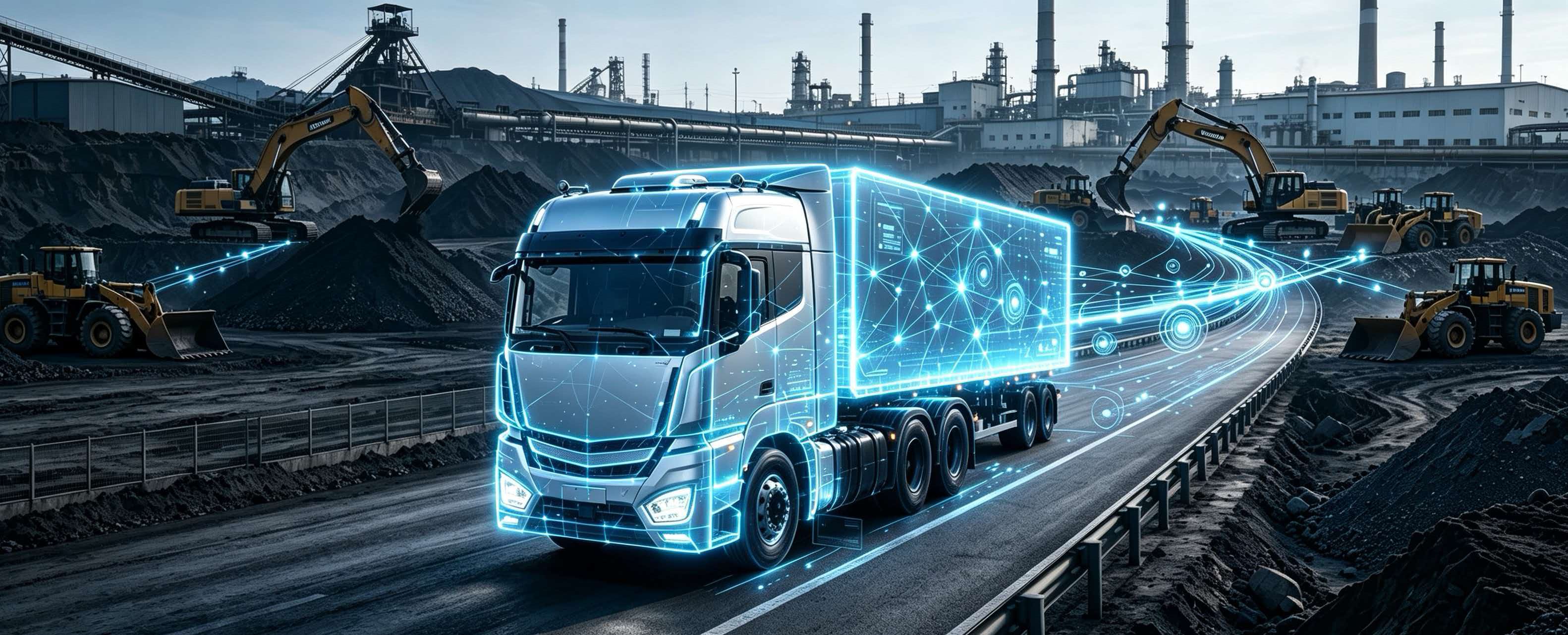
(Image source / Enterprise)
The core members of the EABOT team come from leading enterprises such as Huawei, Li Auto, Momenta and Apple, covering fields including autonomous driving, AI model R&D and engineering implementation, with solid technical and practical experience. Among them, Li Wei, the CTO, once served as the head of algorithms at Inceptio, and participated in R&D and operation support from 0 to 1.
Li Wei introduced to Hard Krypton that the company's model architecture is based on the AI-native paradigm, adopts the Efficient Physical AI technical route, takes general multimodal and world models as the underlying base, supports the special driving capabilities for L4 heavy trucks upward, and realizes continuous feedback and evolution of data and models through the real physical closed loop. The long-term goal is to generalize from heavy truck scenarios to all heavy-duty industries.
Specifically, in this model architecture, the general multimodal pre-training base is responsible for learning scenarios, spatial relationships and environmental changes; the world model is used to generate training data, supplement complex edge scenarios, and assist model training and simulation evaluation. On this basis, the company enhances the model's understanding and execution ability of driving tasks through post-training, and conducts reinforcement learning training for rule compliance and safety requirements.
At the vehicle-side execution level, EABOT has uniquely created the TwinFast "Dual-Fast Collaborative Cognitive Driving System", in which the JEV decision system is responsible for fast scenario judgment and decision-making, and the E2E end-to-end planning system converts decisions into specific vehicle control actions.
The traditional autonomous driving architecture usually completes tasks through the collaboration of a high-level decision model and a real-time planning system. The former is responsible for understanding complex scenarios and making decisions, while the latter is responsible for generating real-time trajectories. However, if the high-level model has a slow reasoning speed, even with strong scenario understanding capabilities, it is difficult to affect the real-time behavior of the vehicle in time. TwinFast is an improvement to the traditional fast-slow system. Its core is to improve the efficiency of high-level decision-making, so that it can better match the speed of the real-time planning system, thus giving full play to the role of AI models in complex driving scenarios.
According to CTO Li Wei, another major advantage that allows EABOT's model to be quickly implemented lies in the data collection and processing system.
At present, the company adds more than 2 million new data clips on average per month, with the automatic labeling scale exceeding 100 million frames. Focusing on the data closed loop, the team has built a complete process covering data infrastructure, data mining, data processing and automatic labeling, and set up an operation team to manage more than 100 vehicles and more than 100 drivers to continuously collect real road data.
For autonomous driving models, data scale is only the foundation. The coverage of complex scenarios, the efficiency of data processing and labeling, and whether the model can continuously obtain feedback from actual operation also affect the R&D progress. EABOT hopes to shorten the cycle from problem discovery to model iteration through the closed loop between vehicle operation, data processing and model training.
In terms of commercialization, EABOT currently mainly verifies L4 autonomous driving solutions and supporting operation processes through its self-operated fleet. For traditional transport fleets, deploying autonomous vehicles is not just about purchasing a set of software, but also involves a full set of operation capabilities such as vehicle management, scheduling, daily operation and maintenance, and exception handling. Therefore, the company plans to hold and operate vehicles by its own team first, verify the technology and cost model, and then output "AI Driver Services" including vehicles, software systems and operation standards to customers, and gradually deliver mature unmanned operation solutions to customers.
From the perspective of industry space, heavy truck autonomous driving is not a single vehicle intelligence market. Its potential value also includes the operation management of transport fleets, vehicle scheduling, energy management, and subsequent collaboration with loading, unloading and other operation links. If autonomous driving can extend from single-vehicle capabilities to the entire transport chain, the corresponding market will no longer be limited to traditional intelligent driving software and hardware, but a comprehensive service market for bulk material transportation and heavy-duty industrial production. The company plans to further expand from heavy trucks to scenarios such as excavators and loading equipment in the future, to realize full-process unmanned operation in heavy-duty industrial scenarios such as mines.
The following is an excerpt from the communication between Hard Krypton and Li Wei, CTO of EABOT:
Hard Krypton: Why did you choose to enter the heavy truck field to do physical AI at this point in time?
Li Wei: We think now is a relatively good time window to enter the heavy truck autonomous driving track. The core reason is that the technical paradigm is changing. In the past, autonomous driving mainly relied on rule-based methods, and industry players have accumulated a large number of R&D achievements on this technical system. However, with the gradual maturity of AI-driven technical routes, especially the continuous development of end-to-end autonomous driving for passenger vehicles and new technologies based on large models, the industry is ushering in a new technical inflection point.
When the technical paradigm changes, new players have the opportunity to bypass the historical burden of traditional technical routes and build advantages directly based on the new architecture. Taking the passenger vehicle field as an example, end-to-end technology has shown obvious performance improvement compared with traditional solutions, and the practice of companies such as Tesla is also promoting the industry to further evolve towards the AI-driven route.
Hard Krypton: Data accumulation is one of the company's advantages. Is this related to the team's previous research experience, or did the company quickly establish data collection and labeling capabilities after its establishment?
Li Wei: More importantly, we have positioned ourselves as a physical AI company from the very beginning, and taken data infrastructure as our core capability for construction. Focusing on the data closed loop, we have built a series of infrastructures from data collection, data mining, data processing to automatic labeling, and set up an operation team responsible for data collection and quality management.
At present, more than 100 of our vehicles are put into data collection, and we also manage a driver team of more than 100 people and corresponding fleet management personnel to continuously obtain real scenario data that meets the needs of model training. For physical AI, data must not only have scale, but also be continuously collected, processed efficiently, and truly serve model training and iteration.
Hard Krypton: What is the difference between the TwinFast dual-fast system and the fast-slow system in traditional autonomous driving?
Li Wei: The traditional fast-slow system usually consists of a high-level decision model and a real-time planning system. The former is responsible for understanding the scenario and judging what action to take, while the latter is responsible for generating specific trajectories and controlling the vehicle to execute.
The problem is that although the high-level model has strong understanding and reasoning capabilities, if the reasoning speed is slow, it will be difficult to affect the real-time behavior of the vehicle in time. For example, if the high-level model can only complete one inference per second, while the underlying planning system can generate ten or more planning results per second, there will be a mismatch in response speed between the two.
Our idea is to make the high-level decision system faster, while retaining the speed advantage of the real-time planning system. The traditional decision-making method based on multimodal language models often needs to generate Tokens one by one to form a chain of thought, which may bring high latency in driving scenarios. The dual-fast system can reduce the dependence on Token-by-Token generation, allowing the model to complete scenario judgment and action selection more directly and efficiently, so that decision-making and planning can collaborate better.
Hard Krypton: The company was established not long ago, and both model R&D and on-board progress are relatively fast. What do you think are the key factors behind this?
Li Wei: I think there are three main factors.
The first is the choice of technical paradigm based on physical AI positioning. We have positioned ourselves as a physical AI company since our establishment, so we chose the AI-driven paradigm, and directly built the architecture around a more generalizable technical route.
The second is data infrastructure and operation capabilities. We have attached great importance to data construction since the establishment of the company. We have not only built a data collection, processing and labeling system, but also continuously obtained real scenario data through the vehicle and driver team. This set of infrastructure can help us accelerate model iteration.
The third is the talent density of the model team. Our core team has strong AI model R&D capabilities. We hope to organize R&D in an AI-native way from the very beginning, taking model capabilities as the core, instead of making partial modifications on the original rule-driven technical system.