The prices of medical aesthetic consumables have plummeted, delighting consumers while leaving enterprises such as Bloomage Biotech, Giant Biogene and Aimeike in a difficult situation?
"Facing the sweeping wave of price cuts, are we fully prepared?" Li Bin, Founder and Chairman of United Lige Medical Aesthetics Investment Group, raised such a question in his article *The Approaching Tide of Product Price Reductions*.
Jin Xing, the founder of New Oxygen, also made a prediction: "Within three years, the supply price of the vast majority of medical aesthetic consumables for institutions will probably drop below 100 yuan. In each track, there may only remain one or two brands that focus on high-end premium positioning similar to luxury brand positioning."
On the other side, the price reduction war has already ignited at the terminal institutional end. Yuansong Group launched an annual membership card with rights and interests valued at over 45,000 yuan during the Double 11 shopping festival, which is sold for only 9,999 yuan; there is also an annual card with rights and interests worth over 100,000 yuan priced at 29,800 yuan. Not only Yuansong, low-price packages such as 99 yuan for three photon therapy sessions, 199-yuan super photon therapy experience, and 880-yuan double eyelid surgery are emerging in endlessly on the market, with various promotion posters spreading everywhere.
Almost at the same time, internet-savvy Jin Xing, capital-experienced Li Bin, the battle-hardened Yuansong Group and various medical aesthetic institutions are all facing this upcoming price reduction wave head-on. Is the medical aesthetics industry really about to usher in an era of comprehensive price cuts? Can this price war push domestic medical aesthetics to embark on a Korean-style large-scale development path?
01
Institutions' Caution Collides with the Supply Surge
At present, medical aesthetic consumables on the market are divided into three categories: Class I consumables represented by medical gauze and examination gloves, Class II consumables represented by hydrating dressings and repair facial masks, and Class III consumables that need to be implanted or injected into the dermis/subcutaneous layer. Among them, Class III consumables have the highest risk and are subject to the strictest regulatory control.
"Our institution stopped all injection-related projects as early as the beginning of this year." Hu Min (pseudonym), the owner of an institution in Shandong, told *Seeing the Beauty Industry*.
"The core reason why we stopped these projects is that the risks outweigh the benefits," Hu Min explained:
First, the regulatory control over injection projects is becoming increasingly strict, bringing considerable operational uncertainty to institutions. "In the past, there were many chaos in the industry, and strict supervision is definitely a good thing in the long run. But once non-compliance problems are detected, the institution will be fined at the lighter level, and ordered to suspend business for rectification at the serious level. In the past, there was still room for negotiation to reduce fines, but this path is no longer feasible now. The customer loss and fixed cost loss caused by business suspension cannot be covered by the profits earned from injection projects at all."
Second, consumers' acceptance of injection projects is declining. "Some customers will have problems such as stiff face and unnatural expressions after the operation. We not only have to deal with customer complaints, but also face the risk of customer loss and no repeat purchases. In the early years, customers were still willing to pay for repair treatment, but now people's consumption is becoming more and more rational and unwilling to make additional investment; even some customers directly buy consumables on e-commerce platforms by themselves, and only want to pay for the manual injection service when they come to the store."
Third, counterfeit and copycat products are rampant in the market, and medical aesthetic institutions have great concerns when making purchases. "If we accidentally purchase counterfeit or copycat products and an accident occurs after injection, the institution will face claims of hundreds of thousands of yuan at the lighter level, and even have its license revoked by the regulator at the serious level, which is really not worth the loss."
Hu Min's concern is not an isolated case. Public data shows that the genuine rate of circulating medical aesthetic injections in 2024 was only 35%; the *ISAPS 2025 Global Survey Report* shows that the number of hyaluronic acid filling cases and poly-l-lactic acid (anti-aging) injection treatment cases was 4.74 million and 426,000 respectively, down 25.2% and 33.7% year-on-year.
On the one hand, institutions are becoming more and more cautious about injection products, and their willingness to purchase continues to decline; on the other hand, the dividend of product approval certificates is fading, and a large number of new products are intensively approved for listing. According to the statistical caliber of *2026 Annual Insight Report on China's Medical Aesthetics Industry*: from July 2025 to June 2026, a total of 46 Class III injection devices were approved within one year, including 25 hyaluronic acid products and 12 collagen products, and 26 photoelectric therapy products were also approved in the same period.
With the surge in supply, medical aesthetic consumables manufacturers have to cope with the price war launched by their peers. Haohai Bio mentioned in its 2026 Q3 financial report that the sales of hyaluronic acid products continued to face pressure, and revenue dropped sharply year-on-year; Jinbo Bio also stated in its 2026 Q3 financial report that the selling price of its core product recombinant type III humanized collagen implant has decreased.
Internally, enterprises need to recover the investment in new product R&D and registration as soon as possible, and amortize the depreciation cost of production lines at the same time. Jinbo Bio mentioned in its 2026 Q3 financial report that the increase in depreciation and amortization of the new production workshop has further squeezed the profit margin.
For the downstream, in the face of increasingly conservative procurement of medical aesthetic institutions, increasing discounts and expanding customer groups have become the main way to break through the predicament. In Q3 2026, Aimeike's sales expenses increased by 47.57% year-on-year. The financial report explained that this was due to the establishment of a new product division, and the rise of staff salaries and new product marketing promotion expenses.
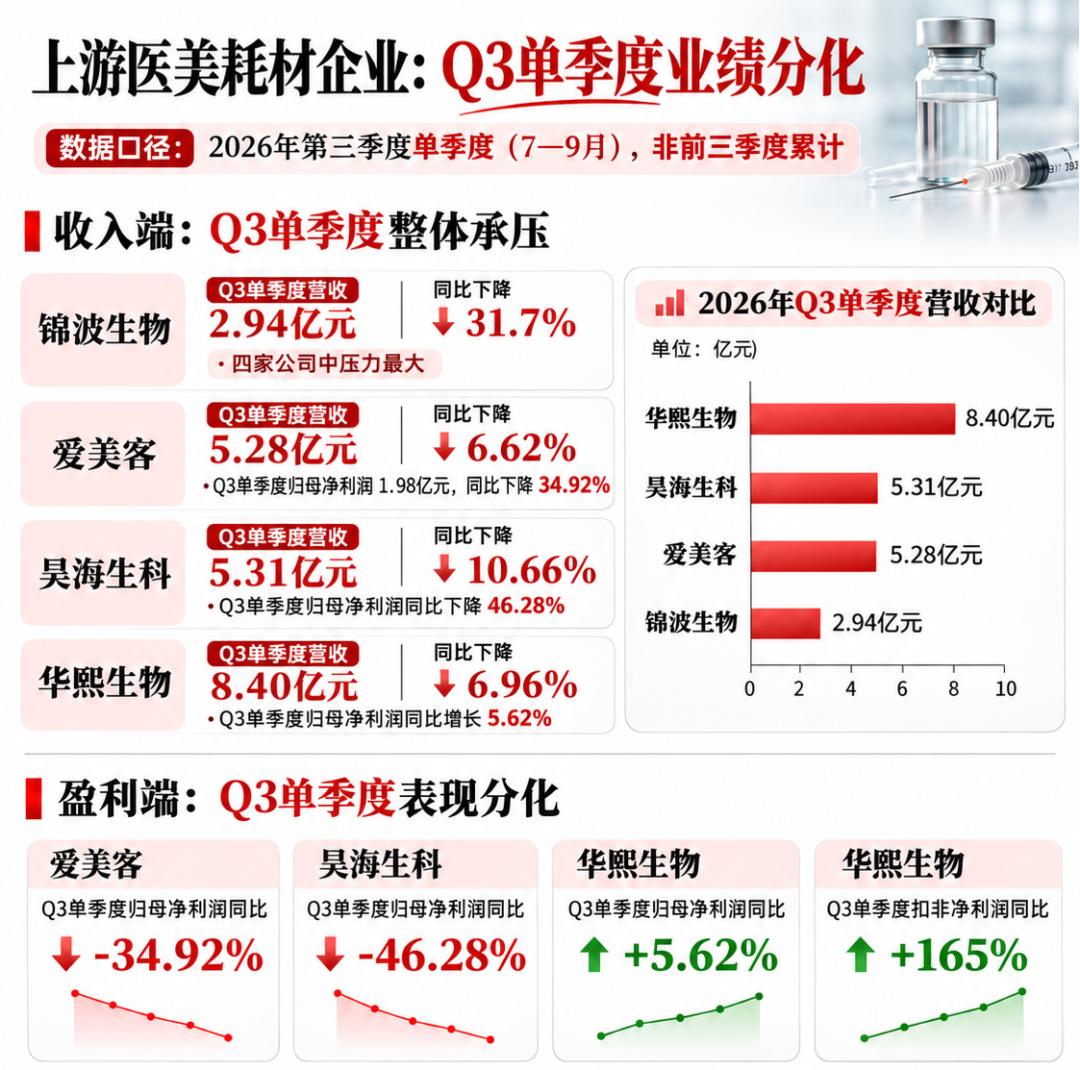
With multiple pressures superimposed, seizing the market through price cuts has become the fastest-acting choice, at the cost of the overall performance of upstream consumable manufacturers being under pressure. Looking at the single-quarter data of Q3 2026: the revenue of Jinbo Bio, Aimeike, Haohai Bio and Bloomage Bio decreased by 31.7%, 6.62%, 10.66% and 6.9% year-on-year respectively. On the profitability side, Bloomage Bio's attributable net profit increased by 5.62% year-on-year, while Aimeike and Haohai Bio's attributable net profit decreased by 34.92% and 46.28% year-on-year respectively.
(Source: Compiled based on financial reports of listed companies)
The continuous price reduction of upstream consumables has instead brought performance opportunities to medical aesthetic institutions. In the first three quarters of 2026, Lancy Co., Ltd.'s total revenue increased by 8.81% year-on-year to 4.709 billion yuan; the revenue of the medical aesthetics sector increased by 8.7% year-on-year. The company's overall attributable net profit plummeted by 79.45% to 203 million yuan, but the net profit of the medical aesthetics sector surged by 145.4% year-on-year. This means that Lancy's medical aesthetics business has achieved double growth in revenue and profit.
02
Difficulty in Customer Acquisition and Weak Upselling, Medical Aesthetics Usher in Price Reduction Expectations
According to the data from Deloitte and Allergan, the net increase in the number of medical aesthetic institutions dropped from about 500 in the first half of 2025 to about 100 in the first half of 2026. When the price competition of some consumables continues to be fierce and the pricing power flows to the institutional end at an accelerated pace, will the operating pressure of institutions push the consumable end to continue cutting prices?
"Now let alone opening new stores, even old stores that have been in business for seven or eight years don't know how long they can survive." Zhang Yang (pseudonym), the owner of an institution in Anhui, told *Seeing the Beauty Industry*.
In his view, "The cost of a 20,000-yuan poly-l-lactic acid anti-aging injection may only be 1,000 yuan, the cost of an 18,000-yuan polycaprolactone dermal filler is 600 to 700 yuan, and the cost of a certain brand of 5,000 to 6,000-yuan salmon-derived injection is 100 to 200 yuan." Excessive profit has become the core of the previous industry operation model of institutions: "intensive advertising investment → conversion of sales leads → invitation of customers to the store → upselling conversion → old customers bringing new customers, continuing to expand new customer groups".
Upselling and acquiring new customers are the foundation for the continuous operation of this model, but now this model is becoming more and more unstable.
On the new customer acquisition side, on the one hand, public top tertiary hospitals, large chains, and doctors' personal IPs are all competing for customers. In particular, top tertiary hospitals, with the advantages of "professionalism + public welfare + transparency", have taken away a large number of customers from private institutions. Deloitte and Allergan's Q1 2026 survey of 2,000 medical aesthetic seekers also pointed out that 55% of people prefer to choose public hospitals when they experience medical aesthetics for the first time.
On the other hand, Meituan, Douyin and Xiaohongshu, as important positions for institutions to acquire new customers, are no longer easy to operate. After communicating with many peers, Zhang Yang found that Douyin's medical aesthetic feed ads have been changed to a targeted invitation mode, and the investment threshold is getting higher and higher.
When institutions generally have difficulty in acquiring new customers, is AI a benefit or an impact on medical aesthetic customer acquisition?
In Zhang Yang's view, AI has indeed brought efficiency improvement, and GEO has gradually become a new direction for customer acquisition. But its direct impact is to eliminate the information gap in the industry, and platforms are also continuously cracking down on AI-generated fake comparison pictures.
The indirect impact is: is AI accelerating the devaluation of appearance premium? Groups that make a living by their appearance, such as models, short drama actors, and scenic area NPCs, were originally the core customer groups of institutions. Now AI has impacted their work, and after their income declines, their medical aesthetics budget will naturally shrink accordingly.
Difficulty in acquiring customers has become the reason why medical aesthetic institutions are concentrating on low-price drainage. Embarrassingly, some media quoted institutional operation data showing that the upselling rate of low-price drainage customers is generally only 8% - 12%. Why is the upselling rate so poor?
There are not only problems with customers' own mentality of wanting to get benefits for free, but also problems with the institutions themselves. For example, the income of the institution's aesthetic consultants is linked to performance, and they will default that customers who buy low-price packages have limited consumption capacity, so they will naturally not pay enough attention in the service process; in addition, many medical aesthetic projects such as hyaluronic acid are non-rigid consumption, so customers will not consider upselling.
In addition to this part of drainage customers, there is another type of customers whose expectations are raised by AI renderings. Hu Min said that some customers come with AI-generated refined renderings, demanding to achieve a 1:1 effect according to the pictures. After the operation, they find that the effect cannot meet their expectations, and they will no longer make repeat purchases.
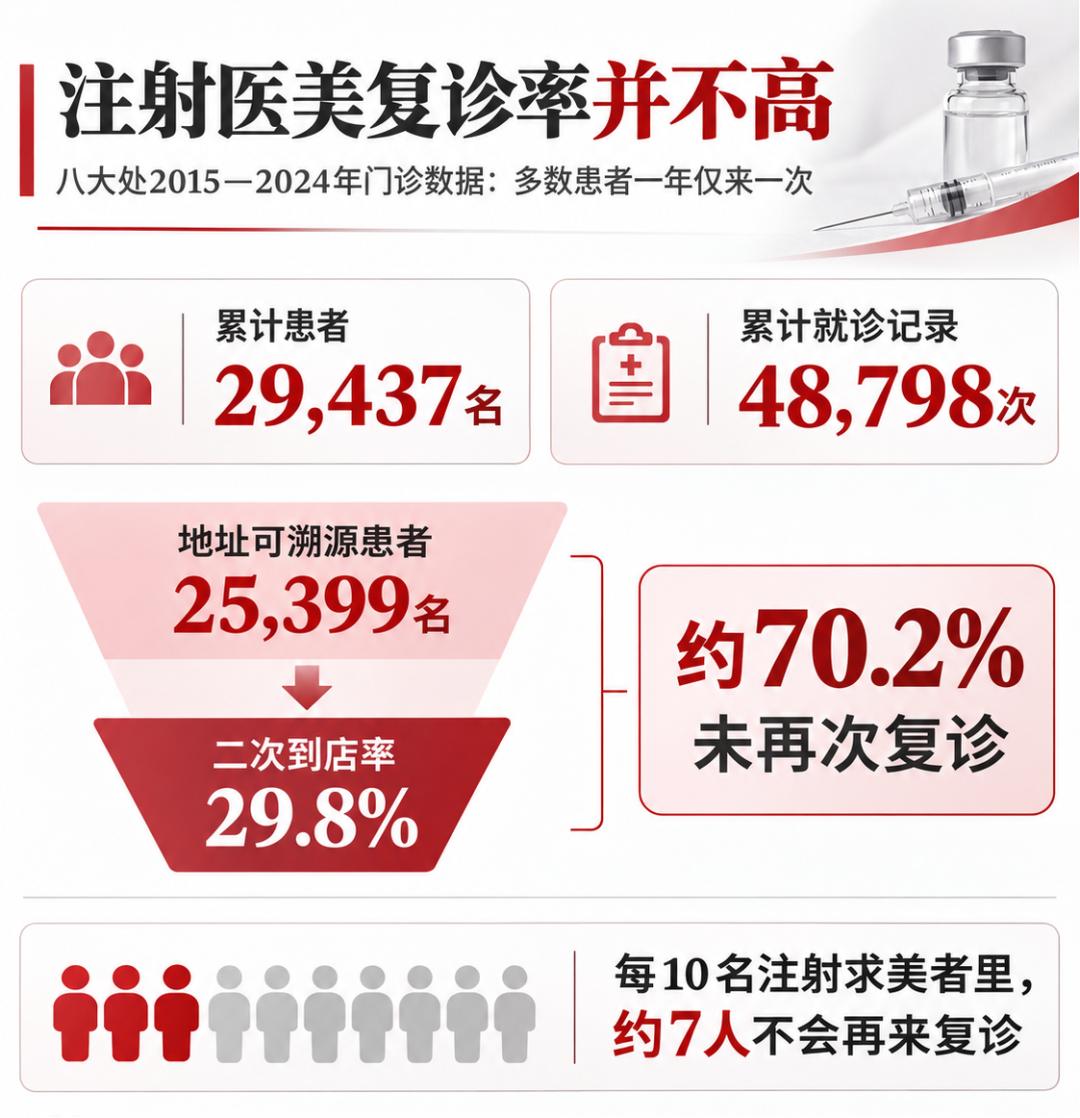
Hu Min's situation is not an isolated case. The Plastic Surgery Hospital of the Chinese Academy of Medical Sciences (commonly known as "Badachu") sorted out the data of injection beauty clinics from 2015 to 2024: among the accumulated 29,437 patients and 48,798 visit records, most patients only came for consultation once a year; among 25,399 patients with traceable addresses, only 29.8% would come to the store for the second time, which means that for every 10 injection medical aesthetic seekers, about 7 will not come back for follow-up consultation.
(Source: Compiled based on the public data of "Badachu")
Even for "Badachu", the renowned gold-lettered signboard of domestic plastic surgery, with advantages in trust, technology and price, the repurchase rate is still so low, and the situation of a large number of small and medium-sized medical aesthetic institutions will only be more difficult.
Entering 2026, this situation has not improved. This single-center study published in the October 2026 issue of *Journal of Cosmetic Dermatology* shows that the follow-up visit rates of local patients in Beijing, adjacent non-local patients, and remote non-local patients in the next year are 26.0%, 21.9%, and 21.2% respectively. Although the difference between regions is only 4 to 5 percentage points, the commonality is very obvious: about 3/4 of medical aesthetic seekers will not come back for repurchase in the next year.
On the one hand, institutions are trapped in the dilemma of poor repurchase, difficult customer acquisition and difficult upselling, and low-price drainage has gradually become the main way for institutions to maintain operation and obtain customer flow; on the other hand, upstream consumable manufacturers are under performance pressure and need to deliver growth answers to the capital market. With multiple factors superimposed, there is still room for the price of medical aesthetic consumables to decline in the future, which is the core reason why the industry predicts that medical aesthetics will usher in a price cut wave.
03
The General Trend of Price Cuts Has Arrived, Can the Medical Aesthetics Industry Transform Smoothly
When the price reduction of medical aesthetic consumables becomes a trend, what impact will it bring to the industry?
On the one hand, the price reduction of consumables will continue to crack down on unlicensed illegal medical aesthetics in China. In Jin Xing's view, the fundamental reason why unlicensed illegal medical aesthetics in China can exist widely for a long time is that the price of medical aesthetics in China is too high. "The compliant products are too expensive, forcing many consumers to consume unlicensed illegal medical aesthetics."
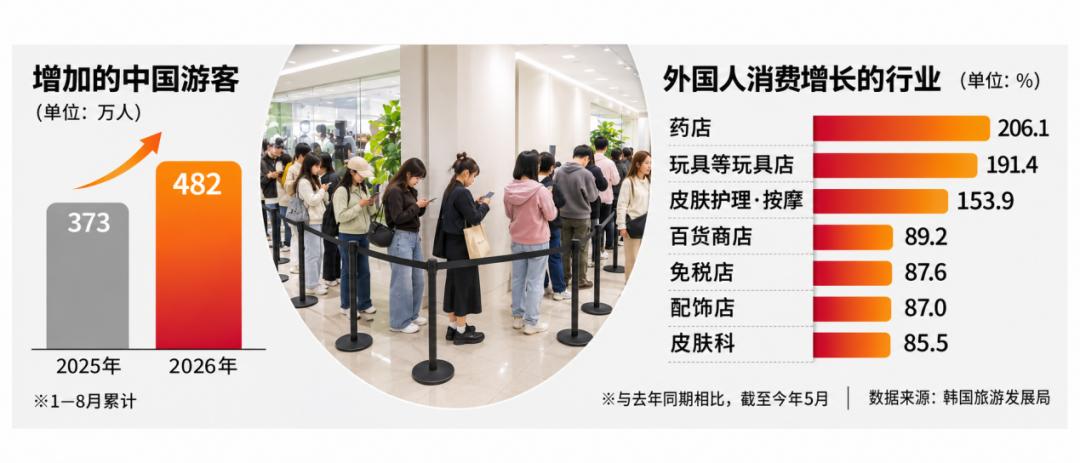
On the other hand, the price reduction of consumables is expected to stimulate domestic consumers. According to a report by *Korea Economic Daily*, from January to August this year, Chinese consumers' credit card payment amount in Korean dermatology clinics reached 332 billion won, an increase of 33.2% over the same period last year. Facing the surge of Chinese consumers, many Korean clinics have specially added Chinese translators.
(Source: *Korea Economic Daily*)
Price is still the core reason that attracts domestic consumers to go to South Korea for medical aesthetics. Li Bin pointed out that South Korea cancelled the VAT refund for foreigners' medical aesthetics from January 2026. This preferential treatment that could offset part of the travel expenses in the past has disappeared, but because the actual price difference is still attractive, medical aesthetic seekers continue to go there.
Are domestic institutions really ready to welcome the price cut wave?
Under the price cut wave, the gross profit margin of consumables continues to decline, but the fixed costs such as rent and labor have not decreased synchronously. Under the pressure of survival, domestic institutions have begun to shift from the past sales-oriented model to a "separation of medical treatment and consumables" model similar to public hospitals: separate charges for registration, examination and consum