Google's new video model ranks first on both leaderboards, outperforming Grok and Seedance, with its price slashed by another 30%
Zhidx reported on November 6 that Google DeepMind has officially launched its new-generation video generation and editing model Gemini Omni 1.2 Flash today. This new model brings three core upgrades: native 15-second video generation, multi-turn conversational editing, and stronger reference image adherence capability.
Meanwhile, the price of Gemini Omni 1.2 Flash is 30% lower than that of the previous generation Omni 1.1 Flash. The price for 720p video generation is reduced to $0.07 per second (equivalent to about RMB 0.46), which is less than 1/3 of the price of Seedance 2.5 for generating videos of the same quality.
In the large model arena, Gemini Omni 1.2 Flash has won the first place on both the text-to-video and image-to-video leaderboards, and ranked third on the video editing leaderboard, outperforming models including FLUX3 Video, Grok Imagine Video 1.5, Seedance 2.0, and Seedance 2.5.
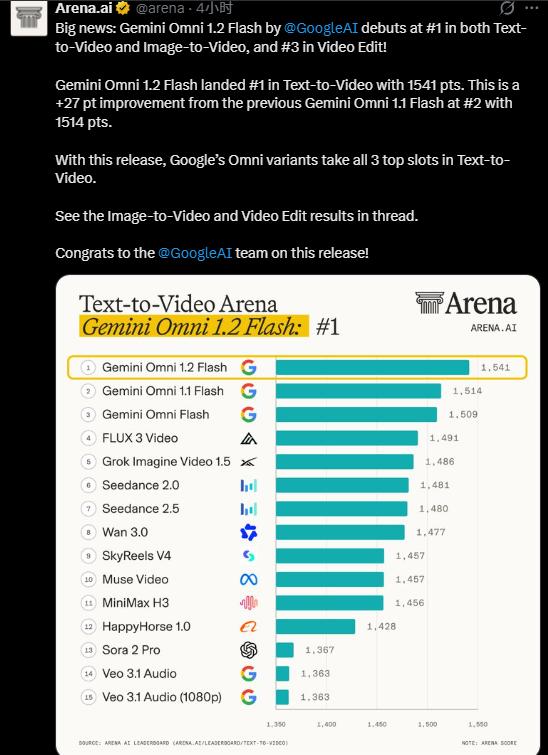
Gemini Omni is a new product line opened by Google outside the Veo video generation model, positioned as a unified model for "creating and editing videos from any modality". Omni Flash entered public preview on the Gemini API at the end of June this year, and Omni 1.1 Flash took over at the end of August, replacing the Veo 3.1 preview in the Gemini API.
Google has shared a large number of generation results of Omni 1.2 Flash. This model natively supports video generation and editing for up to 15 seconds, a 50% increase over the 10-second upper limit of Omni 1.1 Flash, and supports freely specifying the duration between 3 and 15 seconds in 1-second steps.
The model's reference adherence capability has also been significantly enhanced. Users can mix character images, product images, style images, action clips of up to 3 seconds, and audio cues to guide generation, and Omni 1.2 Flash can maintain consistent details from beginning to end across different camera angles.
In the official demonstration, with only one photo of a model plus front and back images of three sets of clothing, the model generated a 15-second virtual try-on video, covering 360-degree turns and match cuts, with consistent model identity as well as the cut and drape of each piece of clothing.
In the side-by-side comparison on the same topic, the restoration degree of Omni 1.1 Flash to the reference image is obviously inferior to that of Omni 1.2 Flash.
In terms of editing methods, Omni 1.2 Flash supports conversational multi-turn fine-tuning: changing products, changing backgrounds, adjusting lighting and weather, switching aspect ratios, all can be adjusted round by round for the same video without starting all over again, and it supports the full 15-second clip.
In the demonstration, the background was sequentially changed from a striped tent to an oak forest, a stable, a market and a stone castle through multi-turn conversations, while the performance of the two characters, the reflection of the armor and the camera composition remained unchanged. This is especially practical for teams that need to produce advertising variants in batches for different audiences.
There are also upgrades in the two dimensions of voice and camera movement. The dialogue generated by Omni 1.2 Flash is more smooth and natural, the lip sync is clearer, and it supports differentiation of multiple speakers.
In terms of camera movement, complex continuous shots such as FPV traversal, large-scale zoom-out, and orbiting can all be realized. The official demonstration completed a continuous FPV flight that traversed the square and went straight to the skylight of the Pantheon dome, with zero jump cuts throughout the whole process.
At present, to use this model, enterprise users can access it through the Gemini API, or try it out on Google AI Studio and Google Cloud Console; ordinary users can experience it in Google's Gemini App, AI video tool Flow, and Google Vids.
Conclusion: The Gap in Image Quality Is Gradually Narrowing
The Era of Competing on Cost and Workflow Has Arrived
The release of Gemini Omni 1.2 Flash reflects the shift in the competitive focus of the AI video generation track. When the gap in image quality among leading models gradually narrows, the stage of simply competing for generation quality is passing, and duration, price, editability and workflow integration have become the new focus of competition.
As costs continue to drop, scenarios that were previously unfeasible due to high costs, such as large-scale A/B testing of advertising materials and SKU-level video coverage for e-commerce, are being turned into reality one by one by video generation models.
This article is from the WeChat Official Account "Zhidx" (ID: zhidxc), written by Chen Junda, edited by Yunpeng, and published by 36Kr with authorization.