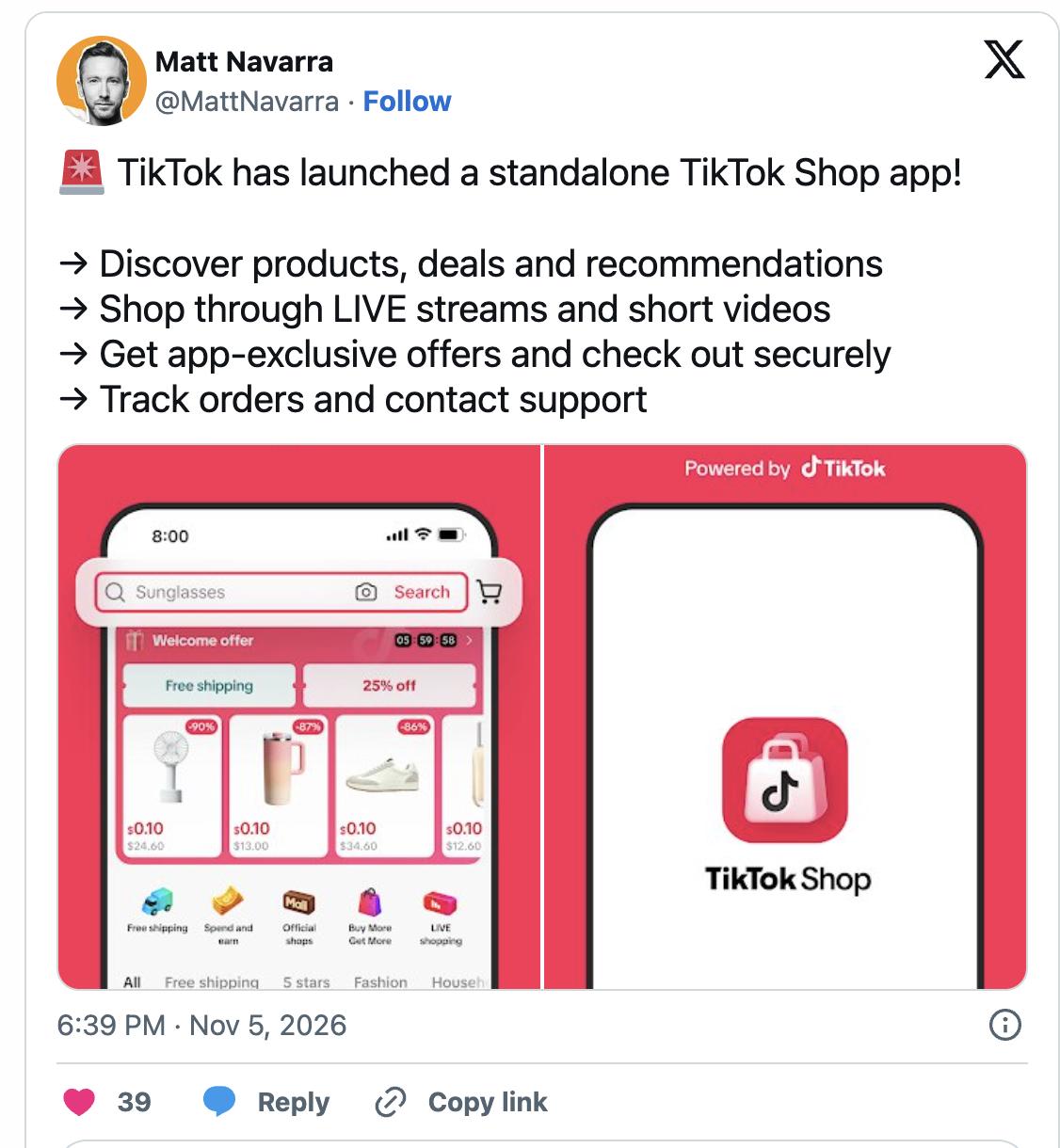
TikTok has just released its standalone app TikTok Shop
On November 5, TikTok launched its standalone TikTok Shop app. It is currently available in Singapore, Malaysia, Thailand and the Philippines, for both iOS and Android, with the UK and the US not included in the launch list. The app itself is a streamlined shopping entry that features personalized recommendations, live stream and short video-driven product sales, app-exclusive discounts, free shipping, built-in payment and order tracking, plus a slogan of "Secure payment, secure checkout".
If you only look at the feature list, this is nothing more than a minor product-level tweak — splitting the Shop function that was already embedded in the main app and giving it an independent icon. But the choice of launch regions reveals a fact far more important than the product itself: the globalization of TikTok Shop is not advancing under a unified corporate structure. It is simultaneously navigating two completely different institutional environments, and the standalone app happens to fall right in the gap between the two.
Southeast Asia is the last large-scale e-commerce battlefield where ByteDance still retains full control
The global GMV of TikTok Shop is expanding at a staggering speed. According to the forecast by Momentum Works, the full-year GMV in 2026 will exceed 100 billion US dollars for the first time, reaching approximately 123.5 billion US dollars, marking a roughly 6.5-fold increase in three years compared to 16.3 billion US dollars in 2023. The global GMV in the first half of 2026 has already hit 50.3 billion US dollars, a 92% year-on-year increase. The US is the largest single market, with a GMV of 11.8 billion US dollars in the first half of the year, up 103% year-on-year, surpassing Indonesia again.
But the standalone app did not go to the US. It landed in four Southeast Asian countries instead.
This is not because Southeast Asia has a larger GMV. The US site alone generated 6.985 billion US dollars in a single quarter, accounting for 25.4% of the global GMV. The reason lies in the ownership structure. In January 2026, TikTok completed the spin-off of its US business and established the "TikTok US Data Security Joint Venture", with Oracle, MGX and Silver Lake Partners each holding a 15% stake, and ByteDance's stake dropping to 19.9%. According to the agreement, the newly established US entity is responsible for managing global product interoperability and certain business activities, including e-commerce, advertising and marketing; while the ByteDance-controlled global TikTok entity remains in charge of several key business segments, including e-commerce operations on the new US platform. This cross arrangement itself illustrates one thing: e-commerce decisions for the US market are no longer made unilaterally by ByteDance. They need to operate within a joint venture framework where the board of directors is dominated by US investors, with data security and algorithm retraining as the core missions.
Southeast Asia does not have such constraints. The operations of TikTok Shop in Singapore, Malaysia, Thailand and the Philippines are still under the direct management of ByteDance's global entity. Launching the standalone app means ByteDance can fully test "whether e-commerce can survive independently after being separated from the main app's content feed" in a market that is not constrained by the spin-off governance. This is not just a product experiment, but even more a control experiment. The success or failure of the standalone app in Southeast Asia will tell ByteDance: to what extent can the user retention and repurchase rate of Shop as an independent entry not rely on the content feed of the main TikTok app. If the answer is "yes", the possibility of this model being eventually transplanted to other markets will rise; if the answer is "no", the logic of "content as the shelf" will continue to be locked inside the main app, and the value of the standalone app will be reduced to nothing more than entry-level competition at the marketing level.
Data from the US market is already rewriting the formula of "TikTok Shop = live stream product sales"
Another background for the launch of the standalone app in Southeast Asia is that the growth engine of TikTok Shop has deviated from the original imagination of the outside world.
For a long time, overseas media and brands' understanding of TikTok Shop stayed at "moving the Asian live stream sales model to Europe and the United States". But data from the US market paints a completely different picture. In the composition of the GMV of TikTok Shop US site in the first half of 2026, live streaming only accounted for 8.2%; short videos contributed 40.4%; and transactions completed directly through online stores (shelf e-commerce) accounted for 51.4%. More than half of the transactions took place in the shelf scenario rather than the content scenario. American consumers have not developed the habit of staying in front of the screen waiting for the host to count down "3, 2, 1, go live with the link". Their more common path is to be attracted by products while scrolling through videos, then go to the store to complete the purchase later, or place orders directly in the search-based mall interface.
This means that in the US context, the real competitor of TikTok Shop is not Amazon's live streaming shopping feature, but Amazon's own search shelf, as well as the low-price mindset of Temu and Shein. The launch of the standalone app in Southeast Asia can also be understood under this logic: it separates the "shelf" from the short video feed of the main app, giving users a browsing and search interface closer to traditional e-commerce, while retaining short videos and live streams as traffic entries. The TechCrunch report directly pointed out this intention: the standalone app gives TikTok Shop the opportunity to reach shoppers outside the main platform and compete more directly with Amazon and Temu. Tubefilter holds a similar view: TikTok will use this to go head-to-head with Shein and Temu.
But the competitive landscape in Southeast Asia is more crowded than in the US. Shopee still accounted for about 45% of the e-commerce market GMV share across six Southeast Asian countries in 2026 (calculated by the full market/platform e-commerce caliber), TikTok Shop (including Tokopedia) steadily ranks second, and Lazada's share has dropped to 6%. If calculated only by the total GMV of the three major platforms, Cube's data shows Shopee takes 55%, TikTok Shop 39%, and Lazada 6% — TikTok Shop still lags behind Shopee by about 16 percentage points in terms of GMV. But from the perspective of traffic, the gap is narrowing rapidly: in September 2026, the total number of visits to TikTok Shop across the six Southeast Asian countries was about 462 million, reaching 97.5% of Shopee's. If the standalone app can convert part of the occasional behavior of "placing orders by the way while scrolling through videos" into the repeated behavior of "opening the Shop app to browse specifically", the ceiling of TikTok Shop's GMV share in Southeast Asia will be reopened. But if it only migrates the existing transactions in the main app to a new icon, its marginal impact on Shopee will be close to zero, while the customer acquisition cost and retention cost of operating a standalone app will become a new burden.
The divergence of "two TikToks" will not only stay at the application level
TikTok's overall strategy is sliding from a short video platform to a super app. TechCrunch listed the features added to the main app in recent years: games, restaurant guides, sports centers, hotel booking, micro dramas, and payments that are under exploration. TikTok has already applied for a fintech license in Brazil, planning to provide prepaid accounts, digital payment and credit services; in Southeast Asia, TikTok Pay has been running in the payment process of TikTok Shop, and there are tests to expand to peer-to-peer transfers between users. The simultaneous expansion of e-commerce, payment and local services points to a complex that takes content and social interaction as the traffic base, and transactions and finance as the monetization exit.
But this complex will encounter a structural asymmetry under the spin-off framework in the US. The global TikTok entity controls the technical architecture of e-commerce, merchant relationships and cross-border supply chains, while the US joint venture entity controls the data of US users, the algorithm training environment and the governance of local business activities. When the standalone Shop app considers entering the US in the future, it needs to meet two sets of logics at the same time: one is the growth rhythm of ByteDance's global e-commerce system, and the other is the compliance review of the US joint venture's board of directors on data flow, algorithm behavior and business expansion. This is not a product decision, but a governance decision. TikTok's current choice not to launch the standalone app in the US may just be a matter of time, or it may be a default recognition of this asymmetry.
The launch in four Southeast Asian countries is therefore more than just a market expansion. It is a stress test for TikTok Shop's "de-contentization survival" in the region where ByteDance still has full control. Whether the standalone app can establish independent user habits and repurchase curves without relying on the main app's content feed; whether it can convert the near parity of visits into a substantial approximation of GMV share in a market where Shopee still accounts for nearly half of the share; whether it can provide a cleaner container for the embedding of payment and financial services than the main app — the answers to these questions will determine whether the standalone app is a replicable template, or a local product limited to a specific governance environment.
TikTok Shop is already a business with an annual GMV heading for 123.5 billion US dollars. Its next stage of growth no longer depends on how much viewing time the main app can attract, but on whether it can build a transaction interface that users are willing to open actively and return to repeatedly outside of content. The standalone app is the first formal response to this proposition. And the fact that it was not launched in the US itself may better illustrate than any feature in the app that the real boundary of TikTok's e-commerce globalization in 2026 is not in the market, but in the governance structure.
This article is from the WeChat official account "Tech Business", written by Zisen and Bowen, and authorized for release by 36Kr.