Trillions of dollars were wiped off the U.S. stock market overnight. Has the AI bubble burst?
The AI investment boom has suffered a heavy blow.
On November 5 local time in the United States, the three major U.S. stock indexes plummeted collectively. The Nasdaq 100 index closed down 6.4%, with a single-day market value evaporation of about 2.3 trillion U.S. dollars; the S&P 500 index fell 4.4%, marking the largest single-day decline since April 2025.
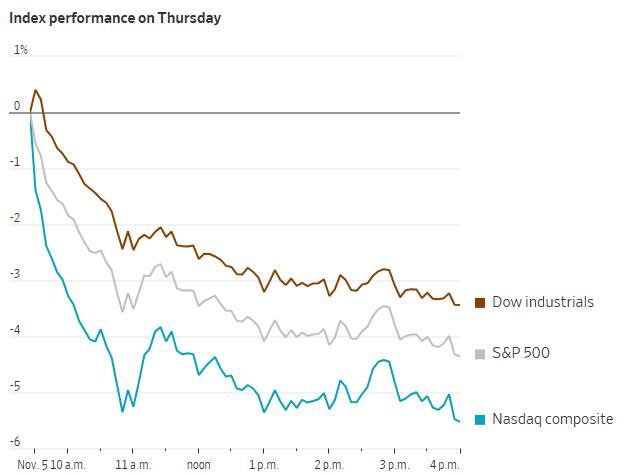
As of the close of trading on November 5 local time in the United States, the decline of the three major stock indexes, sourced from FactSet
Tech stocks have become the hardest-hit area in the sell-off. Share prices of chip companies such as NVIDIA and AMD plummeted, and the total market value of the "Big Seven" tech giants shrank by more than one trillion U.S. dollars overnight. The downward trend spread to the storage, cloud computing and data center industrial chain, and the funds managed by "Cathie Wood" were not spared either.
Behind this sell-off, the market's attitude towards AI investment is changing.
In the past, the expanding capital expenditure of tech giants was regarded as proof of strong AI demand, which also supported the high valuation of companies in the industrial chain. Now, as the scale of investment continues to rise, investors are beginning to ask: When will trillions of dollars in AI investment be converted into revenue and profits?
From chasing the scale of AI investment to examining the return on AI investment, the market's focus is shifting.
01
Tech stocks plummeted collectively, the market value of the Big Seven shrank by over one trillion
On November 5, the sell-off of tech stocks spread from chip companies to storage, servers and data center operators.
The Philadelphia Semiconductor Index once fell nearly 11% during the session, hitting the largest intraday decline since March 2020, and finally closed down 5.23%.
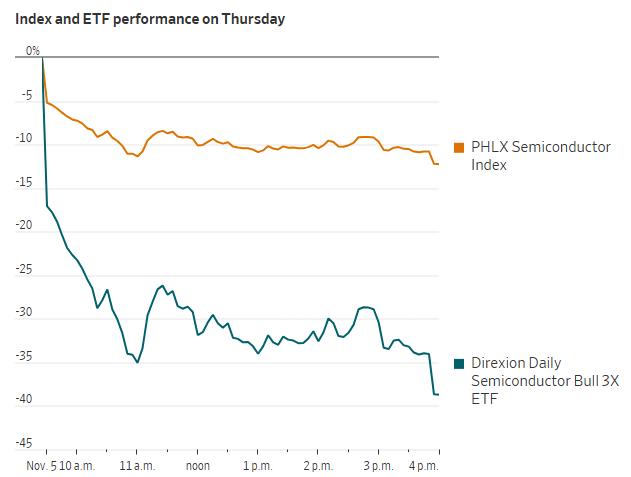
As of the close of trading on November 5 local time in the United States, the decline of the semiconductor index, sourced from FactSet
Among chip stocks, AMD fell 17.3%, Micron's decline exceeded 17%, NVIDIA fell 9.3%, and companies including Broadcom, Intel, Arm and Marvell also closed lower. The storage and hard drive industrial chain is also under pressure, with SanDisk, Seagate and Western Digital all seeing significant declines.
Companies related to AI infrastructure were not spared either. Server manufacturer Dell, cloud computing power service providers CoreWeave and Nebius, as well as data center operators IREN and Applied Digital were all affected. GE Vernova, a supplier of data center power equipment, fell 7.5%, indicating that the sell-off has spread to the energy and infrastructure sectors.
The so-called "Magnificent Seven" U.S. tech stocks also suffered a heavy blow. The total market value of Apple, Microsoft, NVIDIA, Amazon, Alphabet, Meta and Tesla shrank by about 1.04 trillion U.S. dollars in a single day. Among them, NVIDIA fell 9.3%, Tesla fell 10.8%, leading the declines; Microsoft fell 3.6%, Meta fell 4.0%, Amazon and Alphabet fell by about 2.2% respectively, and Apple fell 1.5%.
Not all individual stocks posted declines. Ad tech company AppLovin rose by about 31% after releasing strong performance and issuing guidance higher than market expectations. Funds are still looking for companies supported by solid performance, but stocks that are closely linked to AI infrastructure investment and have high valuations are under greater pressure.
02
Why did AI trading suddenly stall?
The direct trigger for this round of sell-off is the result of the U.S. midterm elections.
The Democratic Party won control of the Senate and the House of Representatives in this election, and secured key victories in major data center industry hubs such as Texas and Georgia. Some Democratic candidates previously explicitly advocated suspending or restricting data center development. The market is worried that with the growing political forces opposing data center construction, related projects in the future may face stricter supervision, longer approval cycles, and even forced delays.
In addition, behind this round of plunge in tech stocks, there are three noteworthy superimposed factors: the return on AI investment is questioned, the financing risk of data centers is rising, and the previously overly concentrated market trading.
First, AI investment is growing larger and larger, but the return remains unclear.
Microsoft, Amazon, Alphabet and Meta continue to increase capital expenditure, and a large amount of capital flows to data centers, chips and power facilities. In the past, the market regarded these investments as proof of strong AI demand, and the valuations of related companies rose accordingly.
However, data center construction requires a large amount of upfront capital, and the investment cannot be converted into revenue immediately. As capital expenditure continues to increase, investors are beginning to worry whether the revenue generated by AI business can cover the construction cost, and how much pressure continuous expansion will put on corporate cash flow.
Second, AI infrastructure construction is increasingly dependent on external financing.
Tech giants have abundant cash reserves, but some data center operators and new cloud service providers need to build computing power facilities through debt or equity financing. These projects feature large investment scale and long payback period, and are sensitive to financing costs and construction progress.
If financing conditions tighten, some projects may be forced to be delayed or scaled back. The growth expectations of suppliers of chips, servers, storage and energy equipment may also be affected as a result.
Third, AI stock trading is overly concentrated, which amplifies the market decline.
In the past few years, AI-related stocks have continued to rise, attracting a large amount of capital to buy in concentrated positions. Some investors also expanded their positions through leveraged trading.
When the market begins to worry about investment returns, concentrated position reduction of funds may trigger a chain reaction. Leverage position adjustment, risk hedging and selling of systematic trading strategies may further exacerbate stock price fluctuations.
Steve Sosnick, chief strategist at Interactive Brokers, pointed out that investors were not in a hurry to buy downside protection before, but after the market suddenly turned, hedging demand increased rapidly.
Wall Street still has divergences over the subsequent trend of AI trading.
David Rosenberg, founder of Rosenberg Research, is worried that once the construction of data centers slows down, the growth expectations of chip and equipment suppliers will also be affected. Mohamed El-Erian, chief economic advisor at Allianz, believes that the market may overreact to AI risks, and short-term stock price fluctuations cannot directly negate long-term demand.
At present, tech giants are still expanding AI investment, and demand for cloud computing and computing power has not suddenly disappeared. But investors are beginning to reassess how much profit these inputs can ultimately generate, and whether the current stock price has already priced in future growth in advance.
03
"Cathie Wood" added positions against the trend
As tech stocks plummeted, "Cathie Wood", who holds heavy positions in high-growth tech companies, was also impacted.
Her flagship ARK Innovation ETF (ARKK) has a highly concentrated position. As of November 5, Tesla, SpaceX, Tempus AI and Circle together account for more than 28% of the fund's assets. As tech stocks are sold off, the fund faces great downward pressure on net value.
But Wood did not stop buying. On November 5, three ETFs under ARK Investment bought a total of 348,400 shares of SpaceX-related assets, with an estimated transaction amount of about 47.4 million U.S. dollars according to the provided data, and sold about 46,200 shares of Alphabet stock at the same time.
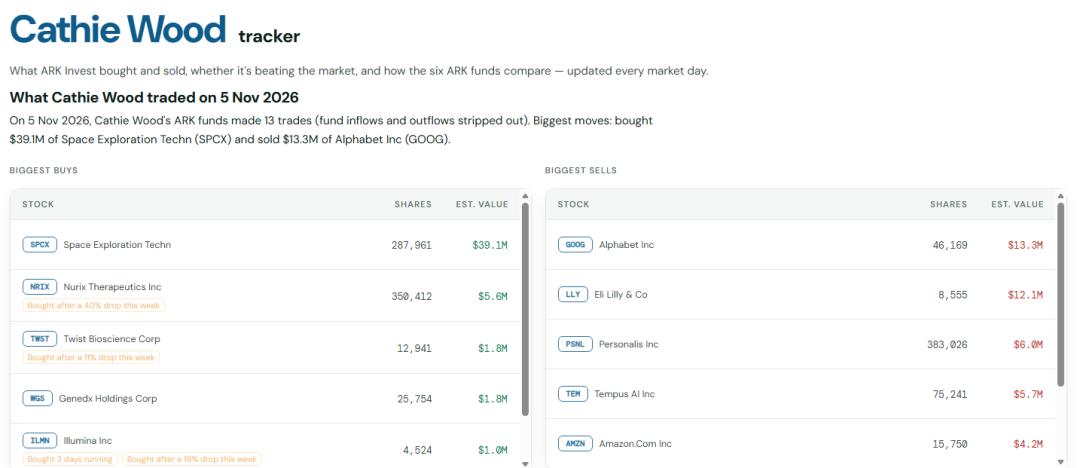
The fund under Wood bought $39.1 million worth of SpaceX shares on November 5
The market is reassessing the valuation of high-growth tech companies, but Wood is still deploying against the trend. At least from the transactions of that day, she did not fully withdraw from high-growth assets due to this round of decline.
This article is from the WeChat official account "Tencent Tech", Author: ZHOU Xiaoyan, Editor: XU Qingyang, published by 36Kr with authorization.