JD that stays out of the food delivery business is the ideal JD that everyone loves.
On November 4, media outlets including Yicai and Red Star Capital Bureau confirmed that Guo Qing (known as Lao K), head of JD's local life services business, has left his post for personal reasons. It has been two years and ten months since he joined JD as a CEO consultant, and only one year and nine months since the nationwide sensational "food delivery war" that accompanied the official launch of JD Delivery.
Guo Qing joined Meituan in 2014, spearheaded the development of its hotel and travel business, entered Meituan's highest decision-making body S-team in 2020, and left the company in 2021. JD's intention in recruiting him was clear: to transplant the organizational capabilities and market combat experience that Meituan had accumulated for its local life business to JD's instant retail landscape.
After the official launch of JD Delivery, it entered the market with three core strategies: "zero commission for merchants", "five social insurances and one housing fund for riders", and "tens of billions in subsidies". Its daily order volume hit 25 million within four months, once accounting for about 31% of the national food delivery market share, which was the closest moment JD's local life business ever came to "reshaping the market pattern".
But as we all know from subsequent developments, market share bought by subsidies is never the same as market share earned through operational efficiency.
01
Activate Users via Food Delivery, But Ended Up Boosting Marketing Expenses
In 2024, when Guo Qing joined JD, the company was in a state of anxiety. The growth rate of its core e-commerce main platform was slowing down, with Pinduoduo and Douyin squeezing its market share from both ends, and the lack of a high-frequency entry point was repeatedly mentioned as a key pain point.
At that time, food delivery was expected to solve two problems at the same time: first, to re-activate users through the daily opening frequency for three meals a day, and second, to pave the way for "instant delivery" and instant retail with the instant distribution network.
In May 2024, JD integrated its existing "Hourly Purchase" service and JD Daojia into the new "JD Instant Delivery" service. In the second half of the year, chain brands including Luckin Coffee, Cotti Coffee, and Burger King quietly appeared in the coffee and milk tea channel of the instant delivery zone. In February 2025, the food delivery service was officially launched as an independent entry. With a combined set of moves including zero commission, subsidies, and social insurance for full-time riders, it quickly gained huge public attention.
But the feedback of the business world never only depends on the momentum at the opening of a campaign.
For the full year of 2025, JD's new business segment recorded an operating loss of 46.641 billion yuan, marketing expenses soared from 48 billion yuan to 84 billion yuan, and the group's net profit attributable to shareholders was cut in half from 41.4 billion yuan to 19.6 billion yuan. Food delivery was the largest source of loss among all, and a Nomura survey showed that JD suffered a loss of 3.3 yuan per order on average.
Standard & Poor's estimates provided another perspective: the losses of new businesses in 2025 eroded 82% of the operating profits of JD's retail and logistics businesses. By 2026, the management's tone has shifted from "expansion" to "loss reduction", and the core task is no longer to seize market share, but to stop losses.
Guo Qing's departure is also regarded by the market as a signal that the food delivery strategy that takes subsidies as leverage and order volume as the measurement standard has reached its limit under JD's financial structure.
According to statistics from Analysys and Redcarnet, during the peak of subsidies, the daily order volume share of JD Delivery once hit about 31%; but after the subsidies were reduced, the share fell back to around 7% in early 2026.
At present, the general public's perception is that users complain that food delivery is not cheap, the types of stores are not rich, and the order delivery is slow; riders complain that the unit price per order is low and there are arbitrary fines; merchants complain that they are forced to participate in activities and cannot make money. In short, the more goods they sell, the less profit they make.
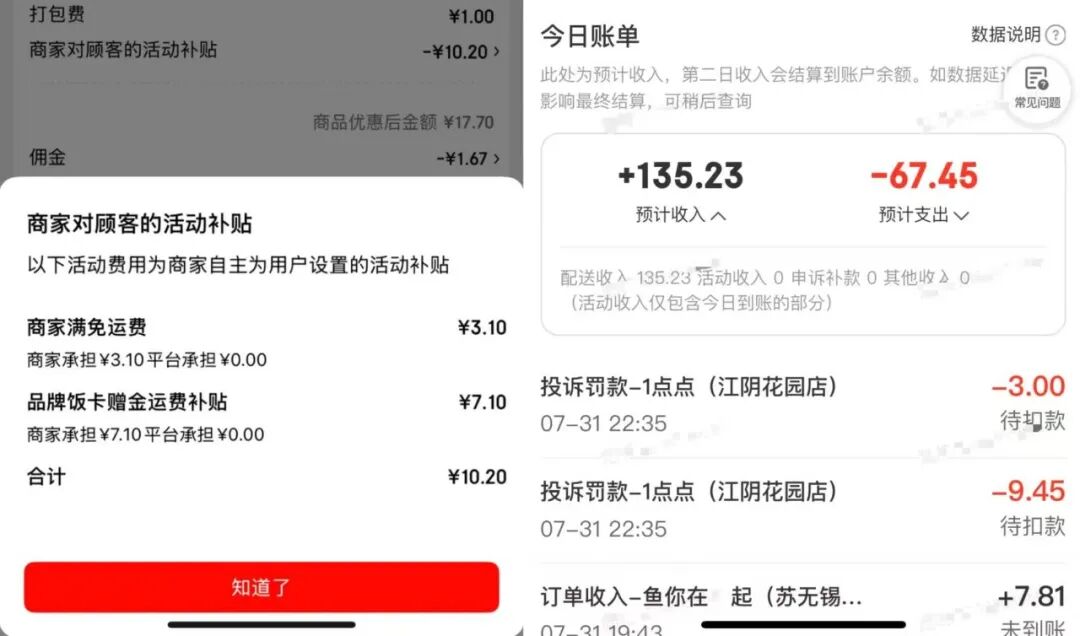
Pei Yan, a rider, told Super Focus that at the end of 2025, the unit price of JD Delivery orders was high, and if no one took an order within 5 minutes, the platform would directly add 5 to 10 yuan to the order, so all orders were snatched up in seconds. Now, the unit price is low: the platform adds 0.1 yuan after no one takes the order for 3 minutes, 0.2 yuan after 5 minutes, and 0.5 yuan after 10 minutes. The backstage keeps dispatching such "low-value bad orders", and there is an upper limit for order rejection per day for each account. Now all riders log off immediately after snatching an order, which is why users always feel that no one is picking up their orders.
More critically, the traffic spillover effect of food delivery has not been fully verified in JD's shelf e-commerce system. The monthly active users of the instant delivery module fell by nearly 40% in the half year after peaking in the second quarter of 2025, but the growth rate of JD's daily necessities category did not slow down synchronously. The latter came more from the optimization of product portfolio and the improvement of the 3P merchant ecosystem, rather than the conversion of high-frequency users brought by food delivery.
High-frequency app openings and shelf e-commerce purchases are two different user mindsets. The connection at the traffic level does not equal conversion at the transaction level. Meituan once tried to use the high-frequency traffic of local life to feed back its shelf e-commerce business, but the model also failed to work.
In the first quarter of 2026, the revenue of JD's new business shrank from just over 14 billion yuan in the previous quarter to just over 6 billion yuan, marketing expenses were cut by nearly 10 billion yuan, and JD immediately recorded its first operating profit in the past four quarters. The capital market reacted directly and positively: after the financial report was released, JD's Hong Kong stock price rose by more than 8%, and investors are glad that JD has stopped pouring money into the bottomless pit of food delivery.
Taobao Flash Delivery continued to reduce losses, cutting losses by 8 billion yuan in Q2. Morgan Stanley estimates that its losses in Q3 will be 9 billion yuan, 1 billion yuan less than the previous quarter. An internal meeting of Guosen Securities stated that Meituan reached break-even in April, and the average profit per order can rise to 0.3-0.4 yuan in June, with expected unit economic profit of 1 yuan in 2028, returning to the 2024 level.
Everyone is heading for a bright future, except that JD's future will come a little later.
02
Shift Ammo from Food Delivery Back to Shelf E-commerce
What does JD still have in hand if it no longer focuses on competing in the food delivery track? The answer has actually been written in JD's balance sheet over the past two decades: supply chain, fulfillment infrastructure, and the "certainty" built on top of these.
In the first quarter of 2026, JD Retail's operating profit margin increased from 4.9% in the same period of the previous year to 5.6%. On the revenue scale of one trillion yuan, a one percentage point improvement in profit margin corresponds to a profit elasticity of tens of billions of yuan. This shows that when resources are not continuously drained by the subsidy black hole of food delivery, the profitability of the core retail business itself has room for recovery.
Instant retail is still a direction that JD should not give up, but its logic should not be "rebuilding another food delivery platform". Instead, it should return to the track that JD is good at: using supply chain capabilities to provide certain fulfillment services for areas 3 to 5 kilometers around users.
The instant delivery of 7FRESH, JD Supermarket, and 3C digital products is a completely different business from the "low-price high-frequency catering" of food delivery. The barrier of the former lies in product supply and warehouse distribution efficiency, while the barrier of the latter lies in merchant density and subsidy sustainability.
The positioning of "quality food delivery" is a decent step that JD found during the contraction period. But if quality food delivery cannot form real synergy with the product ecosystem of JD's main platform, it will still be a food delivery business that requires continuous blood transfusion, rather than a local service that can be nourished by the capabilities of the main platform.
A JPMorgan Chase survey in November 2025 showed that the average daily order volume share of Meituan, Taobao Flash Delivery, and JD was 50%, 42%, and 8% respectively. Data released by UBS in February 2026 changed to 51% for Meituan, 42% for Taobao Flash Delivery, and 7% for JD Delivery, meaning JD's share has fallen back from the peak of 31% to the single-digit range.
There are differences in statistical results, but the trend they reveal is consistent: in the catering food delivery battlefield that has been repeatedly scoured by subsidies, JD only got a costly admission ticket, and the marginal return of staying at the game table is narrowing.
The barrier of food delivery never lies in the thickness of subsidies, but in the density and flexibility of the distribution network. It took Meituan more than ten years to accumulate millions of active riders to maintain stable and reliable fulfillment output in bad weather, peak hours, and long-tail areas.
Behind Taobao Flash Delivery is the local fulfillment foundation accumulated by Ele.me over many years, plus the horizontal infusion of e-commerce traffic within the Alibaba system. JD Instant Delivery does have highlights in delivery timeliness, but the economies of scale of catering food delivery are built on the flywheel of "cost per order decreases as order volume increases". Without sufficient order volume, the flywheel will not turn.
The more hidden cost lies in the brand level. The perception JD has built over the past two decades is "genuine products, fast delivery, and reliable after-sales service", which is a kind of trust in certainty. When the same app starts competing for a 9.9-yuan cup of coffee with subsidy coupons, the boundary of user perception is widened, but the depth of the perception does not necessarily deepen.
Consumers may open JD for food delivery, but they will not necessarily transfer their purchase decisions for a refrigerator or a mobile phone to the platform. In 2025, the daily necessities category recorded a 15.3% year-on-year growth, achieving double-digit growth for five consecutive quarters, which proves that cross-purchase does happen, but its scale is not enough to hedge the losses from food delivery.
The market prospect of instant retail approaching one trillion yuan is real. The Institute of Commerce under the Ministry of Commerce predicts that the scale will reach 971.4 billion yuan in 2025 and exceed one trillion yuan in 2026. The question is not whether JD should do instant retail, but in what posture it should do it. JD's comparative advantages lie in its supply chain, self-operated product quality, and the certain fulfillment of "fast and accurate delivery".
More than 100,000 offline brand stores have been connected under the instant delivery system, covering categories such as 3C, supermarkets, and pharmaceuticals. This path is more compatible with JD's genes. The core of competition in catering food delivery is subsidy efficiency and rider scale, which is exactly the field that JD is least good at, and should not use its profit statement to fight hard in.
Guo Qing's departure may be a signal for the organization to recalibrate its priorities. JD Retail is still one of the few assets with sustainable operating profits in China's e-commerce system. Its value does not lie in providing ammunition for a money-burning competition, but in extending its supply chain capabilities to more products that "deserve fast delivery".
JD, which no longer competes head-to-head in food delivery, is not retreating to its comfort zone, but putting resources back into areas where it can truly build competitive barriers. A JD that can make money continuously and make money transparently is perhaps the JD recognized by users, merchants, and shareholders.
This article is from the WeChat official account "Super Focus foci", written by Fang Wensan, and published with authorization from 36Kr.