Sports and outdoor segments "rescue" the men's wear market
The value recognition and identity labels brought by "hardcore parameters and healthy lifestyles" have become a core consumption logic for men's apparel purchases.
When activities such as hiking, skiing and cross-country running have successively become phenomenal lifestyles, they have not only driven the boom of outdoor sports equipment, but also become the biggest trend and growth point in the men's wear industry. It can be said that outdoor sports have "saved" China's men's wear market. At a time when traditional business and fashion casual men's wear are shrinking, a founder of a men's wear brand even said bluntly, "If there had been no outdoor trend in the past two years, the men's wear market would have been worse."
Since 2020, the traditional men's wear market dominated by formal business wear has begun to experience structural recession. According to the report Menswear in China published by Euromonitor International in December 2025, the overall retail sales growth rate of China's men's wear market is only about 1.6%. The revenue and profits of leading men's wear brands such as HLA, Youngor and Biemlfdlkk have basically fallen into the quagmire of decline or stagnation in the past two years.
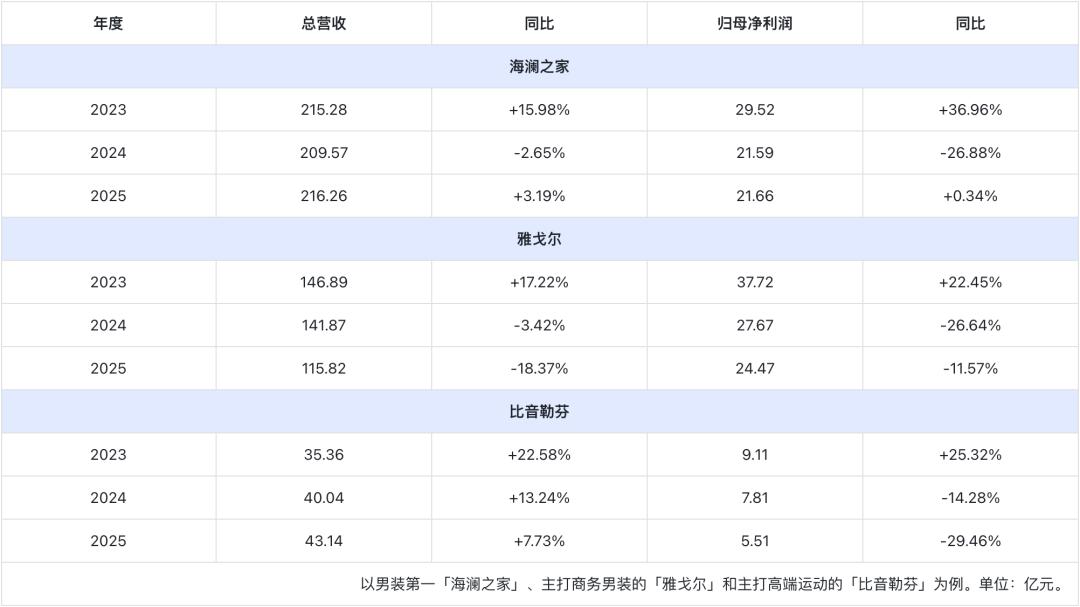
The recession of traditional men's wear is related to the changes in workplace dress codes, as well as the sports casual trend triggered by work-from-home arrangements in previous years. In particular, the outdoor sports sector exploded in 2021, and professional outdoor sports brands such as Arc'teryx, Salomon and HOKA accelerated their penetration into the Chinese market, further fueling this boom. Data from Euromonitor International also shows that the size of China's sportswear market grew by 6.1% year on year in 2025, higher than the 1.6% growth rate of the overall men's wear market.
The squeeze of outdoor brands on traditional men's wear is also very obvious. Wu Lei, founder of fashion casual men's wear brand GXG, mentioned in a recent interview that the high-end and low-end markets of the men's wear industry are basically stable, while consumption in the middle tier is shrinking continuously, and the impact of outdoor brands on the men's wear industry is adding insult to injury.
Driven by both consumption trends and growth pressure, most men's wear brands have begun to transform towards "outdoor sports", ranging from minor product adjustments to large-scale brand incubation. Emerging brands have also seized the trend to grow. For example, FPA, the men's wear brand that ranked first in the Taobao men's wear list in the first and second quarters of this year, focuses on urban light functional style.
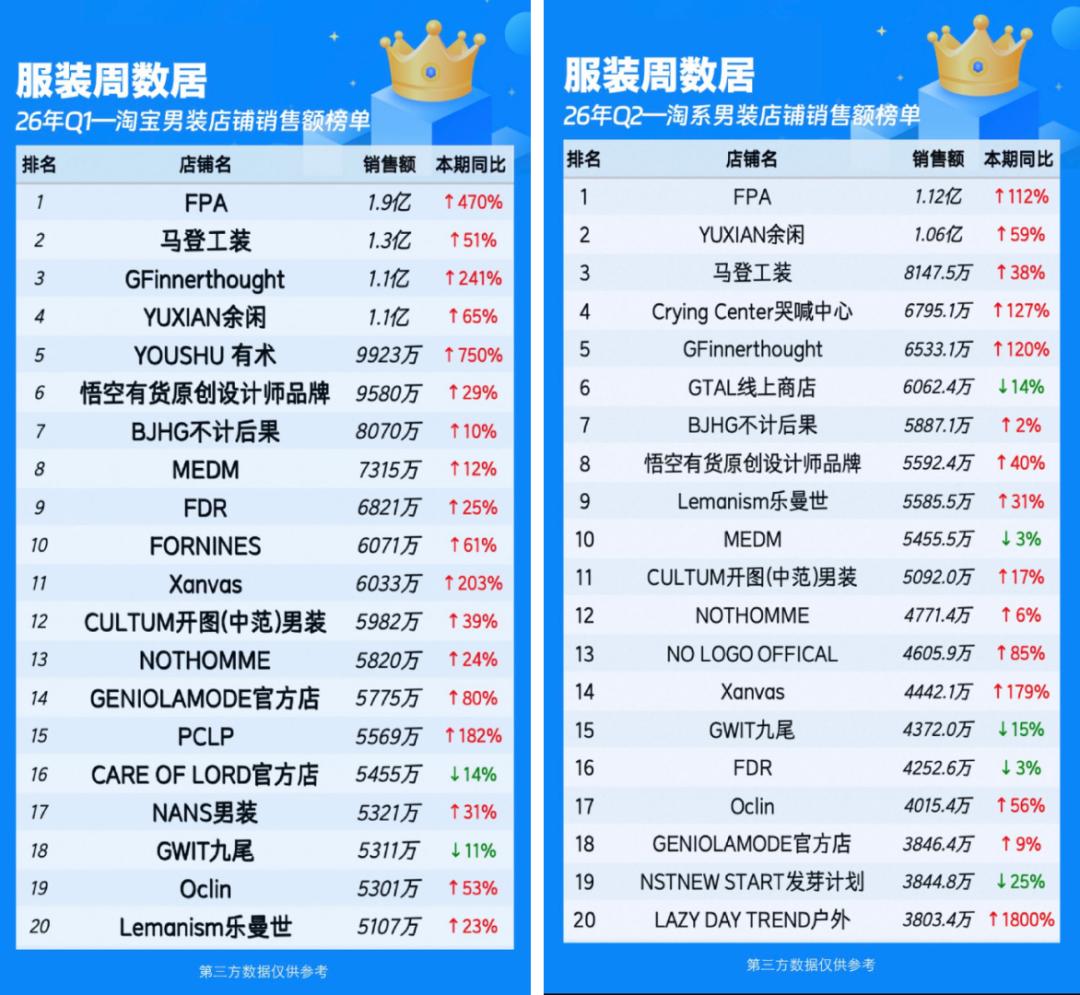
Data source: Apparel Weekly Tracker
Euromonitor International also mentioned in the above report that the retail sales growth of China's men's wear in 2025 "is mainly driven by consumers' shift to pursuing product value, durability and functionality".
The reason why outdoor sports have revitalized the men's wear market first lies in that it accurately caters to the consumption characteristics of male consumers. Loose silhouettes eliminate the body shape restrictions commonly seen in traditional men's wear purchases; various professional fabric technologies and process names fit men's preference for "parameter-based shopping" — when outdoor sports enter the daily life of male consumers, they can learn and study apparel parameters just like they research the parameters of 3C digital products.
The principal of the aforementioned men's wear brand said, in recent years, more and more consumers frequently ask about technical details such as wind resistance and waterproof ratings during consumption.
Supported by clear parameters, male consumers are also willing to allocate more of their wallet share to this category. As Ji Yun, General Manager of Fast-Moving Consumer Goods and Tmall Luxury Division of Taobao Tmall Group, pointed out when mentioning "K-shaped differentiation of consumption" at this year's Golden Beauty Awards, K-shaped consumption is not a fixed class division, but a consumption decision that dynamically changes with categories, time and scenarios. For many men, they may be careful with money on daily basic supplies, but their consumption expenditure in the outdoor sports field steadily occupies the top of the K-shaped curve.
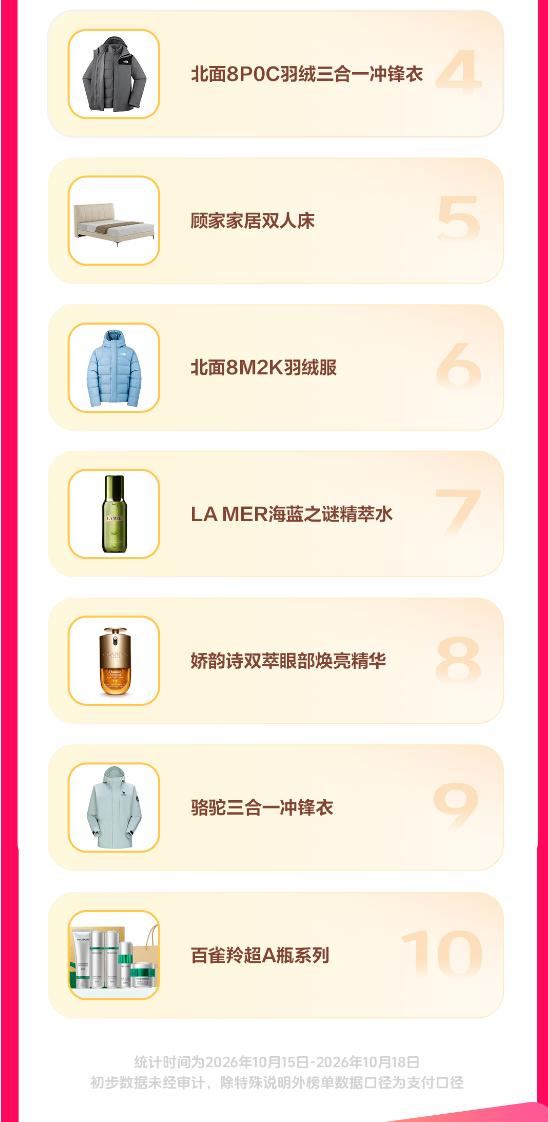
Data from the JD Institute of Consumption and Industrial Development also confirms this trend: among the core consumer group of outdoor equipment, male users account for more than 60%, and the sales of functional and exploration-oriented equipment are growing particularly rapidly. During this year's Double 11, Douyin E-commerce also listed "jackets" as a key explosive product in its operation guide, suggesting merchants to stock up. Judging from the best-selling product list in the opening stage, three of the top ten items are jackets and down jackets that focus on outdoor sports performance.
The rise of "sports luxury" is also the result of the combined effect of the outdoor sports boom and the connotation change of luxury brands on the apparel market. In the past, luxury consumption was more oriented to the identity symbols carried by luxury watches, luxury cars and big logos, but now it has gradually shifted to experiential consumption and healthy lifestyles. Being able to go skiing and cross-country at any time has become the highest-level symbol of "being rich and having leisure time".
As a result, top outdoor sports brands such as Arc'teryx and Descente, backed by the rising popularity of the emerging outdoor sports category, have been abstracted into new "luxury" symbols, and have imperceptibly taken over the social identification function that traditional business men's wear once had. An investor summarized from consumer research that in public institutions, the top leader usually wears Arc'teryx, and people below the top leader will wear Descente.
In an interview article about Arc'teryx CEO Stuart Haselden, Bloomberg Businessweek also mentioned that Arc'teryx is now favored by corporate executives; the article also pointed out that since its parent company was acquired by ANTA in 2019, Arc'teryx's business scale has achieved significant expansion — the Chinese market accounts for a very considerable proportion of its growth.
ANTA, which made early layout around this change, has also reaped the greatest mindshare and commercial dividends. Over the past ten years, through mergers, acquisitions and brand operation, it has formed a brand portfolio covering different price ranges and sports scenarios, including Descente, Kolon Sport, as well as Arc'teryx and Salomon under Amer Sports. After acquiring Jack Wolfskin in 2025, ANTA positioned it as an "all-scenario professional hiking" brand to supplement the mass outdoor market. Different brands target different consumers, but all of them are meeting the demand for sports equipment extending to daily wear and lifestyles.
This demand is also reflected in the rise of operating data. The "All Other Brands" segment in ANTA's financial report, which is centered on Descente and Kolon Sport, recorded a 57.7% year-on-year revenue growth in 2023, and the growth rate exceeded 50% in the following two years. In 2025, Descente became the third 10-billion-level brand of ANTA Group after the main brand and FILA. The 2026 half-year financial report of Amer Sports shows that Greater China has surpassed the Americas to become its largest market in terms of revenue scale.
ANTA also emphasized in its 2026 interim report that the sports footwear and apparel track, which has both functional and lifestyle value, has shown strong anti-cyclical resilience, with growth outperforming the overall retail market.
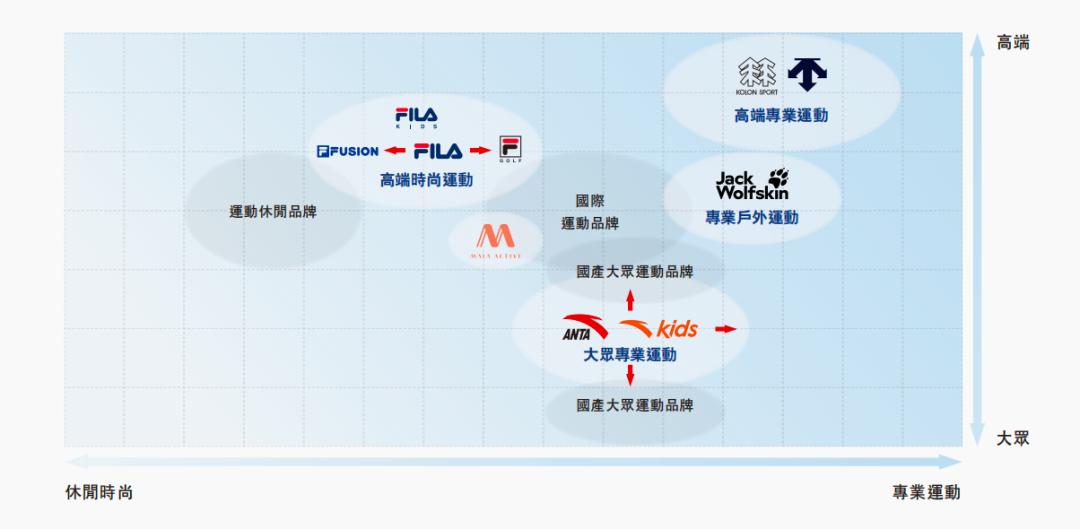
Traditional men's wear brands that want to break the deadlock also take outdoor sports apparel with both hardcore technological parameters and "new luxury" identity labels as a starting point for self-rescue.
The most direct move is product line transformation. For example, Septwolves has drastically reduced the proportion of traditional formal wear, and instead emphasized functions such as wind resistance, waterproofing and lightweight design; Joeone has launched concepts such as "tech men's trousers" and "space trousers", embedding technological elements such as elasticity and wrinkle resistance into product promotion.
Another example is the tactical apparel brand "Dragon Tooth", which received investment from Qichang Capital, Peak Capital and Black Ant Capital this year. Starting as a brand rooted in the military tactical hobby circle, it now benchmarks outdoor products, integrates properties such as water repellency, temperature locking, quick drying and modular storage into basic styles, and gradually develops into daily apparel suitable for multiple scenarios including commuting and outdoor activities, realizing the cross-circle development from tactical apparel to a mainstream men's wear brand.
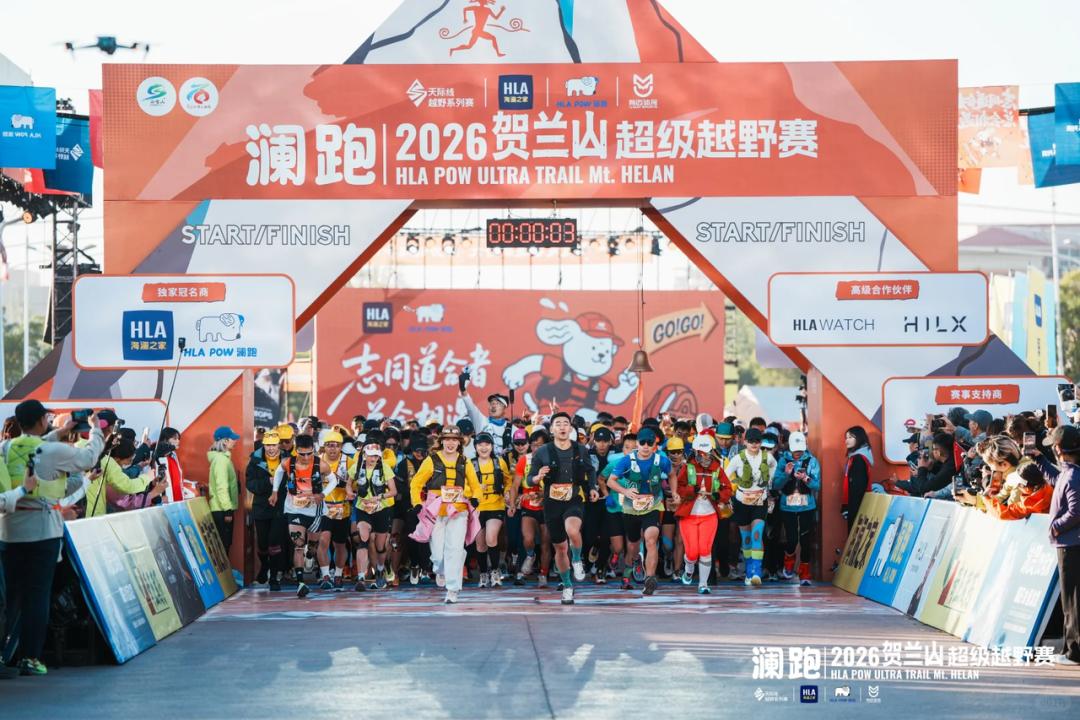
Some leading men's wear enterprises have also begun to acquire or set up outdoor sports sub-brands through capital operation. HLA has internally incubated the sports brand HLA POW, taking cross-country running as a breakthrough, naming events to enter the outdoor circle. Youngor has established a joint venture with the Norwegian outdoor brand "Helly Hansen" to enter the high-end track.
Biemlfdlkk has taken the most aggressive actions. On the one hand, its main brand continues to focus on high-end outdoor sports. During this year's Tmall 618 shopping festival, Biemlfdlkk achieved a 160% year-on-year growth with a customer unit price of 1,000 yuan, ranking 8th in the men's wear category list for the first time. On the other hand, Biemlfdlkk obtained the full-category operation right of Japanese outdoor lifestyle brand Snow Peak in China directly in June this year, set up an independent business division for this purpose, and set a sales target of "5 billion yuan in ten years".
As more and more men's wear brands pour into the market and the market supply gradually becomes saturated, outdoor sports may not become a permanent panacea for traditional brands, and this boom may cool down. Moreover, in the process of transformation, continuous investment is required in R&D, investment, and marketing to reshape brand mindshare, which also forces these brands to face the short-term pain of revenue growth without profit growth. For example, Biemlfdlkk's total annual sales expenses in 2025 increased by 25.20% year on year, far exceeding the 7.73% revenue growth rate. Even with a high gross margin level of about 75%, its net profit still fell by 29.46% year on year.
However, just as the once popular "new Chinese style" finally settled down as a conventional design element in women's wear, what outdoor sports leave to men's wear is not just a style label, but a comprehensive reshaping of fabrics, silhouettes and product logic. The pursuit of technology and comfort by male consumers has become an irreversible underlying consensus.
But more importantly, beyond "hardcore parameters" and "functional fabrics", the value recognition and identity labels brought by community connections and sports culture are the key for outdoor sports to reconstruct the men's wear market, which is also the capability that most men's wear brands are relatively lacking.
This article is from WeChat official account "Narrow Broadcast", author: Yang Yiqi, published by 36Kr with authorization.