6G, Token Factories, Embodied Intelligence: Everything You Need to Know About the Key Highlights of the 2026 Mobile Network Conference in One Article
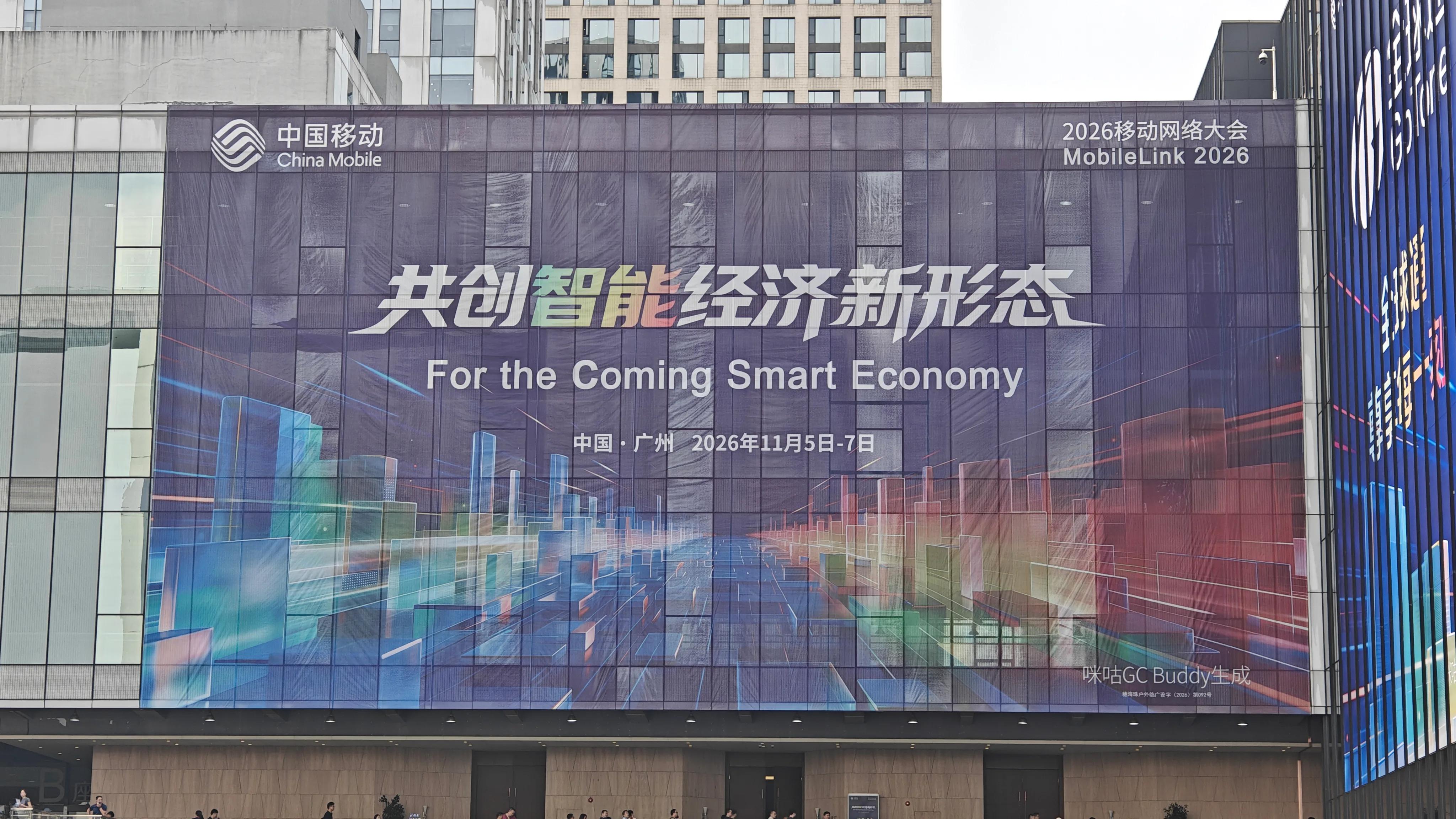
On November 5, the 2026 Mobile Network Conference with the theme of "Co-creating New Forms of Intelligent Economy" grandly opened in Guangzhou.
The reason why the event was renamed from "Global Partners Conference" to "Mobile Network Conference" lies in the transformation of operators' identity and positioning. Today, the network is no longer a general term for base stations and optical fibers, but an integration of communication network, computing power network and intelligent network, with its focus shifting from pure "connection" to the integrated base of communication, computing power and AI.
(Photo source: Shot by Leitech)
As Chen Zhongyue, Chairman of China Mobile, said in June, in the mobile intelligent era, the network is an intelligent stream that carries knowledge and solves problems, and the new era calls for operators to explore broader new fields of intelligent services.
Enterprises including China Mobile, Qualcomm, Lenovo, ZTE, OPPO and vivo exhibited technologies such as 5G-A and 6G at the 2026 Mobile Network Conference, which are the highways in the AI era and the transmission channels for "intelligent streams". ZTE put forward the slogan "Lay a solid foundation with 5G-A, expand the boundary with 6G" at the conference, and in the future, it will integrate AI acceleration through dedicated communication processors via 6G+AI to empower intelligent agent architecture and full-stack AI.
Not only operators and network service providers, but all enterprises are repositioning themselves around AI.
Token Factory, Another "Power Plant" in the AI Field
In March this year, Jensen Huang, CEO of NVIDIA, first proposed the concept of the Token economy, and gave the formula "Revenue = Number of tokens per watt × Available gigawatts". In his view, Token is a new commodity, and AIDC intelligent computing centers oriented to large-scale inference optimization have become factories that produce Tokens.
Indeed, computing power is an important infrastructure in the AI era. Large-scale computing power clusters are continuously providing the computing power required for training and inference for large AI models. A Token factory is a new operation form that takes the data center as the hardware base, superimposes models, inference optimization and scheduling platforms to produce and deliver Tokens.
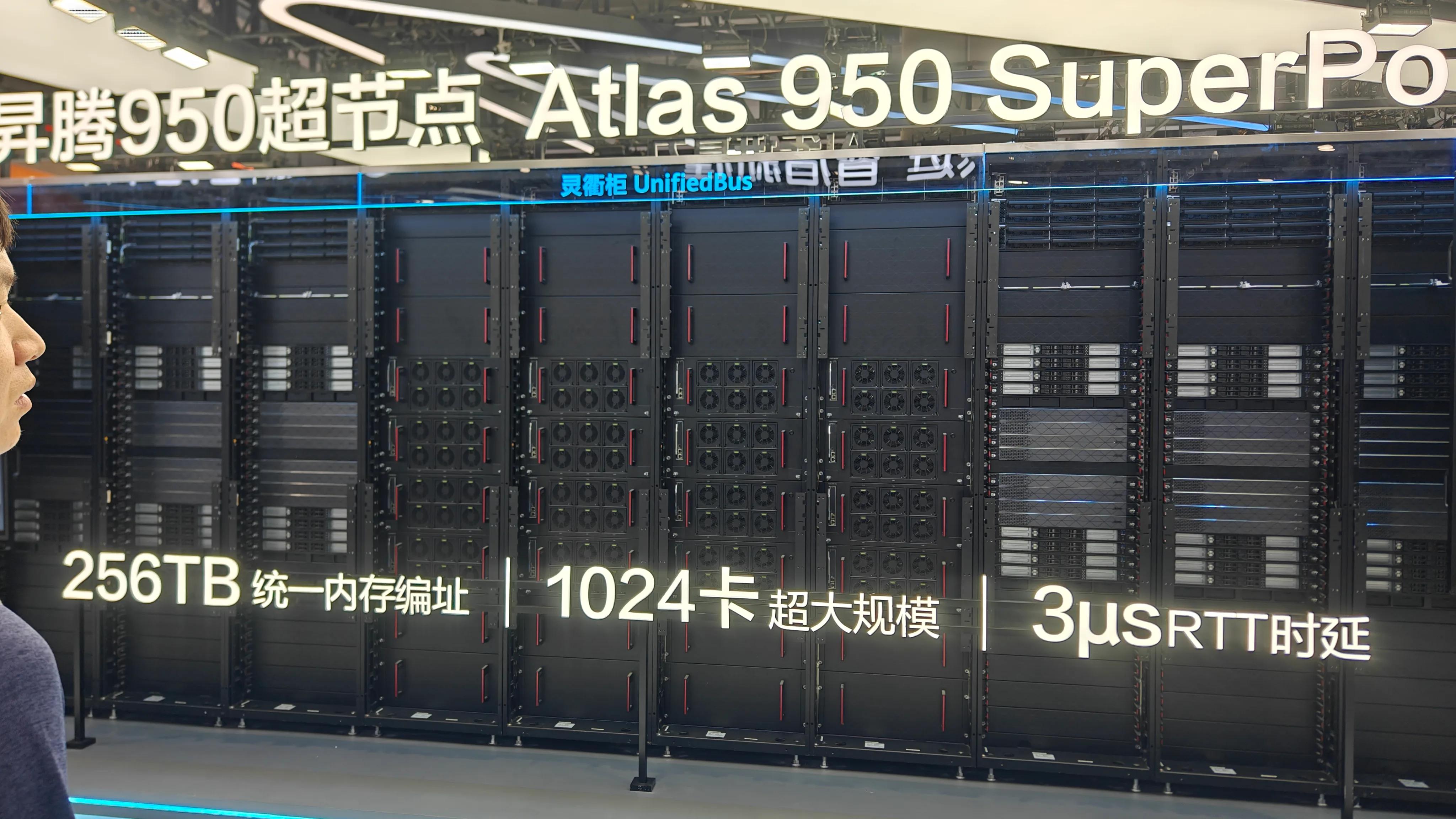
At the 2026 Mobile Network Conference, computing power providers have exhibited Token factory solutions one after another. For example, the Ascend 950 super node exhibited by Huawei adopts 256TB unified memory addressing, is equipped with 1024 Ascend 950 chips, with an RTT latency of only 3μs, and supports many business models such as internal AI self-use, computing card leasing, and Token services.
(Photo source: Shot by Leitech)
H3C UniPoD S80000 super node exhibited by New H3C can accommodate 32 or 64 AI acceleration cards in a single cabinet, covering 32 cards to 1024 cards in the full series, and can be expanded to a maximum of 16384 cards. AI enterprises or Token factories can freely combine and match according to actual usage scenarios.
Moore Threads exhibited the domestic full-function GPU ten-thousand-card trillion-parameter large model training platform — Qune Intelligent Computing Cluster, as well as the low-cost "domestic heterogeneous inference high-quality AI Token factory solution". Through three underlying technologies of Prefill-Decode (PD) heterogeneous collaboration, high-performance heterogeneous KV Cache conversion and heterogeneous computing integration, combined with full-link vertical deep optimization including model adaptation, inference execution, KV Cache management, resource orchestration and service operation and maintenance, it improves the effective Token output and production efficiency of unit resources.
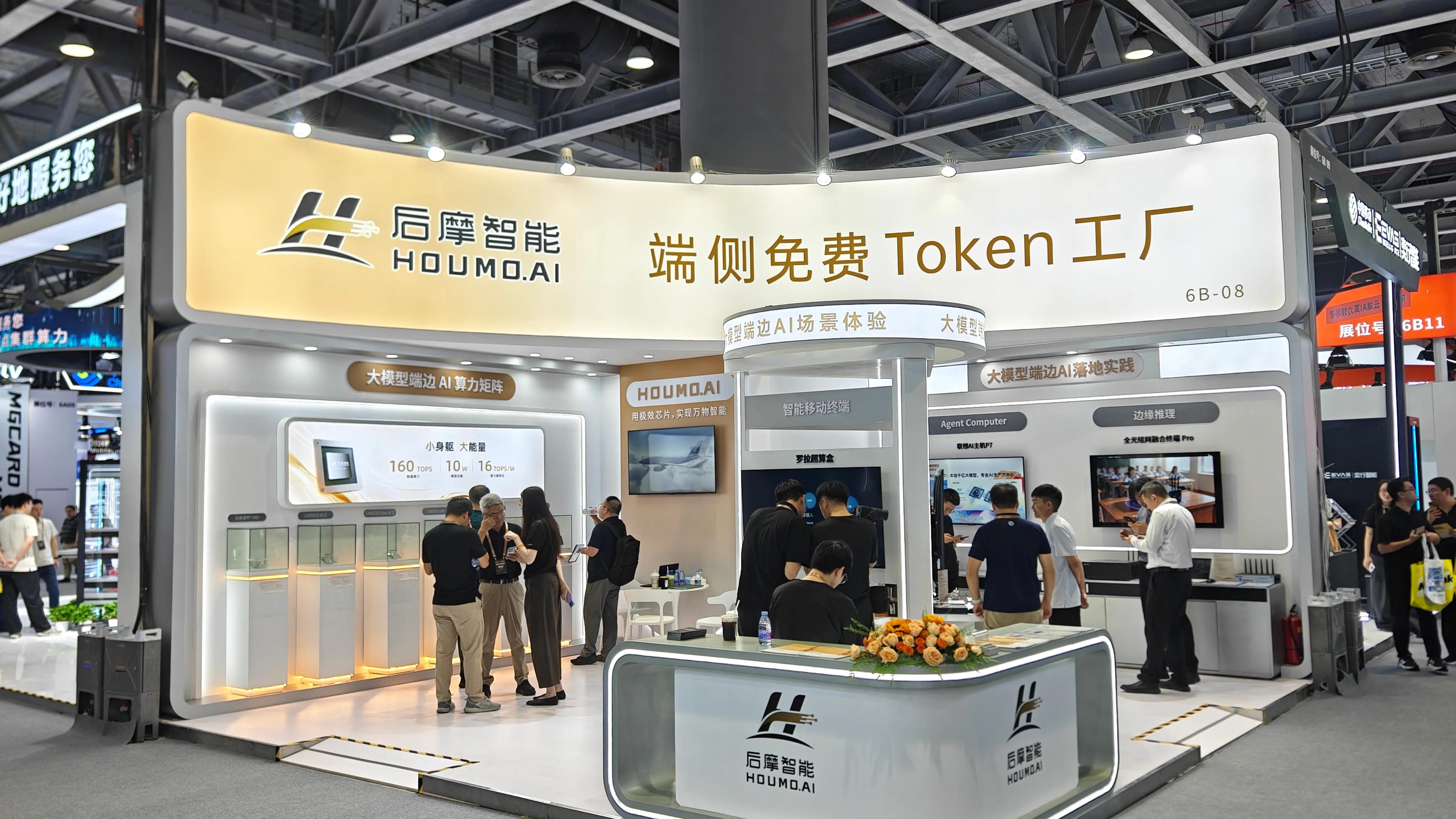
Different from the above manufacturers' solutions that focus on cloud-side AI, Honto Intelligence defines itself as an "end-side free Token factory". Taking SRAM-CIM as the core technology, it lays out two technical paths of 2D CIM and 3D CIM to meet the demands for larger capacity and larger bandwidth, and reduce the marginal cost of end-side AI through computing-in-memory technology.
(Photo source: Shot by Leitech)
In 2024, end-side AI chips could only run models of about 7b, with a performance of only about 10 Tokens. The new generation of AI chips can already run models of about 120b. Coupled with the continuous optimization of large AI models, the capability has been greatly improved under the same parameter quantity, which can meet users' more complex needs. In addition, the advantage of higher privacy will also be a major boost to the popularization of end-side AI in the future.
AI is penetrating into all aspects of our lives, and Token operation is developing in a down-to-earth and in-depth manner, with the industry putting forward higher and higher requirements for the computing network. Token factories to AI are just like power plants to factories. Enterprises including Huawei, Moore Threads, New H3C, Shenzhou Kuntai and Alibaba have put forward their own Token factory solutions.
Leitech (ID: Leitech) believes that in the future, Token factories will provide a steady stream of computing power resources for AI enterprises, just as power plants provide electricity for factories.
Stepping out of the Laboratory into Thousands of Scenarios, Robots Are Another Highlight of the Conference
Since ChatGPT detonated the AI industry, "practicality" has always been a hot topic in the AI field. Well-known large models at home and abroad such as Qwen, Doubao, DeepSeek, Gemini and Claude have proved to us that AI already has practical capabilities.
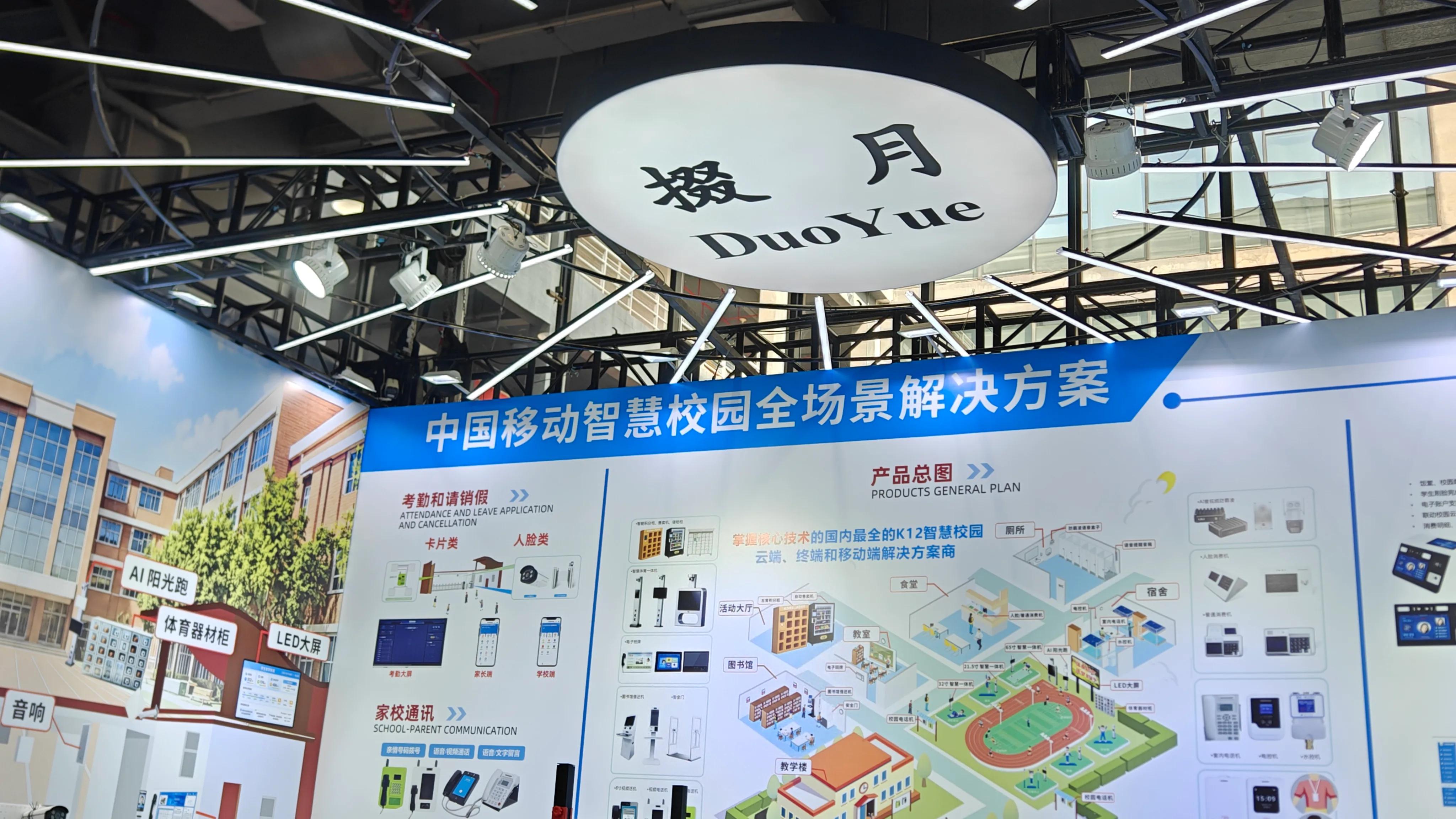
At the 2026 Mobile Network Conference, the smart campus scenario solution of China Mobile exhibited by Duoyue, the multi-scenario AI application exhibited by Shenzhou Taiyue, the AI office solution exhibited by CZUR, and the AI + big health solution exhibited by Whale Technology all show us the performance and role of AI in scenario-based applications.
(Photo source: Shot by Leitech)
However, what Leitech pays the most attention to is embodied intelligent robots. AI applications are no longer new to us today, and robots that are being implemented on a large scale and in scenarios are the pearl on the crown of embodied intelligence.
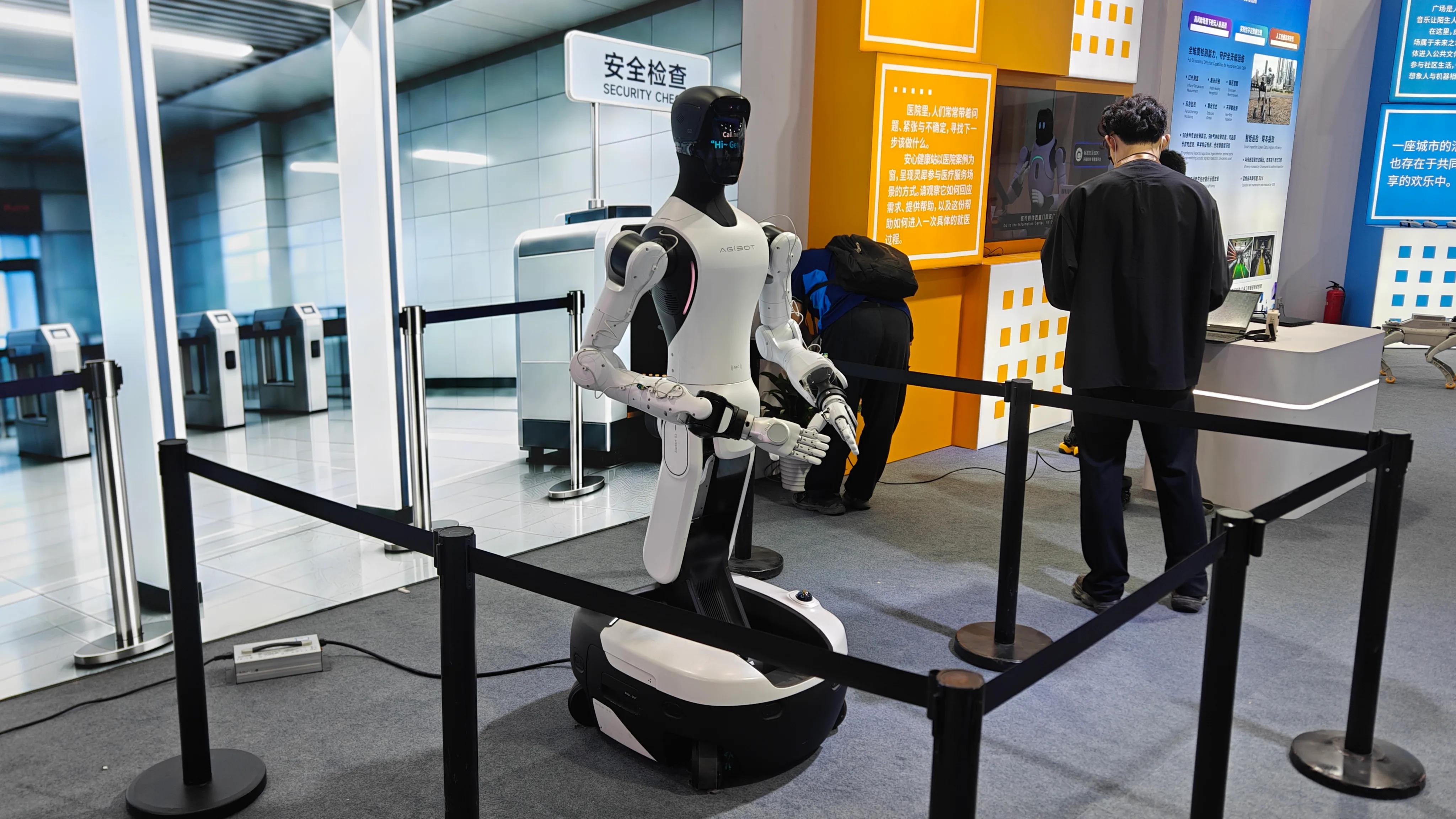
There are not many robot enterprises participating in the 2026 Mobile Network Conference, but enterprises such as Unitree, Agibot, Honor and InTimes Robotics came to the scene and exhibited different categories of products such as robots and dexterous hands.
In terms of scenario-based applications, Agibot exhibited robots designed for subway and hospital inspection, and Fanyinta Technology exhibited the Yaya elderly health companion robot solution. As the host, China Mobile's Mobile Star Chef Robot specially built for the catering scenario was also exhibited on site, demonstrating the full-process coffee making capability.
(Photo source: Shot by Leitech)
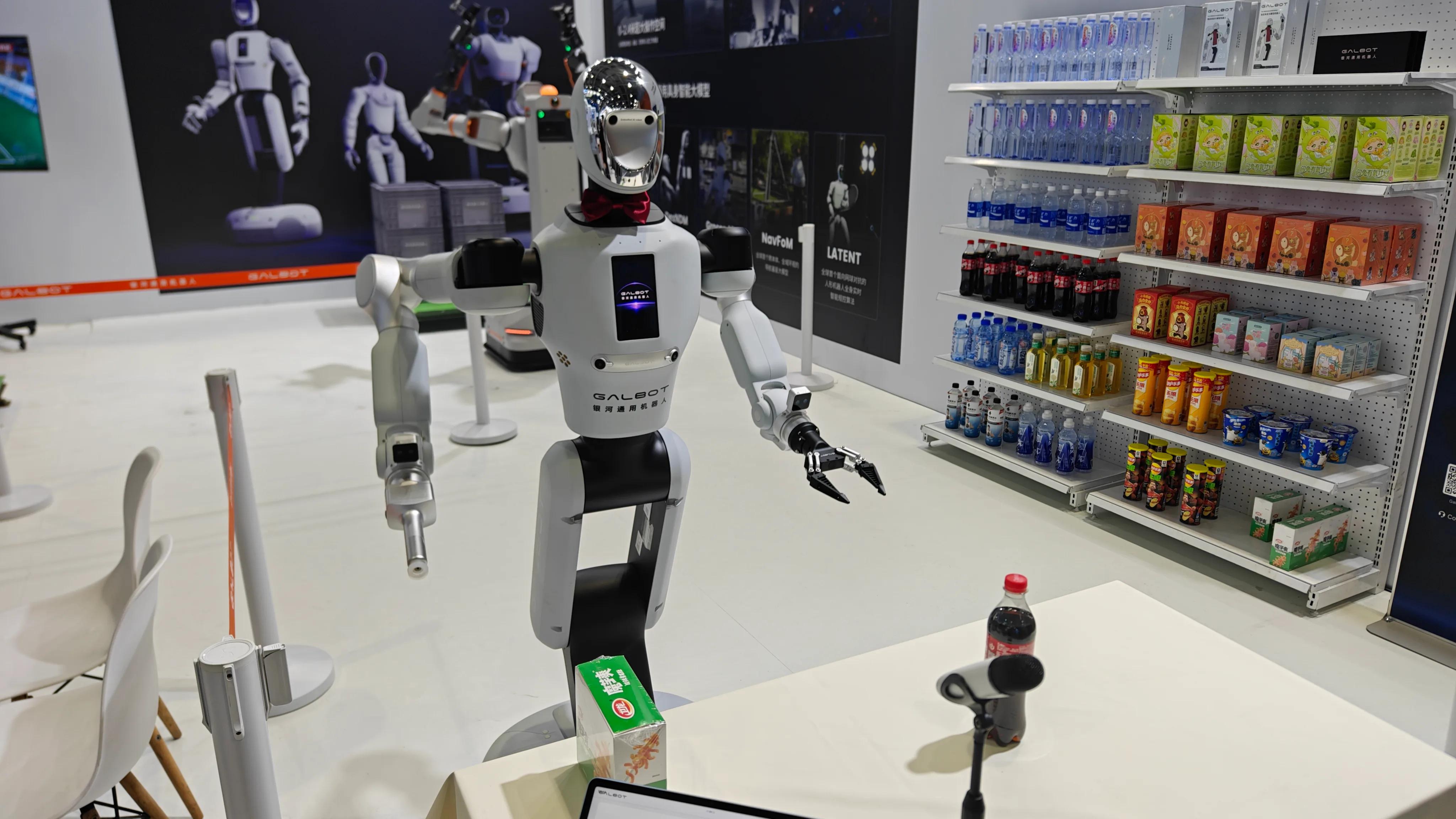
There are relatively mature robot solutions in the inspection field, and the retail industry is the next direction targeted by all embodied intelligent enterprises. Galaxy Universal, which has launched the Galaxy Space Capsule and Smart Pharmacy and cooperated with FamilyMart convenience stores, not only participated in the conference, but also built a small retail scenario on site, where users can place orders on site and the robot will automatically pick up goods for users.
After Leitech's test, the robot of Galaxy Universal can accurately grasp the goods we ordered on the shelf and deliver them to the counter. Of course, compared with manual work, the efficiency of the robot is still much lower.
(Photo source: Shot by Leitech)
When promoting robots, many enterprises will use the scenario of "screwing screws on their own factory production lines" to prove the working ability of robots. Although this scenario has been separated from the pure laboratory, most of them still belong to the "pilot verification line", which is not equivalent to having the ability of large-scale commercial mass production and popularization. Only when the scenarios such as retail and home are fully operated can general humanoid robots truly have popularization value.
At the 2026 Mobile Network Conference, embodied intelligent enterprises did not emphasize technologies and products, but started from scenario-based applications, focusing on demonstrating the working ability of robots. Replicable and migrable general working ability is exactly the basis for realizing Elon Musk's prediction that "there will be hundreds of billions of humanoid robots around the world in the future".
Connection Is the Foundation, Computing Power Is the Resource, AI Is the Core
Different from auto shows and consumer electronics exhibitions, the enterprises participating in the 2026 Mobile Network Conference are basically partners of China Mobile, and most of the products and solutions they exhibit are oriented to the B-end market.
Judging from the products and solutions exhibited by participating enterprises, the positioning of the communication industry is being reconstructed. Communication is no longer independent, but has become the carrying base of AI. Reconstructing the network in the AI-Native (native intelligence) mode replaces the plug-in AI transformation. The network itself has the capabilities of perception, calculation and decision-making. 5G-A delivers the current industrial dividends, while 6G carries out long-term pre-research and gradual evolution.
AI infrastructure is gradually layered. Large model training is concentrated in intelligent computing centers, but intelligent agents, robots, industrial control and low-altitude perception require low-latency, high-reliability, locally privacy-controllable inference. AI is not only a competition for computing power, but also a competition for computing power scheduling networks, deterministic connections and end-edge-cloud collaboration.
In the future, the industry will present a pattern where cloud manufacturers build large models, AIDC intelligent computing centers provide Tokens, and enterprises represented by China Mobile are responsible for selecting models, scheduling and distributing Tokens through MoMA (Mobile Model Service Platform). Relying on the advantages of the national computing network and edge nodes, MoMA will package the computing power of intelligent computing centers into inclusive services that can be called on demand and purchased by the amount of Tokens.
Finally, landing on C-end scenarios, AI will move from cloud large models to distributed intelligence and end-side embodied intelligence. The application focus will also shift from mobile APPs and cloud conversations to networked robots, industrial intelligent agents, home intelligent agents and low-altitude devices.
This article is from "Leitech", authorized for release by 36Kr.