Why are tech giants including Huawei, OpenAI and ByteDance all getting involved in the pharmaceutical industry?
I recently read a book about pharmaceuticals, and one sentence in it shocked me a lot:
Despite the tremendous efforts made by large pharmaceutical companies, the core technology of drug hunting in the 21st century is no different from what it was 5,000 years ago — people painstakingly sample and conduct experiments from a huge number of mixtures, hoping that one of them will be effective.
Of course, when the author wrote these words, AI-driven pharmaceutical research was not as popular as it is today. I can't help but wonder: can AI-driven pharmaceuticals change this situation?
In recent years, a number of tech giants such as OpenAI, Anthropic, ByteDance, NVIDIA, Meta and Huawei have stepped into the pharmaceutical industry to varying degrees. What roles do they play in this field?
1
Tech Giants "Cannot Afford to Miss the Pharmaceutical Track"
In December 2025, Huawei set up a new department called the Pharmaceutical Legion. A few days ago, at the 11th Medical Innovation and Investment Conference, Fan Jie, President of Huawei Pharmaceutical Legion, delivered a message to the industry: "Huawei does not develop drugs, nor does it work on drug pipelines. Our positioning is to be an AI enabler for the pharmaceutical industry."
This statement sparked widespread discussion.
It is not just Huawei. Since the beginning of this year, many tech giants have increased their layout in the pharmaceutical field.
For example, OpenAI released GPT-Rosalind, a life science model in April, which can be used to accelerate drug discovery. In the same month, it established a strategic partnership with Danish pharmaceutical giant Novo Nordisk, planning to deploy AI in all links of pharmaceutical production by the end of this year. In September, it led the investment in Biossil, a start-up that focuses on reviving "failed drugs". In October, it announced the acquisition of Orchestra Bio, an AI drug development collaboration platform.
Compared with OpenAI, Anthropic has been more aggressive in the pharmaceutical field this year:
In April, it acquired Coefficient Bio, an AI biotechnology start-up with fewer than 10 employees, for 400 million US dollars. In the same month, it appointed Vasant Narasimhan, CEO of pharmaceutical giant Novartis, as a member of its board of directors. In June, it launched Claude Science, an exclusive AI product for scientists and pharmaceutical enterprises. In September, it built a physical biological laboratory in the San Francisco Bay Area.
Isomorphic Labs, under Google DeepMind, started earlier and went further in the pharmaceutical field. Its AI-designed cancer drug is about to enter human clinical trials.
Isomorphic Labs completed a Series B financing of 2.1 billion US dollars in May, refreshing the global record for a single financing in AI-driven pharmaceuticals. Recently, there have been reports that it is seeking a new round of financing with a valuation of 40-50 billion US dollars. This valuation, when placed among traditional pharmaceutical enterprises, is already at the level of a medium-sized multinational pharmaceutical company.
In June, ByteDance also spun off its AI pharmaceutical business into an independent company called Anew Labs. Three months later, Anew Labs completed its first round of financing of 290 million US dollars, with a post-investment valuation of about 1.5 billion US dollars.
Why do all tech giants want to get involved in pharmaceuticals? And how much change can AI actually bring to pharmaceutical research and development?
2
How Difficult Is Pharmaceutical R&D?
The reason why I paid attention to the AI pharmaceutical field is that I recently read the book The Drug Hunters: The People Who Discover New Drugs, whose author Donald R. Kirsch is a senior drug hunter with 35 years of working experience.
A drug hunter, as the name suggests, is a scientist who specializes in the discovery and research and development of new drugs, creating drugs from scratch.
There is a sentence in the book that shocked me:
Despite the tremendous efforts made by large pharmaceutical companies, the core technology of drug hunting in the 21st century is no different from what it was 5,000 years ago: people painstakingly sample and conduct experiments from a huge number of mixtures, hoping that one of them will be effective.
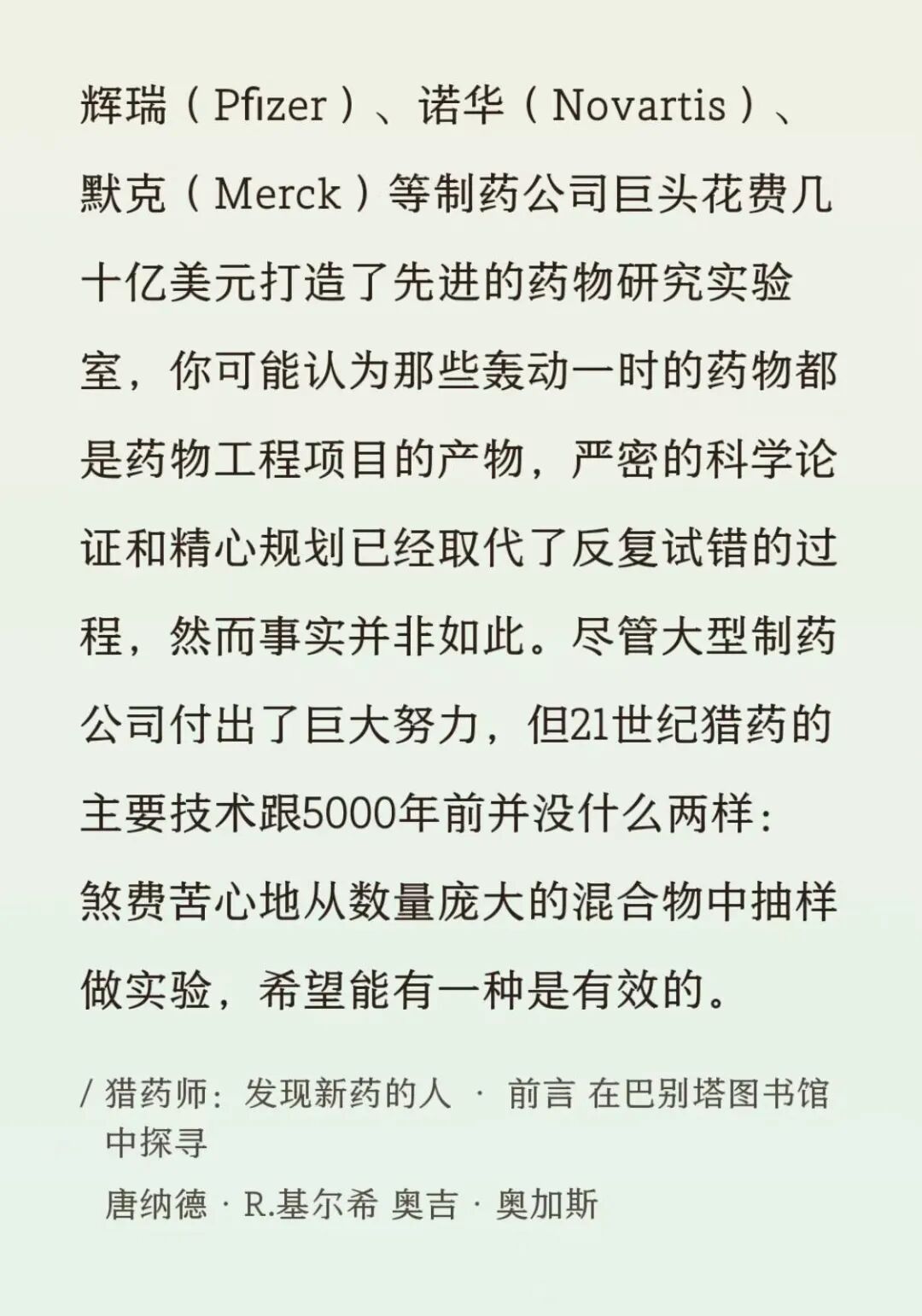
This is not an exaggeration, because up to now, drug discovery still largely relies on luck and accidents.
Why is that?
In the mid-1990s, Ciba-Geigy (now part of Novartis Pharmaceuticals) calculated the number of compounds that could potentially become drugs in the entire universe: 3×1062.
This number means that in order to develop a certain drug, even if 1,000 compounds are tested every second, until the energy of the sun burns out, the number of tested types is only a tiny fraction of this number.
Things like sending humans to the moon or developing atomic bombs are difficult, but there are mature scientific equations, engineering principles and mathematical formulas to calculate the fuel required to reach the moon and the energy required for the atomic bomb.
However, drug R&D can only be carried out by repeatedly screening and trial and error among countless compounds to find the compound that can act on the target (the biomolecule most closely related to the occurrence of the disease) as a candidate drug;
Then preclinical research is needed, that is, to prove that the selected drug is safe and effective in laboratories and animals;
After that, three phases of clinical trials need to be carried out on the human body to ensure that it is safe and effective in hundreds to thousands of patients;
Finally, it has to wait for the approval of the drug regulatory agency before it can be launched on the market.
A set of data can prove how difficult it is for a new drug to be born: only 5% of the pharmaceutical R&D projects reported by R&D personnel can get the approval of the management, and among these approved projects, only 2% can develop drugs recognized by the U.S. Food and Drug Administration (FDA). In other words, the success rate of drug R&D is only 0.1%.
Therefore, there is a "Double Ten Law" in drug R&D: a new drug takes an average of 10 years from laboratory research to final launch on the market, with an investment of more than 1 billion US dollars.
The Argentine writer Jorge Luis Borges wrote a book called The Library of Babel, in which the universe is conceived as a library composed of countless hexagonal rooms. This library extends infinitely in all directions, each room is full of books, and each book contains randomly combined letters. No two books are identical, and occasionally a meaningful sentence appears in the books by chance, which is called "truth".

In Borges' writing, librarians travel and explore in the Library of Babel, hoping to find the truth, but most people spend their whole lives getting nothing, only seeing messy letters.
This is exactly the situation of most drug hunters. Kirsch mentioned in the book that the vast majority of his colleagues graduated from first-class research universities, worked in top laboratories equipped with high-tech equipment, and spent their entire lives studying various bioactive molecules, but finally got nothing and did not find any compound that can safely and effectively improve human health.
Therefore, successful drug hunters in the history of drug discovery often have four basic elements: money, patience, creativity, and very importantly, luck.
3
Accident and Inevitability in Drug R&D
Those drugs that have a profound impact on humanity — aspirin, penicillin, sirolimus, oral contraceptives, Viagra, etc. — also emerged under the combined effect of these factors.
The most well-known one is the story of the birth of penicillin.
In 1928, when the British microbiologist Alexander Fleming used agar plate technology to study Staphylococcus aureus, he did not close the window when he went out. When he came back, he found that fungi had grown on the agar plate, and there was no Staphylococcus aureus around the fungi. Fleming guessed that this fungus would produce a substance toxic to Staphylococcus aureus.
He named this substance "penicillin", and then carried out a series of experiments, finding that penicillin can kill a variety of pathogenic bacteria, so he published a paper to announce his discovery.
The story has only just begun at this point, because a great laboratory discovery does not mean that a useful drug can be produced.
At that time, there was no mature method for large-scale cultivation of fungi, so it was difficult to mass-produce penicillin. In addition, when Fleming first applied penicillin, he used external application instead of oral administration or injection, so the drug effect was not good. Penicillin remained in the laboratory stage for 10 years after its discovery.
Later, World War II broke out, and more effective antibacterial drugs were urgently needed. Two scientists, Howard Florey and Ernst Chain, accidentally discovered Fleming's paper, so they purified penicillin. The higher-purity penicillin had faster and stronger drug effect, making hospitals realize that it was a "miracle drug".
In fact, Fleming had also tried purification before, but he did not have the relevant professional background, so the purification effect was not obvious. Chain had rich experience in purification, Florey was responsible for pathology and overall coordination, and other technical experts participated, which pushed Fleming's discovery a big step forward.
After penicillin was in short supply, large pharmaceutical companies such as Merck, Bristol-Myers Squibb, Pfizer, Abbott and Eli Lilly joined in, began to explore ways to increase the output of penicillin, and finally made it one of the most well-known drugs in history.
In the process of the birth of penicillin, Fleming provided creativity and luck; the later comers Florey and Chain pulled penicillin into people's vision through purification 10 years after the stagnation of penicillin research, showing the patience of drug R&D; large pharmaceutical enterprises such as Pfizer and Merck saw the business opportunity in it, and began to invest huge costs to promote the mass production of penicillin, making up for the element of money.
This is a long-term relay that gradually gathered the four pieces of the puzzle that pushed penicillin onto the historical stage.
There are many other cases in the history of drug discovery that interweave accident and inevitability, such as the latest "king of drugs" tirzepatide.
Tirzepatide is mainly used for diabetes and weight loss. Its global sales reached 36.5 billion US dollars in 2025, with huge market potential, and it became an important factor driving the market value of pharmaceutical giant Eli Lilly to exceed 1.3 trillion US dollars.
Tirzepatide can activate both GIP and GLP-1, two incretins, while semaglutide, which was previously also used to treat diabetes and lose weight, only activates GLP-1.
Eli Lilly has always had an absolute advantage in insulin research, and the world's first commercialized insulin was launched by Eli Lilly. As early as 1996, Richard DiMarchi, a scientist at Eli Lilly, discovered that GLP-1 can be used to treat obesity, and planned to push GLP-1 agonists into the weight loss market, but it was rejected by Eli Lilly's senior management. The reason was that no one thought obesity needed treatment at that time, let alone spending a lot of money on injection treatment.
Moreover, at that time, Eli Lilly not only had Prozac, an antidepressant that dominated the market, but also had Zyprexa, a drug for treating schizophrenia with peak sales of 5.9 billion US dollars, so it did not care about the weight loss drug that seemed to have no market.
DiMarchi had to leave Eli Lilly to start his own business, and later sold the company he founded to Novo Nordisk, a Danish pharmaceutical giant. Novo Nordisk made great determination in the research and development of weight loss drugs. In 2013, obesity was officially defined as a disease by the American Medical Association. In 2014, Novo Nordisk launched liraglutide, and later launched semaglutide, which became a global hit drug.
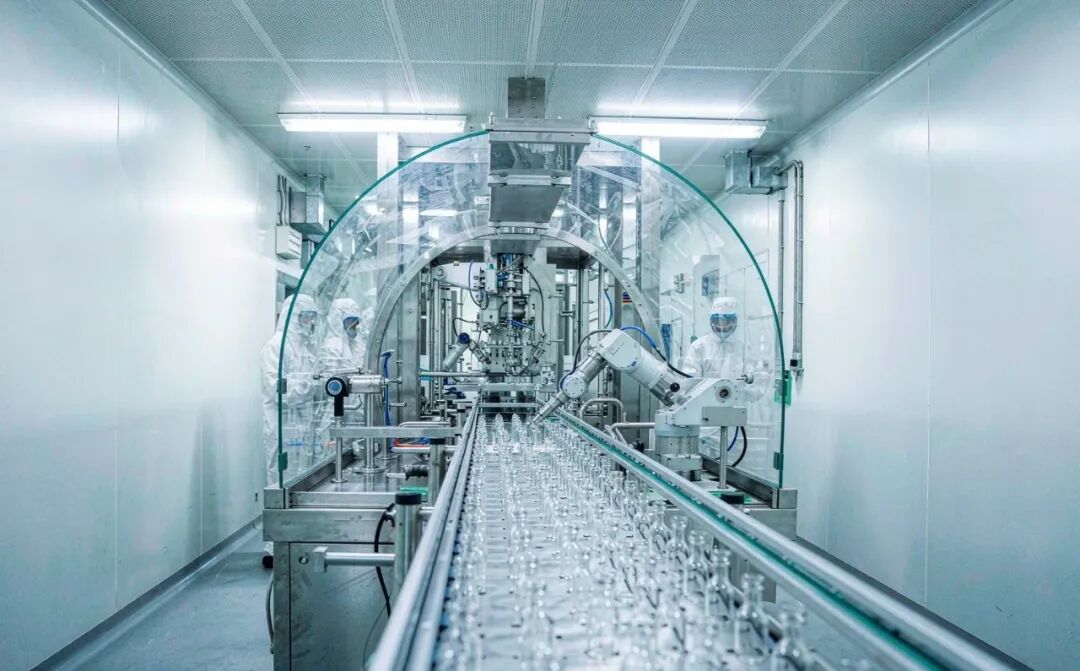
Image generated by AI
When Novo Nordisk was getting better and better in the weight loss field, Eli Lilly was standing on the edge of a cliff. The patents of its cash cow old drugs gradually expired, and sales plummeted with the flood of a large number of generic drugs, while the R&D of new drugs was lackluster.
The more eager Eli Lilly was to find new profitable drugs, the higher the R&D failure rate was. The failure rate of Phase III clinical trials was as high as 60%-70%. The market generally believed that Eli Lilly's innovation engine was broken.
In the critical moment, David Ricks took over as CEO of Eli Lilly. Together with chief scientist Daniel Skovronsky, they withstood huge pressure and insisted on basic research and development. On the one hand, they bet on Alzheimer's disease drugs, and on the other hand, they picked up the incretin research that Eli Lilly was good at.
At this time, Novo Nordisk's semaglutide was already the king in the weight loss field. If Eli Lilly continued to launch GLP-1 drugs, it could only follow behind semaglutide. Eli Lilly then turned its attention to GIP, another insulin-promoting hormone secreted by the intestine. But before that, too many peers had tried to make breakthroughs from GIP, and all ended in failure. GIP was almost abandoned by the academic circle.
Eli Lilly's R&D team found that GIP did not fail, but needed to be combined with GLP-1 to work, and it could also inhibit the adverse reactions caused by GLP-1. Following this idea, they developed tirzepatide, a GIP/GLP-1 dual-target drug.
Tirzepatide was approved for marketing in 2022, and by 2025, it became the "king of drugs" with sales of 36.5 billion US dollars, surpassing semaglutide (36.1 billion US dollars) by a narrow margin. At the same time, donanemab injection for the early stage of Alzheimer's disease from Eli Lilly was also launched in 2024.
Eli Lilly spent nearly 10 years developing tirzepatide. Although there is no cumulative investment data, it invested 2.8 billion US dollars only in the clinical trial stage, not to mention its decades of experience accumulation in the insulin field.
In the field of Alzheimer's disease, Eli Lilly has laid out for more than 35 years, with a cumulative investment of more than 8 billion US dollars. At present, only donanemab injection has "achieved positive results", and other products are still in the brewing stage.
Drug R&D is the combination of inevitability and accident.
4
What Else Is Missing for AI-driven Pharmaceuticals to Succeed?
Can AI reshape pharmaceuticals by changing the four factors of drug R&D?
It needs to be made clear that both AI-driven pharmaceuticals and traditional pharmaceuticals have to go through four stages: drug discovery, preclinical research, clinical research, and approval and marketing.
At present, AI mainly plays a role in the stages of drug discovery and preclinical research.
As written in The Drug Hunters: The People Who Discover New Drugs, in the past, in the drug discovery stage, whether it was target discovery or compound screening, R&D personnel had to rely on personal cognition and experience to repeatedly try and error among the vast sea of genes and proteins, which can be called an "art of trial and error", and success or failure depends on luck.
AI can analyze massive biomedical data to identify potential disease-related targets faster, and then accurately