Frequent botched cases of AI plush toys have occurred one after another. Are consumers of this generation starting to boycott "AI-designed trendy toys"?
"The AI aesthetic of this certain IP is getting more and more prominent now, I don't want to buy it anymore."
"I waited half a year for the pre-order, but the product I received is completely different from the promotional image, the AI-generated promotional pictures are totally untrustworthy."
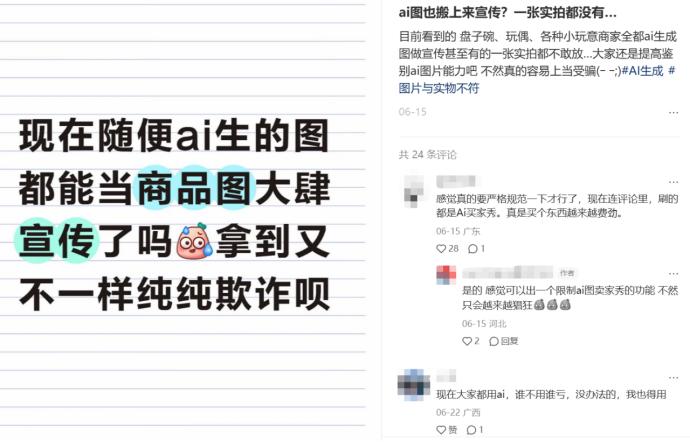
"Beware of AI promotional images. Some merchants put up sales links before even making physical products, what's the difference between this and scamming money out of thin air?"
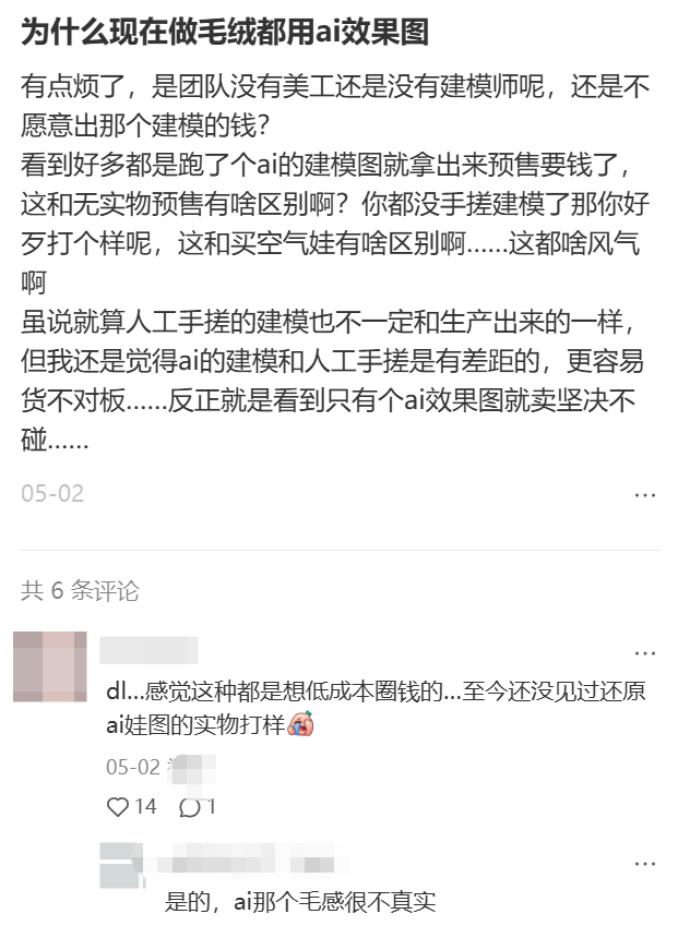
Since the start of this year, similar complaints on social media have been on the rise. "Team using AI" and "AI fraud" have become high-frequency keywords for many users to condemn IP trendy toy merchants: from fan group pre-orders to small unbranded manufacturers, many product links show fluffy, cute dolls with accurate outlines, but consumers receive poorly made products with distorted shapes and lopsided features.
This group of people, who are most willing to pay a premium for emotional value, have begun to guard against AI invading the IP trendy toy sector that relies most on "original aesthetics".
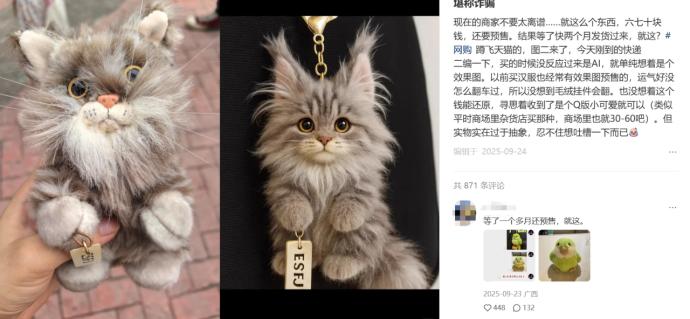

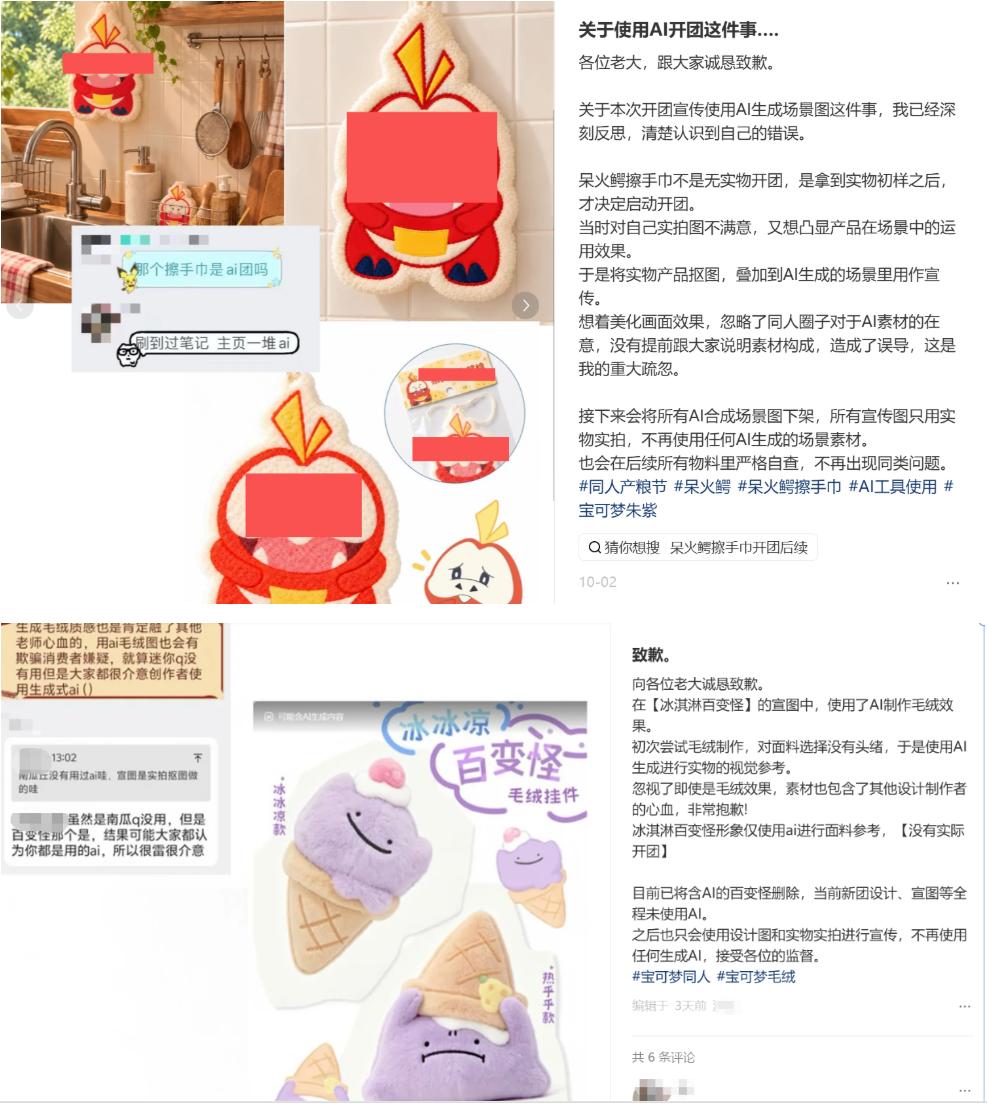
Most of the plush product failure cases shared on social media follow the same script: merchants use AI renderings for promotion first, covering up defects in the structure or even the sampling stage. Many factories claim they can produce the product in the early stage, but later propose "price increases". Responsible "doll organizers" may change factories, pay extra out of pocket or disband the pre-order group, but failed cases are far more common online.
The final result is reflected in the collective sentiment of consumers: "We might as well boycott all products with traces of AI" — from sample images to promotional materials, "using AI" is regarded by many as a sign of the merchant's irresponsible attitude.
But at this year's CTE China Toy & Hobby Fair, AI remains one of the most prominent prevailing trends.
Alibaba Cloud demonstrated the technical system from large AI models to physical devices, while Ant Group's booth promoted the "Digital Technology AI Large Model Full-Stack IoT Solution" that covers glasses, watches and toys. Around the booths of large tech companies, more ODM manufacturers that prioritize customer acquisition hung up "AI Toy" signs to attract customers.
"We can finish sampling for your customized product within one week." A sales representative stopped Spicy Duojiao with a brochure advertising "48-yuan AI plush toys", "We also have existing IP copyrights available for licensing." Behind him hung dozens of plush dolls ranging from 10cm to 35cm in size, some of which are equipped with screens in their eyes that can rotate their eyeballs and greet people under instructions, "We can design the eye animations as you want."
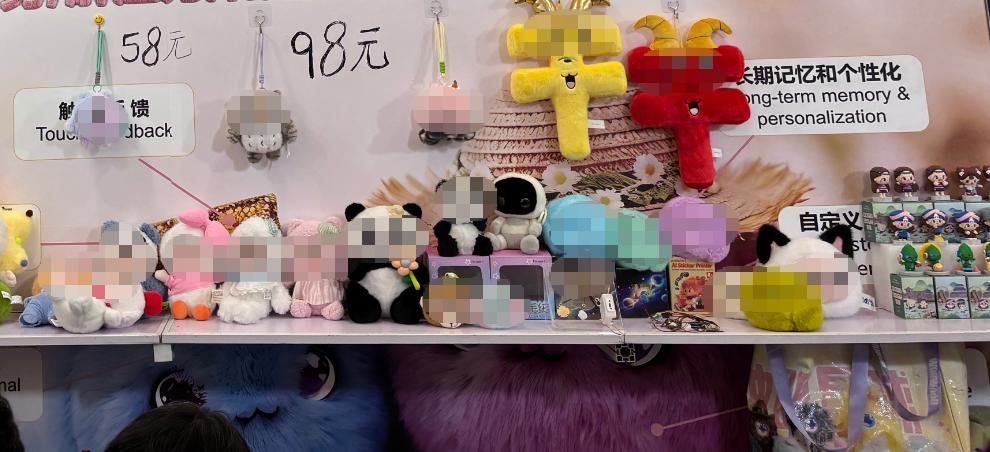
Walking around the exhibition hall, you can pick up more than a dozen brochures with roughly similar content: most of these AI toys adopt core module solutions from third-party AI cloud platform service providers, and access large models such as Doubao and DeepSeek to realize wake-up, conversation and voice interaction. The "customization" service mostly focuses on the design of the plush appearance.
"We get a lot of inquiries." A salesperson at a large ODM factory booth gave a clear answer to Spicy Duojiao, but when asked how many inquiries can actually be converted into orders, he paused for a moment, "It still depends on the specific requirements."
This one-second hesitation is expressed more bluntly on social platforms: "AI empowerment" has brought more design ideas into the industry and lowered the threshold for both sides to get in touch, but the number of deals that actually close is not as large as people imagined.
Has AI really completely changed the trendy toy industry?
The trend of "generative equality" brought by AI has indeed swept into the IP trendy toy sector, and the platforms are full of sharing posts about "AI prompts for IP trendy toy image design" and "AI prompts for physical product realization". But has AI truly brought about a functional revolution and efficiency revolution for IP trendy toys?
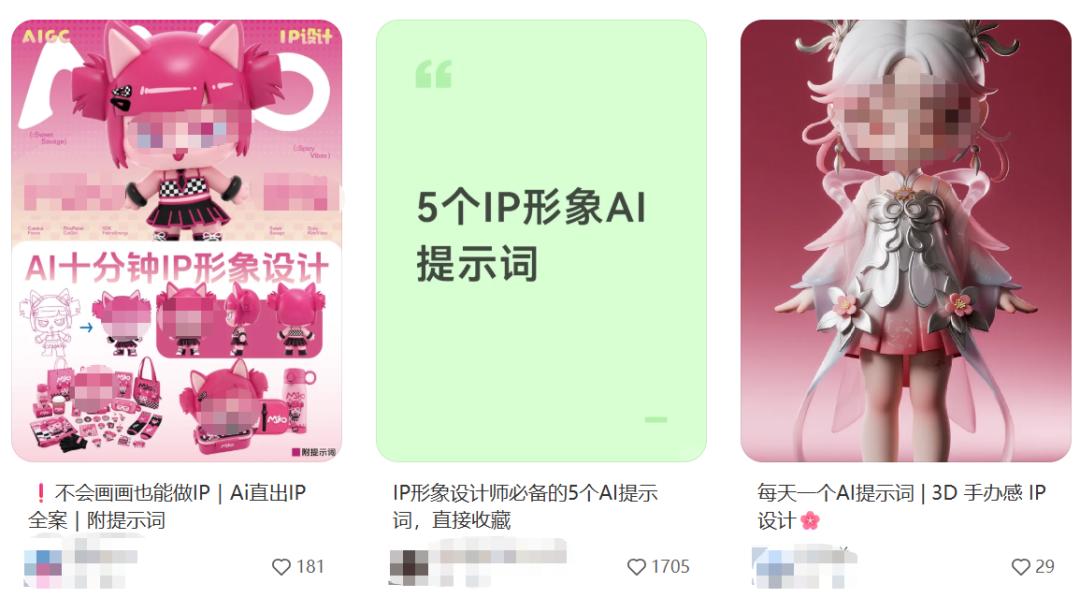
Among all product categories, the plush category with a relatively low entry barrier feels the impact of AI most directly.
"I first generated a rendering with AI, can you make this?" Spicy Duojiao asked many plush ODM booths, and the sales representatives gave very consistent answers: "All are customizable, our designers will make samples for you according to the actual situation." They said the upfront cost ranges from a few thousand yuan to tens of thousands of yuan, and one factory took the initiative to mention, "Now we get a lot of demands for AI-assisted design, we all have experience handling these cases, and we will communicate with you about how to restore the design later."
The reality is that many orders that the sales representatives contacted eventually went nowhere, and those failed cases shared online, all got stuck in this "communication" process.
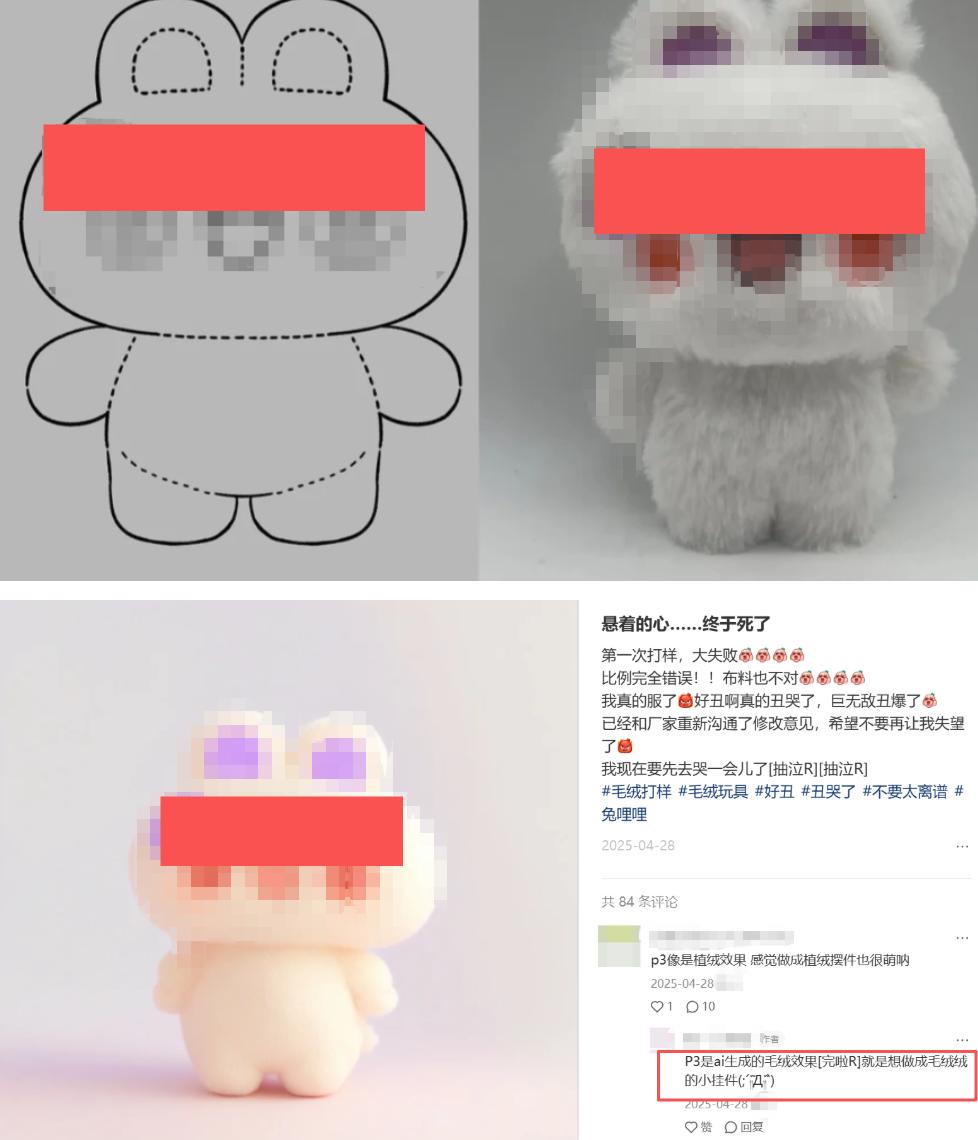
"Most people can accept that for the colors generated by AI, we need to select similar fabrics according to our physical color cards, or customize the materials, this part is not a problem." A factory that accepts private customization and small-batch group pre-orders said, "But many designs in AI-generated images cannot be realized with existing processes and materials, or the AI generates extremely complex designs, which are very difficult for us to explain to customers."
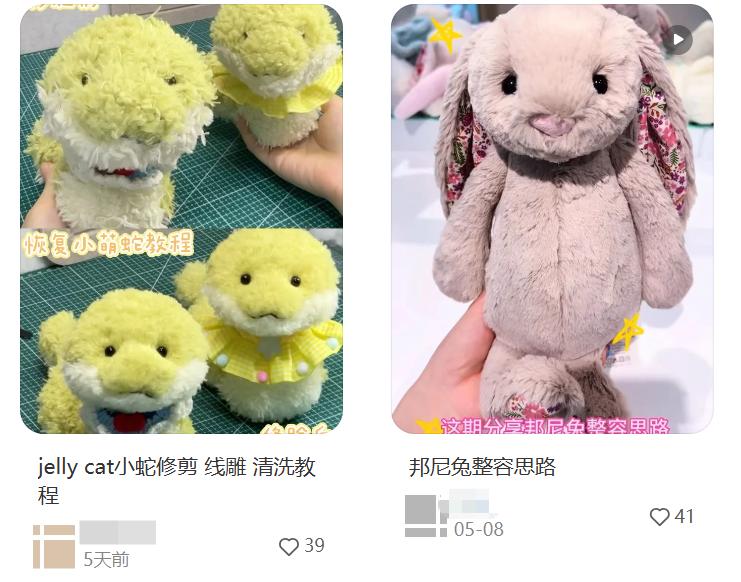
The most direct problem is the stress deformation of plush materials. Long plush materials easily cover the outlines and details of the design, while short plush materials hurt the hand feel and reduce the cuteness. Even mature manufacturers like Jellycat cannot guarantee to balance the two, which is why countless "face trimming and beautifying" tutorials have emerged online. But AI often ignores this point, its renderings look fluffy and perfectly retain all the outlines, but factories can only explain that "such plush materials simply do not exist in reality".
What is more difficult to communicate than designs that "do not exist in physics" is the fact that "you have to pay extra". AI is completely faithful to the initial design draft, so it easily produces designs that increase costs and working procedures: too many colors require multiple types of fabrics, overly complex bumps and structures require skeletons to resist gravity, and complicated accessories require manual sewing, all of which mean higher costs, "the budget will be exceeded before you know it during the negotiation". Even when mass production starts, the wastage rate and defective rate will also rise.
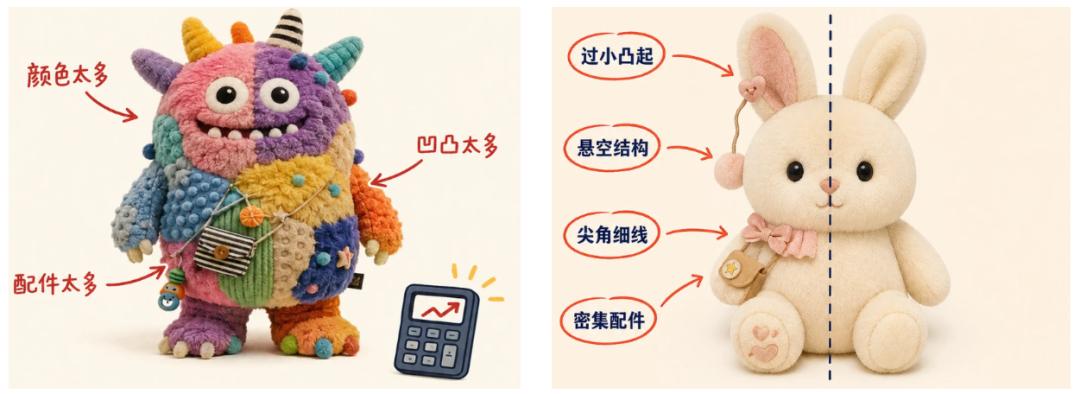
Reference for avoiding pitfalls of AI design images provided by a factory account
In addition, the three-view drawings generated by AI generally lack accurate spatial perspective logic, and interpenetration errors such as "a third hand" are very common. In the end, pattern makers still need to rely on their experience to "translate" the images into a physically feasible product.
Even if some people complain that "they get a headache as soon as they see AI-generated renderings", front-line practitioners do not completely reject AI: AI can help reverse analyze prompts from existing hit products or reference images, and quickly inspire new ideas through rough perception of different fabric textures. But the term "efficiency revolution" still needs to be discounted in actual operation: "For some customers who know exactly what they want and understand the actual production process, AI does provide concrete visual images, which reduces communication costs to a certain extent. But for more 'newbie' customers, facing the illusion of 'what you see is what you get' created by AI images, the communication cost will be even higher."
The information gap about the capability boundary of AI also creates room for opportunism and "deceiving both sides". Customers compare prices with designs that are difficult to produce, while factories take orders first with a general low price. The quotation of "several thousand to tens of thousands of yuan in the early stage" can be seen everywhere at the exhibition, but the real cost disputes usually occur after sampling.
The efficiency gain at the generation end stops right at the factory gate.
The "intermediate layer" is everywhere, but the new species of AI trendy toys has not arrived yet
If we only look at product narratives, the story of "AI-empowered toys" has been told for several years. There are successful cases in the market, but from the perspective of the entire trendy toy market, they are still more like adding new AI features to mature products, rather than a new species that fundamentally changes what AI trendy toys are. While the new species is difficult to give birth to, a huge sinking "intermediate layer" has already appeared at CTE.
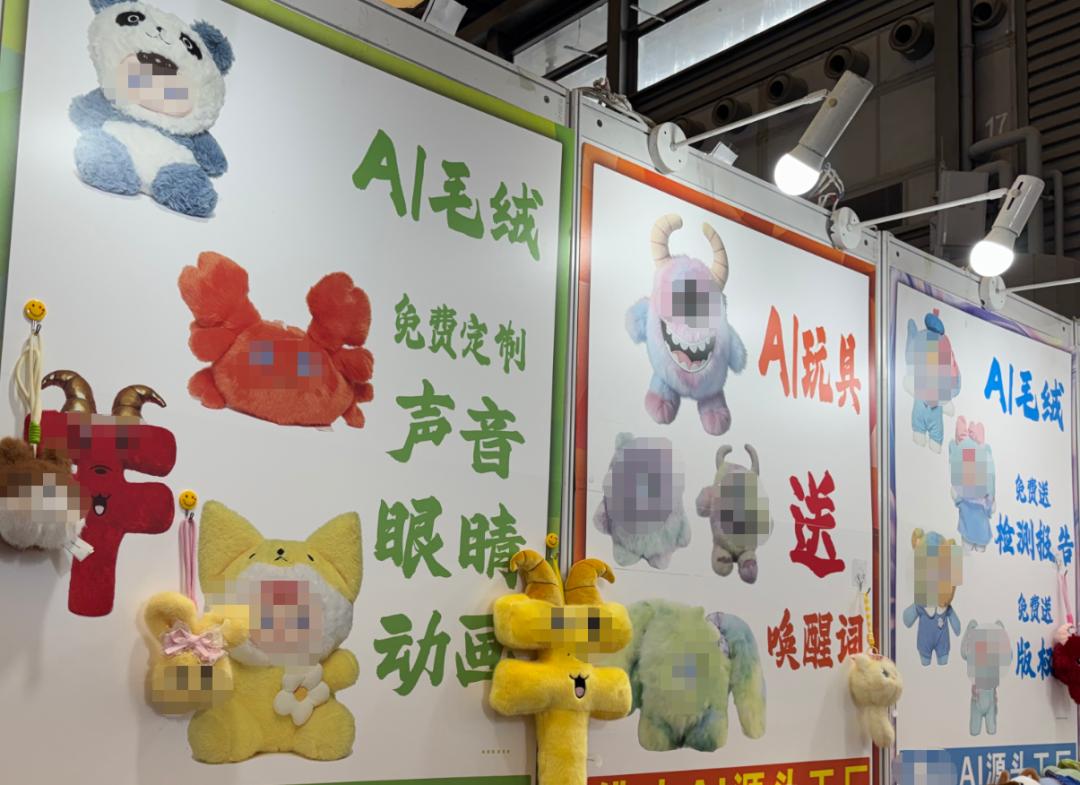
This "AI source factory" that actively stopped Spicy Duojiao put the biggest word "free" on its display board: "Free customized sound eyes, free wake-up words, free copyright, free test reports."
The finished products on the booth are priced from 48 yuan to 120 yuan. According to the introduction in the brochure, all products uniformly use module chips from a listed company, connect to the cloud large model via the internet, and customers can ship the products after selecting the model according to market preferences, installing batteries and speakers.
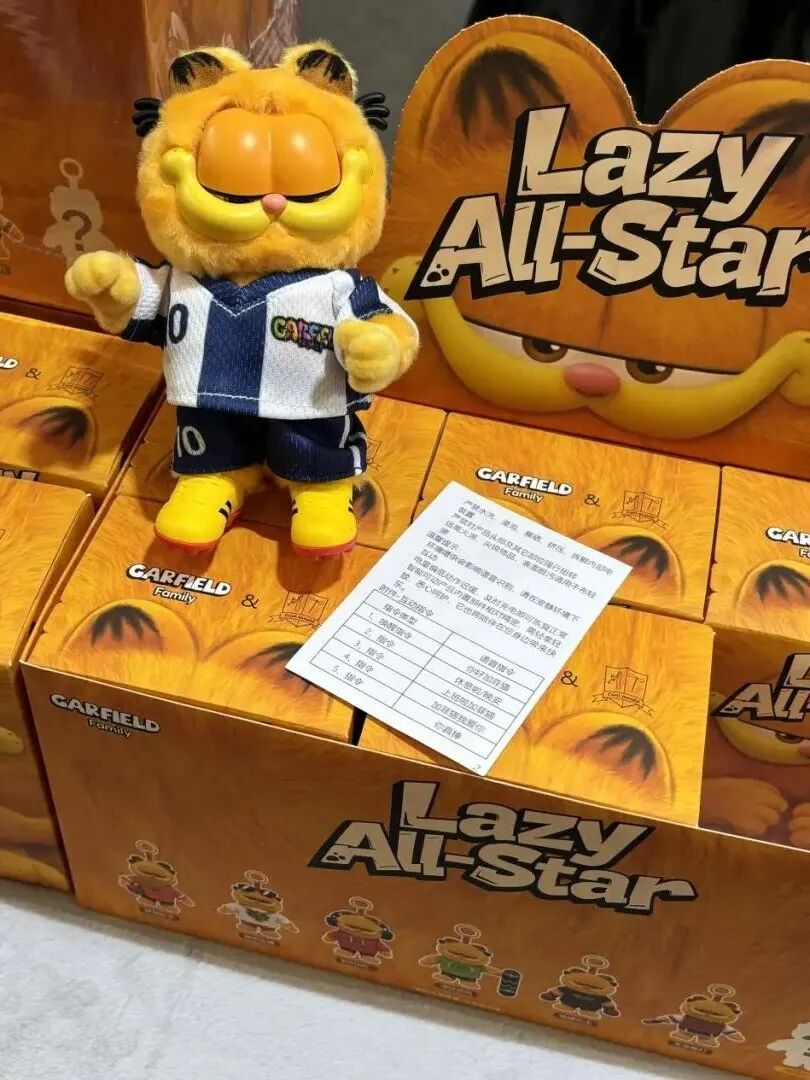
Another factory displayed officially licensed Garfield blind boxes priced at 79 yuan. The sales representative introduced that "the hidden version is integrated with AI" and can realize interactions such as blinking and turning its head, "other ordinary versions are manually operated".
After a round of visits, you will find that there are not a few OEMs with similar solutions. Their quotations, configurations and achievable interactions are almost identical: two small circular screens are embedded in the eyes to switch animated expressions, activated by a specific wake-up word, and after a few seconds of network delay, the connected large language model can perform simple Q&A conversations such as weather queries.
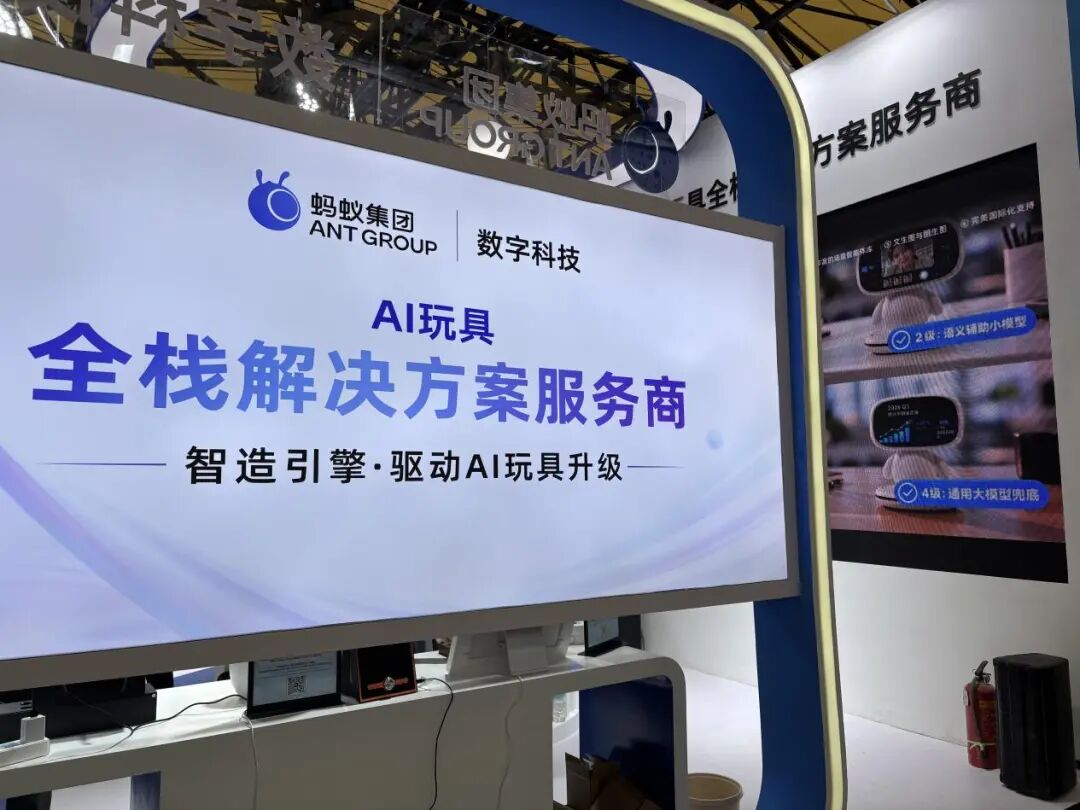
In addition to scattered small and medium solution providers, tech giants are also trying to establish order at the underlying level. At the exhibition site, Ant Digital Technology demonstrated its full-stack AI large model solution, covering smart glasses, watches, earphones, children's toys and trendy toys. However, the more mature the full-stack solution is, the harder it is for front-end products to avoid homogenization.
This description is not meant to belittle, it is precisely the intermediate layer that brings AI companionship from geek toys into mass consumption. According to reports from Beijing Daily, the current basic AI chip solution has been controlled within 20 yuan, "essentially all plush toys can be upgraded to smart products through 'chip + shell'." But the prosperity of the intermediate layer does not automatically give birth to new species. When technical solutions converge, competition returns to appearance, character setting and price: after the hustle and bustle, small and medium manufacturers return to the previous round of competition points. For most traditional toy OEMs, AI does not bring drastic changes, but a new packaging for mature and long-standing traditional businesses.
Several brands that have developed relatively maturely under the concept of "AI toys" have gradually differentiated into different directions.
The first direction is to combine with IP, either seeking IP empowerment or serving IP expansion. Robosen chose to widely seek external IP authorization, and made IPs such as Disney, Minions and Transformers into consumer-level interactive