Seven-Year Breakout of China's Flexible Display Industry
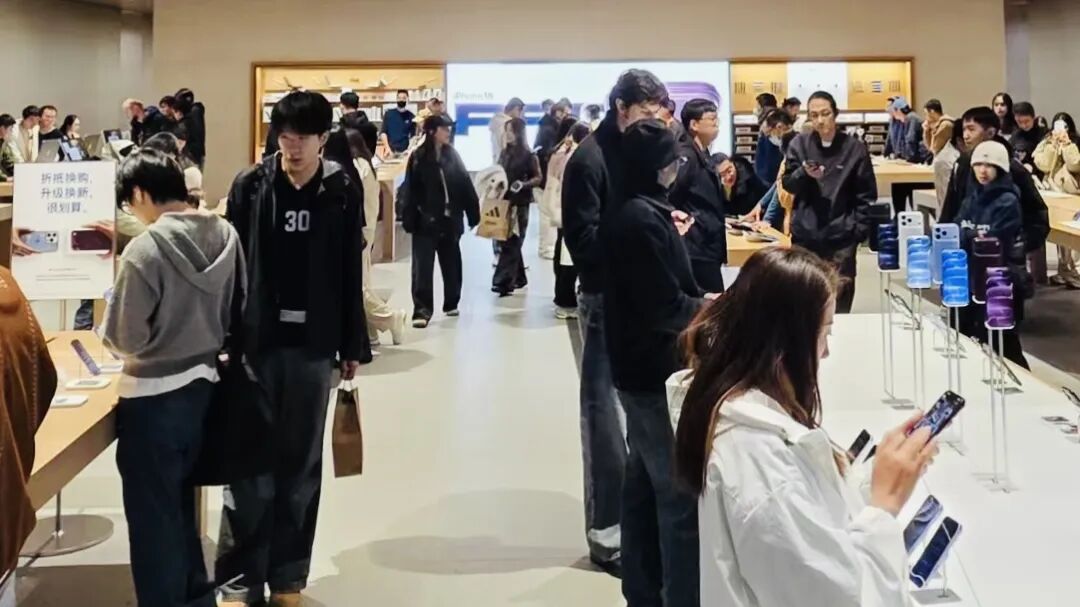
At the Apple Store in Sanlitun, Beijing in November, the "two contrasting states" of the iPhone Duo are separated by a glass entrance door.
Outside the store, scalpers are yelling anxiously that "I lose money on every unit I sell"; inside, customers are willing to spend ten minutes testing the device even if their own phones run out of power and shut down. Right now, Apple is mired in a product crisis caused by the iPhone Duo.
On October 26, Apple acknowledged that a "small number" of iPhone Duo units have inner screen issues, and asked affected users to contact AppleCare for replacement. Apple did not explain the cause of the malfunction. But a similar incident happened to Samsung seven years ago on the eve of the Galaxy Fold launch: the review units suffered screen failures, and Samsung mentioned issues such as partial impact on the hinge and foreign objects inside the device affecting the display in its preliminary investigation.
Apple's predicament fully demonstrates the core difficulty of foldable screens: after a screen is folded repeatedly, its display performance, materials, mechanical structure and manufacturing process must maintain long-term coordinated operation. Any concentrated stress, discontinuous support or assembly deviation may leave a visible mark on the most prominent position of the inner screen.
Seven years have passed since the first foldable screen came out, "being able to fold" is no longer a novelty, but "folding well" still remains extremely difficult.
On the other side of the world, Chinese manufacturers have completed their most intensive product training precisely during this period.
From the early stage when mobile phone manufacturers adopted Samsung's inner screens, to the stage where BOE and TCL CSOT supply flexible OLED panels for both inner and outer screens of some models, to the current stage where Visionox cooperates with terminal manufacturers to jointly solve drive and software problems, domestic panel makers have gradually extended their supply capabilities to material selection, module stacking structure, optics, power consumption control and testing methods. What they are striving for is no longer just orders for domestic mobile phone models, but also in-depth participation in defining the product experience of foldable screens.
In the competition of foldable screens, the terminal product is the "outer facade", while the ability to fold well is the "core foundation".
With the strong support of panel manufacturers, Chinese terminal manufacturers are also constantly exploring new product forms. For example, Huawei's triple-fold and large-format foldable phones have locked in market share before competitors launched similar products.
But this screen competition is far from reaching its end. Currently, Samsung Display can still rearrange its quarterly market share relying on key customer projects. Especially after Apple, this super-large-volume customer, joins in, its shipment ranking will only become more stable. This also shows that a fierce offensive and defensive battle is underway behind the consumer electronics sector.
The strength of panel manufacturers determines whether the foldable screen category can continue to develop, and it also affects the final success or failure of terminal manufacturers.
7 Years of Pursuit: Screens Grow Together with Mobile Phones
Samsung was the first to complete the large-scale verification of foldable screens, and was also the first to demonstrate the difficulty of this business.
Before the Galaxy Fold, flexible displays had appeared in exhibitions and concept products for many years. But after Samsung pushed foldable screens into the mass consumer market, the engineering difficulty of foldable screens was fully exposed. The hinge determines how the screen bends, the protective layer and support structure determine what impact it can withstand, and foreign objects and assembly processes may change the actual state of this structure.
After Chinese terminal manufacturers entered the market, they quickly pushed the competition of foldable screens to the dimensions of lightness and thinness, crease performance, battery life and reliability. Although many early products were not perfect, and some models directly adopted Samsung's inner screens, the intensive release of mobile phones gave the supply chain continuous opportunities for iteration and correction.
The changes in supply relationships clearly show this development path.
The OPPO Find N uses Samsung's inner screen and BOE's outer screen. For the Xiaomi MIX Fold 4, the inner screen is supplied by Samsung Display, while the outer screen is provided by TCL CSOT. Domestic panels and Samsung panels can coexist on the same device. At this point, domestic Chinese panel manufacturers get landing opportunities sometimes for outer screens, sometimes for specific form factors, and sometimes as the second qualified supplier in multi-source supply systems.
But a complete independent supply model is also emerging gradually. According to official data from BOE, both the inner and outer flexible OLED panels of the OPPO Find N3 Flip are exclusively supplied by BOE; both the inner and outer screens of the Xiaomi MIX Flip are also fully supplied by TCL CSOT. Terminal brands such as Honor also cooperate with multiple domestic suppliers, and Visionox has also entered key customer projects.
It should be noted that the discussion of supply chain changes here is based on the supply relationship of specific models and specific screens, not a fixed binding relationship between a certain brand and a single supplier.
Therefore, this change is not a simple "replacement". More often, panel manufacturers pass verification in one project first, and then strive for more complete screen solution orders. Terminal manufacturers also use this mode to balance performance, cost, supply security and product launch rhythm. So at present, the foldable screen industry still maintains a coexisting state of separate supply for inner and outer screens, exclusive supply for some models and multi-source supply.
This change is reflected in the market as drastic and frequent share fluctuations.
Statistics from Counterpoint and DSCC show that in the first quarter of 2024, BOE's share in foldable screen panel supply reached 48%; in the second quarter of 2025, Samsung Display returned to the first place with a 53% share. In the first quarter of 2026, BOE accounted for about 45%, Samsung Display about 22%, and Visionox, TCL CSOT and Tianma accounted for about 16%, 13% and 4% respectively; by the second quarter, Samsung Display's share rose to 66%, while BOE's share dropped to 22%. It can be seen that the market share ranking does not fully reflect the actual "strength" of manufacturers, but is highly dependent on the launch rhythm of new terminal products and procurement cycles.
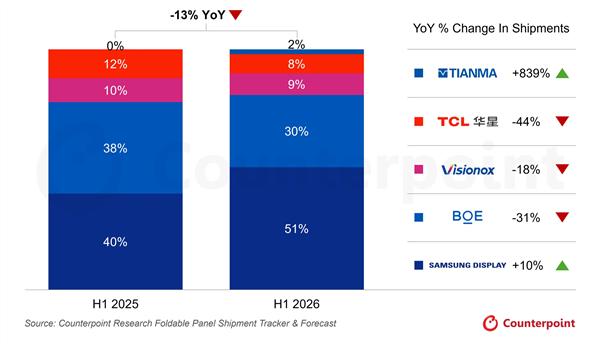
It is precisely under this premise that the high-frequency iteration of Chinese terminal manufacturers has gained more value.
In the fierce industry competition, each generation of products puts forward new requirements for thickness, weight, brightness, battery life and reliability, while large-format folds, small-format folds, triple folds and wide folds put forward different bending forms and structural space requirements. In the process of meeting these demands, panel manufacturers have obtained new verification scenarios, and product experience accumulated through projects has gradually turned into engineering experience.
The hinge determines the bending track, support mode and closed state, and the flexible OLED, OCA optically clear adhesive, support plate, flexible flat cable and protective layer must all cooperate with this mechanical movement. Every time mobile phone manufacturers "strive for one more millimeter of thinness", the space left for material buffering and structural support is reduced; every additional "half an hour" of battery life required by consumers will also impose constraints on screen power consumption.
When it comes to specific products, what users see is a lighter, thinner mobile phone with lighter creases, while what panel manufacturers receive is a set of mutually restrictive demands.
Although the ranking of panel manufacturers cannot be decided in a short time, after the iPhone Duo incident, it is time for panel manufacturers to step onto the front stage.
Behind a Crease: The Core Competence of Screen Manufacturers
No matter how many theories are discussed, the most critical detail of foldable displays still remains the crease.
From a macro perspective, a foldable display module is formed by stacking multiple layers of structures, mainly including the flexible OLED display layer, upper and lower cover plates, OCA optically clear adhesive, and the bottom support plate. When bending, the outer side of the module is stretched while the inner side is compressed. Different layers bear different degrees of deformation due to differences in position, thickness and hardness, and uneven deformation will eventually form creases.
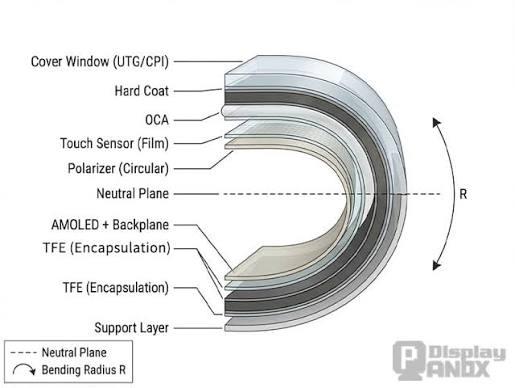
Among them, the adhesive layer mainly plays a buffering role. OCA allows a certain degree of interlayer slip between adjacent materials, dispersing the bending stress instead of concentrating it all on a single layer. But this also requires trade-offs: if all layers are locked too tightly, local strain is easy to concentrate, leading to cracks; if there are too many soft layers or the recovery ability is insufficient, permanent deformation may remain after repeated bending, making the screen look "floppy".
This structure is a bit like a stack of paper that can slide slightly relative to each other: it is not difficult to bend it, the difficulty lies in making all layers return to their original positions as much as possible after each unfolding. On this basis, thinning the module, adding soft layers and strengthening support will all cause chain reactions. Cracks, delamination, local wrinkling after compression and permanent deformation correspond to different internal failures, which appear to users as aggravated creases, bright lines or black spots, damaging the use experience.
Therefore, optimizing crease performance and improving the reliability of foldable screens cannot be completed by processing any single layer of material alone, and requires a management solution for "all layers" as a whole.
For this complex structure, the three major domestic Chinese panel manufacturers have proposed different engineering combinations.
BOE tends to build a complete independent platform.
The mirror-like "zero-crease" foldable display exhibited at this year's AWE is developed by optimizing both structure and materials. It can be roughly understood as adopting a multi-neutral-layer architecture with gradient modulus design, so that the elasticity of materials changes gradually from the display center to the bending area, dispersing tensile and compressive stress to multiple layers instead of concentrating them on a single interface. The cooperation between different layers is slightly more complicated, but in short, BOE did not only modify a single layer of material, but re-matched all layers in the screen, so that they can share the pressure with each other during bending, and cooperate with harder supports and hinges to prop up the middle area, so that the crease becomes lighter after repeated unfolding.
TCL CSOT integrates stacking structure, support, hinge and surface optics into one single solution.
Its publicly demonstrated integrated crease-free solution introduces multi-layer UTG to clamp the display screen in the center, making the fragile display layer closer to the area with smaller strain, so as to reduce local deformation of the display surface; the bending area uses gradient support materials with micropores smaller than 20μm to make the support more continuous, and cooperates with adhesive materials to release stress of all layers. For the height difference at different positions of the hinge, the solution also adds a filling treatment to reduce the transmission of mechanical structure force to the display surface. In short, it uses a finer grid to hold a thin film, so that the middle part will not collapse, and the film itself is not easy to form deep creases.
But that is not all, TCL CSOT also optimized the visual perception effect. Its soft light solution adopts a micro-structure low-reflection film layer to disperse specular reflection and reduce glare, making the crease less visually noticeable. So this solution actually adopts a "two-pronged approach": one is to make the crease not obvious physically, the other is to make it not obvious visually.
Different from the first two manufacturers, Visionox focuses more on the irreversible deformation of materials and the recovery ability after bending.
The traceless foldable screen solution released by the company this year cancels the traditional PET polymer film layer, and adopts high-stiffness non-plastic materials to reduce permanent deformation left after long-term repeated bending. In short, it replaces the "paper" that is easy to leave permanent creases after being folded with a material that is less likely to leave traces and can spring back better after being released.
Overall, the three panel manufacturers are all working on solving the crease problem, but their entry points are different: BOE redistributes stress through multi-layer structure optimization; TCL CSOT launches a "combined punch" of multi-layer glass clamping, fine support and optical weakening; Visionox replaces easily plastically deformable materials to improve recovery ability.
This shows that the technological competition of domestic Chinese panel manufacturers has gone deep into the interior of the display module.
For example, in response to the demand for lighter and thinner foldable mobile phones, BOE and TCL CSOT have also adjusted their optical structures accordingly. Among them, BOE's COE technology integrates structures such as color filters onto the encapsulation layer, and other optical structures undertake the low-reflection function. TCL CSOT's PLP is its POL-less route that does not use the traditional circular polarizer, and it also produces color filter films on the screen. Both technologies aim to eliminate the traditional circular polarizer, so as to thin the module while maintaining low reflection and good display effect as much as possible.
When the technology reserve is sufficient, panel manufacturers have also reached the stage of defining industry standards.
Manufacturers have begun to evaluate the folding performance of foldable screens from different indicators such as crease depth, touch difference, reflection visibility and display effect under bright states. Of course, meeting one standard cannot prove that the screen is truly "traceless". But the more important value of these indicators is that panel manufacturers have turned engineering experience into discussable evaluation dimensions.
After all, only after the product reliability is fully verified, can a foldable product be truly delivered to consumers.
Making a Foldable Screen Phone Is Far More Than Just Producing a Foldable Screen
If we understand foldable screens simply from the perspective of supply chain delivery, the most important dimensions for panel manufacturers to land their products are only parameters and cost. But foldable screen mobile phones are extremely complex products, and even mobile phone manufacturers themselves sometimes cannot accurately predict what the final product performance will reach.
To make a good foldable screen phone, terminal manufacturers and panel manufacturers need to go through the pre-research, structural design and verification stages together, so that they can make joint trade-offs for crease performance, thickness, power consumption and reliability. Nowadays, what panel manufacturers deliver is more and more not just a single component, but a complete engineering solution that works in coordination with hinges, materials, drivers and software.
The cooperation between BOE and OPPO is reflected in the full-stack delivery capability.
Both the inner and outer flexible OLED panels of the Find N3 Flip are exclusively supplied by BOE. The inner screen adopts a water-drop shaped bending design with a bending radius of only 2.4mm, and is equipped with UTG cover plate and COE polarizer-free technology; the outer screen is also BOE's flexible OLED. This means that what BOE delivers is not just two independent panels, but a complete display solution covering inner and outer screens, cover protection and optical structure.
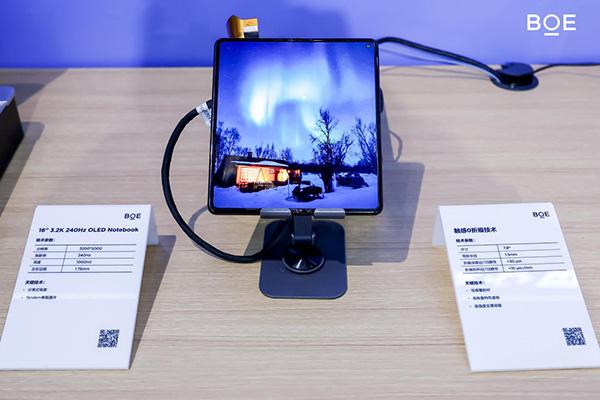
From a strategic perspective, BOE has been extending its full-module capabilities to the upstream industrial chain in recent years.
For example, in August this year, BOE and 3M established a joint laboratory, focusing on optical films, optically clear adhesives, structural adhesives and folding technologies. The two sides embed material R&D into the panel architecture definition process, and integrate resources for mechanism simulation, optical testing and mechanical reliability testing. The significance of this cooperation lies in changing the position of panel manufacturers in the supply chain: in the past, the common practice was to select materials after the panel architecture was determined, but now materials and design drawings are modified synchronously.
On the other hand, the cooperation between TCL CSOT and Transsion demonstrates the complete process from pre-research to mass production.
In July 2022, the two sides established a joint laboratory, upgrading