Global tablet shipments have hit a new historic low, with Huawei's shipments dropping by over 40% and Apple's shipments falling by nearly 30%.

Image Source: Jiemian Gallery
The successive launch of new products has not reversed the downward market trend of the tablet industry.
On November 5, the latest industry report obtained by Jiemian News from market research firm Omdia shows that the global tablet market delivered a pessimistic performance in the third quarter of 2026. The total shipment dropped to 32.191 million units, equivalent to 32 million units, a sharp year-on-year decline of 23%, hitting the lowest single-quarter shipment record in nearly three years. The Middle East, China, and Western Europe have become the most severely impacted regions, with market declines significantly higher than the global average, and downward pressure on the industry has spread to multiple core consumer markets.
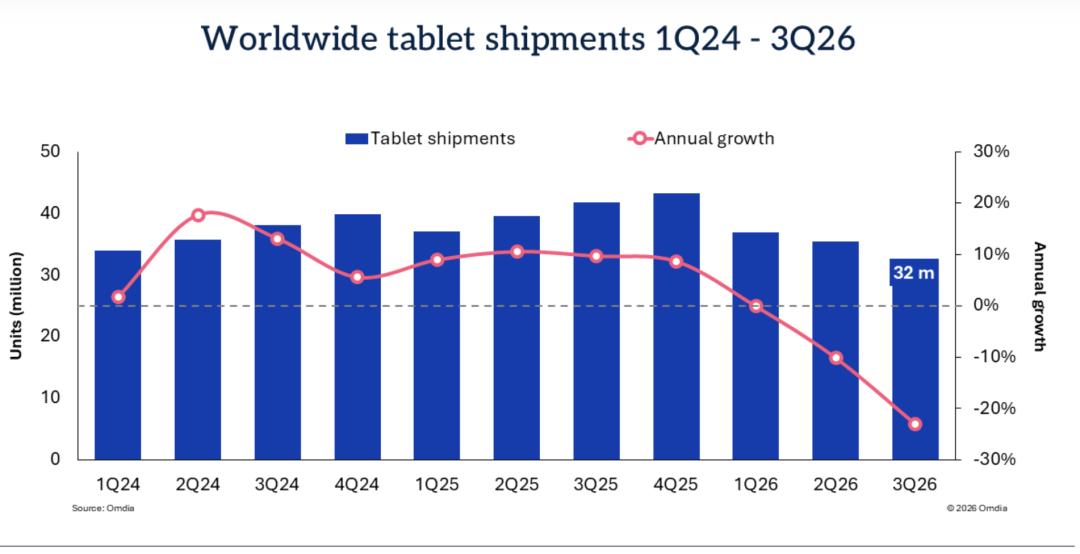
Global Tablet Shipments in Recent Three Years Data Source: Omdia
Compared with the industry performance in the second quarter, the market decline has exceeded many people's expectations. In the second quarter of 2026, global tablet shipments reached 36 million units, down 10% year-on-year. At that time, the market had already broken the usual seasonal pattern of rising shipments driven by the back-to-school season in the second quarter of previous years, showing signs of fatigue. After only one quarter, the year-on-year decline more than doubled directly, and the double-digit contraction trend continued to intensify, which is sufficient to show that the entire category is facing systematic challenges.
From the perspective of the competitive landscape of leading manufacturers, the overall shipment performance of the top five brands is unsatisfactory, especially Huawei and Apple, which have seen significant declines.
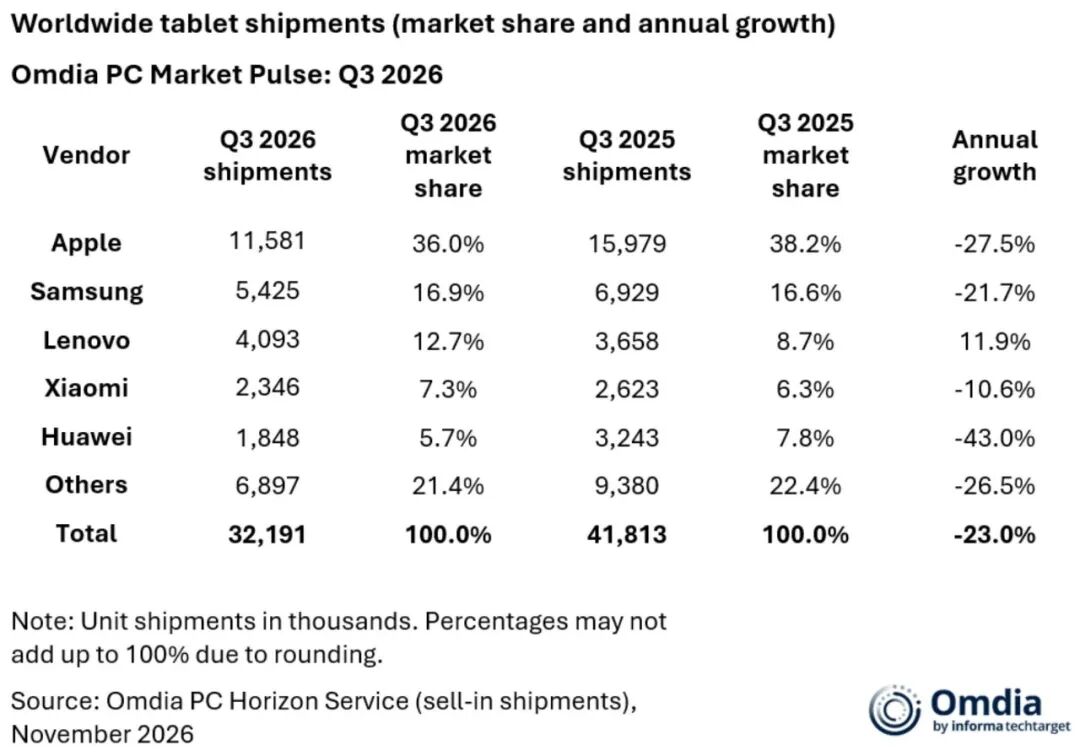
Shipments of the Top 5 Global Tablet Brands in the Third Quarter of 2026 Data Source: Omdia
Although Apple still maintains its leading position in the industry, with shipments of 11.581 million units in the third quarter of 2026 and a market share of 36.0%, compared with the shipment scale of 15.979 million units in the same period of 2025, it has fallen by 27.5% year-on-year, and the decline is higher than the average level of the overall market.
Apple's newly released financial report for the fourth fiscal quarter of fiscal 2026 (June-September 2026) also shows that the iPad business is under pressure, with quarterly revenue of 6.229 billion US dollars, down 10.4% year-on-year, compared with 6.952 billion US dollars in the same period last year. Even though Apple launched the iPad mini equipped with an OLED screen this quarter and updated its hardware products, it still failed to stop the contraction of shipment scale.
Samsung steadily ranks the second in the industry, with quarterly shipments of 5.425 million units, accounting for 16.9% of the market, down 21.7% year-on-year. Although the brand launched the Galaxy Tab S12 series flagship tablets to try to boost consumer enthusiasm in the high-end market, the reality of parts shortage is prominent. The bottleneck of component supply continues to suppress the release of actual shipments, and the market potential of new products has not been fully utilized.
Amid the general downward trend, Lenovo has become the only enterprise among the top five manufacturers to achieve positive growth. In the third quarter, Lenovo's tablet shipments reached 4.093 million units, with a market share of 12.7%, a year-on-year increase of 11.9%. It is also the manufacturer with the largest increase in market share among leading brands this quarter.
Lenovo's growth did not come from its 2-in-1 detachable tablet business, whose shipments shrank significantly year-on-year. The report points out that Lenovo's ordinary tablet products have good channel distribution in most regions, with strong performance in markets except Europe and Latin America, which supports the overall performance resilience of the brand. This also continues the trend of the second quarter, when Lenovo was also the only brand among the TOP5 that maintained year-on-year growth, relying on channel strategies to hedge against risks brought by the general environment.
Xiaomi ranks fourth in the world, with shipments of 2.346 million units this quarter, accounting for 7.3% of the market, down 10.6% year-on-year. Relying on the good performance in the Latin American market, Xiaomi's market share has even achieved a slight increase, and the launch of new products of the Pad9 series has also brought certain help, but it still cannot resist the downward pressure of the global overall market, and the overall shipments have declined year-on-year.
Huawei is the brand with the most severe decline among the five leading manufacturers. In the third quarter of 2026, its shipments reached 1.848 million units, accounting for 5.7% of the market, plummeting 43.0% year-on-year, ranking last among leading manufacturers. However, we cannot simply dismiss Huawei's tablet business entirely. Against the background of the overall cooling of the global market, it still achieved year-on-year shipment growth in Central and Eastern Europe and the Asia-Pacific region, and still maintains competitiveness in local markets. It is just that these increments are not enough to offset the sharp decline in other major markets.
In addition to the top five, the remaining small and medium-sized manufacturers collectively shipped 6.897 million units, with a market share of 21.4%, down 26.5% year-on-year, and the decline is also higher than the 23% level of the global overall market. Under the dual pressure of supply chain pressure and weakening consumer willingness, the survival pressure borne by small and medium-sized brands is even greater than that of leading brands.
The tight component supply chain is one of the core factors running through the sluggish tablet market in the second and third quarters. The tightening of component supply not only restricts the capacity release of various manufacturers, but also further changes the resource allocation logic of manufacturers: manufacturers are more willing to tilt resources to product lines with higher strategic weight such as mobile phones and AI PCs, and the resource investment obtained by the tablet category shrinks accordingly.
Himani Mukka, Research Manager at Omdia, said, "Continuous supply chain restrictions have constrained manufacturers from carrying out substantial hardware upgrades, and new models lack sufficiently attractive differentiated highlights compared with previous generations. As a result, more and more consumers tend to delay replacement and wait for major product iterations before making purchases."
Looking back at the trend of two consecutive quarters, the tablet market has bid farewell to the moderate growth cycle in the past period and officially entered a stage of in-depth adjustment. New products and technological iterations are certainly the key to breaking the deadlock, but before the shackles of the supply chain are lifted, neither large manufacturers nor small and medium-sized brands can easily get out of the predicament of declining shipments in a short time. Even if manufacturers want to adjust their product and channel strategies, they can only passively wait for the improvement of external supply chain conditions to expect to reach the market inflection point.
Himani Mukka predicts that the supply chain conditions will be further tightened next year, and the global tablet market will not achieve a substantial recovery until at least 2028.
This article is from the WeChat Official Account"Jiemian News", written by Song Jiannan, and published by 36Kr with authorization.