After Zhong Xuegao, is Tiger Head Bureau also about to make a comeback?
On November 2, Chicecream resumed sales, with products listed on JD Platform mainly in combination packs of 4 pieces, 8 pieces and other specifications. Two days later, on November 4, a user posted a note on Xiaohongshu with the title: We've kept you waiting, Tiger Head Bureau.
Following Chicecream, Tiger Head Bureau, which is also a sample of the "previous generation" new consumer brands, is about to make a comeback?
Tiger Head Bureau's "Restart and Return"
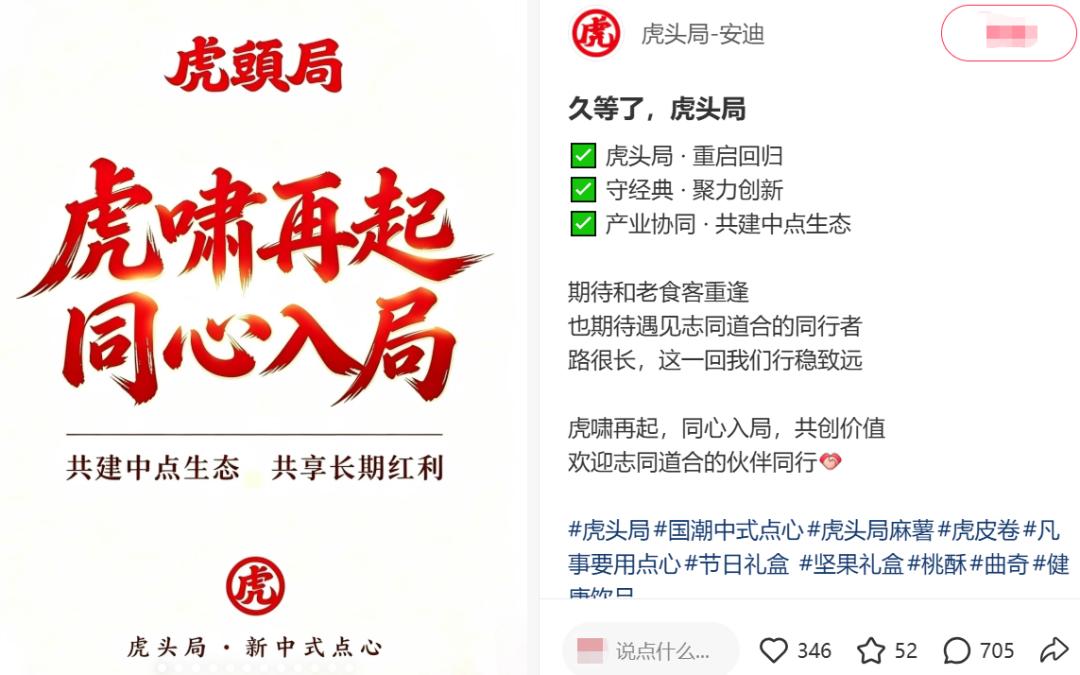
Around 1 p.m. on November 4, Xiaohongshu user "Tiger Head Bureau - Andy" published a note with only a few lines of text, accompanied by 12 pictures, announcing the "restart and return" of Tiger Head Bureau, the once-popular internet-famous baking brand.
In the announcement, Tiger Head Bureau no longer operates under the name "Tiger Head Bureau Standard Chartered Bakery", but has changed its brand identity to "Tiger Head Bureau · New Chinese Style Pastry". After its return, Tiger Head Bureau will focus on "upholding classics, gathering strength for innovation" on the one hand, and "industrial collaboration, jointly building the Chinese pastry ecosystem" on the other.
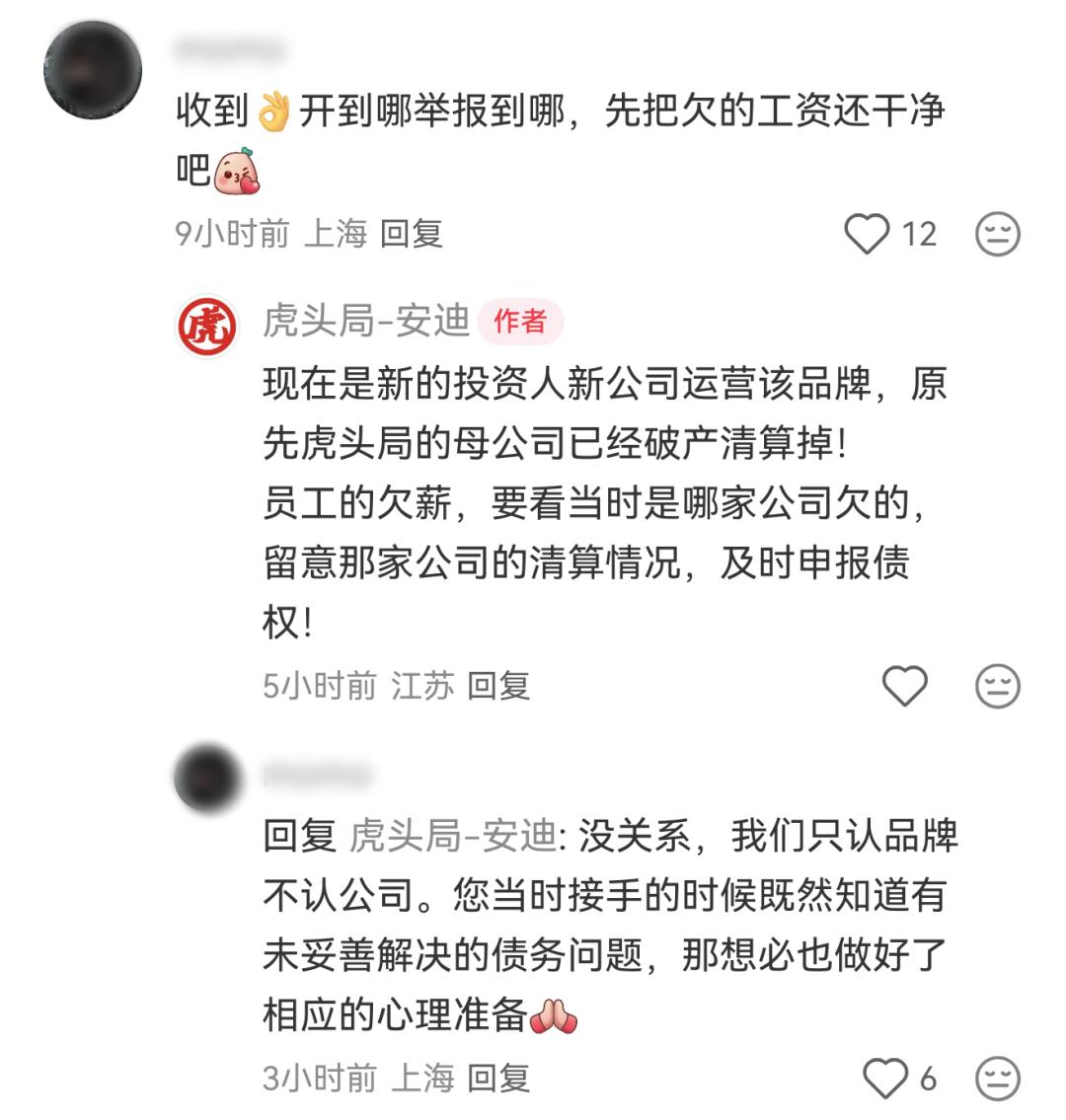
In the comment section under the note, some netizens left messages asking for unpaid wages online, and "Andy" responded: The brand is now operated by a new company with new investors, and the original parent company of Tiger Head Bureau has gone through bankruptcy liquidation. For the unpaid wages of employees, please check which company owed the salary at that time, pay attention to the liquidation progress of that company, and declare your creditor's rights in time!
Another netizen asked "Will you reopen the store in Changsha after the comeback?", and "Andy" said "We plan to reopen the Changsha store first".
Judging from the comment section, although Tiger Head Bureau has been away for two or three years, many netizens still miss some of its products and hope it can open stores in their cities as soon as possible.
For Tiger Head Bureau, which wants to make a comeback, there is probably no better news than this.
How did Tiger Head Bureau collapse
The starting point of Tiger Head Bureau's story was not low. It started in Changsha in 2019, entered the Chinese pastry track with the positioning of "snack-oriented, health-focused, and national trend-aligned", and was once regarded by capital as one of the "twin stars of new Chinese style baking". At the peak of new consumption financing in 2021, Tiger Head Bureau completed its Pre-A round of financing in January that year, led by HSG, with IDG and Challenger Venture Capital as follow-on investors; seven months later, HSG teamed up with IDG, Tiger Global and GGV to invest 50 million US dollars, pushing the brand's valuation to 1.5 billion yuan.
According to statistics from some media, the valuation of a single store of Tiger Head Bureau at its peak was about 375 million yuan, while the single-store valuation of Heytea in the same period was about 71.51 million yuan, and that of Nayuki was about 25.09 million yuan. The highest monthly turnover of Tiger Head Bureau's first store reached 1.27 million yuan; when its first Beijing store opened in Wukesong, some customers spent two hours traveling from outside the Fifth Ring Road to visit the store. At the end of 2021, Tiger Head Bureau announced that it would open 150 stores by the end of 2022.
In the next year, in April 2022, Tiger Head Bureau opened 14 stores at one go, and the situation seemed to be developing in the expected direction. However, no one expected that the turning point would come so quickly.
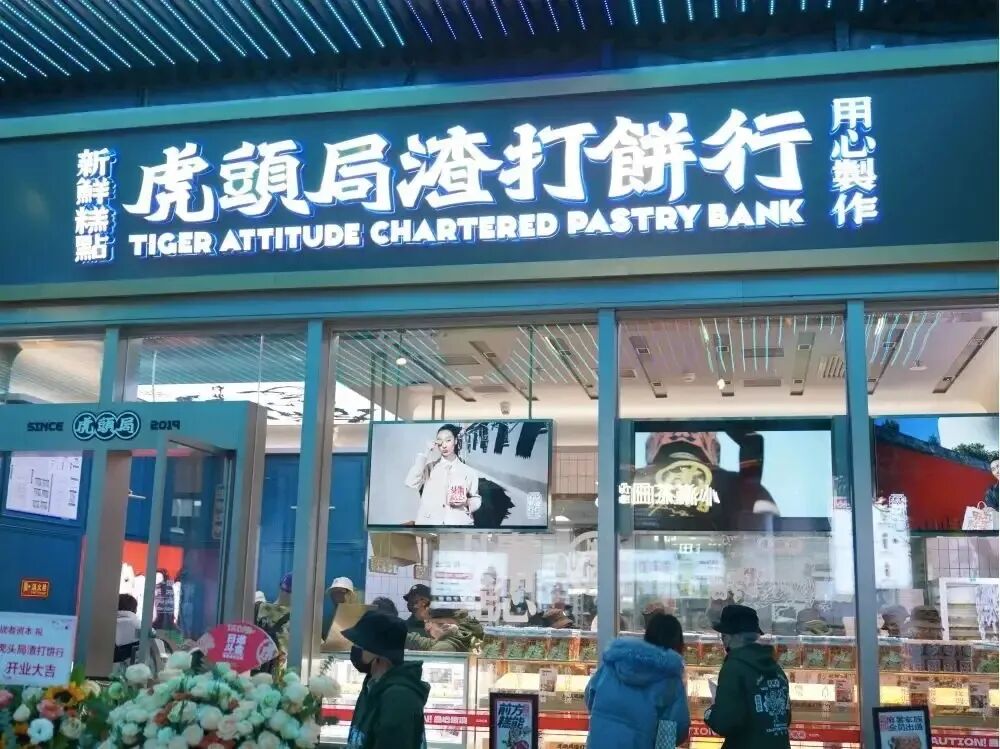
△ Picture from Can Dian Bao
In the second half of that year, rumors of store closures, layoffs and unpaid wages emerged one after another. Some suppliers stopped supplying due to overdue payment for goods, and Tiger Head Bureau's signature products such as mochi rolls and rice cakes could not be sold normally for a period of time. At the end of November, the official team of Tiger Head Bureau admitted that it was facing capital pressure, and withdrew from cities including Chengdu, Chongqing and Beijing. In March 2023, former employees posted articles online, claiming that the company had laid off more than 1,000 people, defaulted on salaries for four and a half months, and the total amount of overdue payment for suppliers, rent, loans and wages reached about 200 million yuan. In April, Tiger Head Bureau closed its online flagship stores on platforms including Tmall, Douyin, Pinduoduo and Dewu, and its founder Hu Ting was restricted from high consumption.
At this point, a brand that was still extremely prosperous two years ago reached its end, and what happened next just drew a full stop: in January 2024, Shanghai Wanwu Youyang Catering Management Co., Ltd., the parent company of Tiger Head Bureau, was applied for bankruptcy review, and the court accepted the case in March of the same year; another related entity, Shanghai Tiger Head Bureau Catering Management Co., Ltd., was ruled bankrupt by the Shanghai Third Intermediate People's Court in March 2025. The administrator confirmed that there was no property available for distribution, and the bankruptcy procedure was terminated.
Looking back, the failure of Tiger Head Bureau can hardly be attributed to "poor products". Its mochi, tiger-skin rolls and egg tarts did have high recognition at that time. The real problem lies in its operation rhythm: it used the speed required by capital to run a business that requires slow and steady efforts. The continuous rise of valuation means that the brand has to maintain continuous growth, which means opening stores rapidly. However, Tiger Head Bureau adopted a fully direct-operated and asset-heavy model, and the investment of a single store in some shopping malls was as high as 2 million to 3 million yuan. Before the single-store profit model was fully verified, the huge amount of capital required for store expansion could almost only rely on the next round of financing. Once the financing stopped, the entire capital chain broke.
This is not the exclusive story of Tiger Head Bureau. The story of another "twin star of new Chinese style baking" — Momo Pastry Bureau is very similar. The first cycle of new Chinese style baking is essentially a collective clearance after being prematurely matured by capital.
The first hurdle for the comeback
Counting from April 2023 when Tiger Head Bureau closed all its online flagship stores, three and a half years have passed, and the brand seemed to have completely faded out of the public view. Therefore, its announcement of making a comeback is really surprising.
But the comeback is not easy. For Tiger Head Bureau, the first hurdle to cross is: how to deal with old debts.
Legally, after the bankruptcy procedure is terminated, the debts of the original entity are eliminated along with the entity. The new entity that takes over the brand assets does not necessarily need to take over the old debts. "Andy" has clearly told netizens that "for the unpaid wages of employees, please check which company owed the salary at that time, pay attention to the liquidation progress of that company, and declare your creditor's rights in time." This is exactly the same as the comeback path of Chicecream. Chicecream also went through the bankruptcy liquidation of its old company, and its brand assets were auctioned off. 508 intangible assets were sold for 21.1 million yuan, and the new operation entity was not established until June 2026, which is a completely separate legal person from the bankrupt old company.
However, former employees who were once owed wages do not care about these legal clauses. Some of them hold a firm attitude: "We only recognize the brand, not the company. Since you knew there were unresolved debt problems when you took over the brand, you must have been prepared for the corresponding consequences." Consumers who failed to refund their stored-value cards back then will not buy this explanation either: "You use the name of the original Tiger Head Bureau to open new stores, aren't you ready to face the questioning of consumers?"
In short, even if the new company has completely cut off the legal connection with the old debts, it is difficult to completely separate itself from the old debts in actual business operations.
Of course, this does not mean that new investors need to pay for the old company's debts. There is no such legal obligation, nor is it realistic in business operations. But at least they cannot pretend that the past problems never happened. In fact, the word "restart" itself implies recognition of the old debts, rather than covering up the past problems.
Otherwise, when you shout slogans like "restart", "comeback" and "return", people can't help but ask: Is this a sincere attempt to run the business again, or just a move to harvest the remaining residual value of the brand?
Does Tiger Head Bureau still have a chance?
First look at the overall market. Data from NCBD (Can Dian Bao) shows that the size of China's baked food market reached 541.7 billion yuan in 2025, with a year-on-year growth of 2.6%, and the growth rate slowed down significantly. Freshly made baked products account for 64.1% of the entire baking market, still being the main force.
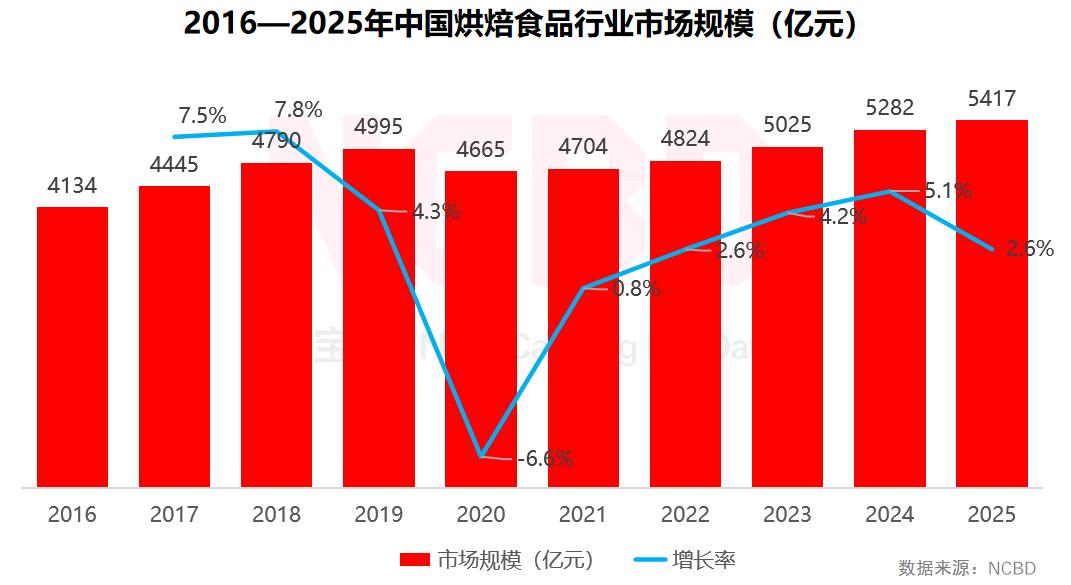
However, the number of offline stores is shrinking sharply. Data from NCBD (Can Dian Bao) shows that the store closure rate of bread/baking category from 2025 to 2026 is 25.9%, surging 5.8 percentage points year on year. Data from Zhaimen Canyan shows that as of October this year, the number of baking stores has decreased by 103,000 in net terms over the past year.
In this market characterized by "involution-style growth", we cannot say that Tiger Head Bureau has no chance, but its opportunity does not lie in "becoming a top player again", but lies in several more specific directions:
The first is regional selection. Top baking brands are mainly concentrated in East China and South China, and there are still market gaps in second-tier cities in Central China, Southwest China and northern China. Tiger Head Bureau was founded in Changsha, and the Hunan market still has brand memory of it. The plan of "reopening the Changsha store first" is a pragmatic choice. Starting from a specific region is more realistic than expanding across the whole country at once.
When it comes to opening stores, the reasonable path is to open several stores first, verify the profitable single-store model, and then talk about franchise and ecosystem building. If it starts large-scale investment promotion immediately and turns "jointly building the Chinese pastry ecosystem" into a story of collecting franchise fees, it will just repeat the old mistakes in a different way.
The second is to develop the supply chain business. If the "jointly building the Chinese pastry ecosystem" mentioned in the announcement really refers to supply chain collaboration, Tiger Head Bureau can choose not to expand stores, but to focus on factory operation, distribution and brand authorization, to make profits from the whole industrial chain. This path does not have a very high ceiling, but its cash flow is more stable.
The third is to tap the brand value. Tiger Head Bureau's IP still has high recognition, and it still has value in scenarios such as tourist souvenirs, co-branding and content marketing. This business model does not require high store density, which is suitable for light asset trial operation.
The hidden problem behind brand comebacks
The comebacks of Chicecream and Tiger Head Bureau point to a fact: brands, as intangible assets, are being picked up from the ruins and re-priced.
Chicecream's 508 intangible assets were sold for 21.1 million yuan. What the buyer values is obviously not the heavily indebted old company, but the brand name "Chicecream". Behind the new operation team is Royal Xiaohu, a frozen food company whose total channel terminal retail sales exceeded 4 billion yuan in 2025. It has the supply chain, channels and the ability to put the brand back on the shelves. The comeback of Tiger Head Bureau is similar: the brand name still has residual traffic, old debts are left in the old shell, and the new entity will test the water first. If the business can grow, it will continue to operate; if it fails, the loss is controllable.
This is not a bad thing in itself. The effective reuse of brand assets is always better than letting the brand disappear completely. But behind this, a problem has been exposed: when the only thing separating the death and rebirth of a consumer brand is an auction procedure, the meaning of "building a brand" has changed.
Entrepreneurs can use capital's money to expand wildly, use traffic to inflate valuation, and leave debts to employees and suppliers when the business collapses; while the brand name, trademark and visual assets can be taken over by another group of people at a very low cost from the ruins, and repackaged into a new business story. The old responsibilities have not been settled, but the new narrative has already started.
However, those former employees who were owed salaries for four months, and the suppliers whose cash flow was dragged down, do not have the option of "making a comeback".
A healthy consumer market should not make the life and death of a brand easier to turn the page than people's livelihood.
This article is from WeChat official account "Can Dian Bao", written by the editorial department of Can Dian Bao, and authorized for release by 36Kr.