While some raise tens of billions of yuan merely through PPT roadshows, others are left with only 2 million yuan in their accounts: the most brutal controlled experiment in the 2026 venture capital circle
In 2026, the venture capital circle is witnessing two completely opposite narratives unfolding at the same time.
On one side, Silicon Valley's pricing of "narratives" has reached a point where neither products nor revenue are required. According to statistics from Silicon Valley VC Leonis Capital, since 2024, 119 so-called "Neolabs" — a new category of small AI labs in Silicon Valley founded by top AI researchers — have raised a total of 943 billion U.S. dollars in financing, most of which have not generated revenue yet, and some do not even have products. Thinking Machines raised 2 billion U.S. dollars at a valuation of 12 billion U.S. dollars before any product was launched. The logic given by investors is: gather talents, computing power and capital first, and deal with products and markets "later".
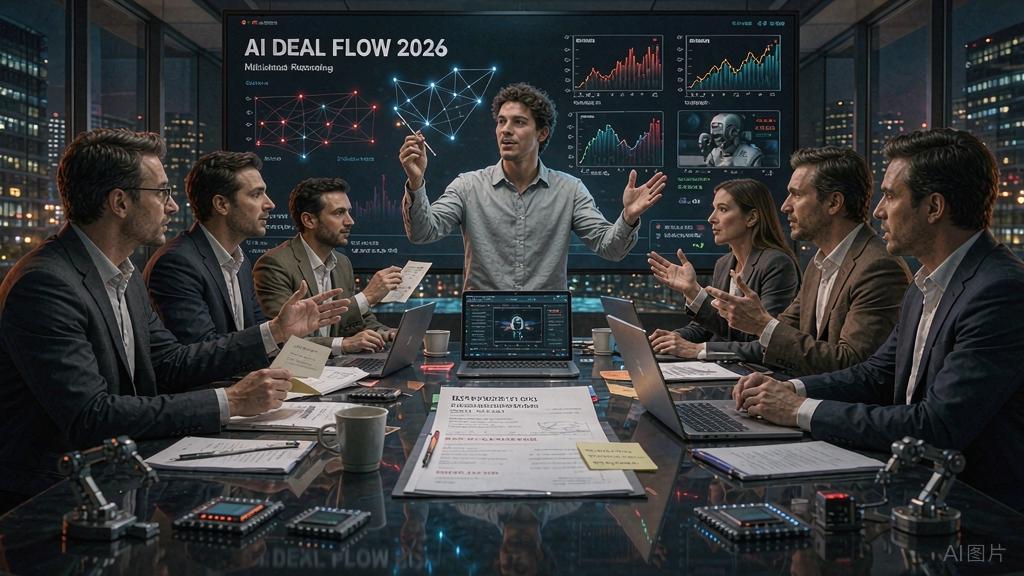
On the other side, China's primary market is experiencing a dual loss of control in valuation and financing rhythm, and after the loss of control, the ebb tide comes faster than anyone expected. In the first half of 2026, the embodied intelligence track saw 322 financing deals with a total amount of nearly 93.5 billion yuan, and the number of unicorns with a valuation of 10 billion yuan surged from 3 to 22. Some companies had a valuation of 200 million yuan in February, which soared to 3 billion yuan in July — 15 times in five months. Star projects directly told investment institutions "no due diligence needed, invest directly if you want to". Before the industrial and commercial change of the last round was completed, the next round of financing had already started. NI Zhengdong from Zero2IPO Group shared a speechless case at a conference: "The valuation was 900 million yuan when we made an appointment, and we met yesterday and were told that the round will close soon. If you want to invest now, you have to follow the valuation of 3 billion yuan; if you really can't catch up, the valuation of the next round will directly jump to 8 billion yuan."
Putting these two scenes together, the core proposition put forward by Yuval Noah Harari in *Sapiens: A Brief History of Humankind* suddenly becomes extremely specific: The reason why Homo sapiens rule the world is that we have the ability to tell "fictional stories", making thousands of strangers believe in the same thing, thus launching large-scale collaboration. Companies, currencies, valuations, and unicorns are essentially products of this kind of "fictional story". The story of Neolabs is fascinating enough: a group of talented researchers from large tech companies form a team around a technical hypothesis, raise hundreds of millions of dollars first, train their own models, and the product is only a downstream result of the research. This is the most extreme embodiment of the logic in *Sapiens: A Brief History of Humankind* — the narrative itself is a kind of realizable resource. If the story is told well enough, the scale of collaboration can break through any physical restrictions.
But Harari buried another sharper judgment in the same book: "The Agricultural Revolution was the biggest scam in history." Humans thought wheat had domesticated the land, but in fact it was wheat that domesticated humans; they thought settlement brought abundance, but in reality it brought more arduous labor and a more monotonous diet. This metaphor, placed in the context of venture capital, directly points to those companies with extremely grand narratives and extremely fragile survival: they use the story of "the future" to exchange for resources today, but have never established a real foundation that can survive independently.
The signals of the ebb tide have appeared intensively. The embodied intelligence track ushered in a turning point in September 2026: after 36 trading days of listing, Unitree's stock price fell from 1100 yuan to 404 yuan, and its market value evaporated by more than 280 billion yuan; the total financing amount of the track dropped by 40% from August to September, and only 4.9 billion yuan remained in the first half of October — while the peak monthly financing amount was 33.9 billion yuan. What is more thought-provoking is the reversal of investors' attitudes. An investor known for his radical style used to not do due diligence on projects a year ago, "If I want to invest in you, I will do it, and the money will arrive in one week"; now his standard reply has become "This project needs to be presented to the board of directors", and then there is no follow-up. When the narrative recedes, people swimming naked will find that they have never learned to swim.

However, companies that truly survive through cycles take a different path. Ember Technology, a young team of about 60 people, develops 3D generative large models. At its most difficult time, there was only 1 to 2 million yuan in cash left on the account. Instead of taking the shortcut of "2D to 3D upgrading", it stubbornly pursued the more difficult path of "3D native". The results are as follows: nearly 80% of its revenue comes from overseas markets, its B-end customer revenue exceeds the sum of all companies in the same track, and its annual recurring revenue (ARR) reaches tens of millions of U.S. dollars, making it the only 3D generative startup mentioned in Jensen Huang's CES keynote speech. Ember did not first tell a 10-billion-yuan story to look for revenue, but first proved that the technical route can generate real revenue, and then its valuation followed up.
This draws a clear dividing line for entrepreneurs and investors.
For entrepreneurs, first of all, you must have the courage to admit: you have to tell stories, because you cannot gather resources without telling stories. Without the ability to create "fictional stories", it is impossible for 14 people to leverage a collaboration scale of tens of billions of dollars in 30 days. But after the story is told, you must immediately face Harari's question about the "Agricultural Revolution": Is the story you are telling buying you time to build real capabilities, or is it covering up the fact that you have no real capabilities at all? A verifiable executable standard is: if the next round of financing does not arrive in six months, can your company survive on its own? Ember only had 1 to 2 million yuan in its account at its most difficult time, but it had a proven technical route and ongoing revenue — what it lacked was money for acceleration, not money for survival. This difference is the accessible path between narrative and survival.
For investors, *Sapiens: A Brief History of Humankind* provides a counter-consensus review framework. When everyone is pricing for "narratives", the truly scarce ability is to judge whether there is an accessible path between the narrative and survival. The lesson from the embodied intelligence track is straightforward: when the number of 10-billion-yuan valuation unicorns surges from 3 to 22 within five months, and the financing rhythm is compressed from "yearly" to "monthly", valuation is no longer a judgment basis, but becomes a chip in the game of passing the parcel. What is really worth betting on is not the one that tells the biggest story, but the one with a solid foundation of real technology and real revenue under the story.
A question Harari repeatedly asks in *Sapiens: A Brief History of Humankind* is: Human beings gain power from "imagination", but eventually they have to go back to "reality" to accept the test. The 2026 venture capital circle never lacks people who are good at telling stories. What is lacking are those who, after telling the story, are willing to lower their heads to develop products, generate revenue, and pave the path from "fiction" to "reality" inch by inch.
This article is from the WeChat official account "Postwave Evolution Planet", author: Mark, published with authorization from 36Kr.