A Youth Olympic Games, thousands of drum beats, a permanent sovereign cloud: Alibaba's report card in Dakar
Text by Wang Yi
What is the ultimate form of an Olympic sponsor? Is it plastering logos all over the venues, or keeping the brand name visible in broadcast footage?
Over the past decade and more, Chinese brands have purchased a huge number of "exposure slots" in the world's top sports events. Exposure is surely critical, as it is the most direct return on event sponsorship. But exposure has its limits: once the competition ends and logos are removed, the connection between the brand and the event often comes to a halt. For a tech company, if it only stays at the stage of "being seen", its technology is nothing more than a one-off investment.

At the Dakar Youth Olympic Games, Alibaba is trying to answer a different question: beyond buying exposure, can sponsors also "stay behind"? Its choice is not to make the logo bigger, but to embed technology into the event itself, so that it can keep operating even after the closing ceremony. At the same time, it brings technology into the on-site experience, so that every audience who travels from afar can create their own unique "Dakar memory" through the interaction between AI and Sabar drums.
This is not a reallocation of the sponsorship budget, but a shift in the sponsor's role: from a brand standing on the sidelines of the event, to an experience that is easily accessible both inside and outside the venues, and a capability that remains long after the event concludes.
To see clearly how this "staying behind" comes to be, we have to start the story on October 31, 2026, in Dakar, Senegal.
On this day, the Dakar Youth Olympic Games officially opened. This marks the first time in the history of the modern Olympic Games since the inaugural 1896 Athens Olympics that an Olympic event has landed on the African continent. 153 events, 2,700 young athletes from around the world, and tens of thousands of spectators and staff members will gather in this West African city. And the way Senegalese people welcome the world is through drum beats.
In Dakar, drum beats are almost a form of "language". Drums are played at weddings, at baptisms, and are indispensable at grand wrestling galas, where drummers strike the drumhead with one hand and tap the drum body with a wooden stick in the other, producing warm, varied rhythms to which dancers respond improvisationally with their movements. Locals call this "the dialogue of drums". This drum, called Sabar, is the most representative traditional musical instrument in Senegal, and the most natural sound heard during festivals, hospitality, and family gatherings. It is an integral part of Senegalese people's daily lives.
For Alibaba, the first step to "stay behind" is to understand this language. The drum beats should not just be background music for the event, but a brand-new interpretation of this language empowered by technology, allowing young people from all over the world to strike the drums at the opening ceremony, enabling ordinary people to generate their own drumming videos with their faces in the Olympic square, and finally leaving the cloud that supports all this in Senegal.
The drum beat is the entry point, and "staying behind" is the ultimate goal.
01. From Real Drum Beats to AI Avatars: A "Thousand Drum Beats" Experience for Everyone
In the past, the typical move of top-tier event sponsors was to buy a more eye-catching logo display on the sidelines. This time, Alibaba took a step forward first: it integrated itself into the content of the opening ceremony, and stood at the most core position on the stage.
At the opening ceremony, IOC President Kirsty Coventry delivered a speech, after which Senegalese President Bassirou Diomaye Faye officially declared the Youth Olympic Games open. Immediately afterwards, Alibaba's AI co-creation film was played: the camera shuttled through the clouds and landed at the venue. After a 20-minute on-site performance, the large screen broadcast the AI video in full screen again, and the accompanying narration made it clear that this video was generated by Alibaba.
This arrangement does not place the sponsor's content in the warm-up or intermission segments, but in the first visual content presented right after the opening, followed by a second emphasis through the combination of on-site performance and full-screen broadcast. For sponsors, having a logo appear on the sidelines is a form of exposure, but this film means that the technology itself has become part of the opening ceremony narrative.
This footage comes from an AI co-creation project launched by the organizing committee and Alibaba: 100 young people from different countries around the world were invited to submit photos, and based on Alibaba's self-developed video generation large model Wan3.0, short clips of the 100 people wearing costumes in the yellow, green and red colors of the Senegalese national flag and playing drums were generated, which were finally integrated into a roughly 1-minute opening co-creation video.
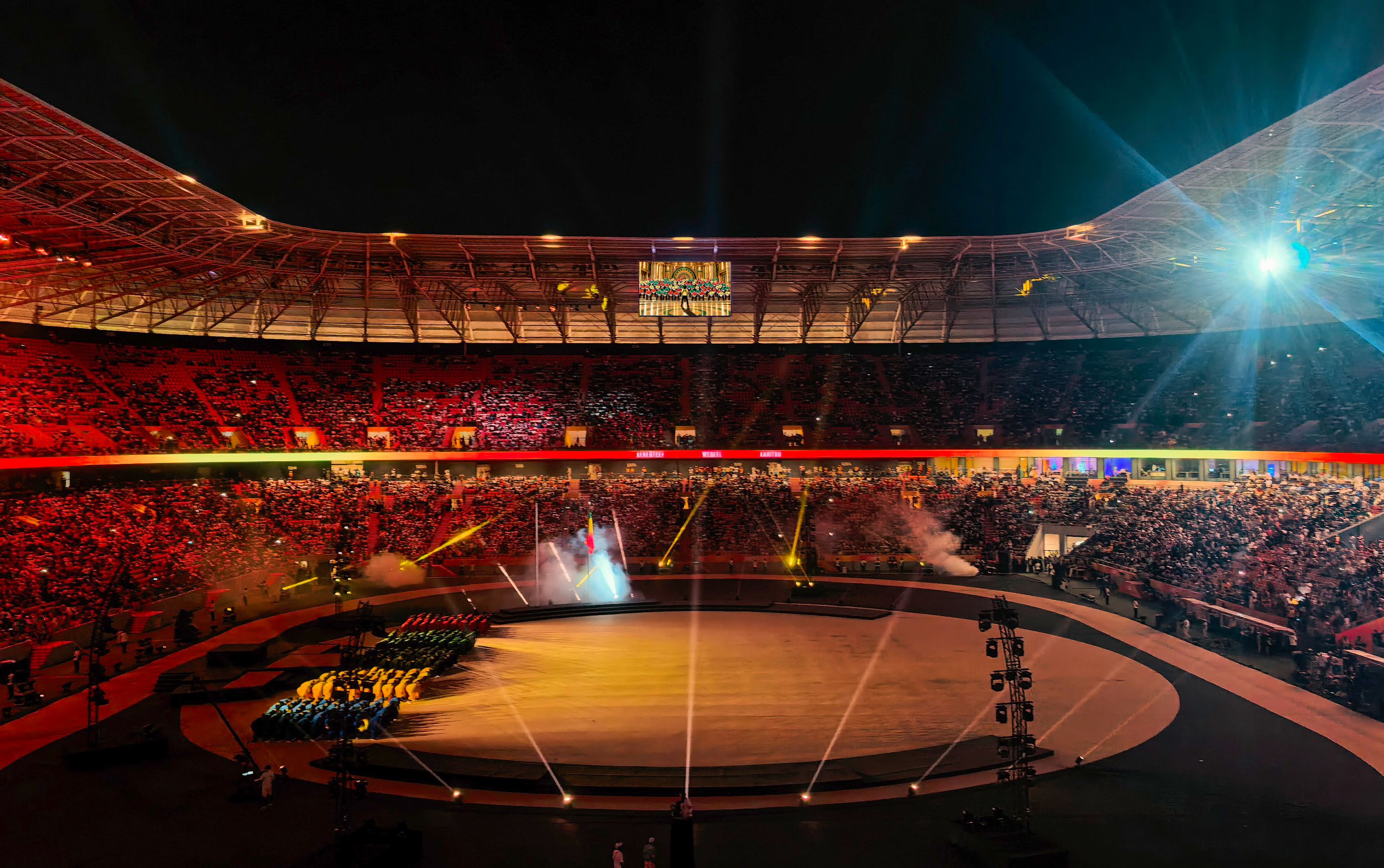
The AI video generated based on Alibaba's video and image generation model Wan3.0 made its debut at the opening ceremony of the Dakar Youth Olympic Games
At the scene, a square formation of real drummers played drums to celebrate, with the Sabar drum music being rough and full of vitality; on the large screen, young "AI drummers" from all over the world crossed mountains and seas to join this celebration. Real drummers and virtual drummers shared the same stage, using Sabar drum music to show the world Senegal's "Teranga" (hospitality and inclusiveness) hospitality culture.
AI breaks the constraints of geography and time, allowing young people from different regions to step onto a "virtual stage". This is the first time that Alibaba's AI technology has participated in the presentation of Olympic opening ceremony content in the form of cultural co-creation. As Coventry said, "People from all corners of the world and all walks of life can discover the beauty of Teranga, strike the Sabar rhythm, and resonate in sync with the first Olympic Games on the African continent."
But the highlight moment of the opening ceremony only lasts a few minutes. If technology only serves the large screen, it is still just a brilliant display. Outside the competition venues, Alibaba also combined the drum music culture to turn technology into an experience that audiences can participate in and take away. In the Olympic Square, which is not far from the main stage and open to all the public, a "drum music co-creation" activity for ordinary people is taking place.
In the area with the densest flow of people during the competition period, Alibaba has built an offline AIGC interactive space - the Hospitality Drum AI Experience Station, which is open to all local residents and tourists.
The experience starts with a real strike. Participants walk up to the all-in-one machine, strike a physical Sabar drum to wake up the system, and the intelligent assistant driven by the Qianwen large model will guide them to take a photo. After that, a 10 to 15-second AIGC video is quickly generated: participants, with their own faces, wear traditional Senegalese costumes and strike the Sabar drum in a virtual world full of African elements.
Under the high-frequency interaction of 400 person-times per day on average, the whole process from taking photos to getting the video is smooth. After the video is generated, participants can print an exclusive commemorative card, scan the code to send their own AIGC avatar to the on-site large screen. Countless participants' avatars gather together to play African drums in ensemble - this is no longer a real drum, but a phenomenal visual scene of "global participants playing African drums together".
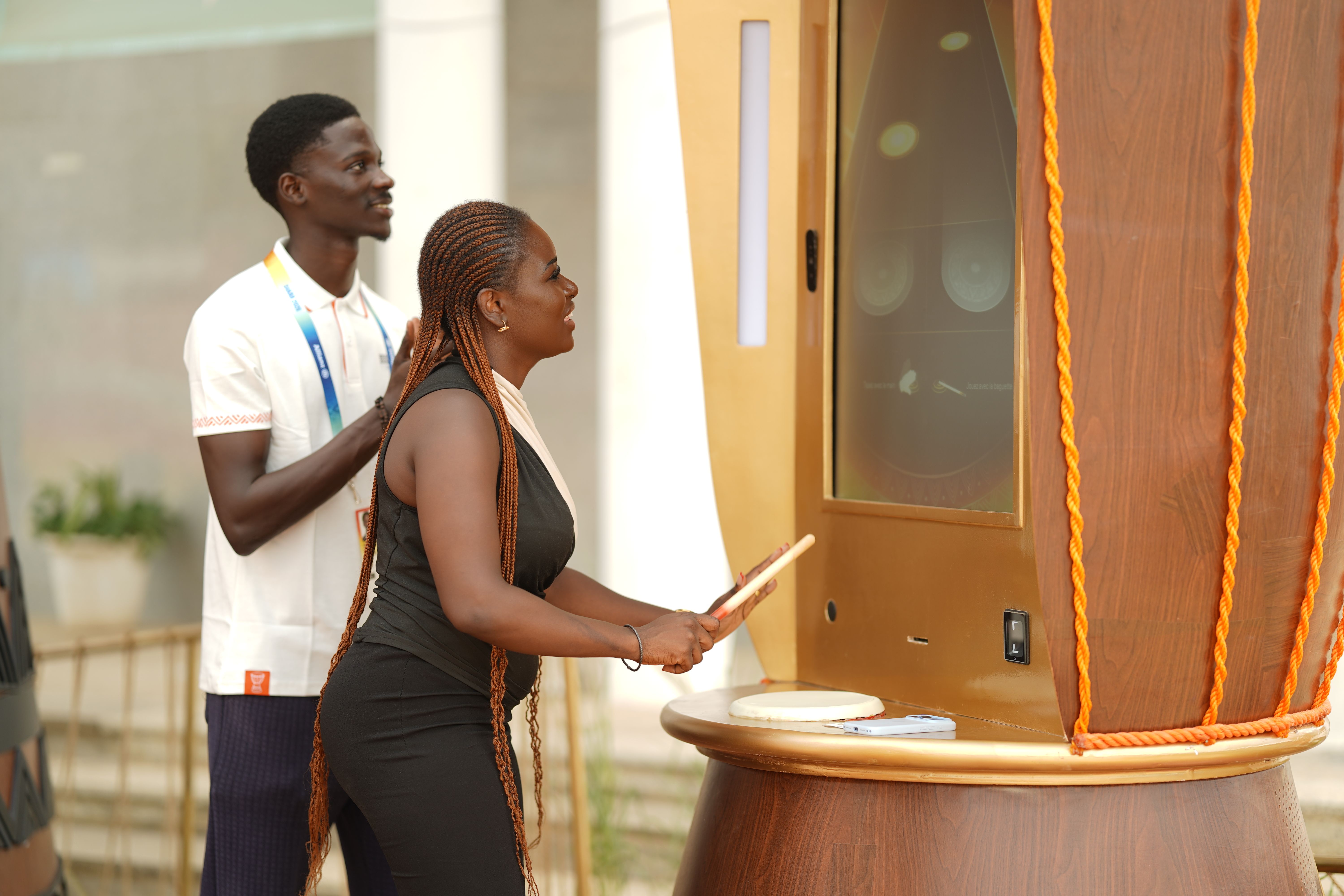
Participants strike the Sabar drum at Alibaba's Hospitality Drum AI Experience Station
This 75-square-meter space has almost had a queue at the door since it opened at 9 a.m. In the queue, there are young athletes wearing sports uniforms of various delegations, local families with children, and many media reporters holding cameras trying to capture the moment of "AI drumming". An average of 400 person-times per day means that during the 14 days of the competition period, an AIGC video is generated here every two minutes on average, and about 5,000 on-site experiences are expected to be completed throughout the competition.
In the evening, the large screen outside the experience space is usually surrounded by several circles of people. When a participant who has just got the exclusive commemorative card (Beat Card) scans the code successfully, his virtual avatar pops up on the huge drum surface and plays ensemble with dozens of AI avatars of different skin colors and costumes, cheers and applause always burst out from the crowd. For many young Senegalese people who are experiencing the Olympic Games for the first time, this small interactive space has become the closest part of this international event to them, and also the part they are most willing to share.
Real drums, virtual drums, the ensemble of hundreds of people on the large screen - in Dakar, technology blends into daily life, and the traditional cultural experience has changed from "one-way display" to "two-way participation". The more lively the on-stage experience is, the more it tests the invisible base behind it.
02. The Invisible Rhythm: The Digital Base Supporting "Thousand Drum Beats"
When the on-stage AIGC videos are generated in real time under the daily average interaction of 400 person-times, when the footage of hundreds of people playing ensemble at the opening ceremony needs to be broadcast to the whole world, when tens of thousands of people, tickets and certificate information pour in at the same time - the digital base of the Dakar Youth Olympic Games must pass three tests at the same time: high availability, low latency and data sovereignty.
Alibaba Cloud has deployed the first Olympic dedicated cloud base for the Dakar Youth Olympic Games. Based on Alibaba Cloud's Apsara Stack (Apsara Enterprise Edition) product system, this base adopts a dual-AZ high-availability architecture, and all core systems including ticketing and electronic visas run on this cloud, which will support zero-interruption operation of core systems within the 14-day competition period. Under strict data sovereignty and high availability requirements, this is the first dedicated cloud base built based on Apsara Stack in the history of the Olympic Games.
Complementary to the cloud base is the breakthrough of the cloud-based ticketing system. This is the first time in the history of the Youth Olympic Games that paid tickets for all sessions have been realized. This system covers 7 competition venues and 1 Festival Site, supporting the sales and ticket verification admission of about 1 million tickets for all sessions. Through more than 100 on-site PDA devices, the system realizes that millions of tickets can be "sold smoothly, verified quickly, and allow people to enter smoothly".
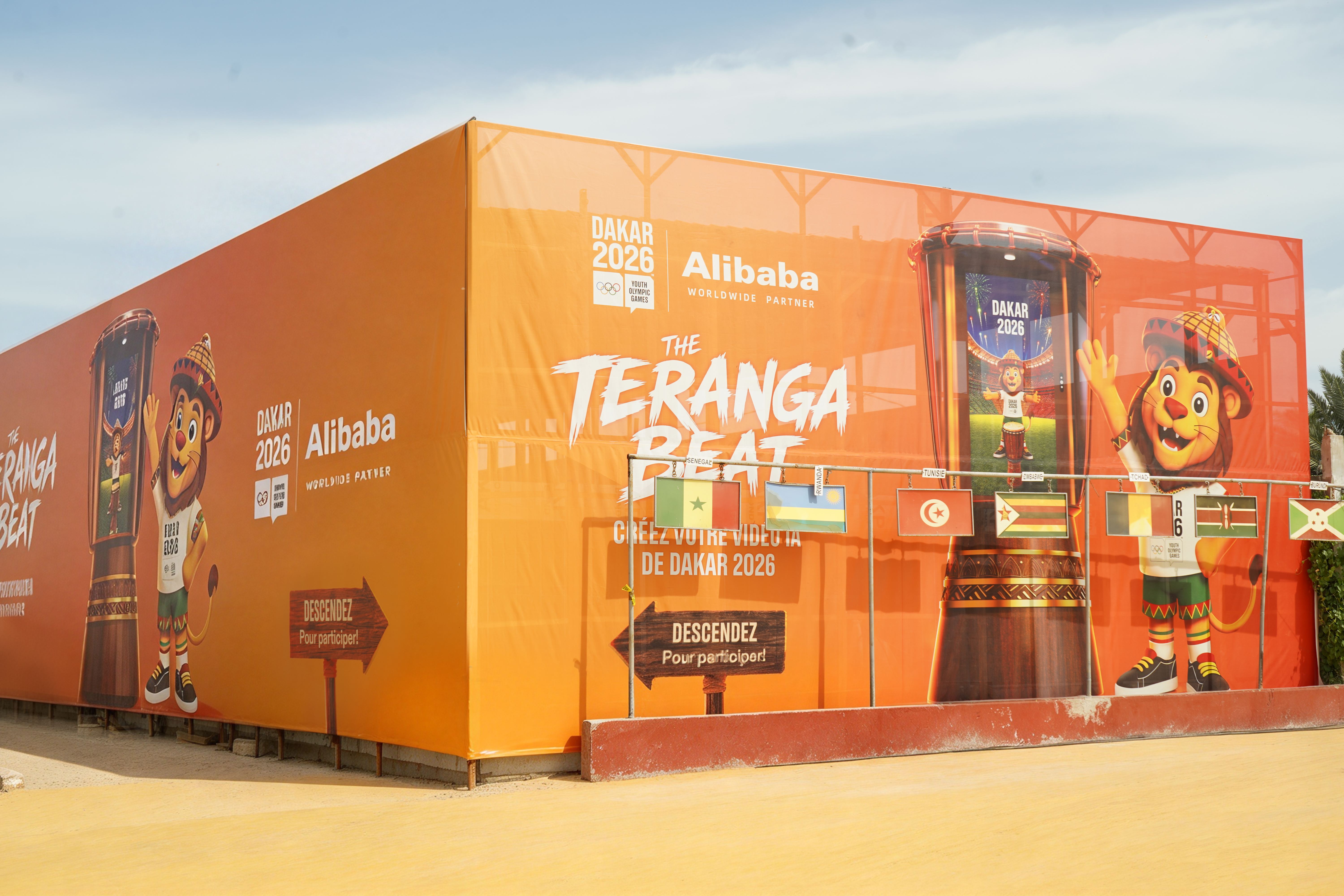
Alibaba's The Teranga Beat experience space at the Dakar Youth Olympic Games site
In The Teranga Beat experience space, technology shows humanistic care that crosses languages.
There are intelligent Q&A all-in-one machines on site. Relying on the semantic understanding of the Qianwen large model and the RAG retrieval-augmented generation architecture, the system has built an exclusive knowledge base. Combined with the speech recognition model locally deployed by FunASR, no matter where athletes and audiences come from, they can ask Qianwen questions in English or French - about the competition schedule, venues, and what Teranga means, supporting multi-round conversations and follow-up questions.
The Qianwen large language model is responsible for multilingual understanding and response, Wan3.0 is responsible for generating drumming videos, and FunASR is responsible for local multilingual speech recognition. The technical parameters are hidden, leaving the hospitality philosophy that "no matter where you come from and what language you speak, you can be understood here".
These capabilities have allowed Alibaba to further transform from an "opening ceremony content participant" and "on-site experience provider" to the base supporting the operation of the event. But if the base only operates during the competition period, it is still just a service provider. The so-called ultimate form is not to stop at doing a good job in event services, but to leave a cloud to help a country.
This is also the real different step of this Dakar Youth Olympic Games from previous editions: the retention after the event.
03. From Event Benchmark to Commercial Reuse: The "Long-termism" of Chinese Technology Going Global
In the past, most Olympic sponsors' participation in the event ended with the closing ceremony. The dedicated cloud base deployed by Alibaba Cloud for the Dakar Youth Olympic Games will be fully transferred to Senegal after the event, transformed into Senegal's national sovereign cloud, and serve the local digital construction for a long time.
"What also impresses me deeply is that Alibaba is committed to leaving a solid AI cloud technology legacy for Senegal after the Youth Olympic Games, beyond the event itself," said Coventry. The 14-day event is the beginning of the cooperation, and the post-event sovereign cloud is the continuation of the cooperation. This cloud has evolved from "serving one event" to "empowering an entire country".
The highest state of technology is not to show off skills, but to leave capabilities that can take root and sprout.
This dedicated cloud base built based on Apsara Stack has not only withstood the extreme pressure of the Olympic event, but also provided a "combat-tested" credible sample for the whole world, especially the public sector, large enterprises and large event organizers, under the strict requirements of data sovereignty and high availability. The Dakar Youth Olympic Games is the best proof of this sample: it is not just a project delivery, but also a window to show the world the advanced nature of Chinese technology.
Putting this Youth Olympic Games into a larger commercial picture, Alibaba's layout in Africa has not been achieved overnight. From the landing of eWTP in Rwanda and Ethiopia, to the introduction of African characteristic commodities through Tmall Global, to Alibaba's cloud computing infrastructure in Africa, the Dakar Youth Olympic Games is just a highlight node on this long-term cooperation clue.
For Africa's first Olympic Games, the challenge is not only the 14-day event operation, but also how to fill the long-term gap in digital infrastructure. Compared with traditional material assistance, technical cooperation allows African countries to obtain "capabilities": a sovereign cloud means that Senegal can develop its own digital industry on this basis in the future.
Looking at this Dakar Youth Olympic Games as a whole, Alibaba's participation covers three dimensions: event operation, intelligent experience and public welfare. This has gone beyond the single role of a sponsor, showing a Chinese technology company's complete interpretation of the "Olympic spirit" and "China-Africa friendship".
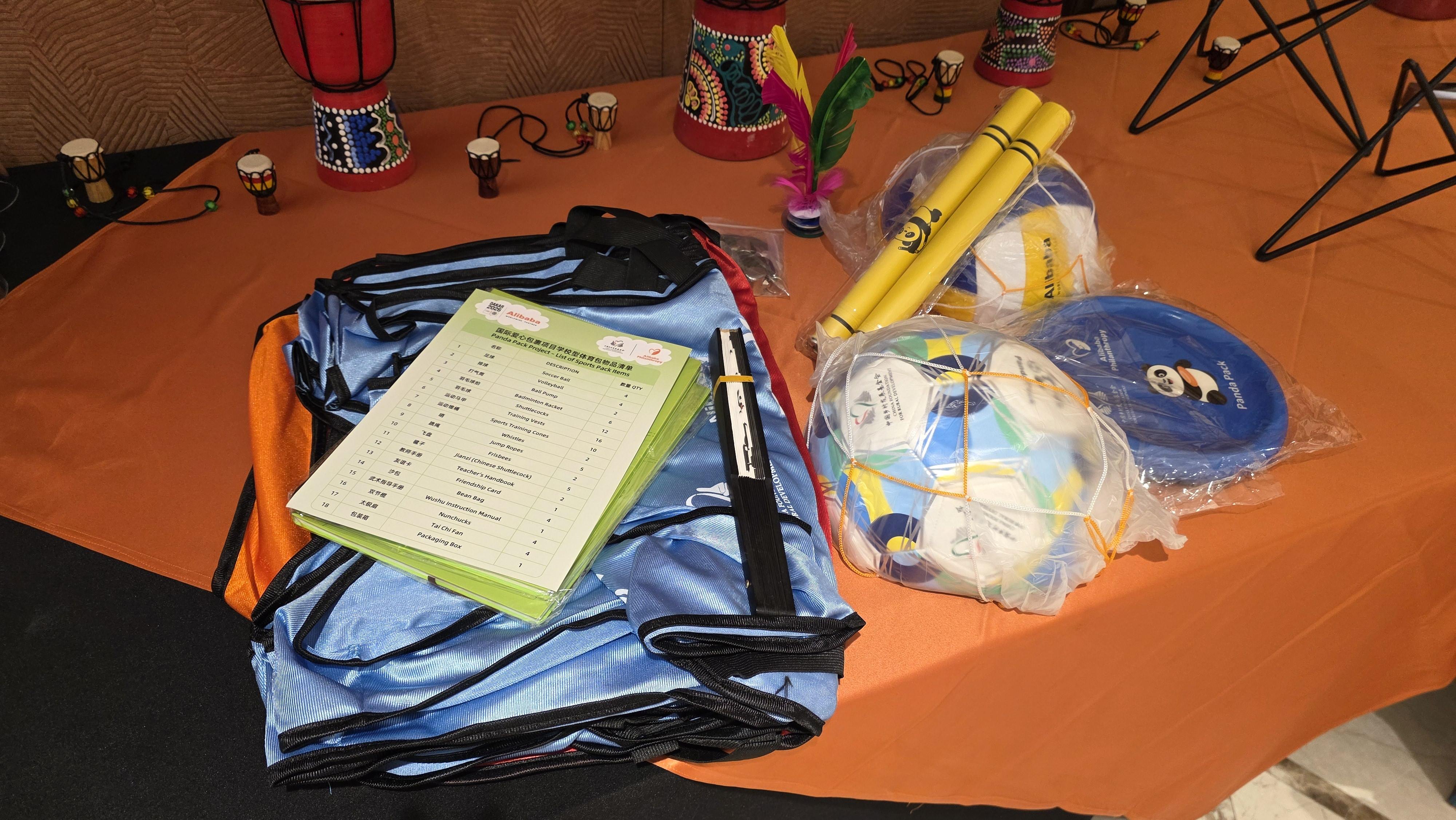
Panda Pack sports equipment kit
In the public welfare dimension, Alibaba, in partnership with the China Foundation for Rural Development, launched the Panda Pack program, donating sports equipment kits to 850 primary schools across Senegal, benefiting more than 350,000 local children. This is not just a one-off event peripheral, but also allows the next generation in Africa to feel the kindness from China in sports enlightenment, which is a concrete expression of the long-term