36Kr Exclusive | Sinovation Ventures has invested in a Chengdu-based embodied model company, which has realized training-free handling of new parts in the picking process.
Author | Qiao Yujie
Editor | Yuan Silai
This article is about 3000 words, with an estimated reading time of 8 minutes
Hard Krypton learned that Chengdu RuixinXing Technology Co., Ltd. (hereinafter referred to as "RuixinXing") has recently completed a new round of financing of tens of millions of yuan, and the investors include Sinovation Ventures, Zhongli Co., Ltd. and Today International.
Founded in 2019, RuixinXing was co-founded by Zhou Jun, Distinguished Professor of the Changjiang Scholars Program and professor of University of Electronic Science and Technology of China, and Xu Ling, professor of Southwest Jiaotong University. It focuses on the research and development of embodied intelligence technologies and products for industrial scenarios.
The company started with mobile robot controllers, and has accumulated technical capabilities in SLAM, navigation, motion control, visual perception and decision-making around products such as AGV and AMR. Relevant products have been widely used in industrial scenarios. At the present stage, RuixinXing is extending these accumulations to the whole embodied intelligent robot, trying to solve the problems of high deployment cost and insufficient environmental adaptability faced by robots when entering factories.
In industrial picking scenarios, robots need to deal with a large number of parts with different shapes and sizes. Traditional solutions usually need to collect data, label data and retrain models for different parts, and the training cycle for a single part takes at least one week. If hundreds of types of parts need to be processed, the deployment cycle may be extended to dozens of weeks. At the same time, the training process also involves cloud computing power costs.
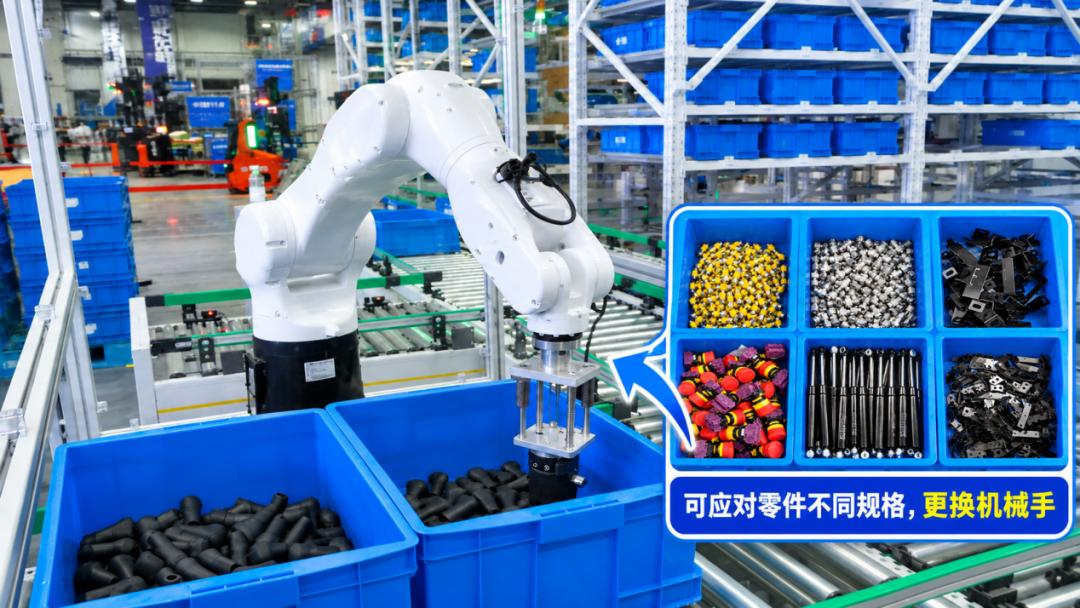
In response to the actual demands of industrial spare parts such as numerous categories, large shape differences and fast order changes, RuixinXing has launched the world's first embodied intelligence training-free grasping model based on human brain-like mechanism. Through adaptive learning, it realizes training-free for new parts, eliminates the one-week training time and thousands of yuan of training cost for each part. It also supports the use of ordinary 3D cameras at the level of thousands of yuan to replace high-precision 3D cameras worth tens of thousands of yuan, reducing the hardware cost of system picking, grasping and perception. The system can select grasping methods such as clamping jaw, air suction and magnetic suction according to the characteristics of workpieces, which is suitable for industrial picking and related material operation scenarios.
(Source/Enterprise)
Zhou Jun introduced to Hard Krypton that RuixinXing's idea is not to train the VLA model for every new part, but to add a knowledge extraction and retrieval mechanism on the base model, and through online learning, let the robot accumulate experience in the process of performing tasks, and then use this information to adjust subsequent grasping actions to form a real-time feedback and adaptive closed loop, which can achieve "learning while doing".
This mechanism is closer to the human grasping method. For example, when people pick up a water cup or a pen, they usually do not need to calculate the precise distance between the object and the hand in advance, but constantly adjust the action according to the seen shape and the feedback after contact. RuixinXing hopes to endow robots with similar dynamic adaptability, so that they can still complete grasping according to real-time perception when encountering untrained new parts.
In addition to picking, loading, unloading and handling are still the key scenarios that RuixinXing focuses on. Traditional mobile robots usually rely on LiDAR to perceive the surrounding environment and complete positioning. When the goods, material frames or other facilities in the factory move, the robot may face inaccurate positioning, and needs to re-identify the environment and adjust the driving path. At the same time, when multiple robots perform tasks at the same time, problems such as traffic congestion, path conflicts and unreasonable task allocation will also affect the overall operation efficiency.
RuixinXing's embodied "cerebellum" technology has the capabilities of environmental adaptation and multi-agent collaboration. Different from some embodied intelligence enterprises that start from manipulator operation, the company has continued to research and develop mobile robot technologies such as AGV and AMR since its establishment in 2019, and has accumulated long-term engineering experience in movement, obstacle avoidance, positioning and navigation in factory environments.
On this basis, the company has independently developed a thousand-level intelligent collaborative scheduling system in the past two years, which combines task allocation, real-time dynamic scheduling and data analysis to solve the collaborative operation problem of multiple robots in a limited space. The company has also added large model perception capability to the original mobile robot system to improve the robot's adaptability to dynamic environments, and further support multi-agent cluster scheduling.
Software and hardware co-design is another technical capability emphasized by RuixinXing. Zhou Jun said that the operation of the embodied intelligence model not only involves the algorithm itself, but also is closely related to the computing power, power consumption and cost of the underlying hardware. If you directly rely on high-computing-power hardware to run complex models, it is difficult to reduce the cost of the whole machine. Relying on the research accumulation in algorithms and chips, the team can carry out collaborative optimization in the process of model deployment to hardware, and reduce algorithm complexity and hardware resource requirements on the premise of ensuring model accuracy.
At present, RuixinXing has launched a number of products for different scenarios. On June 29, 2025, the company jointly released the first generation of industrial picking robots with Zhongli Co., Ltd. Users can remotely issue the type and quantity of parts, and the robot automatically completes the picking process. For commercial scenarios such as supermarkets, the company has also developed an unmanned picking solution. Considering that commodity packaging is mainly in the form of bottles, cans and cartons, the robot uses an air suction end effector to complete grasping.
In November 2025, RuixinXing further launched the "Fly Box" product and the second-generation embodied picking robot. The previous generation of solutions required the robot to move autonomously to different material frame positions to complete picking, while the Fly Box system can quickly send the material frames of corresponding materials to the picking platform to shorten the time required for material switching and material retrieval. The second-generation robot adopts a dual-arm design, and the two arms can be adapted to different types of end effectors to cover more part categories.
In addition, the company has also launched a single-arm picking station, which can switch end effectors such as two-finger clamping jaws, air suction, magnetic suction and dexterous hands according to the part type, and combine with AMR, CTU and conveyor belts and other equipment to build different picking systems.
In terms of multi-robot collaboration, RuixinXing once demonstrated the collaborative operation of 50 mobile robots on the site of Zhongli Co., Ltd. in November 2025. The demonstration site is about 30 meters × 30 meters, and the system needs to complete multi-task scheduling in a limited space, and deal with traffic congestion and path coordination problems between robots.
The following is the Q&A with the founder (slightly edited):
Hard Krypton: How to understand RuixinXing's "brain-like embodied model"? Why is this architecture expected to solve the training problems of existing large models?
Zhou Jun: We can understand the brain-like embodied model as a hierarchical architecture. The bottom layer is the base model, including VLA, world model, etc., which is responsible for providing basic perception and motion capabilities; on this basis, we add a knowledge retrieval and transfer mechanism, and combine task execution and experience accumulation through online learning.
The reason why humans can pick up a part they have never seen before does not mean that every time they encounter a new object, they have to relearn it from scratch. For example, we have learned to pick up a water cup, and when we pick up a paper cup, we can transfer the existing grasping experience according to the similarities between the two, without retraining tens of thousands of times.
The training and execution of some existing large models are relatively separated: the model is trained with a large amount of data first, and then executes tasks after deployment. If new parts are encountered, supplementary data and retraining are often required to adapt to the new situation.
We hope to integrate learning and execution, so that the robot can obtain real-time feedback and accumulate experience during the grasping process. At the same time, when it encounters a new part, it can retrieve similar objects processed in the past and transfer existing knowledge to the current task. There are two key points in this process: one is "learning while doing", and there is no need to wait for a large amount of new data to be accumulated before training; the other is "knowledge transfer", which can extract reusable information from past experiences to help robots handle new objects.
Hard Krypton: What is the degree of dependence of this architecture on data? What capabilities have been realized so far?
Zhou Jun: From the final goal, we hope to reduce the model's dependence on training data as much as possible, but at present we are still in the stage of gradual realization, and the progress of different tasks is different.
Taking industrial picking as an example, we have been able to complete grasping without special data training for new parts. For handling scenarios, we can also complete some tasks with less data or even no additional training data. However, assembly involves more complex operation accuracy and motion requirements, and more data support is still needed at this stage.
Therefore, we are not saying that embodied robots no longer need data, but hope to reduce the need for repeated data collection and model training for each new task through online learning and knowledge transfer. To what extent the data demand can be reduced in the future still needs to be further confirmed with technology iteration and more scenario verification.
Hard Krypton: What stage has the model implementation reached now?
Zhou Jun: At present, we have carried out landing tests in the factories of enterprises such as Zhejiang Zhongli, Haier, BOE and Zhongji Chuangxu. These leading factories have relatively strict requirements for the introduction of new technologies. Robots not only need to be able to complete tasks, but also need to have sufficient generalization ability to adapt to different parts and environments; at the same time, the operation rhythm should be as close to manual work as possible, and the cost must be reasonable. Only when these conditions are met at the same time, customers may really deploy robots into the production process.
We have long provided industrial customers with mobile robot products such as AMR, and related products have been applied in some factories. This allows us to accumulate a customer base and better understand the actual needs of factories. Compared with only verifying whether a single robot can complete a certain action, we pay more attention to whether it can enter the real production environment, complete tasks stably, and meet customers' requirements for efficiency and cost.
In the next step, we still need to pass more factory tests to continuously verify the generalization ability, operation efficiency and system stability of the model, and gradually promote products from scenario testing to large-scale delivery.