Having secured hundreds of millions of yuan in investment from Hangzhou state-owned capital, Kai-Fu Lee is poised to bring AI into corporate decision-making levels.
The enterprise AI market is entering a period of commercial reshuffling.
As large models are adopted by enterprises, work including coding, document processing, and report generation is being largely taken over by AI. Although the efficiency gains brought by technological progress are quite significant, these changes have not yet been widely translated into revenue and profit growth in corporate financial reports, leaving founders who embraced AI full of confusion.
Amid such anxiety, new competitive opportunities are emerging quietly on this track. Compared with efficiency improvement for individual positions, enterprises are more concerned about whether AI can penetrate core business links such as sales, supply chain, and production operations, participate in business analysis and decision-making, and truly improve business performance.
As one of the former "Little Six Tigers" of large models, 01.AI has chosen to place a new bet on this direction.
At the beginning of 2025, Kai-Fu Lee took the initiative to withdraw from the continuous pre-training competition of ultra-large parameter foundation models in advance, shifting R&D resources to decision-making AI and industrial AI transformation. More than a year later, according to previous media reports, the company has set a target of 1.5 billion yuan in order value in 2026 and plans to sprint for an IPO in 2027.

On October 28, the state-owned assets of Hangzhou municipal government and Linping District government invested hundreds of millions of yuan in 01.AI. The company's headquarters will be located in Linping, Hangzhou, and an industrial AI transformation base will be constructed there.
By shifting from foundation model R&D to the enterprise market, the competitors 01.AI needs to face have changed. Cloud vendors, traditional enterprise software companies and AI-native startups are all competing for the technology budget of enterprise clients.
In this market, model performance is only part of the competition. Which AI capabilities enterprises are willing to pay for, and whether 01.AI can build long-term advantages with its own production and R&D capabilities, will determine the future commercial value of this AI unicorn.
01. AI spending keeps rising, while enterprise revenue growth lags behind
Recently, changes in financing and valuations of global AI giants are reflecting the capital market's focus on growth quality.
On October 31, The Wall Street Journal reported that OpenAI originally planned to raise $30 billion in a new round of financing, but has currently obtained about $110 billion in subscription commitments, and the financing target has been adjusted to a maximum of $200 billion.
Anthropic is also facing valuation scrutiny. According to Reuters' report on October 15, some investors are considering an Anthropic IPO valuation of about $1.5 trillion, lower than the previous market expectation of about $2 trillion.
As the valuation of leading AI companies reaches the trillion-dollar level, whether revenue growth can cover the continuously high computing power investment has begun to affect investors' judgment.
Fortunately, the revenue growth points of AI companies are clearer than before. The recently disclosed financial data of Anthropic provides another observation window. According to the S-1/A prospectus submitted on November 2, the company's revenue in the first three quarters of 2026 reached $332.42 billion, a year-on-year increase of about 1206%, with an operating loss of about $1.3 billion. Enterprise customers have become the main force of revenue. In the past 12 months, more than 11,900 customers have contributed at least $100,000 in revenue to it. Other data shows that this group of customers contributed more than 70% of the revenue in the first half of the year.
Enterprise customers are becoming an important source of revenue for foundation model companies. Claude Code can already participate in code writing, debugging and testing, and enterprise APIs are also widely used in software development and business processes.
However, the rapid revenue growth of AI service providers does not mean that customers have obtained the same level of financial returns.
According to Goldman Sachs Global Investment Research's September 2026 report, large U.S. cloud vendors spent about $800 billion on capital expenditure that year, and the market expects the figure to reach about $1.1 trillion in 2027. According to its model, cloud vendors need about $300 billion in AI-related revenue each year to cover corresponding investments.
Such a huge investment ultimately needs the support of downstream application demand, while the actual business effect of enterprise AI still shows obvious differentiation.
McKinsey's "2026 Global AI Survey" shows that about 80% of respondents said AI has improved their personal work efficiency, but only 6% of respondents meet its criteria for "AI high-performance enterprises". Research from MIT NANDA also found that about 95% of enterprise generative AI pilots have not produced measurable financial returns.
These data reveal a contradiction in the enterprise AI market: it is increasingly easy for employees to use AI to complete tasks, but the business performance of an enterprise involves multiple departments, business systems and management processes, and local efficiency gains can hardly be automatically transmitted to overall profits.
For example, a manufacturing enterprise wants to reduce inventory, and AI alone analyzing warehouse data is far from enough. Sales forecasting, production scheduling, procurement planning and capital turnover interact with each other, and any adjustment may change the work arrangements of other departments.
Therefore, enterprise AI is extending to more complex business scenarios.
This market has gathered different types of competitors. Cloud vendors rely on computing power infrastructure, model services and platform ecosystems, traditional software companies have in-depth knowledge of enterprise business systems and customer resources, and AI-native companies try to redesign the way enterprise software is used with the advantages of large model technology and product innovation.
In his new book *AI Future Has Arrived*, Kai-Fu Lee once raised a question: Enterprises have invested so much in AI, what exactly has changed in their quarterly financial reports?
01.AI takes decision-making AI as its new business direction, trying to bring AI into the business management process of enterprises. Compared with how many questions the model can answer, managers are more concerned about whether it can understand the business situation and assist in solving actual business problems.
02. Kai-Fu Lee's new bet: Can AI enter the enterprise decision-making layer?
When 01.AI was founded in 2023, the domestic large model industry was at the peak of technology and financing competition. The Yi series open-source models helped the company establish model technology influence in the first echelon of the international market, but with the continuous iteration of open-source models such as DeepSeek and Alibaba Qwen, the competitive environment of the foundation model market has gradually changed.
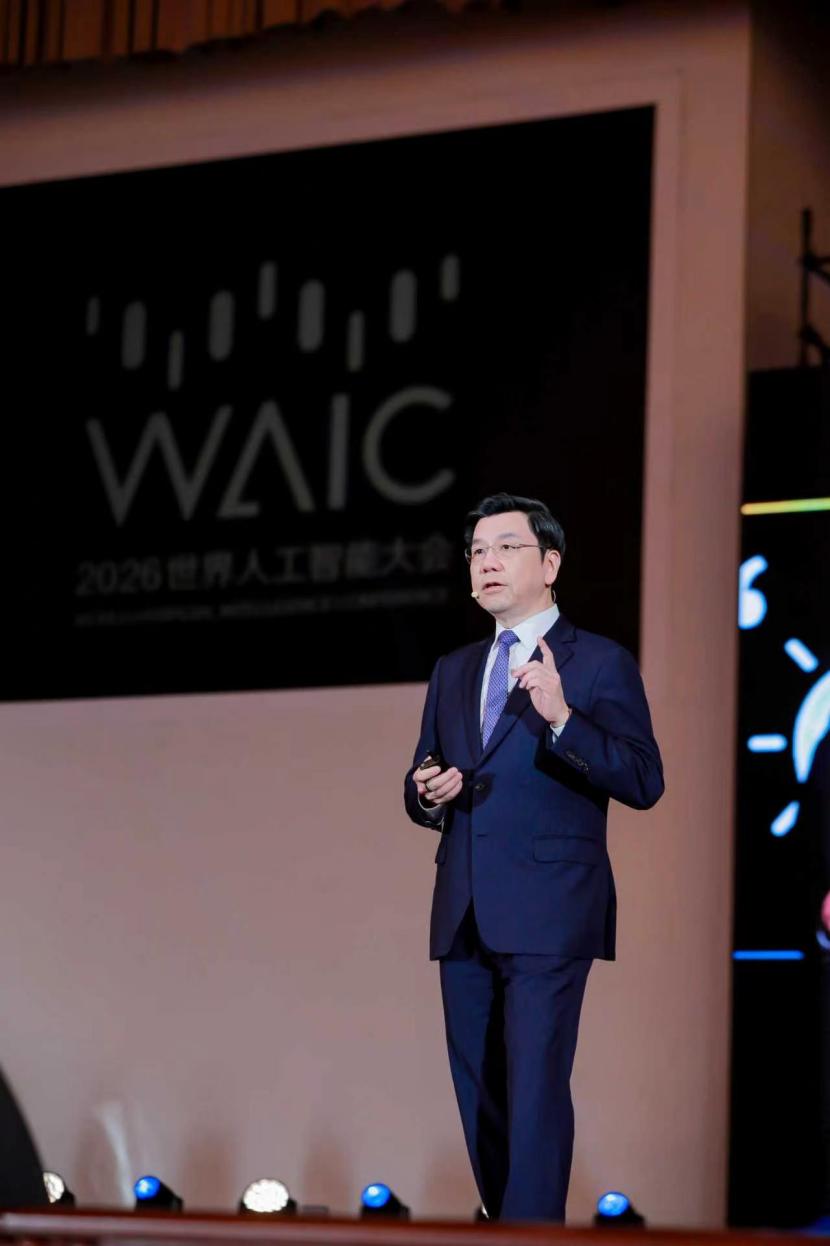
In July 2026, Dr. Kai-Fu Lee, founder and CEO of 01.AI, shared cutting-edge AI technology and industrial development trends at the World Artificial Intelligence Conference held in Shanghai.
At the beginning of 2025, 01.AI took the initiative to adjust its strategy, investing more R&D resources in enterprise AI, shifting the focus of competition from the parameter scale of foundation models to the ability to let AI penetrate the core business of enterprises, promote industrial transformation through decision-making AI and improve business performance. It has formed a business system of "No.1 Leader Project + Wance AI + FDE".
Behind this system is a gradually clear production and research path: promote AI to enter the core operation of enterprises with "No.1 Leader Project", build business understanding and decision-making capabilities with Wance AI, accumulate business experience of world-class customers with FDE, and explore large-scale replication through platform productization. For 01.AI, whether these links can be connected will directly affect its long-term competitiveness.
Among them, the "No.1 Leader Project" is led by the top management of the enterprise, linking AI projects with business indicators such as revenue growth, cost control and profit improvement, and then coordinating departmental execution through the DRI (Directly Responsible Individual) mechanism.
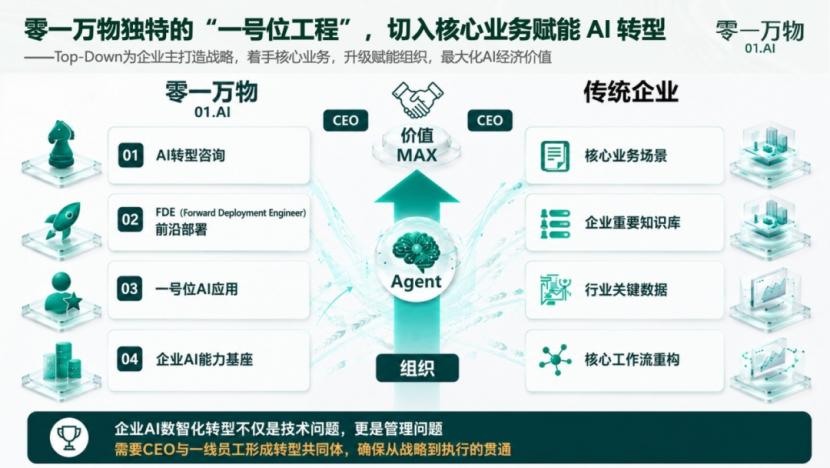
01.AI uses the "No.1 Leader Project" to cut into the core business of enterprises, connect strategy and execution, and promote AI transformation.
This is related to the internal organizational structure of the enterprise. Sales, procurement, production and finance departments often use different business systems. It is difficult to promote the adjustment of business processes involving multiple departments only by the IT department purchasing a set of AI tools.
Apart from organizational problems, AI also needs to understand the complex business relationships of enterprises.
Assuming that the inventory of a manufacturing enterprise suddenly increases, the reason may come from lower-than-expected sales, or it may be related to production plan adjustment or stocking for new orders. The ERP system records inventory and procurement, and the CRM system stores customer and sales data, but these data themselves cannot fully explain business changes.
Wance AI is the key tool that 01.AI intends to use to solve this problem.
One of the core technologies of Wance AI is Ontology 2.0, which includes two parts: enterprise map and dynamic context.
The enterprise map connects information such as orders, customers, inventory, equipment and responsible persons, helping AI understand the business relationships behind the data. Dynamic context technology can continuously track the business status, allowing AI to analyze and judge based on the latest business information.
Gartner estimates that about 80% of enterprise data is unstructured data, including emails, meeting minutes, chat messages and work orders. These pieces of information are scattered in different departments, but may contain important business clues.
01.AI uses the generalization capability of large models to support natural language business graph construction, shortening the initial modeling work that traditionally takes several months to several days, greatly reducing the technical threshold and deployment cost of enterprise business modeling.
On this basis, Wance AI also introduces controlled execution system and multi-model routing. The former improves the reliability of AI when processing important business tasks through execution constraints and result verification; the latter calls different models according to task complexity to optimize reasoning cost.
These technologies form an important part of 01.AI's current production and R&D capabilities. After the company took the initiative to withdraw from the large model pre-training competition, it can make full use of the technological progress of top open-source models, and focus its R&D strength on enterprise business understanding, decision-making systems and application products.
Similar technical routes have emerged in overseas markets.
Palantir, the U.S. AI analytics giant, has long used Ontology to connect enterprise data, business objects and execution processes, and introduced large models into enterprise operations through the AIP platform. Its financial report for the first quarter of 2026 shows that U.S. commercial business revenue increased by 133% year-on-year to reach $595 million.
Although Palantir's growth has provided a valuation sample and commercialization confidence for the enterprise AI market, 01.AI still needs to consolidate its long-term competitive advantage through its own products and customer delivery.
Around Wance AI, 01.AI has launched No.1 Leader AI applications such as Boss AI, Investment Officer AI, and Top Sales AI, covering business management, investment decision-making and sales growth. According to the company's internal data, after 01.AI deployed the relevant system, the business opportunity conversion rate increased by about 2 times.
At present, the company has promoted enterprise AI practices in large customers such as global leading energy and mining enterprises, leading Asian manufacturing enterprises and multinational insurance groups. For enterprise AI companies, entering the core business scenarios of large enterprises is an important step to verify product capabilities.
Serving these customers requires engineers to go deep into the site, understand business processes and complete system deployment. 01.AI adopts the FDE (Frontier Deployment Engineer) mode, which feeds back business requirements and implementation experience at the customer site to the product R&D team.
At present, this model is also valued by global technology companies. Microsoft announced in July 2026 that it would invest 2.5 billion US dollars to establish Frontier Company, planning to organize 6000 industrial and engineering experts to go deep into customer sites and promote AI to enter enterprise business processes.
Research from MIT NANDA found that among its interview samples, AI projects that adopt the external deep partner solution have about twice the proportion of entering the deployment stage than the in-house self-developed solution.
However, the FDE model also brings the cost problem commonly faced by the enterprise AI industry. Large customers require a lot of on-site engineering support, and if each project needs to be redeveloped, the growth of customer volume will also push up personnel investment.
01.AI's response idea is to combine the on-site delivery capability of FDE with the platform-based R&D of Wance AI. Frontier deployment engineers go deep into the business site, co-create with customers, distill expert experience, common technologies and practical results into platform product capabilities, and gradually form standardized product modules and delivery systems. This means that 01.AI has the opportunity to meet the personalized needs of enterprises while reducing repeated development, lowering marginal delivery costs, and breaking through the restriction that project scale grows synchronously with the number of engineers.
This is also the important background for 01.AI to put forward "crossing the AI transformation gap and verifying the value of industrial AI" as its core positioning. Enterprises need to overcome data, process and organizational barriers, and AI technology companies need to rely on a set of "AI transformation operating system" to let AI enter core business management and achieve "mass customization" at the same time.
For 01.AI, in the future, in addition to the order scale, the reuse degree of platform products among different customers will also affect its commercialization quality.
03. How much space can Hangzhou's manufacturing ecology provide for industrial AI?
Hangzhou state-owned assets' investment in 01.AI also provides a new case for observing the local AI industry layout.
Hangzhou has formed a relatively active foundation model and cloud computing ecology. The development of enterprises such as Alibaba Cloud and DeepSeek has made it an important town for China's AI technology innovation. At the same time, it has a profound manufacturing foundation, and the production and operation links of enterprises provide rich scenarios and potential market demand for AI applications.
Previously, 01.AI has expanded its AI business at different levels. Overseas, the company cooperated with Kazakhstan to promote sovereign AI construction, participated in the AlemLLM Kazakh large model and AI education projects. Among them, the AI education pilot has been launched in 10 rural schools, and it is planned to expand to 500 schools in 2027. In China, the company expands the market by co-building industrial AI bases with local governments and undertaking large-scale enterprise projects.
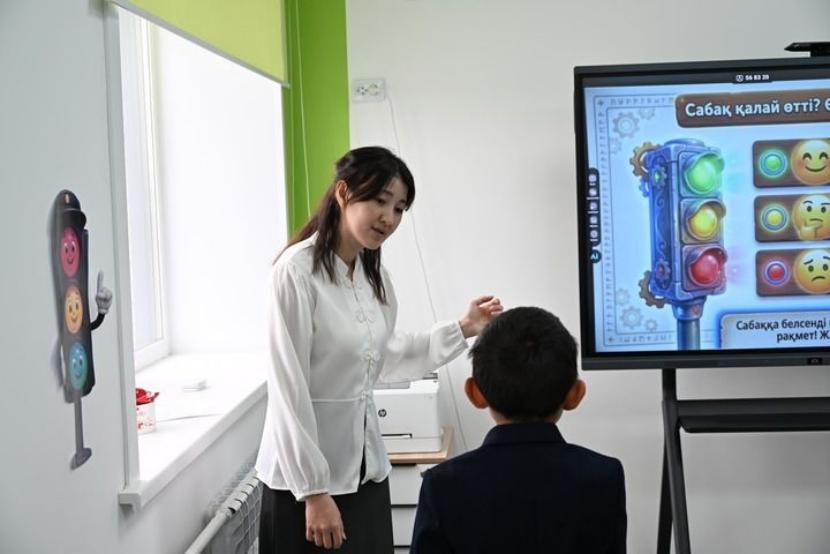
On September 1, 2026, the "AI Dual-Teacher Classroom" driven by 01.AI's large model was officially launched in Tilektes Secondary School, Kazakhstan. Relying on the deep empowerment of large models in multiple dimensions such as teaching evaluation, it assists the local teaching intelligence in the whole process and promotes inclusive education.
The relocation of the headquarters to Linping this time has further shortened the distance between 01.AI and Hangzhou manufacturing customers.
According to a report from Hangzhou Net on October 31, the total industrial output value of designated-size enterprises in Linping exceeds 180 billion yuan, with 30 listed enterprises