8,000 Lucky Coffee outlets are calling out to Mixue's headquarters for help | DeepKr
Text by Zhong Yixuan
Edited by Qiao Qian, Yang Xuan
Zhang Hongchao and Zhang Hongfu, the founders of Mixue Group, are known for being low-profile. Media rarely capture their images or public statements. Even at the listing bell-ringing ceremony, the two founders did not show up, and 8 mascots appeared on their behalf.
However, at the beginning of 2026, Lucky Coffee franchisees publicly searched for them.
The franchisees hoped that the founders of Mixue would step forward to turn the tide. The winter at the beginning of the year was "the coldest Spring Festival" for Lucky Coffee, as a multi-store Lucky Coffee franchisee described it. He ran more than ten Mixue Ice City stores at the same time and grew up with the company. In February this year, this franchisee wrote a long letter on the social platform, *To Mr. Zhang: Lucky Coffee Franchisees Really Can't Hold On Anymore!*, with intense wording.
This letter spread rapidly among franchisees. Another early Lucky Coffee franchisee told 36Kr that entrusted by many franchisees, he finally added Zhang Hongchao's WeChat after several twists and turns and forwarded everyone's opinions to him. Zhang Hongchao quickly called back, saying "Lucky Coffee will definitely make changes."
Changes are indeed taking place.
People close to them said that at the beginning of the year, the two founders organized a national store inspection, gathered loss-making Lucky Coffee franchisees, and wanted to figure out what exactly happened. A Lucky Coffee franchisee also said that at this year's franchisee annual meeting, Zhang Hongfu expressed his apology on the spot, "He felt that he didn't do a good job and was very sorry for everyone."
As the actual manager of Lucky Coffee in its early and middle stages, around 2023, Zhang Hongfu often invited Lucky Coffee franchisees to the company to put forward suggestions and participate in product R&D meetings. In 2025, after Mixue Group went public, Zhang Hongfu gradually delegated power and withdrew from the front-line management of Lucky Coffee. Until this year, Zhang Hongfu stepped forward again, leading a team to several cities to investigate competing coffee brands such as b³, Ora and Kenyue Coffee.
All these mean that Lucky Coffee has truly reached the edge of needing to be saved.
From an external perspective, at the end of 2025, Lucky Coffee just announced that it had exceeded 10,000 stores, surpassing Starbucks in scale and becoming the third largest coffee brand in China after Luckin Coffee and Cotti Coffee. However, according to 36Kr's understanding, the "dense expansion" has led to a decline in store performance, especially in the sinking market. Therefore, Lucky Coffee has stopped opening new stores in counties and towns since the beginning of the year, and the total number of stores has now dropped to around 8,000.
Another insider told 36Kr that in the first half of 2026, the average daily turnover of each Lucky Coffee store was about 2,000 yuan, which translates to less than 200 cups. Considering the unit price, this is a figure that is difficult to break even.
Franchisees not making money, coupled with the off-season in winter, means that a wave of store closures may come. "With the number of new stores controlled in the second half of the year, Lucky Coffee may see a net store closure status before the end of the year," an industry insider said.
What is more tricky is that Mixue's competitors are gaining strong momentum.
Luckin Coffee, which has more than 30,000 stores, added more than 5,000 stores net in the first half of the year. In summer, it put forward the slogan "Luckin is all you need", and announced high-profilely that the sales of non-coffee categories (tea drinks, fruit juice, yogurt, etc.) exceeded 20 billion yuan. Guming, the second largest tea drink brand, also announced that coffee revenue accounts for more than 20% of its total revenue, "Without coffee, it would be difficult for us to maintain the growth in the first half of the year."
It is obvious that the boundary between tea drink companies and coffee companies has long been blurred, and the best defense is offense. Mixue Ice City incubated Lucky Coffee as early as 9 years ago, which carried the ambition of "rebuilding another Mixue". However, Lucky Coffee, which once expanded to 10,000 stores nationwide, is still underperforming expectations at present.
Mixue Ice City sells lemonade for 4 yuan, while Lucky Coffee sells American coffee for 5 yuan. Both hold the "cheap" killer feature, so why can Mixue sell tea drinks well but never sell coffee well?
This cruel question lingers in the minds of Mixue's managers, and not only theirs.
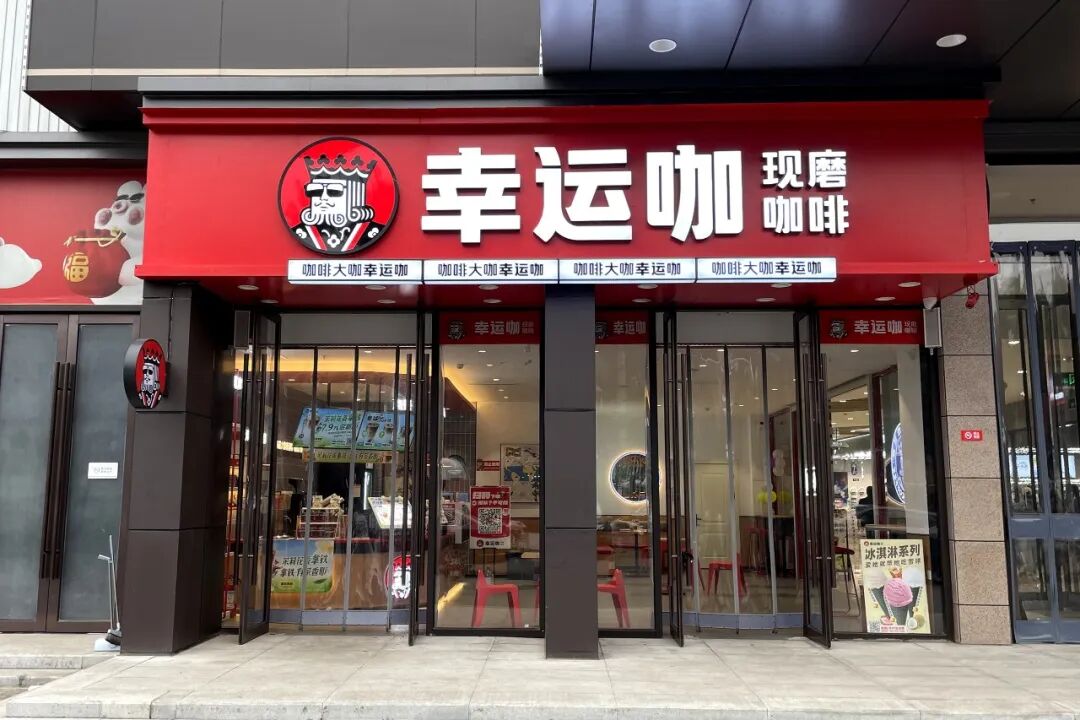
Lucky Coffee store
The Original "Cappuccino"
In August 2020, when franchisee Chen Li met Zhang Hongfu for the first time, he counted that there were only 7 people in total at Lucky Coffee's headquarters including himself. The so-called headquarters was actually just a very small office in the same building as Mixue Ice City. Qiu Tengyu, the first general manager of Lucky Coffee, was also present, and he was in charge of investment promotion at that time.
That was also the first year that Lucky Coffee was fully acquired by Mixue Group. Before that, it was a local specialty coffee brand in Zhengzhou. The core members of early Lucky Coffee were all transferred from Mixue Ice City. Many franchisees, including Chen Li, first learned about Lucky Coffee through the recommendation of Mixue's investment promotion team.
Chen Li's first impression of this start-up team was "vibrant". At that time, the internal positioning and judgment of Lucky Coffee were already very clear: Lucky Coffee aimed to be a more affordable Luckin Coffee, priced at 5-8 yuan. As for the development route, Lucky Coffee decided to start from towns, then expand to university towns, and finally attack provincial capitals after the resources of the two were mutually supportive.
Regardless of whether the demand exists, Lucky Coffee did seize the blank of price range and store locations.
In 2020, the chain rate of coffee in China was only 13%, and it was highly concentrated in first-tier cities. Starbucks and Luckin Coffee were the well-deserved leaders, with around 4,000 stores each. The former had an average customer unit price of more than 30 yuan, while the latter's main products were priced at 10-15 yuan, and the subsidies were fading, so price increase became inevitable.
In the broader third-tier and lower cities, scattered and independent coffee shops were the real ecosystem. There were almost no competitors for chain coffee priced at 5-10 yuan.
At that time, no one in China could define whether coffee could only grow from first-tier cities or also rise from the sinking market. In the early stage of Lucky Coffee's investment promotion, in March 2020, Zhang Hongfu shared his mood on WeChat Moments: "It feels like I'm back to my youth, full of excitement and passion."
A few months later, Chen Li became one of the first batch of Lucky Coffee franchisees, with a number among the top 100. His store was opened in a third-tier city in Henan, with an investment cost of more than 200,000 yuan.
Many years later, Chen Li still clearly remembers his second meeting with Zhang Hongfu. At that time, Mixue Ice City had already become the first tea drink brand in China with more than 10,000 stores. In his opinion, the boss of a 10,000-store brand personally came down to inspect stores and patiently listened to the opinions of franchisees, whose diligence far exceeded his imagination.
According to his account, that day Zhang Hongfu passed by his city and wanted to take a look to see if there was a Lucky Coffee store there. He opened his mobile phone and found Chen Li's store nearby. "The store was backlit at that time. I saw a middle-aged man in a blue shirt walk in. The light was so dazzling that I didn't recognize who he was for a moment. After I saw clearly, wasn't that the boss?"
During that period, the management often inspected stores to understand the situation of franchisees. But the fact was that the operation status of the first batch of Lucky Coffee stores was not good. Chen Li feedback that his store only earned two or three hundred yuan a day, the core reason being that no one here drank coffee.
"At that time, many customers came in and asked, do you have fruit tea? I said we only have two types of fruit tea, most of the products are coffee. They left immediately after hearing that."
Chen Li said that by the end of 2020, he lost 50,000 yuan. When he checked the accounts with surrounding franchisees, he "found that everyone was losing money". Everyone went to the company to complain that "it's impossible to sell well only by selling coffee", and got the reply that Lucky Coffee needed to slowly cultivate the coffee market.
From 2020 to 2022, Lucky Coffee's product strategy was to use milk tea-like and sweet coffee to educate the sinking market, so as to attract people to come to the store and try new products. For example, American coffee was added sugar by default, and the formula was clearly written on the menu. Original milk coffee was marked as "coffee with milk flavor", and brown sugar pearl latte was marked as "coffee with pearls". The most basic words were used to help people understand the products and flavors. In the early menu, brewed coffee and freshly ground coffee each accounted for 1/4, and half of the remaining SKUs did not even contain caffeine (i.e. ice cream, milk, tea).
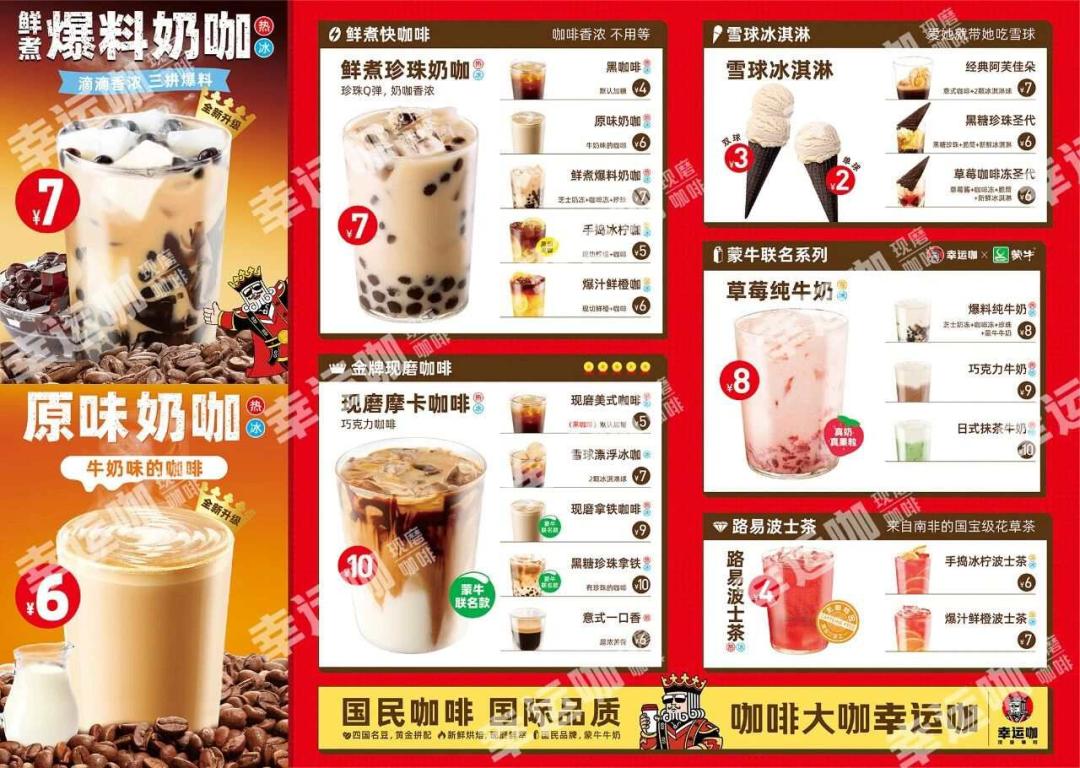
(Lucky Coffee's early menu, provided by the interviewee)
Strictly speaking, the so-called milk coffee should be called "coffee-flavored drink". In the early days of Lucky Coffee's entrepreneurship, Qiu Tengyu, the then general manager, told 36Kr that Lucky Coffee's users were people who did not often drink coffee, and were even not used to drinking directly from the cup mouth, so they needed straws. For this reason, Lucky Coffee even changed the cup type. "If you only make classic coffee, it means you give up most of the people who want to drink coffee but don't know how to drink it," he said.
Coffee-flavored drink was regarded as a transition. This choice can also be traced in Mixue's entrepreneurial experience.
In the early days, Mixue Ice City made iced coffee with very simple raw materials: Nescafe coffee powder, sugar and water, which were stirred to finish. The dosage was also based on feeling, and the measuring container for coffee powder was just a spoon. Zhang Hongfu even handwrote a label, saying "Cappuccino, 1 yuan per cup" — he didn't know what "cappuccino" was at that time, he only knew it had a romantic name from Elva Hsiao's song title.
At that time, Starbucks had not yet settled in Henan, and McDonald's just started to test freshly ground coffee in China, but Mixue's instant iced coffee sold very well. From 2008 to 2011, this iced coffee had always been the best-selling summer product of Mixue Ice City.
After 2021, Lucky Coffee's milk tea-like products began to disappear. The best-selling burst milk coffee in Chen Li's store was removed from shelves, and was gradually replaced by flavored coffee, with the proportion of coffee products reaching nearly 70%. The next year, following the trend of Luckin's Coconut Latte, Lucky Coffee launched Coconut Latte, which became its first product with sales exceeding 100 million yuan.
With hit products and basically mature coffee products, Qiu Tengyu told 36Kr that when Lucky Coffee's stores were iterated to the fifth generation and its brand slogan was "Lucky Coffee, the Coffee Guru", the store profit model had been basically polished, and it was time to expand.
By the end of 2022, Lucky Coffee's stores had expanded from 500 to more than 2,000 in just one year. In China, it had ranked among the top three coffee brands in scale, second only to Luckin Coffee and Starbucks.
This result was quite impressive. Zhang Shen, a Lucky Coffee franchisee, attended the annual meeting that year. He said that Lucky Coffee franchisees sat in the very middle of the Mixue Group, which made him very proud. That year, Chen Li's store also exceeded one million yuan in sales.
It took two years for Lucky Coffee to keep thinking about what coffee should look like in the sinking market, but this space and time came from the gap period of competitors. At that time, Starbucks was still in first-tier cities, Luckin Coffee had just recovered from the fraud scandal and was still proving it could make profits, while Cotti Coffee had just been established.
But the gap period did not last long, and the real danger came soon.
Drawing a Mark on the Moving Boat to Find the Sword
2023 was the most dramatic year in China's coffee war, and the human variable was amplified to the extreme in the business world. No one could have expected Lu Zhengyao's break with Luckin Coffee. No one knew Luckin better than Lu Zhengyao and was more eager to replicate Luckin's success. Several accidents gave birth to Cotti Coffee.
The 9.9-yuan subsidy war was well known to all. Cotti Coffee launched it, Luckin Coffee followed, and other coffee brands fell into a unanimous and strange silence. It seemed that there was only one price range of 9.9 yuan in the market. As a result, in just 3 years, China's coffee chain rate soared from 13% to 40%, which was unprecedented globally.
During that period, Lucky Coffee was almost silent in this war. Many franchisees told 36Kr, "Lucky Coffee just watched its competitors open stores frantically." A franchisee said that his store was almost powerless to fight back under the siege of Luckin and Cotti. By the second half of the year, the average daily turnover of each store dropped from 4,000 yuan to 2,000 yuan, cut in half.
Insiders said that Lucky Coffee's original goal that year was to sprint to 10,000 stores, and later the goal was changed to 5,000. But its final net new stores were only more than 600.
In the early stage, the group's internal positioning of Lucky Coffee was a start-up company, hoping it to remain "independent".
Many franchisees confirmed that before 2023, Lucky Coffee franchisees were not allowed to publicly mention the relationship between themselves and Mixue Ice City, and there could be no Snow King or any promotional banners related to Mixue in the stores.
Until 2022, Qiu Tengyu also mentioned to 36Kr that Lucky Coffee did not spend a penny on publicity, following Mixue's style, because the latter did not spend similar money when it was small. Lucky Coffee's brand building idea was to "take old franchisees as the core, achieve word-of-mouth growth, and expand normally through WeChat Moments".
In the first half of 2023, Lucky Coffee had more than 2,000 stores, still at the leading scale. Someone once proposed to invite a brand spokesperson, but it was rejected on the grounds that the scale was not large enough and the effect would not be good. "They believe that Mixue's current influence is built on its scale. Mixue doesn't even need to do special marketing, and any small move can become a public opinion topic," the aforementioned person mentioned.
But in retrospect, the external environment for Lucky Coffee's growth is completely different from that of Mixue Ice City, and the way of following step by step is difficult to work.
Like many traditional consumer enterprises, Mixue Ice City grew bigger by rolling snowball with its own funds. It was founded in 1997, and developed slowly for more than ten years before it reached the scale of 1,000 stores. It was not until after 2016