The FDE position is extremely popular nowadays, but how many years can a person keep working in this role?
After working as an FDE for several years, what further development paths can you take? The author of this article shares four different directions, breaks down these four evolution paths clearly, hoping to help everyone.
In the past one or two years, AI has made the FDE position a hot role, and many people want to become FDEs. But before you jump in, let's first take a look at how this role will develop after you work as an FDE for 3 to 5 years.
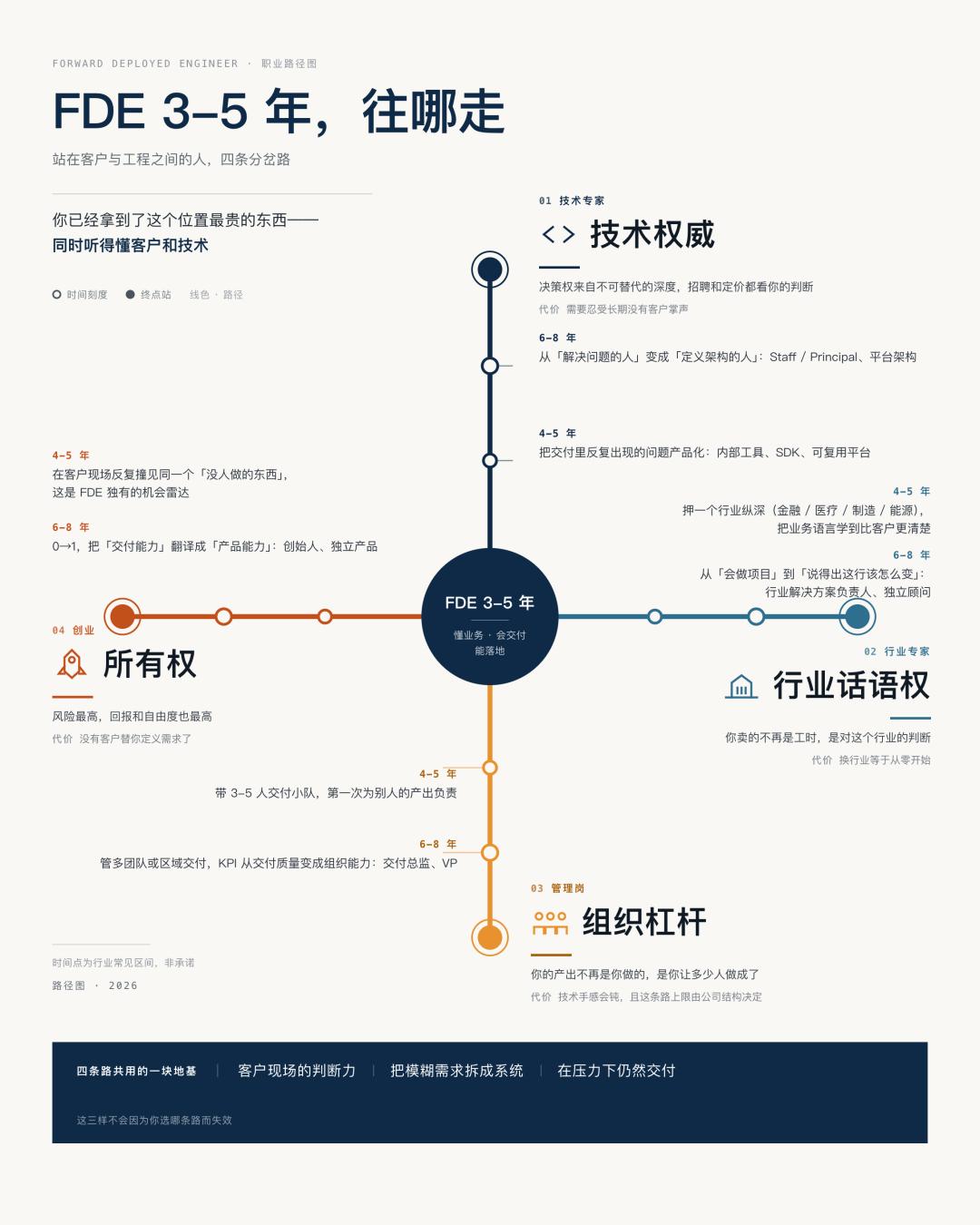
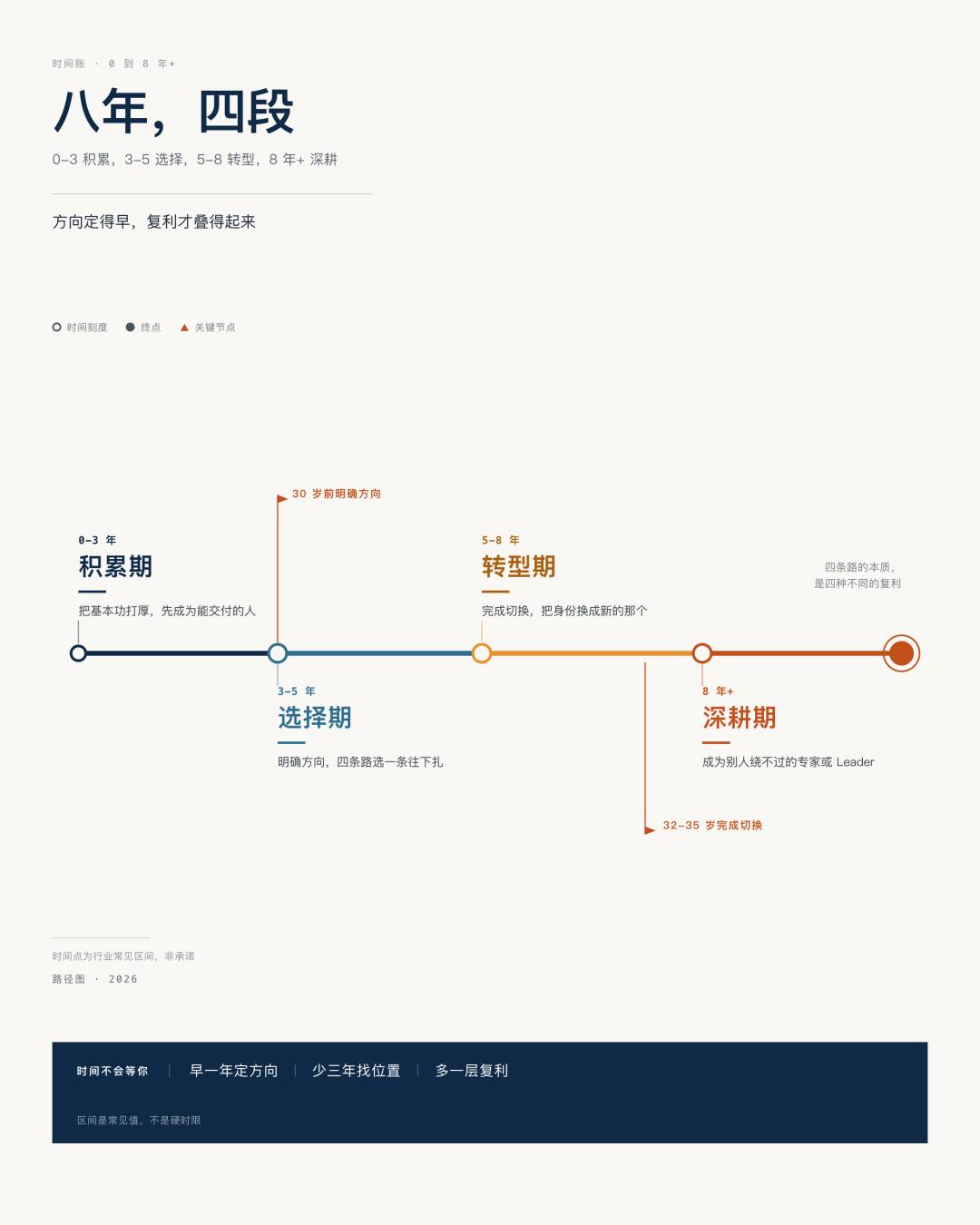
The industry report from Alibaba Cloud states: Frontline on-site delivery is suitable for the accumulation of 3-5 years of experience, and it is the golden stage to consolidate practical implementation capabilities. For long-term development, you need to gradually transform into a solution specialist, pre-sales architect, or team lead. The 3-5 year mark is the accumulation period. If you are still doing basic execution work such as system installation and parameter adjustment after 5 years, you will face two problems: your physical strength can no longer keep up, and the market does not need so many "skilled workers" with high labor costs.
Path 1: Technical Specialist
—— Become the "person called in to put out fires"
This path is the most straightforward.
When you work on projects on site, you find that you repeatedly solve problems in a certain technical direction, and you do it better than others. When other FDEs encounter such problems, they will come to ask you for advice. You start to realize that you are more interested in "writing code to solve technical problems" than "talking with clients about their requirements".
This is the right time to make the switch, which usually comes at the end of the 3-5 year accumulation period.
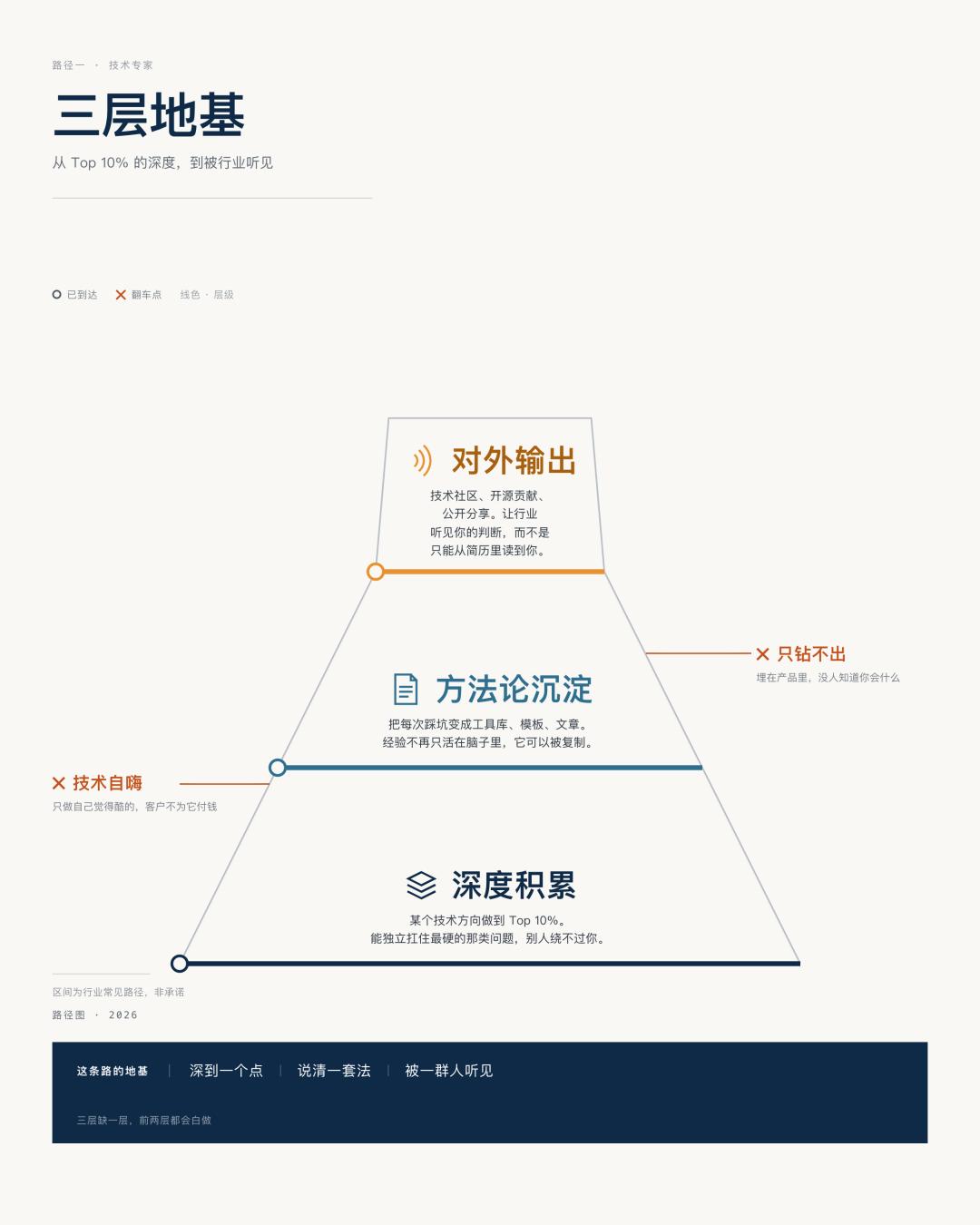
To take this path, you need in-depth expertise: rank among the top 10% in the industry in a specific technical direction. You can choose RAG retrieval optimization, Agent workflow design, MLOps infrastructure, or multimodal implementation, pick a direction that you are both good at and interested in, and then build up experience in this direction in every subsequent project.
More importantly, you need to precipitate your capabilities: refine the technical problems you solve on site every time into reusable methodologies, tool libraries or articles. After you solve a problem of insufficient RAG retrieval accuracy at the client site, you can't just leave it at that. You need to write down what methods you used, why they worked, and how to reuse them when encountering similar problems next time. This precipitation process is the watershed that separates you from a "skilled worker" to a "specialist".
The third point is external output: write technical blogs, share on technical communities, and contribute code to open source projects. Let the market know that "this person is very strong in this technical direction", so that when someone encounters such problems, they will think of you.
I have met an FDE who accumulated more than 30 client cases in the direction of RAG retrieval optimization, precipitated hybrid retrieval, Rerank, and evaluation methods into an internal tool library, and was later promoted to Principal FDE, specifically responsible for tackling complex retrieval problems. His work is no longer "on-site delivery", but "being called in to put out fires" — when a project is stuck with low retrieval accuracy, he can solve the problem in just two weeks after he arrives.
Path 2: Industry Specialist
—— Become the "indispensable person in this industry"
This path is completely opposite to the technical specialist path: your value lies in how well you understand a certain industry.
When is the right time to take this path?
Usually, after you have completed more than 3 consecutive client projects in a certain industry (healthcare, finance, manufacturing, retail, government affairs), you can start to predict what problems clients in this industry will encounter, and even know what they need before they put forward their requirements.
Your value shifts from "solving technical problems" to "understanding industry pain points and solving them with technology".
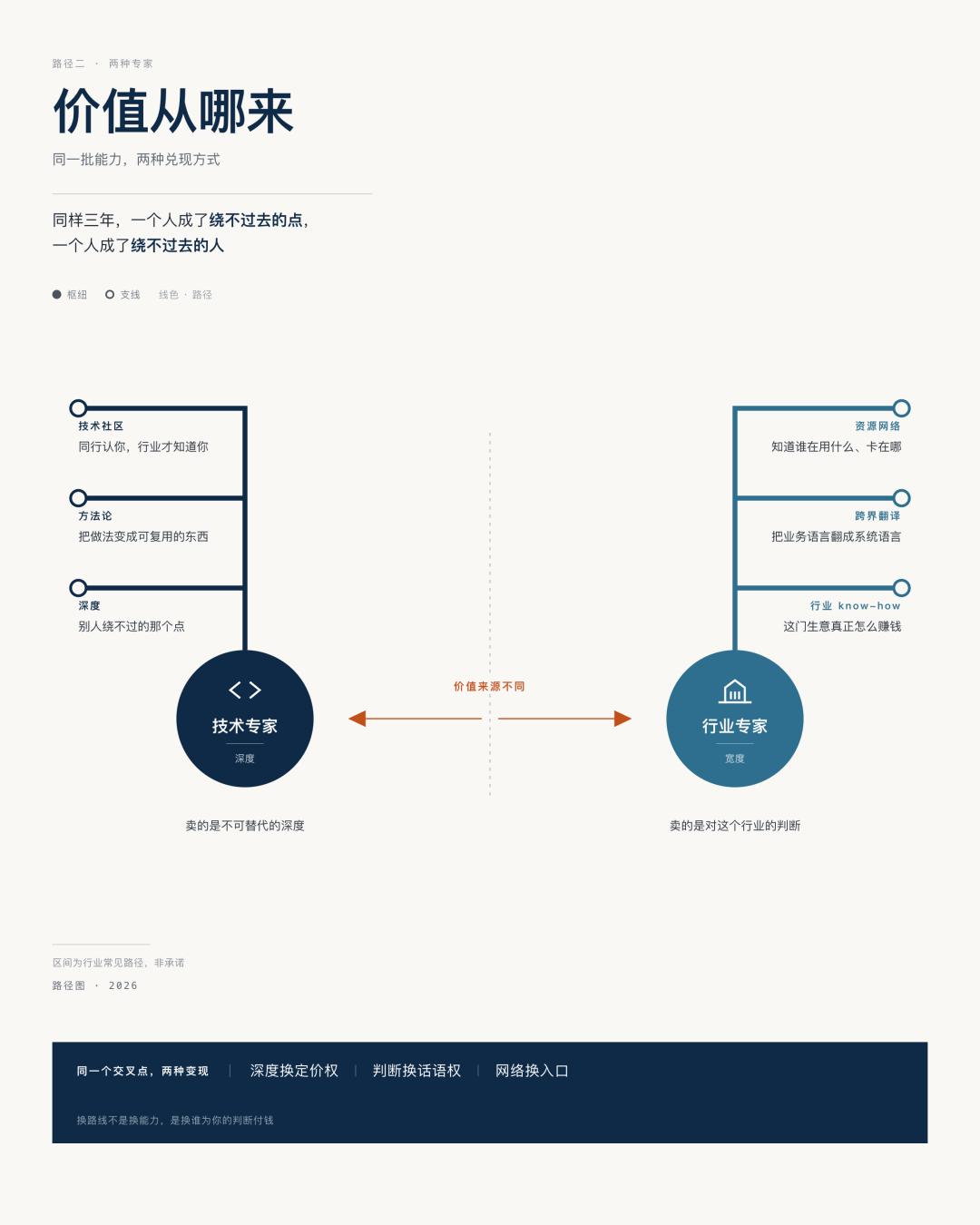
The first required capability for an industry specialist is industry know-how.
For example, if you choose the healthcare industry, you need to know what systems such as HIS, EMR and PACS are for, what the real working process of doctors and nurses looks like, why hospital data cannot be called arbitrarily, which links have the most severe pain points, and which links can generate profits. All these can only be obtained by immersing yourself in the work site.
The second capability is cross-domain translation.
When the client says "our doctors spend two hours writing medical records every day", you need to realize that this means doctors have very high time costs, and AI can help them reduce repetitive work. Then you translate this requirement into a technical solution: use AI to extract medical record templates, automatically fill in basic information, and reserve key judgment parts for doctors.
The third capability is resource network.
After you have completed 10 hospital projects in the healthcare industry, you not only know the directors of the information departments of these hospitals, but also know several industry specialists in healthcare informatization, understand which vendors are reliable, which policies are coming soon, and which directions are traps. This network itself is of great value.
The biggest risk of this path is choosing the wrong industry.
If you choose an industry with too small market size or too low digitalization level, your career ceiling will be very low. For example, if you choose a very segmented traditional manufacturing industry where only 100 enterprises across the country have such demands, and each enterprise can only have one project per year, your ceiling will be fixed there.
When choosing an industry, you need to look at three indicators: whether the market size is large enough, whether the willingness to digitalize is strong, and whether the payment capacity is sufficient.
Another risk is the degradation of technical capabilities.
If you stay in the industry for too long, you will become an "industry consultant in FDE's vest" with degraded technical capabilities. You can understand the client's requirements, but you cannot implement the solution and have to ask other engineers for help. In this case, your value will be discounted — why don't clients directly find an industry-savvy consultant plus a tech-savvy engineer?
Path 3: Management Position
—— Shift from "I can get things done" to "I can make the team get things done"
This path is the leap from "doing things" to "leading people".
When is the right time to consider a management position?
Usually when you can independently control the whole process of complex projects, from requirement collection to delivery and post-project review. You start to take the initiative to help new employees review projects and sort out methodologies, and find that you enjoy "passing on your experience" to others. The company starts to let you participate in recruitment, training and project allocation for the FDE team.
This is the key node, which usually comes at 5 to 8 years of work experience.
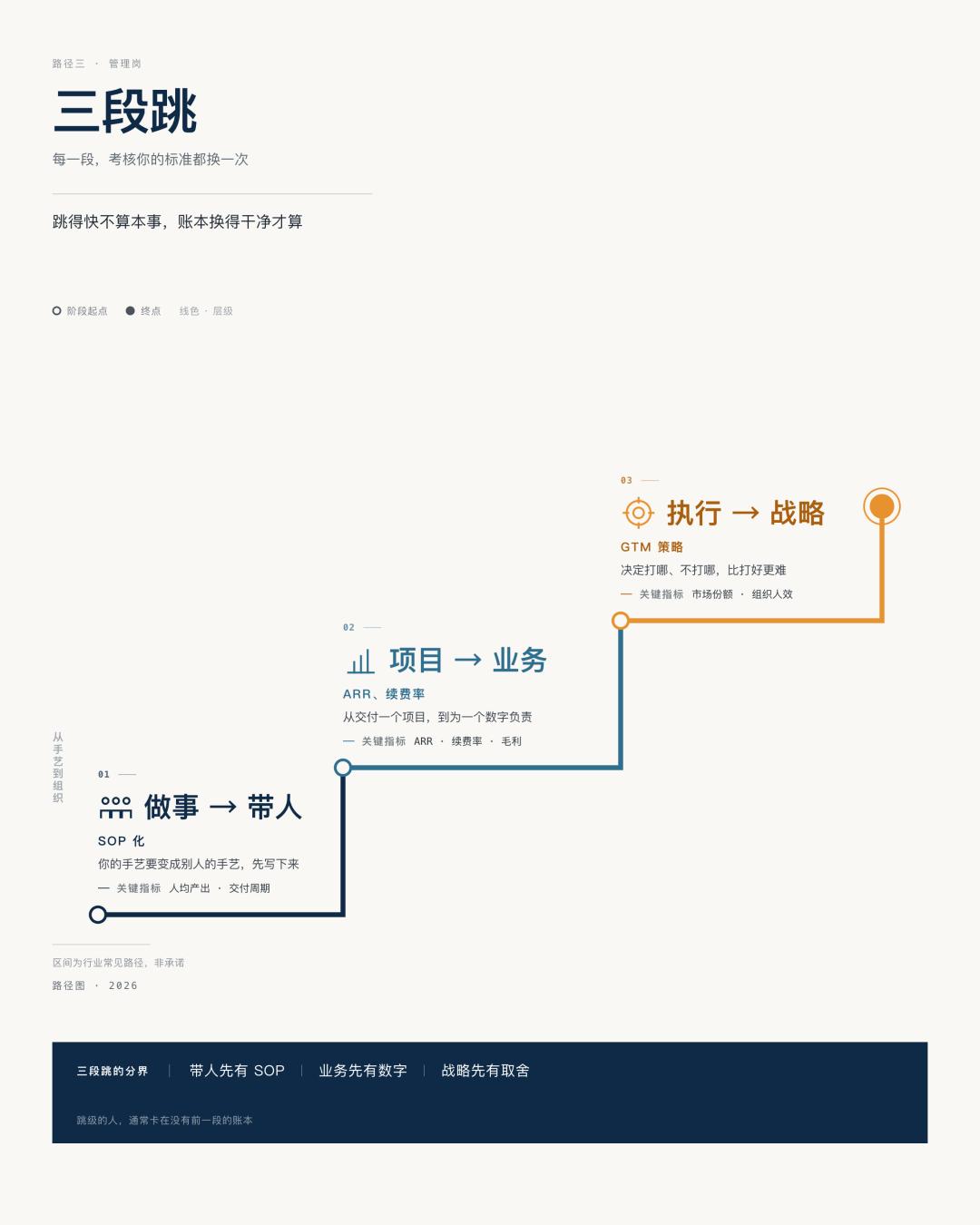
The hardest part of the management position is the transition from "doing things" to "leading people".
You can no longer do things by intuition. You need to turn things like "how to discover requirements", "how to write technical solutions" and "how to manage client expectations" into methodologies that can be taught to new employees. This process is very painful, because for many things you can do correctly by intuition, when you break them down into SOPs, you will find that "I don't know why it works, but it just does". At this time, you have to force yourself to figure out "why it works".
The second transition is from "project" to "business". Your KPI is no longer "how many projects you delivered this month", but "how much revenue the team can bring this year", "whether the client renewal rate can stay above 80%", and "whether the capabilities of team members have improved". This is a change of perspective: you need to start thinking about problems from a business perspective.
The third transition is from "execution" to "strategy". You need to start participating in the company's GTM strategy, deciding which industries to enter and which not to. You need to think about "which direction our FDE team should develop towards", "which clients are worth deep cultivation and which clients should be abandoned", and "what the team's capability model should look like".
The most common pitfall for management positions is being unwilling to delegate. You still rush to the front line to do projects yourself, and don't give new employees opportunities, as a result, the team's overall capabilities cannot be improved. This is the mistake most managers with technical backgrounds make: they think "it's faster for me to do it myself than to teach new employees to do it", and as a result, the team will always rely on them, and they can never get out of trivial work. The core capability of a management position is to make the team deliver projects successfully.
Another pitfall is staying away from the front line for too long. You become insensitive to technology and clients, and turn into a "manager who only knows how to hold meetings". When team members encounter technical problems, you cannot give valuable suggestions; when clients put forward new requirements, you cannot judge whether the requirements are reasonable. In this way, you will lose the trust of the team.
Path 4: Starting a Business
—— Highest risk, highest ceiling
The switching timing for this path is very clear: you find a pain point that "all clients have but no one has solved" during your on-site work, you already have 3 to 5 seed clients who are willing to pay for your solution, and you have a clear product direction and the first batch of clients in hand.
The core capability of starting a business is productization. After you have completed 10 client projects on site, you find that 80% of their requirements overlap, then this 80% part should be made into a standard product, and the remaining 20% is customized. If you cannot achieve this, you will become a "one-person outsourcing company" — every client requires customized delivery, and you will always be stuck in endless projects and can't scale up your business.
The second capability is business development. The most common failure mode for FDEs starting a business is "strong technical capabilities but weak business capabilities". You have to learn to sell products, negotiate contracts, manage payment collection, and control costs. If you are not good at these, it is recommended to find a partner with a sales background — he is responsible for selling the products, and you are responsible for developing the products. Business capabilities cannot be built overnight.
The third capability is risk tolerance. You may have no income at all in the first 6 months. Can your savings support you through this period? Does your family support you? You need to think clearly about all these questions before starting a business.
The most dangerous thing for starting a business is starting too early. You resign before you have accumulated enough client resources and industry connections, and as a result, you cannot find the first batch of clients. The suggestion from FDE-Wiki is: verify the MVP in your spare time, find 3-5 seed clients to pay for verification, and resign only when you have a clear product direction. Quitting your job blindly to start a business is a gamble.
Another pitfall is that you only know how to do projects but not how to make products. After you start your business, you find that every client has different requirements, and you are still doing customized delivery without precipitating standard products. As a result, you work very hard but your income cannot go up — because your time is limited, you can take at most 10 customized projects for clients a year.
The judgment criteria: do you have the confidence that "if I quit my job tomorrow, at least 3 clients are willing to follow me"? If not, first accumulate client resources and productization capabilities in your current position, and then consider starting a business.
The Essence of the Four Paths:
Shift from "Executor" to "Decision Maker" or "Specialist"
After reading the four paths, you may be wondering "which one should I choose"?
The answer is simple: see what you enjoy doing.
Technical specialists enjoy delving into technology and solving the most difficult technical problems.
Industry specialists enjoy understanding business and becoming trusted partners of clients.
Management position holders enjoy cultivating teams and watching new employees grow.
Entrepreneurs enjoy making their own products and serving more clients.
The essence of the four paths is the same: you need to shift from "passively responding to requirements" to "actively creating value".
Many FDEs think that as long as they work on the front line on site for 5 years, they can naturally transform into a technical specialist or industry specialist.
That won't happen.
If you only repeat execution, do not actively precipitate methodologies, do not output externally, and do not build industry connections, after 5 years you will only be a "skilled executor".
The market only cares about "how much unique value you can create".
Whether you are still working on site three years later depends on whether you want to — if you choose the industry specialist or management path, you may still be on site, but at that time you are a "needed specialist".
This is the difference.
This article is from the WeChat Official Account "Everyone is a Product Manager" (ID: woshipm), written by Wangshi Suifeng, and published with authorization from 36Kr.