The shadow battle among Chinese CXOs has advanced to the "seed round"
In 2026, an animal testing company began to invest capital in seed rounds.
Joinn Laboratories is one of the major players in China's non-clinical safety evaluation sector. It has invested a total of approximately 757 million yuan and 8 million US dollars in multiple funds and investment vehicles, including the Life Science Park Phase II Fund, Yifeng Mingyuan Seed Fund, Beinao Phase I Equity Investment Center, and Pablo Hill.
757 million yuan is not a large sum for a company with a market capitalization of around 10 billion yuan, but what matters is the stage where the capital is deployed: the seed round.
What does the seed round mean? A company at this stage may only have three team members, one patent, and a rented laboratory, with no tangible product to speak of. The mortality rate of projects at this stage is alarmingly high.
Why would a company that makes a living from testing fees take such a huge risk?
01
Safety assessment sits far at the downstream end of the industrial chain
First, let's clarify what kind of business the safety assessment industry is.
Before a new drug can be tested on humans, it must pass a critical checkpoint: it is tested on animals to measure its toxicity and determine the dosage level that causes adverse reactions. This checkpoint is called safety evaluation, commonly referred to as "safety assessment" in industry jargon. Without passing this step, no subsequent clinical trials can proceed at all.
This business occupies a very special position in the industrial chain. It sits far downstream in the entire journey of pharmaceutical companies: a firm must first identify the target molecule, complete pharmacological research, and resolve process-related issues before it reaches the safety assessment stage. If any preceding link gets stuck, no safety assessment order will be generated.
As a result, the revenue of companies like Joinn Laboratories naturally lags behind industry prosperity. When Biotech companies have sufficient financing, the number of safety assessment orders will only rise two years later; once financing cools down, the order book will see a noticeable gap after one and a half years.
This is an inherent deadlock of the service provider model: you are always waiting for others to reach your stage of the process.
Moreover, this stage has a very narrow pool of options. When pharmaceutical companies reach this point, there are only a handful of service providers for them to choose from, which seems like a good thing at first glance. But on the flip side, the number of projects that can reach this stage is inherently limited. Once the upstream capital flow dries up, no matter how stable your position is, it will not help.
The industry has already gone through such a cycle. Before 2021, China's innovative drug R&D investment rose steadily year by year, and CXO production capacity was scheduled two years in advance. Any company that expanded its production capacity could make profits, and orders could be sold out no matter how far in advance they were booked. After 2022, financing receded, and Biotech companies cut R&D spending first, then cut outsourced services. The impact of order cuts usually takes one and a half years to appear in CXO financial statements.
During those two years, almost all CXOs were talking about the same thing: how to shift their customer structure from Biotech companies to large pharmaceutical enterprises. However, the total number of orders from large pharmaceutical companies is fixed, while the number of competitors fighting for these orders keeps growing.
Joinn Laboratories' solution is to move its ecological niche upstream.
Almost all the funds it invests in are focused on early-stage projects, and some even go into the seed stage. This choice aligns highly with its safety assessment business: the earlier it gets in touch with teams working on CGT, ADC, nucleic acid drugs, and brain science, the more likely it is to secure subsequent toxicology, pharmacokinetics, and GLP safety assessment orders from these teams.
Haoyuan Chemexpress follows the same logic, but in a more upstream position. In 2026, it participated in BeiGene Wojie Innovation Fund and Chongqing Yudu Life Science Pilot Fund, and also built an external investment framework through an investment platform based in Hainan. Its main businesses, including molecular building blocks, tool compounds, CMC, and API intermediates, all belong to the most upstream segments of drug discovery, so it also needs to connect with teams at the earliest stage of development.
These two companies share one common feature in their capital layout: restraint.
They do not aim to turn their invested funds into profit centers, nor do they fight for the controlling stake of these funds. They only treat capital deployment as a radar. The radar does not generate profits; its function is to detect potential opportunities.
Become a shareholder of the customer before the customer officially becomes your client. This is the most plain motivation for this round of CXO capitalization.
02
Three levels of betting depth
Even though all these companies make investments, their investment approaches vary greatly. Let's first look at which stage each of the six companies is positioned at.
WuXi AppTec has the broadest business scope, covering the full pipeline from drug discovery, preclinical research, clinical trials to commercial production, and accepts all types of orders; Tigermed only focuses on clinical services, connecting hospitals, sponsors, and regulatory authorities; Pharmaron extends its business from laboratory services to CMC, macromolecule drugs, and clinical research; Asymchem focuses on small molecule CDMO, and has only expanded its business to peptides, ADCs, and synthetic biology in recent years; Joinn Laboratories only engages in safety assessment; Haoyuan Chemexpress is positioned even further upstream at the molecular building block segment.
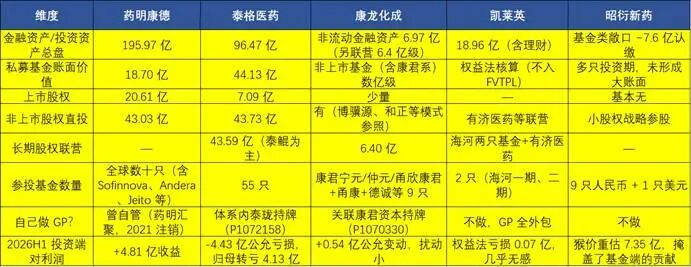
The stage where a company is positioned determines how far it is separated from its customers, and also determines how deep it is willing to go in capital deployment.
The shallowest level is to act solely as a limited partner (LP). To put it plainly, this means only providing capital without participating in management, entrusting the funds to professional fund managers, and holding a corresponding share of the fund. Joinn Laboratories, Haoyuan Chemexpress, and Asymchem are generally at this level.
Asymchem's approach is more targeted. Through its series of Haihe Asymchem funds, it exclusively invests in innovative drugs, synthetic biology, and other directions related to its own business, and the listed company entity does not act as the general partner (GP). What it pursues is not financial returns, but customer cultivation: if a small company obtains financing from its fund today, it will naturally place orders for scale-up production of small molecules, peptides, and ADCs with Asymchem tomorrow.
The intermediate level is that the listed company acts as the LP, while its affiliated platform acts as the GP. Pharmaron adopts this structure: the listed company entity provides capital, while its subsidiary Pharmaron Capital manages funds and makes investment decisions in multiple funds. Its synergy scope covers laboratory services, CMC, macromolecule drugs, and preclinical research, which is wider than that of Joinn Laboratories, but its cases of direct investment and exit are not as rich as those of Tigermed.
The deepest level is to cover all three roles: LP, GP, and direct investor.
Tigermed has gone the farthest down this path. It has invested in more than 50 funds, and manages large-scale industrial funds such as the Tai Kun Fund through its subsidiary Tailong Investment, forming a complete "LP+GP+direct investment" system. By the end of 2025, its investment portfolio covered more than 200 companies and over 50 funds, with a book value close to 10 billion yuan.
WuXi AppTec has made this layout more cross-border. It has participated in European funds such as Jeito II, BioDiscovery 7, and Sofinnova, and has also incubated domestic innovative drug companies through its affiliated fund Tonghe Yucheng. Tonghe Yucheng later became an independent market-oriented institution, but it still maintains close ties with WuXi AppTec's CRDMO platform. This layout is less of a financial investment, and more of a global project filter: every segment from molecular research to commercial production can connect to its own production capacity.
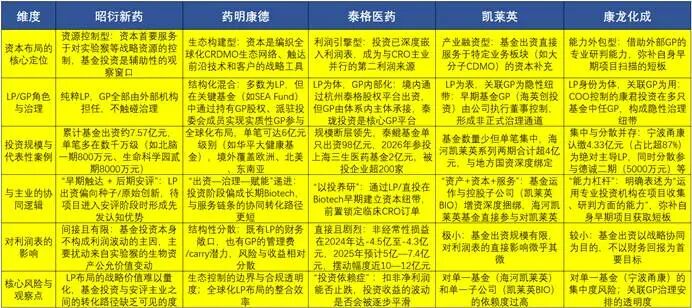
Why is there such a big difference in the depth of their investment?
Because their positions are different. Safety assessment sits at the narrowest entrance of the industrial chain, so it can only explore a little bit upstream, and exploring too far will not bring any benefit; CDMO focuses on scale-up production, and it is enough to cultivate customers to the point where they can place orders; clinical CRO is closest to commercialization, and once a project enters the clinical stage, every subsequent phase will generate revenue, so it is worth heavy investment; platform-based companies can provide all types of services, so they want to access all types of projects, and naturally expand their layout to the maximum scope.
The six companies have not converged into the same model. Their capital layouts are almost all one step further upstream along the stage of their core business.
03
Between capital and orders
The companies that have taken the most determined steps are the first to face the corresponding costs.
In the third quarter of 2026, Tigermed's non-recurring net profit reached 450 million yuan, but its attributable net profit recorded a loss of 272 million yuan.
The core business made a profit of 450 million yuan, but the financial statements showed a loss of 272 million yuan. The gap of more than 700 million yuan comes from the investment side.
This is the cost of heavy investment. When you hold a large number of equity stakes in biomedical companies, these stakes act as a profit amplifier when the industry valuation rises; once the industry cools down, the same batch of equity stakes will turn into a profit black hole. This has nothing to do with the core business: laboratories remain open as usual, projects are delivered as scheduled, and payments are collected normally, but an additional impairment loss needs to be recorded on the book.
The term "fair value change" sounds complicated, but to put it plainly: at the end of the year, revalue all the equity stakes you hold at the market price. Record the increase as profit and the decrease as loss, even if you have not sold any of the stakes.
WuXi AppTec also has considerable exposure to such investments, following the same logic.
Therefore, the first major risk of this business model is that operating risks are replaced by capital risks. In the past, CXOs only bet on one thing: whether they can secure orders. Now they have to bet on another thing: how the industry's valuation will trend in the next three years, and no one can control this second factor.
The second major risk is exit. Once you invest in a fund, you have to exit eventually. There are only three possible exit paths: IPO, merger and acquisition, and secondary share transfer. The accessibility of these three paths is directly linked to the market sentiment of the innovative drug secondary market. When the exit cycle is extended, the assets on the book will become stagnant capital, which looks rich but cannot be cashed out.
The most easily overlooked point is that becoming a shareholder does not equal getting the order.
The invested company can still outsource its clinical services to other providers even after receiving your investment, or directly terminate the project due to poor financing conditions.
The capital tie can shorten the distance of getting to know each other, but it cannot shorten the distance of service delivery.
There is also a more sensitive line: related party transactions.
Asymchem was once inquired by regulators about its investment in the SinoVision project, which is a typical case. If a company holds equity in a customer and also sells services to that customer, regulators and the market will raise questions about how the price is determined, who makes the decisions, and whether the company has relaxed conditions to inflate revenue.
This does not mean that this structure is problematic. Industrial capital investing in its own customers is a common practice worldwide, and the logic is completely valid. But it requires two things: transparent pricing and independent decision-making. If either of the two is missing, the market will question the fairness of the transaction.
There is another layer of risk: management attention. Post-investment management, project screening, and attending LP meetings all take up the management team's time. After all, the foundation of CXOs lies in production capacity, service delivery, and customer trust. Capital layout can expand the field of vision, but it cannot replace the core business. When there is a conflict between the two, the side that requires long-term, painstaking effort often ends up losing out.
04
Some invested companies will grow, others will not
Let's go back to the question at the beginning: why would an animal testing company invest in seed rounds?
Because it wants to detect opportunities at an earlier stage. The earlier you spot a potential customer, the more likely you are to be on their candidate list before they decide who to choose for their safety assessment needs.
But there is still a long way to go between spotting an opportunity and actually securing the order. There are no shortcuts on this road, only delivery quality, delivery speed, and the willingness of the customer to choose you again next time.
Essentially, this round of capitalization of Chinese CXOs is moving the business relationship one step upstream: changing from the model of "you come to me" to "I am already here waiting for you". This move is reasonable in the current context, because the R&D source of innovative drugs is getting earlier and earlier. If you only get to know the customer when they enter the clinical stage, they have already chosen their service provider.
But it also adds a new variable to the financial statements. In the past, when evaluating CXOs, people only looked at orders, capacity utilization, and gross profit margin; now they also have to look at investment exposure, exit rhythm, and fair value changes. The same profit statement now mixes two types of income with completely different natures.
This is not a bad thing, but it requires readers of the financial statements to be more careful.
When Joinn Laboratories invested 757 million yuan, there was no immediate extra gain on its book. The real return will only come when those small companies with only three team members grow up, and reach the stage where they need safety assessment services.
Some of them will grow up. Others will not.
This article is from the WeChat Official Account "Yi Yao", written by Yan Song, and published with authorization from 36Kr.