Uber: Its ride-hailing "leg" has slowed down, can its food delivery "leg" hold up?
Uber (UBER.US) released its Q3 2026 earnings report before the US Eastern time market opened on November 4. The overall results were mixed: core gross bookings slightly missed expectations, with ride-hailing performance weaker as usual while food delivery delivered stronger results; on the profit side, the situation reversed, as ride-hailing margin continued to rise while food delivery margin declined. The details are as follows:
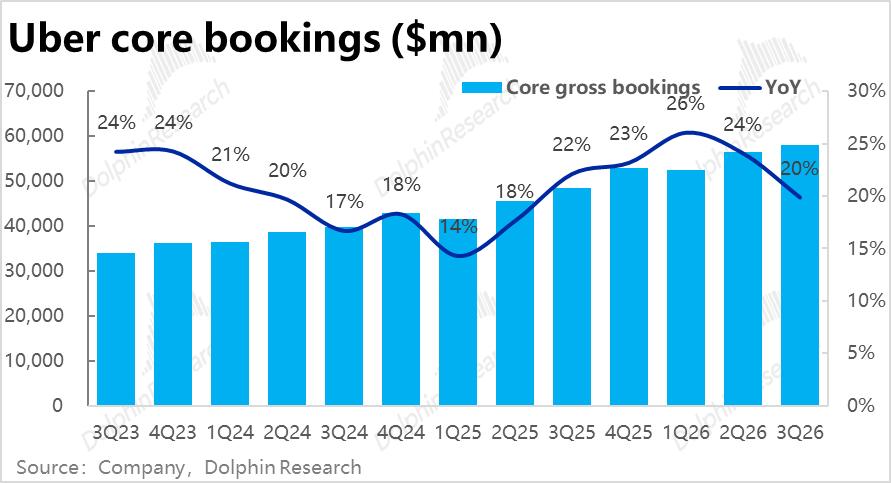
1. Core Gross Bookings: Slowdown in volume growth is the main drag, price increase partially offsets part of the impact
Total gross bookings reached USD 59.8 billion, up 20% year-on-year at constant exchange rates, which was basically in line with market expectations, but slowed down by about 2 percentage points compared with the previous quarter. Excluding freight, the core gross bookings of ride-hailing plus food delivery were about 0.4% lower than expected.
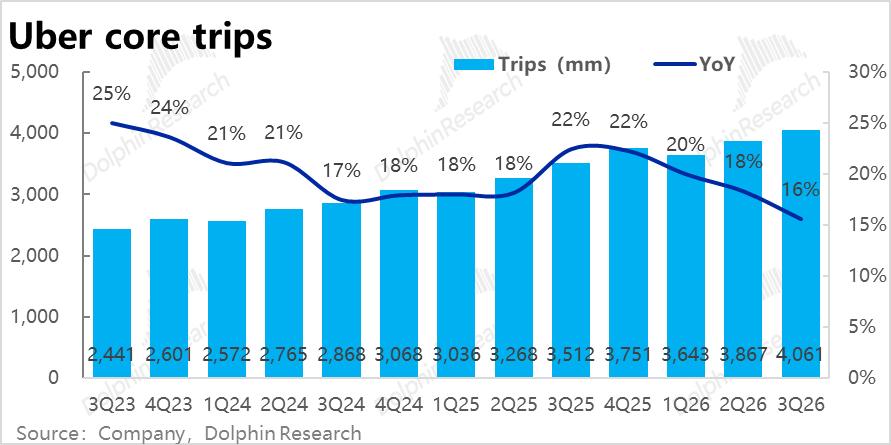
From the volume and price split perspective, the slowdown of core gross bookings (food delivery + ride-hailing) is mainly dragged down by volume. Total orders increased by 16% year-on-year, nearly 3 percentage points slower than the previous quarter, marking three consecutive quarters of slowdown. Correspondingly, monthly active users increased by 14% year-on-year this quarter, also seeing three consecutive quarters of declining growth rate; the volume slowdown is due to the deceleration of new user acquisition.
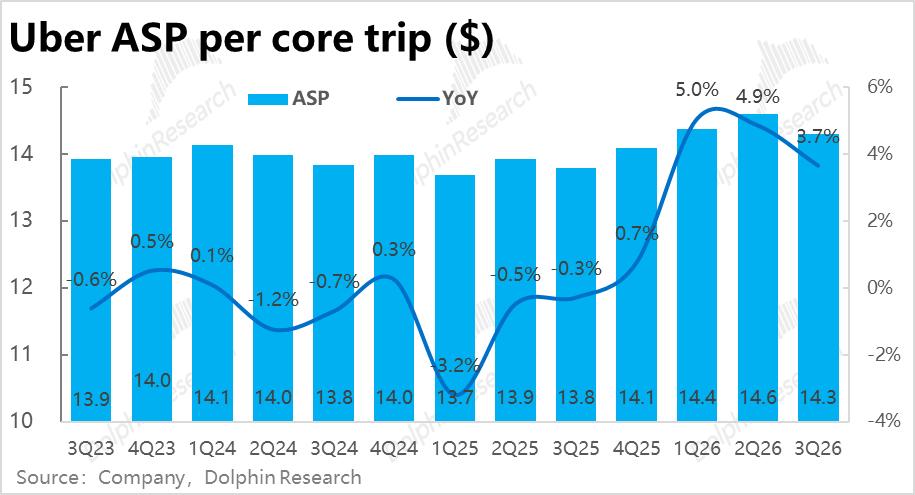
On the price side, average order value increased by 3.7% year-on-year, offsetting part of the drag from volume. The company emphasized that this is mainly due to structural changes: orders are tilting towards the US market, food delivery business and high-end ride-hailing services with higher per-order value, while corporate travel (up about 50%) and grocery retail (up about 40%) also recorded faster growth.
The company's explanation for the slowdown is: half of the reason is the shortage of ride-hailing drivers in multiple overseas markets (India, Brazil, etc.), and the other half is that the Turkish Trendyol Go acquired in the middle of last year has entered the year-on-year base, reducing the pulling effect on the growth rate of food delivery orders.
2. Ride-hailing: Gross bookings and revenue both missed expectations
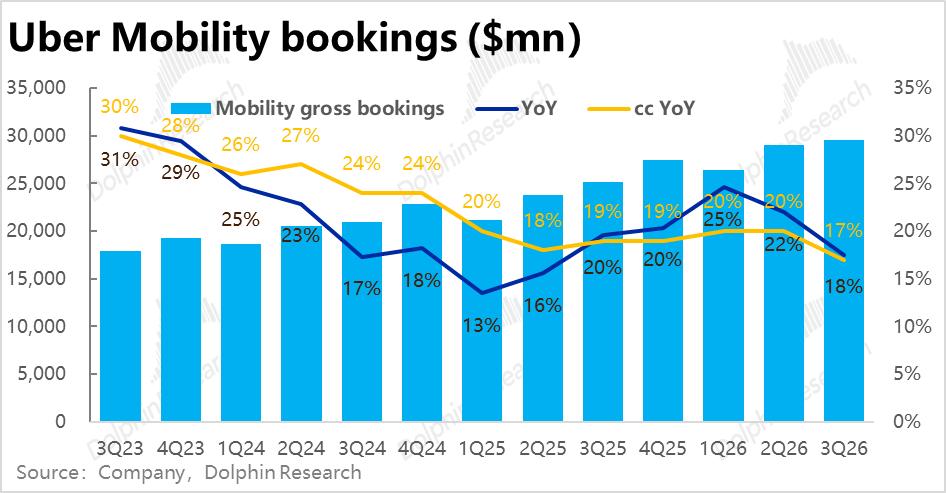
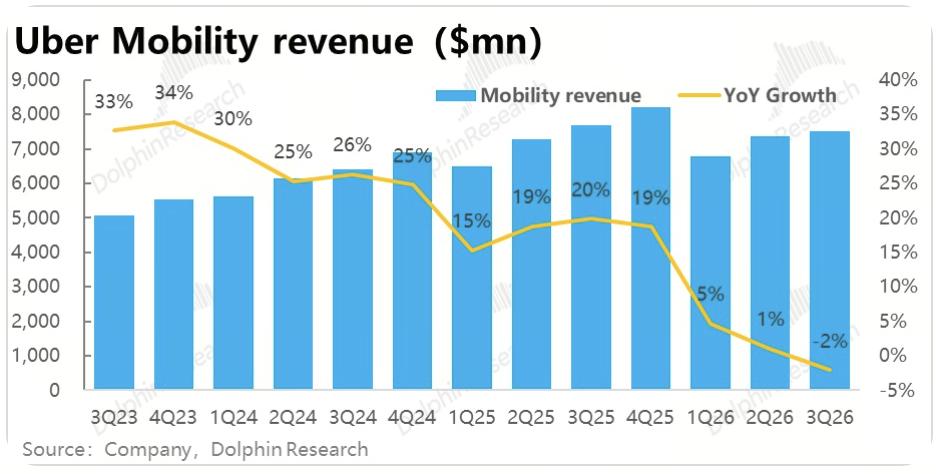
Ride-hailing gross bookings reached USD 29.5 billion, up 17% year-on-year at constant exchange rates, about 3 percentage points slower than the previous quarter, about 1% lower than market expectations. The segment revenue was USD 7.5 billion, also 2.3% lower than expected.
Revenue fell by about 2% year-on-year, and the negative growth is still mainly caused by the caliber adjustment of the UK business (driver compensation was changed from operating cost to revenue deduction, which dragged the monetization rate by about 350 bps this quarter). But this adjustment was already included in market expectations. Therefore, the underperformance against expectations is still due to the weak order growth itself.
According to management's explanation, the weak performance of ride-hailing lies in the supply side: rising oil prices, tight local labor market, and drivers being poached by other platforms; the US region only slowed down slightly, and the dividend from insurance fee reduction still exists.
3. Food delivery: Gross bookings are solid, but monetization rate is trending down
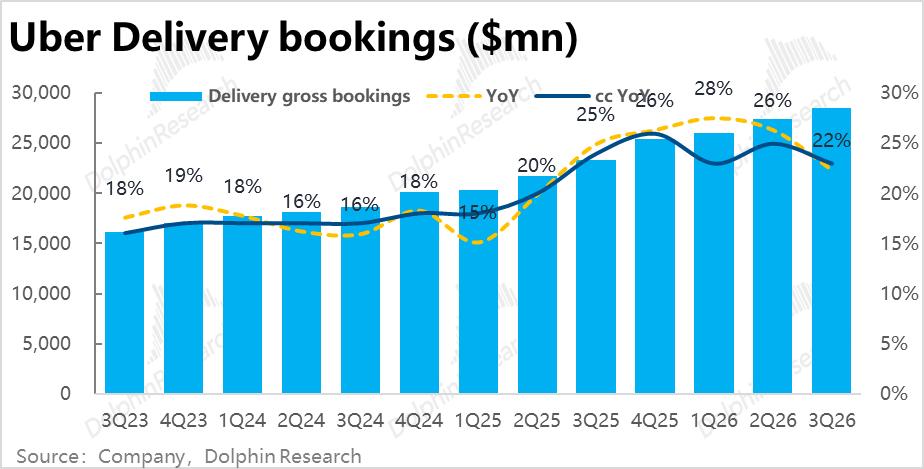
Food delivery gross bookings reached USD 28.5 billion, up 23% year-on-year at constant exchange rates, about 2 percentage points slower than the previous quarter, but slightly exceeded expectations. Trendyol Go acquired last year has entered the year-on-year base, and its pulling effect has faded. However, there are newly consolidated Getir (delivered in the third quarter) and Careem (consolidated at the end of July) this quarter, but their scale and impact are limited.
According to management, excluding the impact of mergers and acquisitions, the organic growth rate of the business is still accelerating.
In terms of driving factors, first, grocery retail increased by about 40% year-on-year, maintaining high growth for consecutive quarters, and Costco has become one of the top merchants on the platform by gross bookings; in addition, the core catering business itself is also accelerating. The biggest challenge at present is whether rider supply can keep up with demand.
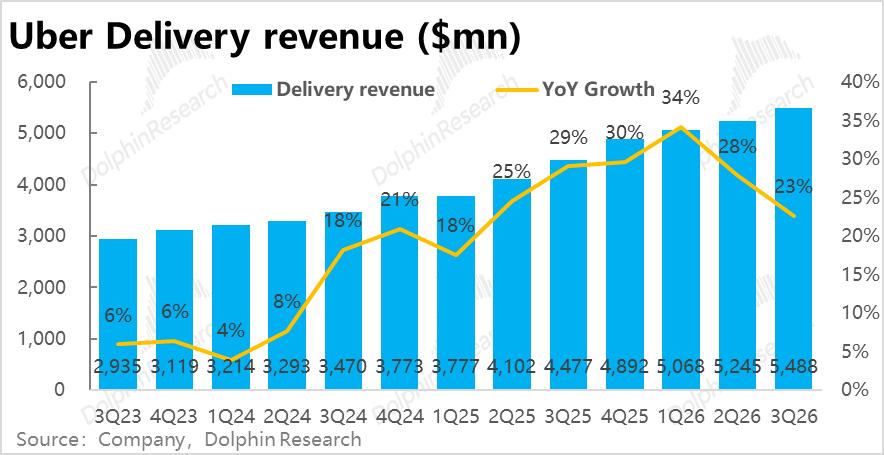
However, while gross bookings performed well, food delivery revenue was 0.5% lower than expected, which was mainly dragged down by the year-on-year flat monetization rate that was lower than expected. Combined with the company's explanation, the underlying reason should be the increased investment in cost-effectiveness, and the increased user subsidies offset revenue.
4. Freight: Revenue far exceeds expectations, but the impact on the overall situation is limited
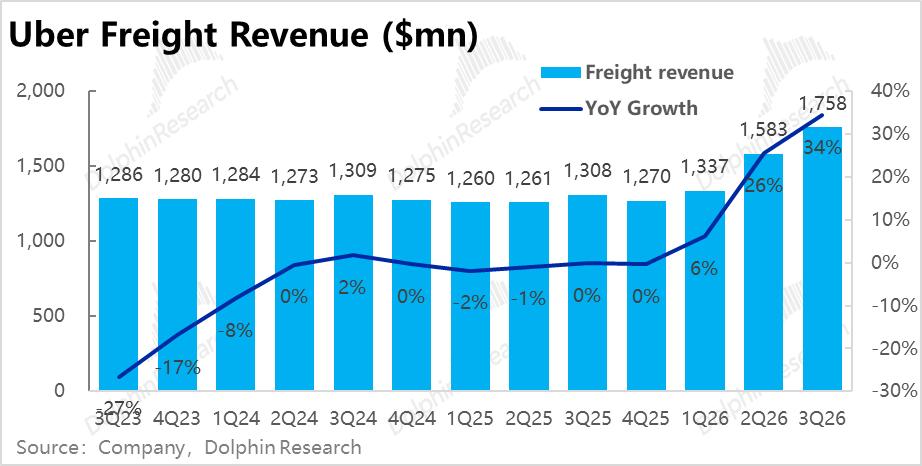
Freight revenue reached USD 1.76 billion, up 34% year-on-year, about 23% higher than expected, accelerating for the third consecutive quarter. The company said that on the one hand, demand from large enterprise customers is high; on the other hand, it is expanding its European business and using AI to improve efficiency and reduce costs.
However, freight only accounts for about 3% of total gross bookings, and operating profit still recorded a loss of about USD 33 million, which is roughly in line with expectations, with limited impact on the overall performance.
5. Segment profit performance: Ride-hailing margin hits new high, food delivery margin declines quarter-on-quarter
Contrary to the growth pattern where food delivery outperforms ride-hailing, the profit side sees ride-hailing stronger than food delivery.
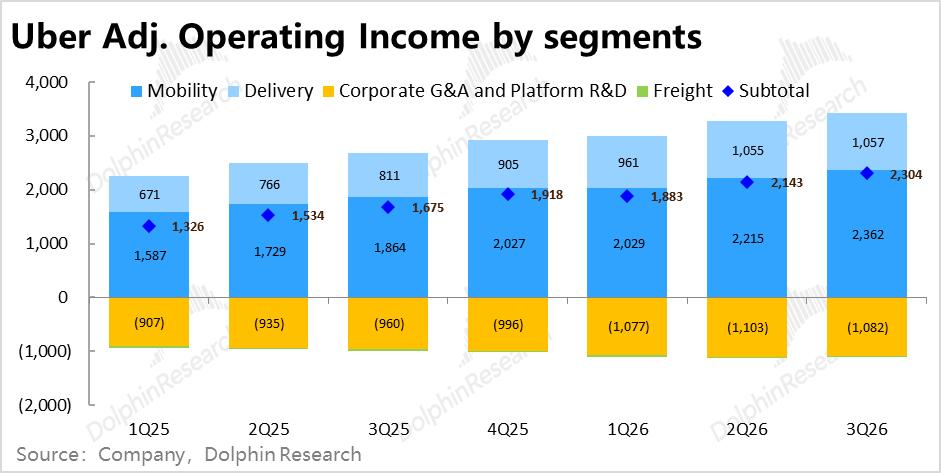
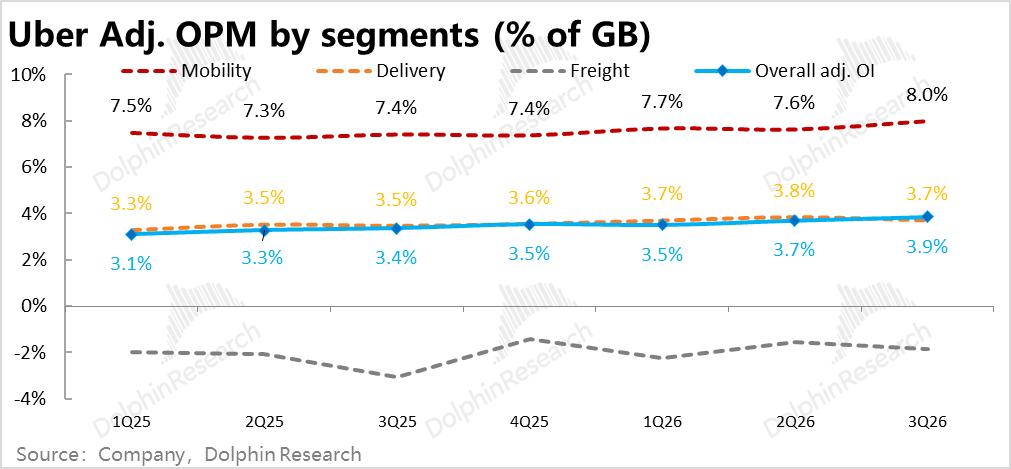
Ride-hailing segment operating profit reached USD 2.36 billion, about 5% higher than expected, with a margin (as a percentage of gross bookings) of 8.0%, up about 0.4 percentage points quarter-on-quarter, hitting a new high. Dolphin Research speculates that this is mainly due to the cost reduction brought by the US insurance reform, and the rising proportion of high-profit US orders and high-end orders, which offsets the impact of increasing subsidies.
Food delivery segment operating profit reached USD 1.06 billion, about 4% lower than expected, with a margin of 3.7%, down about 0.1 percentage points quarter-on-quarter. Dolphin Research speculates that this may also be caused by rising subsidies and the low margin of newly consolidated Getir and Careem.
6. Costs, expenses and overall profit: Expense growth rate is much slower than gross bookings, supporting margin
Gross profit reached USD 6.4 billion, about 2% lower than expected. Gross margin was 43.5%, up about 3.7 percentage points year-on-year, but this is mainly affected by the UK caliber adjustment. Calculated as a percentage of gross bookings, gross margin is about 10.7%, which is basically flat with the same period last year.
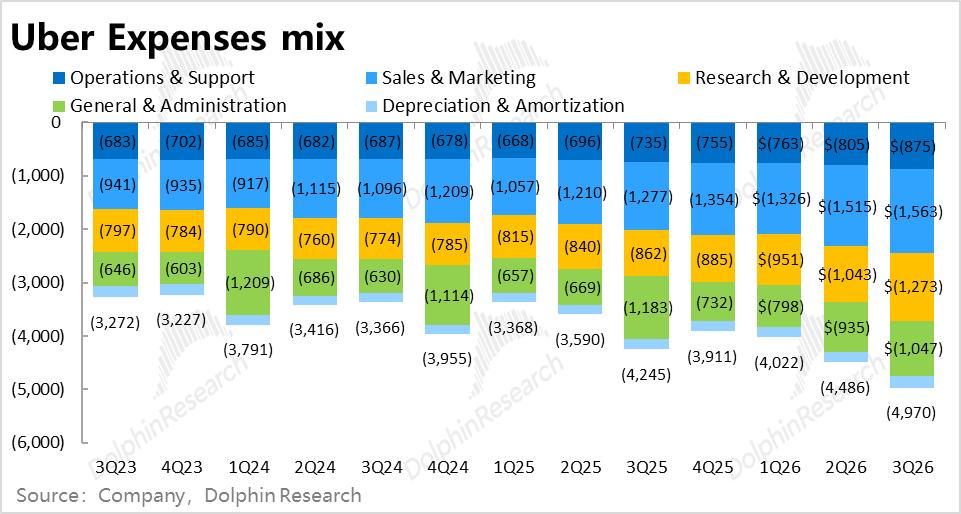
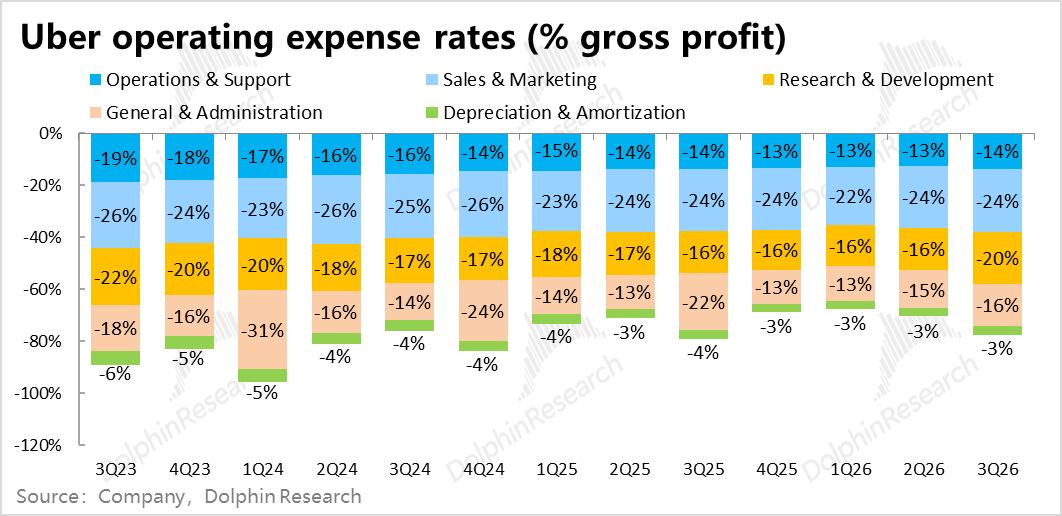
The improvement of margin mainly relies on the expense side. Due to the impact of one-time expenses this quarter, we focus on adjusted operating expenses, which reached about USD 3.45 billion this quarter, up only about 11% year-on-year, and the proportion of gross bookings decreased by about 0.5 percentage points year-on-year.
GAAP operating profit was USD 1.45 billion, which at first glance was about one third lower than expected, because about USD 860 million of one-time expenses were included: USD 480 million in legal and regulatory expense provisions, USD 190 million in layoff and restructuring expenses, USD 55 million in M&A related expenses, etc. Excluding this part, the actual profit slightly exceeded expectations.
Free cash flow this quarter was about USD 2.5 billion; but share repurchases were only USD 750 million, about half of that in the same period last year, as funds were prioritized for mergers and acquisitions.
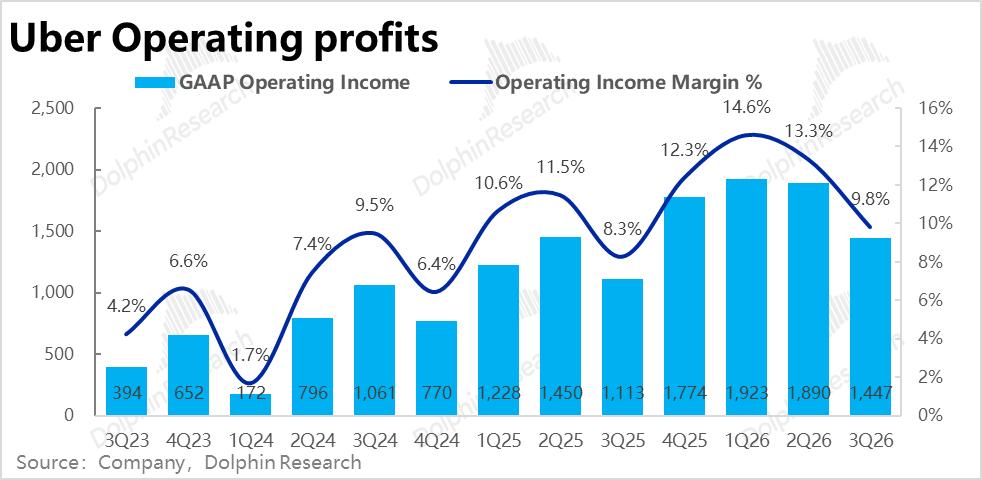
7. Overview of core indicators
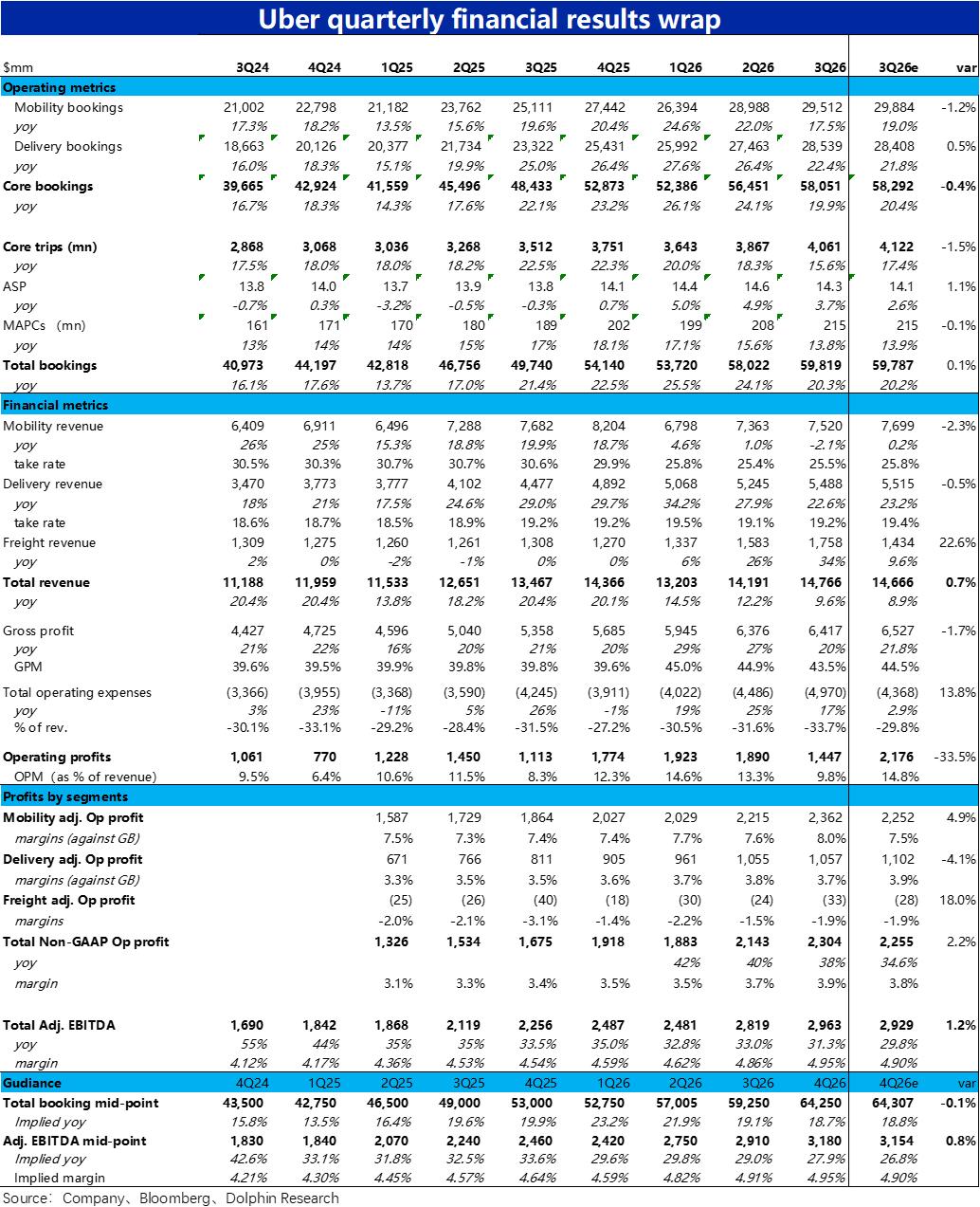
Dolphin Research Views:
1. This quarter's performance: Growth is decelerating, while margin provides underlying support
The problem with this set of performance lies in growth, especially in the ride-hailing segment: order volume and monthly active users have slowed down consecutively, and the Q4 guidance did not give any signal of re-acceleration. Although the company stated that the slowdown of ride-hailing is mainly due to insufficient driver supply overseas, it will inevitably intensify market concerns about the competition from autonomous driving.
On the bright side, the food delivery business that the company currently values more delivered solid growth, and the organic growth of grocery categories plus the external growth brought by mergers and acquisitions can be regarded as supported by "two legs". However, possibly due to heavy investment, the margin performance of food delivery is not good, which is after all a fly in the ointment.
Overall, against the background that the valuation is suppressed by the threat of autonomous ride-hailing, this set of performance cannot be regarded as a plus, but it also does not falsify the company's still decent fundamentals.
2. Outlook for subsequent performance: Gross bookings guidance is slightly lower than expected, profit is slightly better but growth rate is decelerating
In terms of future outlook, let's first look at the company's quantitative guidance:
Q4 gross bookings is guided at USD 63.25 billion to 65.25 billion, representing a year-on-year growth of about 19% at the midpoint, continuing to slow down compared with this quarter and slightly lower than expected. Management explained that exchange rate dragged down by about 1 percentage point, and the escalation of conflicts in the Middle East during the peak tourism season added another 1 percentage point of drag. Calculated at constant exchange rates, the midpoint growth rate is flat with that of the third quarter.