Coherent: Achieving both revenue growth and profitability, keep sprinting full speed toward the light?
Coherent released its FY1Q27 earnings results on the early morning of November 5 Beijing time (after US stock market hours). The overall impression from Dolphin Analyst is positive, as the company continued its steady operation, and the upward adjustment of long-term gross margin guidance boosted market confidence, driving its stock price up 8% after hours.
However, the company's market capitalization has evaporated by more than 50% from its peak in half a year. Combined with its fundamentals, can this financial report win the favor of capital?
1. Revenue: Solid performance within expectations
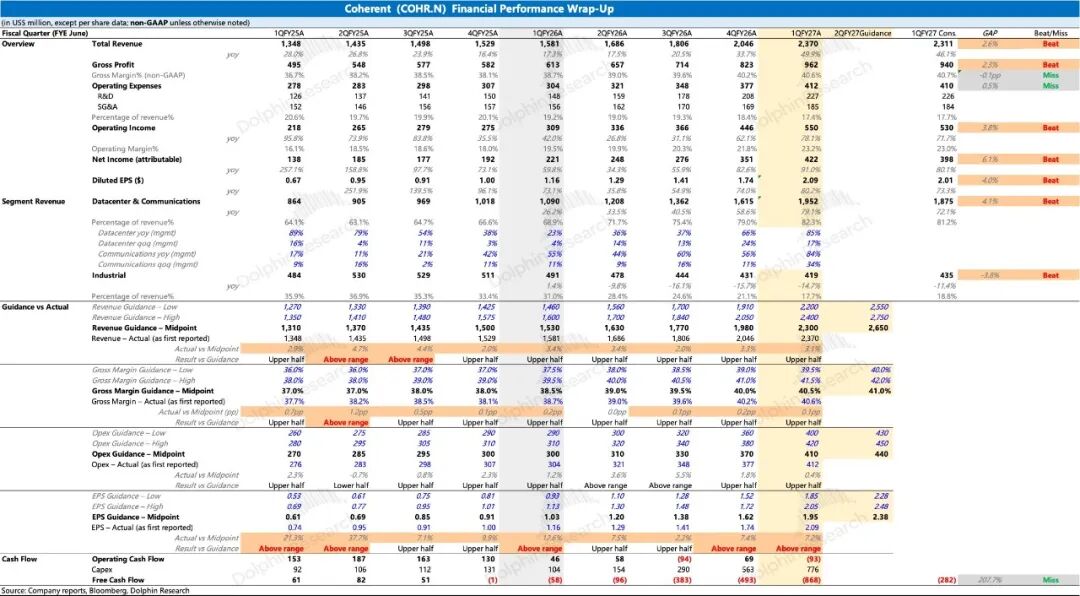
Total revenue reached USD 2.37 billion, up nearly 50% year-on-year and about 16% quarter-on-quarter. As always, the figure fell in the upper half of the company's guidance range (3.1% higher than the midpoint of the guidance), and the revenue structure is also accelerating to tilt towards the data center and communications sector.
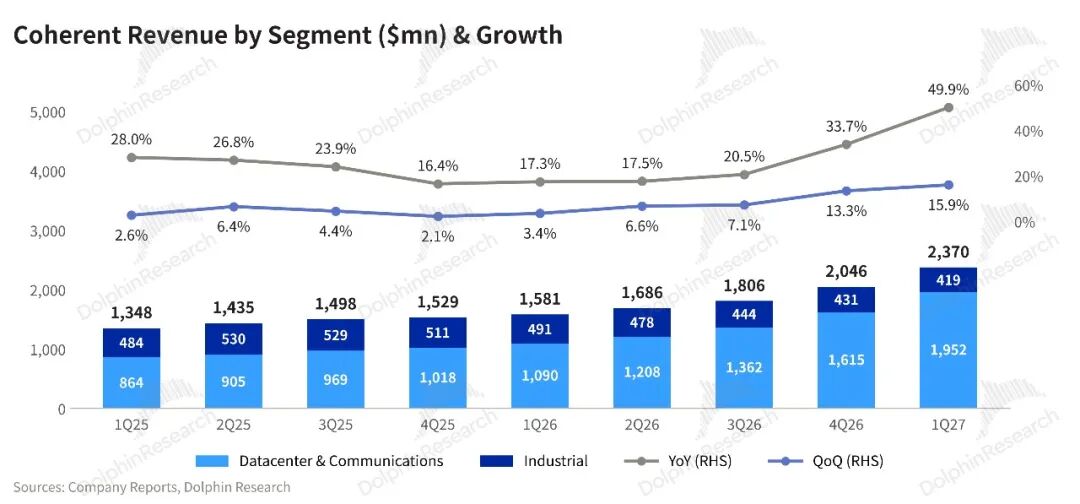
Revenue from the data center and communications segment hit USD 1.95 billion, up 79% year-on-year, 4.1% higher than the consensus expectation, and its proportion in total revenue rose to 82% (79% in the previous quarter). The details are as follows:
- The growth rate of the data center business was delivered, rising 85% year-on-year, fulfilling the management's previous target of over 80%. In terms of optical modules, 1.6T products have been rolled out in volume at multiple customers, the revenue of optical modules in the next quarter will see strong growth driven by both 1.6T and 800G products.
- The communications business grew 84% year-on-year, mainly from Data Center Interconnect (DCI)/Scale-Across, while the traditional telecom business also maintained growth. The revenue of Scale-Across/DCI (AI-driven) exceeded USD 200 million this quarter, about 4 times year-on-year, with an annualized revenue of about USD 1 billion. The company expects that by the end of CY27, its quarterly revenue will double compared with Q1, implying an average sequential growth of about 15% in the following five quarters.
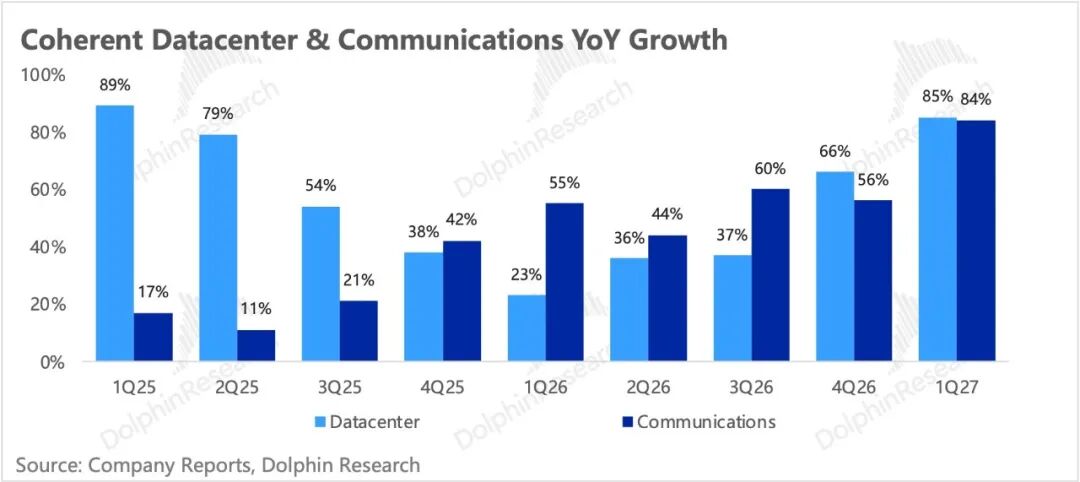
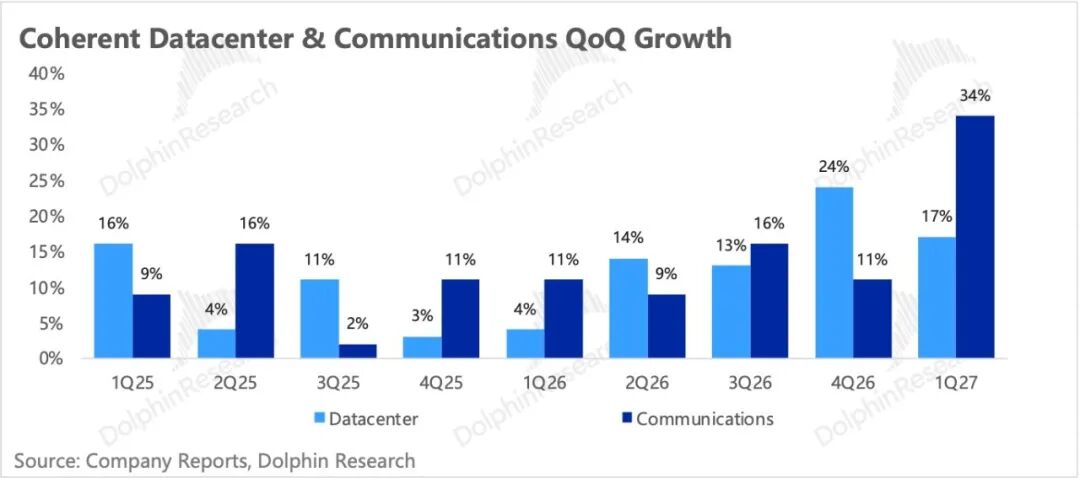
The company's guidance indicates that demand remains strong, and both the data center and communications business will continue to achieve strong sequential and year-on-year growth in 2Q.
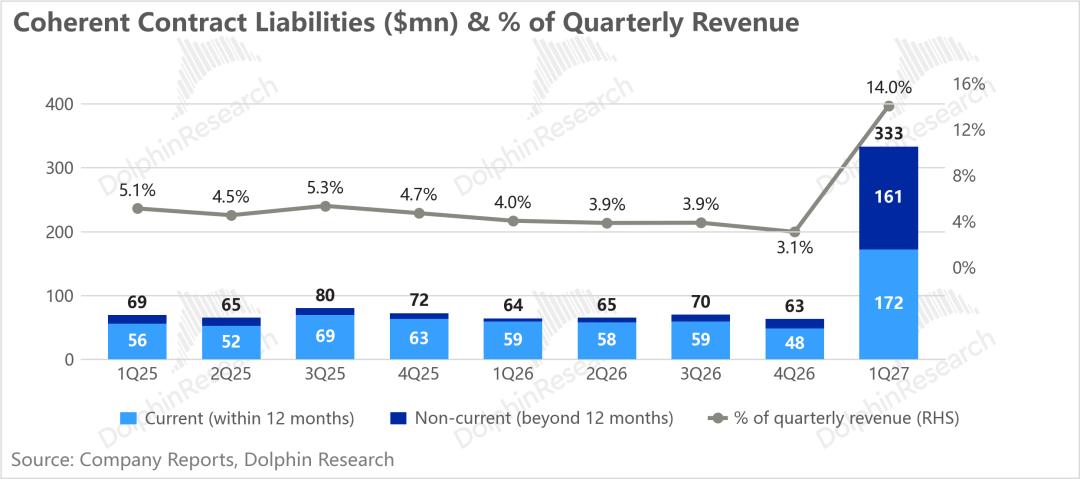
The visibility of demand sustainability is also relatively high: Order coverage for CY27 is sufficient, orders have been scheduled to CY28, and long-term agreements are generally signed around 2030. As evidence, contract liabilities rose to 5.3 times that of the previous quarter, of which the part whose revenue will not be recognized for more than one year increased from USD 15 million to USD 161 million.
The longer-cycle visibility comes from the PhotonLink platform: the company signed a new five-year long-term agreement worth about USD 20 billion this quarter, with the counterparty being the second anchor customer (a leading AI company) other than NVIDIA, which will start to contribute revenue in early CY28.
2. Gross Margin: The most "solid" result
The gross margin for this quarter reached 40.6%, up 1.8 percentage points year-on-year and 0.4 percentage points quarter-on-quarter; the long-term target was raised from 42% to 45% (to be achieved in a single quarter before the end of 2028).
As orders are already fully scheduled, Dolphin Analyst pays more attention to order delivery quality — the growth rate of gross margin in the process of revenue expansion. In the view of Dolphin Analyst, gross margin is the part that is truly satisfying.
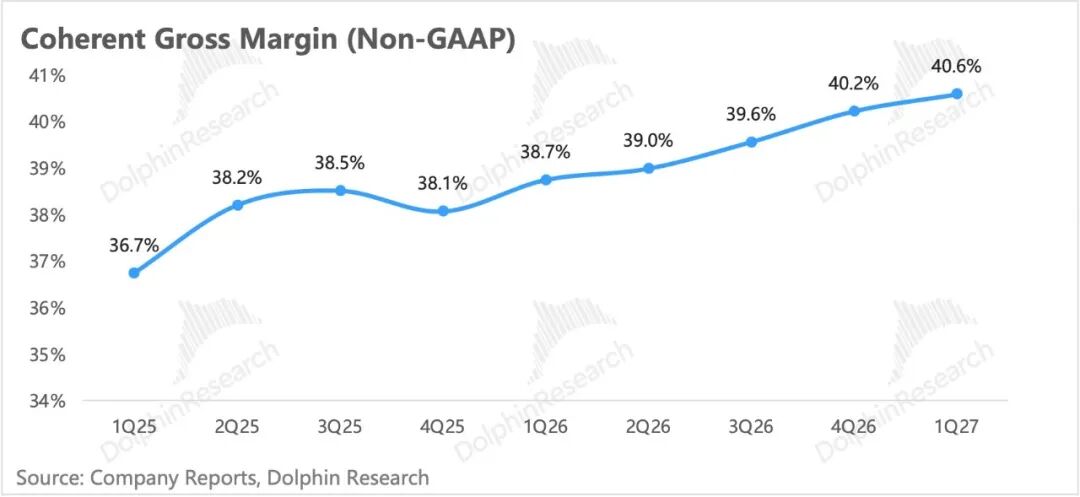
The sequential and year-on-year improvement of gross margin this quarter mainly comes from price increases, lower product input costs and higher manufacturing yield, among which price increases are concentrated in the data center and communications sector.
Dolphin Analyst believes this point is particularly critical during the 1.6T ramp-up period. The new product transition did not drag down gross margin, easing the market's previous concerns about profit margins during the product structure upgrading period.
The company also raised its long-term gross margin target from 42% to 45% (to be achieved in a single quarter before the end of 2028). The realization path given by the management, in descending order of contribution, is: the scale effect brought by the volume release of high-margin new products and the full production of 6-inch indium phosphide (InP), price increases, and cost reduction.
Among them, the dividend of 6-inch production capacity has not yet been realized. The ratio of self-production and external procurement of the company's InP devices is basically the same as that of a year ago. Although the self-owned production capacity has doubled, it is fully consumed by the growth of optical modules.
As the production capacity will more than double again before the end of CY27, the company will gradually shift to self-production in the next few quarters; the yield of the 6-inch line is already higher than that of the 3-inch line, and the output per furnace of the same epitaxial furnace is 2.5 times that of the 3-inch line, so self-produced lasers will have cost advantages later.
3. Expenses and Profit
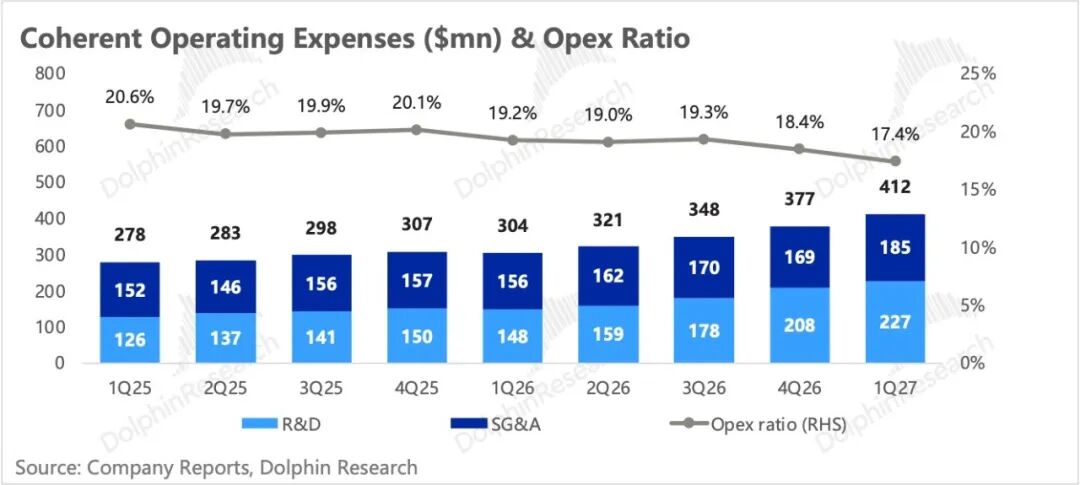
Non-GAAP operating expenses were USD 412 million, basically in line with the consensus expectation. The expense ratio was 17.4%, down nearly 2 percentage points year-on-year, and has been lower than the long-term target of 18%. The incremental R&D investment is mainly allocated to optical modules, PhotonLink (device resale platform), OCS and multi-rail transmission platform.
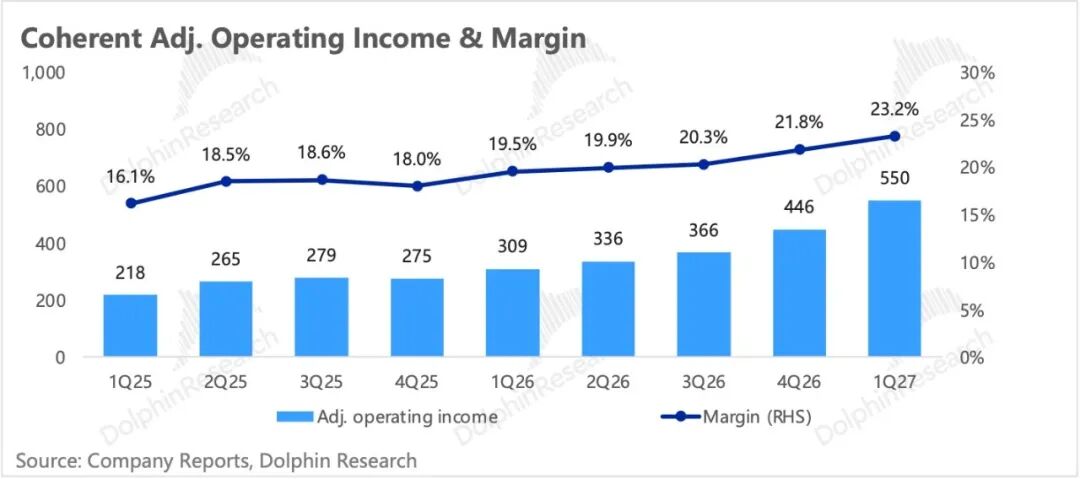
The final recorded operating profit margin was 23.2%, 0.3 percentage points slightly higher than the consensus expectation.
4. Cash Flow: Receivables converted into inventory, negative cash flow is not a problem
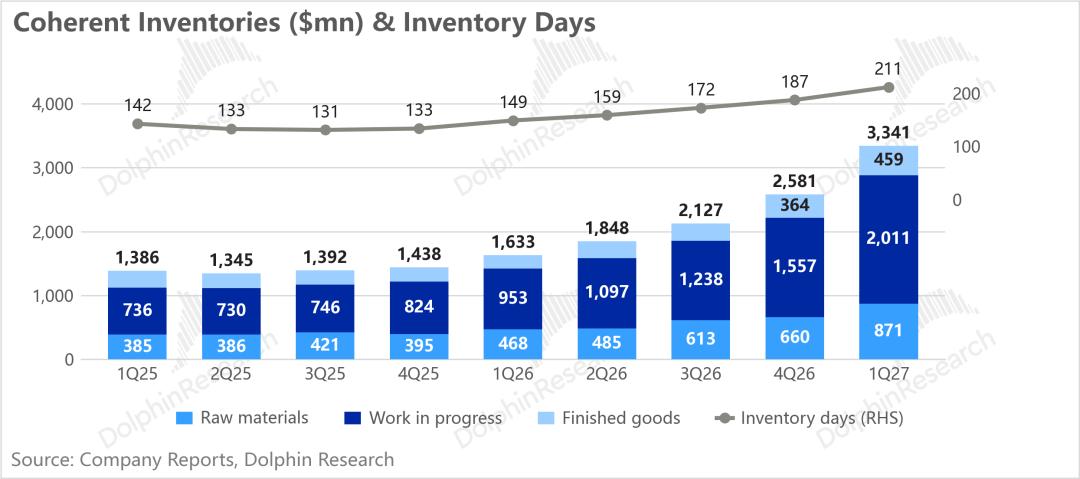
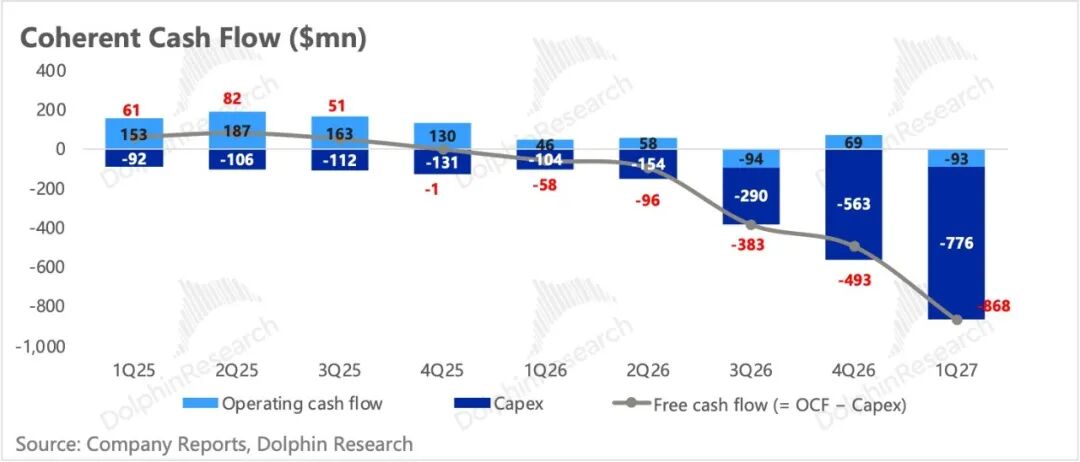
Operating cash flow was -USD 93 million (USD +46 million in the same period last year), mainly due to a substantial increase in inventory to support revenue growth: inventory increased by USD 76 million quarter-on-quarter to USD 3.34 billion, of which semi-finished products increased by USD 450 million, implying that subsequent growth will continue to rise.
During the capacity expansion cycle, capital expenditure was USD 776 million, compared with USD 556 million in the previous quarter. The management said that the figure will rise sequentially in 2Q, and the company is still actively expanding production, it is difficult for capital expenditure to decrease in the short term.
The final recorded free cash flow was -USD 868 million.
5. The following is an overview of the company's performance
Dolphin Research View:
1. The upward adjustment of gross margin guidance is the most direct positive news this quarter. From 40.6% this quarter to over 45% in a single quarter before the end of 2028, it is equivalent to an increase of about 0.5 percentage points per quarter in the next 9 quarters, which is basically consistent with the sequential growth rate of 0.4 percentage points this quarter.
Such guidance shows that the management is quite confident in its operation during the tight cycle of InP. Considering the volume release of 6-inch production lines and vertical integration, it is very possible to achieve the gross margin target.
2. The core highlight is still the supply-demand inflection point of InP, on which the market is quite tangled. On the one hand, people worry that the shortage of InP will restrict the shipment of module manufacturers and affect revenue; on the other hand, people worry that after the industry (especially Chinese laser manufacturers) expands production, EML will be oversupplied, triggering a price war. The company's response is:
- The output of self-produced InP lasers doubled year-on-year, one quarter ahead of schedule, and will more than double again before the end of CY27, and the required substrates have been locked (more than 5 suppliers);
- All self-produced InP is currently used by itself to make optical modules, which still cannot meet its own demand, and no lasers are sold externally;
- No risk of EML oversupply can be seen before CY28;
- For the 400mW ultra-high power CW laser for CPO, only one competitor (Lumentum) has been seen, and no Chinese manufacturers are involved.
Under the tight supply pattern, the company relies on its full-stack capabilities from epitaxy, chips, devices, modules to systems to ensure supply: Sherman in Texas and Sweden continue to expand InP production capacity, and the 6-inch line in Zurich will be put into production in the first half of CY27.
This is the foundation for the continuation of the company's growth narrative.
3. In terms of risks, pay attention to the following points:
a. Pricing depends on InP supply and demand, which is the core risk. Strong demand on the demand side has reached a consensus, but there are huge differences in the InP production capacity of the whole industry, making it difficult to judge the supply-demand inflection point. Several forces are easing the shortage of light sources:
Large-scale expansion of InP production capacity;
The CW silicon optical scheme uses one laser to supply multiple channels, and the InP consumption per module is lower;
Solutions that do not rely on InP, such as VCSEL, are diverting part of the demand;
Domestic EML and CW lasers from Source Photonics, Accelink and other manufacturers are being released in volume. Once the supply-demand relationship shifts from tight to loose, the profitability of modules and optical chips will drop significantly.
b. The barriers in the module segment are limited. The threshold of assembly and manufacturing is not high, and bargaining power mainly comes from upstream and downstream. Under the CPO architecture, the core link (optical coupling) is transferred to semiconductor packaging and testing factories. Once the packaging and testing factories master this process, they can compete with module manufacturers relying on their production capacity.
At the same time, the design link of CPO is basically handed over to switch chip manufacturers, which are the main downstream of pluggable modules. The pure OEM model like Fabrinet may also have opportunities.
c. DSP production capacity constraint. DSP is constrained by TSMC's advanced process production capacity, which is another uncertainty on the supply side.
d. Continuous large-scale capital expenditure is another variable to be verified. Expanding production lines and upgrading equipment have significantly deteriorated short-term cash flow, and there is no sign of slowdown in investment in the short term.
Although there are confirmed purchase orders and multi-year supply agreements behind it, it remains to be verified in subsequent financial reports whether the company can complete this round of rapid and capital-intensive ramp-up without sacrificing profit margins, causing working capital tension or delaying customer certification.
4. How to value Coherent?
In our view, in the industrial upgrading process from traditional communications to AI optical communications, the most valuable asset of Coherent compared with traditional module manufacturers is laser chips and their InP production capacity, which is confirmed by Marvell's premium acquisition of Lumentum. This asset is further amplified in NPO/CPO. In the process of rapid switching of external environment, technology and demand, light source is the most certain asset. As the second largest light source manufacturer in the market, Coherent deserves to enjoy a premium.
From the historical P/E perspective, we can see that since the outbreak of AI in 2023, the company's valuation multiple has been roughly in the range of 15-30 times, and the current valuation multiple is close to the lower edge of the historical range.
