The Second War of Search: The buyers have shifted from human beings to models
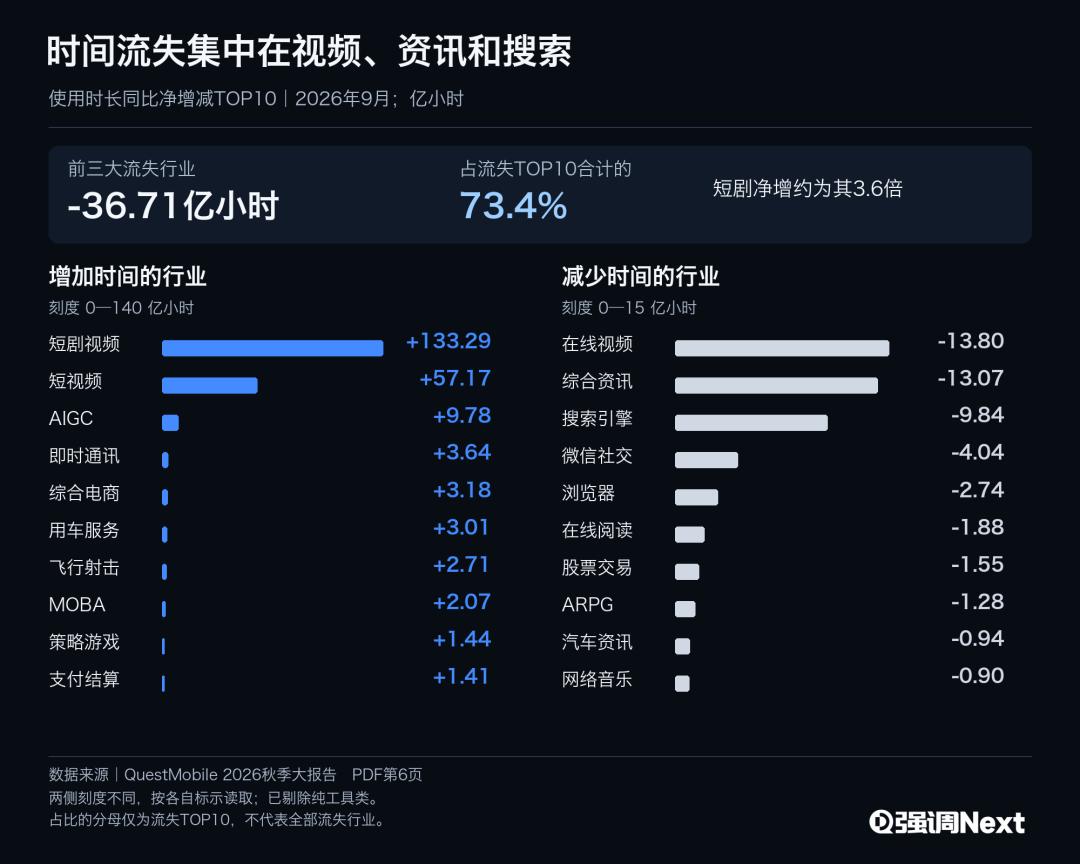
According to QuestMobile's latest autumn report, in September 2026, the total monthly usage duration of the search engine industry decreased by 984 million hours compared with the same period last year. On the same chart, the AIGC industry saw an increase of 978 million hours, while browsers and general information platforms decreased by 274 million hours and 1.307 billion hours respectively.
These two sets of close figures are easily interpreted as an equivalent shift. However, the total industry duration does not record where each user comes from and where they go, nor can it calculate how much search volume has been replaced by AI. It first indicates that the information acquisition methods organized around search and information consumption are losing part of users' time.
Search companies have begun to market themselves to new buyers.
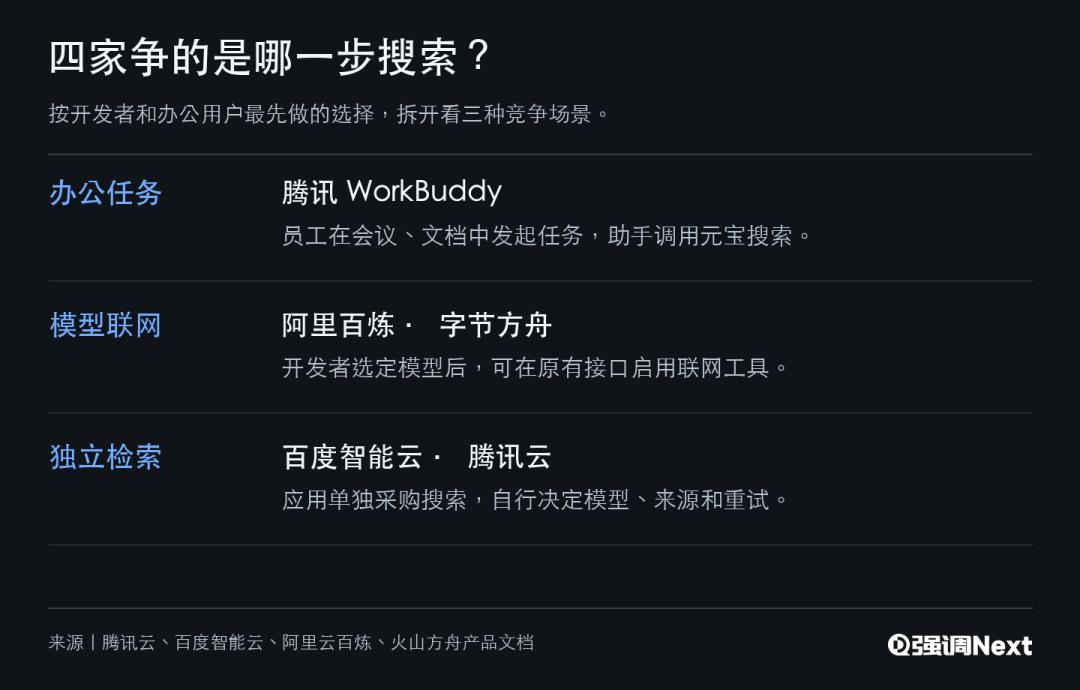
On October 20, Tencent opened its Yuanbao Search through Tencent Cloud. Nine days later, it released Buddy One, which takes WorkBuddy as the workbench, connects Tencent Docs, Tencent Meeting and ima, with Yuanbao Search responsible for real-time retrieval. Baidu Intelligent Cloud launched a search API promotion on October 30, while Alibaba Bailian and ByteDance Volcano Ark have also integrated networked search into the model invocation process.
A new market centered on search is taking shape. Users submit questions to assistants, and the assistants go to procure relevant materials. The parties who own the users, find the information, and pay for the query have started to belong to different entities.
The second war for search has thus raised a more difficult problem than invocation volume: when answers are delivered by assistants, how much bargaining power can search retain?
What is left for search after losing users' time?
Traditional search integrates several businesses on a single page. Users raise demands, search engines sort information, websites get traffic, and advertisers purchase impressions or clicks. Search companies not only provide technology, but also control the distribution opportunities.
AI assistants have changed this path. When an employee asks an assistant to compare the latest updates of three suppliers, the assistant can first check their official websites, then look up announcements, run additional searches if the dates do not match, and finally deliver a form. The user only makes one commission, but the backend may execute multiple queries. The assistant gets the full task, while the search interface often receives only one sub-problem among them.
This determines that the two sides do not have symmetric information. The assistant knows exactly what the user wants to procure, whether the user will follow up after viewing the answer, and can more easily observe whether the final task is completed. The underlying search service usually can only see the search terms and returned results. Even if retrieval is indispensable, the power to decide who to buy from next time still rests with application developers.
This change is also reflected in user behavior. QuestMobile disclosed that in August 2026, the monthly average usage times per user of search engine apps dropped by 21.7% year on year, while AI-native apps grew by 67.1%. The total duration data in September further shows that the search industry is under pressure, but neither of these two types of indicators can be directly converted into backend query volume.
Therefore, the most favorable scenario for search companies is that users spend less time looking for materials, while assistants perform more valuable retrievals on their behalf. The most uncomfortable scenario is that they bear the costs of crawling, updating and sorting, but can only quote per call to a small number of large customers, who control the answer display and subsequent transactions.
It is the same search, but different positions may lead to different revenue shares.
Tencent completes office scenario layout, Baidu expands search supply
This explains why Tencent first embedded search into WorkBuddy.
A salesperson needs to revise a visit outline based on the meeting minutes and the customer's new announcement from the previous day. The minutes are stored inside the enterprise, while the announcement is external. Connecting meetings and docs solves the problem of where existing materials are, and integrating search makes it possible to obtain new information. If employees still have to open the browser by themselves, find the original text and re-upload it, the assistant will return the work to people at the most critical step.
Tencent disclosed that WorkBuddy uses Yuanbao Search to find technical documents and official interface descriptions, reducing tool calls and model reasoning rounds. ima combines the knowledge base with public network materials, and the amount of valid source recall after integration has increased by about 10%. This investment first improves what its own products can accomplish.
Tencent occupies both the application layer and the retrieval layer, and has the opportunity to use the completion of final tasks to improve search in turn. Which material is really useful and which kind of result makes the model repeatedly conduct supplementary checks can be fed back within the same product system. Its value may be reflected in the retention and payment of office products, and not all of it will be counted into the search interface revenue. Tencent has not disclosed this part of the revenue, nor has it listed the proportion of WorkBuddy's search calls separately.
In this round of changes, Baidu also has the opportunity to re-expand the scope of search services. The assistant that the user initiates the request from can be separated from the party that finally completes the retrieval. In the past, search capabilities were mainly accessed by users through its own entrances. After opening APIs, assistants of other companies can also become customers. The more scattered AI applications are, the more worthy of observation the value of this cross-application supply becomes.
Baidu has turned web page, image, and video retrieval, as well as source site, title, URL and original text fragments into callable capabilities, and provides knowledge base access and enhanced Q&A based on the Wenxin large model. For developers, the practical use of these capabilities is to continue verifying sources and organizing answers after obtaining materials. Therefore, Baidu can not only supply retrieval, but also participate in subsequent generation and enterprise application delivery.
This gives Baidu the opportunity to apply its accumulated search capabilities to a wider range of customers. Developers can purchase retrieval results by accessing one interface. If they decide to build it on their own, they also need to maintain web crawling, index update and sorting for a long time. As long as the effect and cost of outsourcing are appropriate, innovations at the application layer may continue to be converted into customer demand for Baidu.
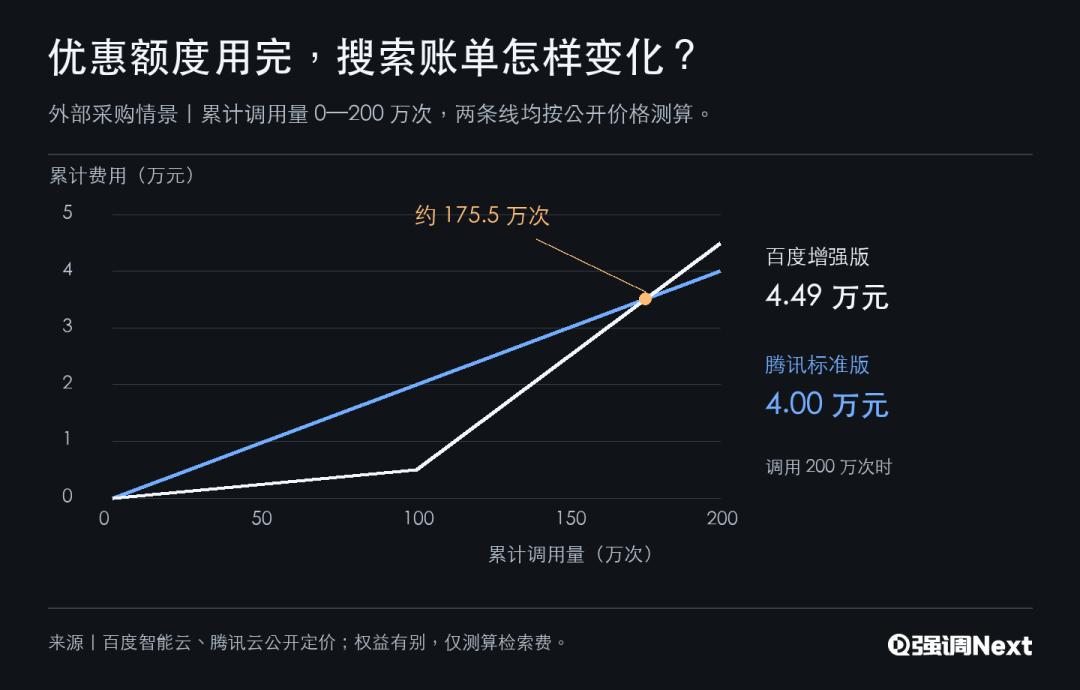
The promotional price of 4.9 yuan per thousand calls for the enhanced version first reduces the trial cost of this capability. The total quota of the discount is 1 million calls, which means that 4900 yuan can complete 1 million call tests, and the excess part is billed at 40 yuan per thousand calls. Teams can verify whether their applications need network access and which problems are error-prone based on this, and then decide on long-term procurement. The role of the quotation is to make the existing search capabilities easier to enter new development processes.
What is more noteworthy is the incremental demand. An assistant automatically updates research materials for dozens of companies, or continuously verifies technical documents, which may generate retrievals that did not happen in the past due to the limitation of manual time. Once this part of demand is formed, it will be a new service opportunity for search suppliers.
Tencent can get returns from WorkBuddy completing more tasks, while Baidu has the opportunity to benefit from its own applications, external retrieval and model services at the same time. Both companies can embed search into longer business processes, and the value created by one set of capabilities internally and the price charged externally can be calculated separately.
Model companies have mastered a new default option
The advantages of Alibaba and ByteDance appear before the search procurement process.
Developers who have already used Qwen can enable networked search for supported models on Bailian. Volcano Ark has also integrated networked tools into the model invocation process. Teams can complete the access along the existing interface to supplement real-time information for answers. If an independent retrieval supplier wants to enter the market, it has to prove that accessing an additional set of services is worthwhile.
In the last round of search competition, the default entrance determined who users would contact first. In this round, the default tools in the model platform have a similar effect. After engineers select the development environment and then decide what search to use, independent suppliers may even have to fight for the opportunity to enter the test.
Microsoft has already demonstrated a clearer path. It announced in 2025 that Bing Search APIs would be retired on August 11 that year, and advised customers to migrate to Grounding with Bing Search in Azure AI Agents, so that Agents can generate answers using real-time web materials. The general search interface has been transferred to the Agent service system, and search capabilities have also become part of the attraction for developers to use the cloud platform.
From this perspective, the low unit price of search is not sufficient to prove that this business has no value. For companies that sell both models and cloud services, search can help customers complete applications, and then bring other paid usage. Large manufacturers that can calculate returns across multiple services will bear price competition in a different way from suppliers that mainly rely on retrieval fee revenue.
Independent retrieval still has opportunities. If enterprises use multiple models at the same time and want to retain sources, citations and audit rules when replacing models, they have reasons to purchase search separately. Vertical industries may also pay for more complete, updated and faster materials.
As a result, two opposing forces will appear in procurement. Model platforms hope that customers will continue to use built-in tools, while developers want to retain choices among effect, cost and replaceability. Which side is stronger determines whether search can finally be charged as an independent service for a long time.
Websites begin to recalculate the account of "trading content for traffic"
Deeper changes are taking place in the upstream of search.
In the past, search engines could obtain a large amount of public content behind a practical exchange: websites allow indexing, search brings readers, and websites then monetize through advertising, subscription or transactions. After AI directly reads the content and generates answers, the connection between the content being used and readers visiting the website has weakened.
A study published by Pew Research Center in July 2025 analyzed the browsing data of 900 American adults. In its Google search sample of March 2025, on pages with AI summaries, the proportion of users clicking on traditional result links was 8%; the figure for pages without AI summaries was 15%. The proportion of clicks on source links in the summary was only 1%. This cannot represent all users, but clearly presents the situation websites are facing: being cited does not necessarily bring visits.
Content providers have already begun to try another form of exchange. Cloudflare launched the Pay Per Crawl test in 2025, allowing websites to set prices for AI crawler access. Its document updated in July 2026 is still marked as a closed test, which cannot be regarded as a generally formed charging market, but the direction is clear. In the past, they expected search to bring readers, now they try to charge directly for machine access.
This will affect the cost structure of retrieval services. Search companies face procurement bargaining from model platforms and developers on one hand, and may have to pay authorization or access fees to content providers on the other. If what they mainly provide is public web pages that everyone can obtain, the price pressure they bear will be more obvious.
It is precisely for this reason that content advantages need to be implemented in the deliverable scope. Tencent's public product specifications list Tencent News, Sogou Encyclopedia and Penguin Account, and does not promise that third parties can retrieve the full text of all WeChat Official Accounts. ByteDance's document lists Douyin resources including Douyin Encyclopedia, which also cannot be expanded to the full volume of short videos. The group owning content products does not mean that external customers can stably call these contents. For example, WeChat Official Account content is obviously restricted by copyright.
The more reliable new information AI needs, the more search suppliers have to prove their value. Some rely on unique materials, some rely on update speed, and some help developers reduce retry and processing costs. The differences that can really be charged will fall on specific tasks. Whether an announcement is complete, whether a form retains the statistical caliber, and whether a piece of real-time information can trace back to the original source, may all change the result of a task.
This competition may not soon grow into a large independent market. Large manufacturers are very likely to first use search as a supporting capability for office products, models and cloud services, and independent API revenue is only a part of it. But the interest relationship has been rearranged. Assistants want to control users and reduce procurement costs, content providers want to get returns from machine access, and search companies have to find reasons for payment between the two sides.
Tencent integrating search into WorkBuddy is a specific landing point of this change. The bigger problem is that after users hand over information searching to AI, the revenue that used to be concentrated on search pages will finally stay in whose accounts.
This article is from the WeChat official account "Emphasize Next" (ID: leo89203898), author: Qingyun, editor: Xiaobai, published with authorization from 36Kr.