As players like "Pang Donglai" enter the market, why are retail brands collectively launching a "counteroffensive" in the hotel sector?
After hotel groups have collectively deployed new retail for many years, numerous retail brands in China have finally begun to enter the hotel industry on a large scale in reverse.
Pang Donglai's new store in Xuchang is building a 100-meter hotel benchmarked against the international luxury brand The Ritz-Carlton;
Sports brand FILA has launched the FILA Hotel in Shanghai, which is now open for reservations and is about to open;
Want Want is leveraging its brand IP to build a themed hotel with a total investment of over 1.2 billion yuan, which is expected to be completed next year.
Retail brands and the hotel industry share inherently similar genes. All the brands mentioned above are leaders in their respective fields. Their collective move to "open hotels" — for hotel brands, is it a professional competition, or mutual learning of experience? How can the hotel industry learn from their strengths?
01 The hotel moves of "Pang Donglai-style brands": Breaking the barriers of the hotel industry?
Without detailed rules or specific plans, the news that Pang Donglai is going to open a hotel immediately went viral, and its "explosive influence" has been proven once again.
Pang Donglai plans to build the Hotel of the 4th Phase of Dream City in the East District of Xuchang, with a total investment of about 6.5 billion yuan, and it is scheduled to open in September 2029. According to the latest news released by Yu Donglai, the hotel will be benchmarked against the international luxury hotel brand The Ritz-Carlton.
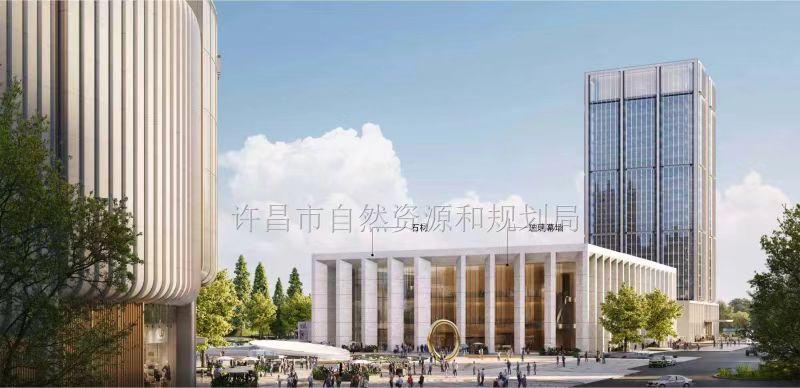
Pang Donglai Hotel planning map Source: CLS.cn
For ordinary consumers, there is one more new landmark to "check in".
But for practitioners in the hotel industry, this is more than an ordinary cross-border store opening: it means a retail brand regarded as a "service myth" by the whole industry has brought its service standards into the high-end luxury track, the core of the hotel industry, which has aroused stronger curiosity and wait-and-see attitude across the sector.
Before Pang Donglai, Want Want had already told a story of a retail brand running a hotel in advance.
On October 13, the Nanjing Shenwang Hotel with a total investment of over 1.2 billion yuan officially held a restart construction ceremony. This project that has been silent for nearly 20 years will be reconstructed, transforming from a traditional business hotel into a Want Want IP-themed hotel.
This is not just about building a hotel, and it may set an example of experience upgrading for the hotel industry.
An 8-meter-tall giant Wangzai sculpture, a 3,000-square-meter immersive parent-child park, and classic products such as Wangzai small steamed buns and rice crackers will all be moved into the hotel. Judging from the planning drawing, it is not just a simple placement of several brand logos, but to build a complete scene where people can stay, play and taste the food.
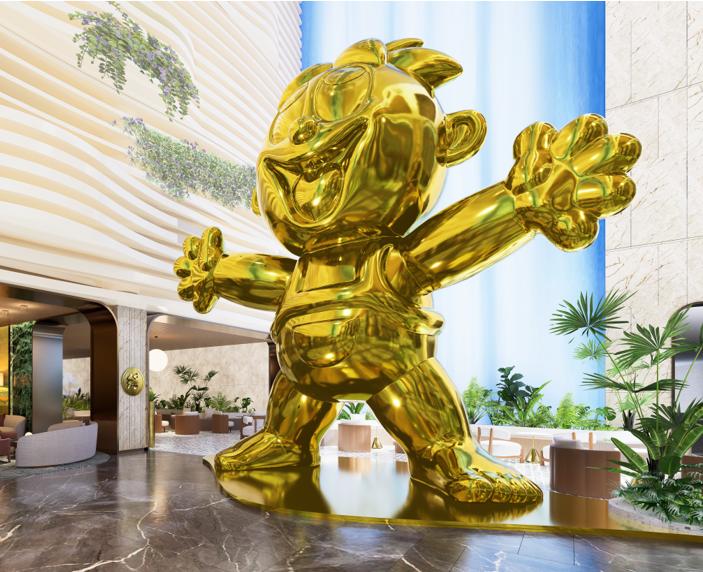
Want Want Wangzai sculpture Source: Jimu News
A more recent case is the FILA Hotel, which has opened for reservations and will officially open in the fourth quarter of this year.
It does not follow the old path of traditional hotels. Centered on the three key words of sports, fashion and community, it will fully present the FILA sports fashion lifestyle.
The very prominent feature of this hotel is its sports elements. The PURE sports and fitness space set up on the third floor includes a fitness club, a swimming pool, a group training area, yoga and Pilates classrooms, changing and shower areas, and rest areas. Even the hotel's gym has been directly upgraded to a FILA brand experience center.
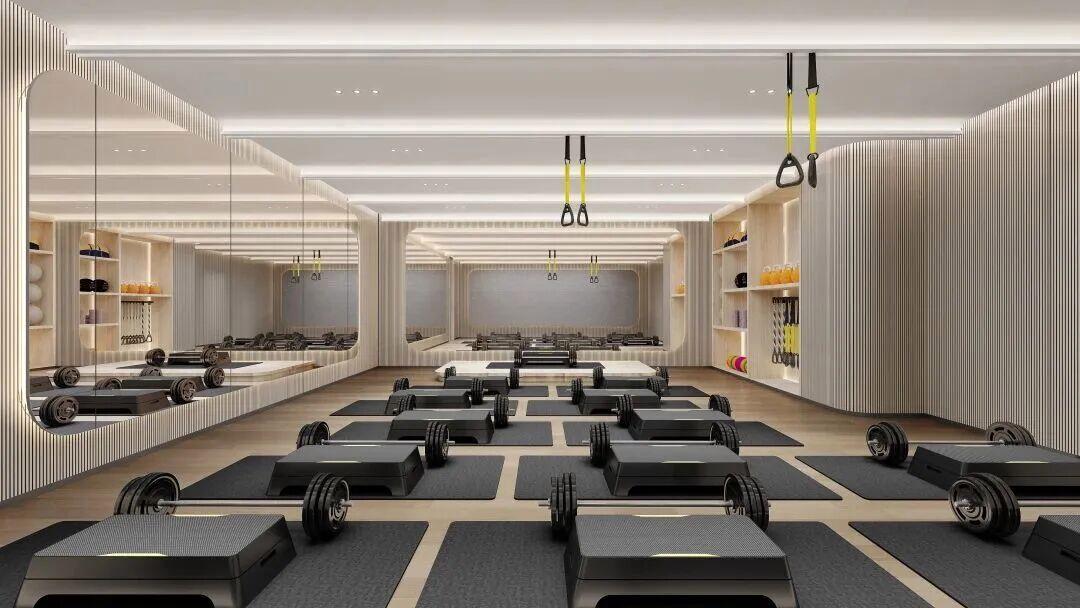
Source: LP New Landmark
These three retail brands from different tracks have almost set their sights on the hotel industry at the same time, bringing their areas of expertise to the hotel industry for reconstruction.
The construction process of Pang Donglai's Dream City has been broadcast live to the public continuously, and its high-standard professional requirements have been praised by netizens as "worthy of this year's Luban Prize". Before the project is completed, it has already demonstrated its professionalism with high standards.
Pang Donglai has a widely recognized service system, Want Want has IP assets accumulated over decades, and FILA has mature operation capabilities for sports fashion communities.
These retail brands may seem "layman" in terms of experience when entering the hotel industry, but they also bring unique advantages, which may present a new mode of existence in the hotel industry.
For a long time, the barriers of the hotel industry come from its industrial characteristics — heavy investment, slow return and strong operation, which have built up the industrial barriers.
However, with the changes in new consumer demands, this group of retail brands give full play to their own advantages in user trust, emotional connection and experience innovation to create their unique value in the hotel industry. This is the current upgrading direction of the hotel industry, and it is also what many traditional hotel brands lack.
02 What they open is a "brand flagship store" that is available for accommodation
It is not new for outsiders to cross the border to run hotels.
A few years ago, there were "coal bosses" and "oil bosses" who focused on acquiring high-star hotels, and beauty brands cooperated with luxury hotels on products.
The former follows the capital logic: taking hotels as core asset allocation, focusing on property value appreciation, social status and asset accumulation. The latter follows the channel logic: there is not only direct product binding, but also the possibility to turn hotels into offline experience extensions to attract traffic for core products.
When retail brands run hotels, they take the third path — the brand logic, to build an all-round, immersive brand flagship store that people can stay in.
Out-of-town tourists come to Pang Donglai for shopping, and choose to stay at the hotel for the night. This not only accommodates a large number of non-local customers, but also allows customers to experience Pang Donglai's thoughtful services and ultimate details more completely. The 24-hour immersive experience translates the "service trust" that Pang Donglai has established in the retail sector into the accommodation scenario.
The destination effect brought by this brand not only brings direct profits, but also undertakes and converts huge traffic, which is difficult for traditional hotels to establish and achieve.
The essence of Want Want's move is to accumulate IP value.
As a national fast-moving consumer goods brand, the advertisements of Wangzai Milk and the taste of rice crackers and senbei are familiar to people born from the 1980s to the 2010s. But in the past, these memories only stayed on supermarket shelves and in TV commercials.
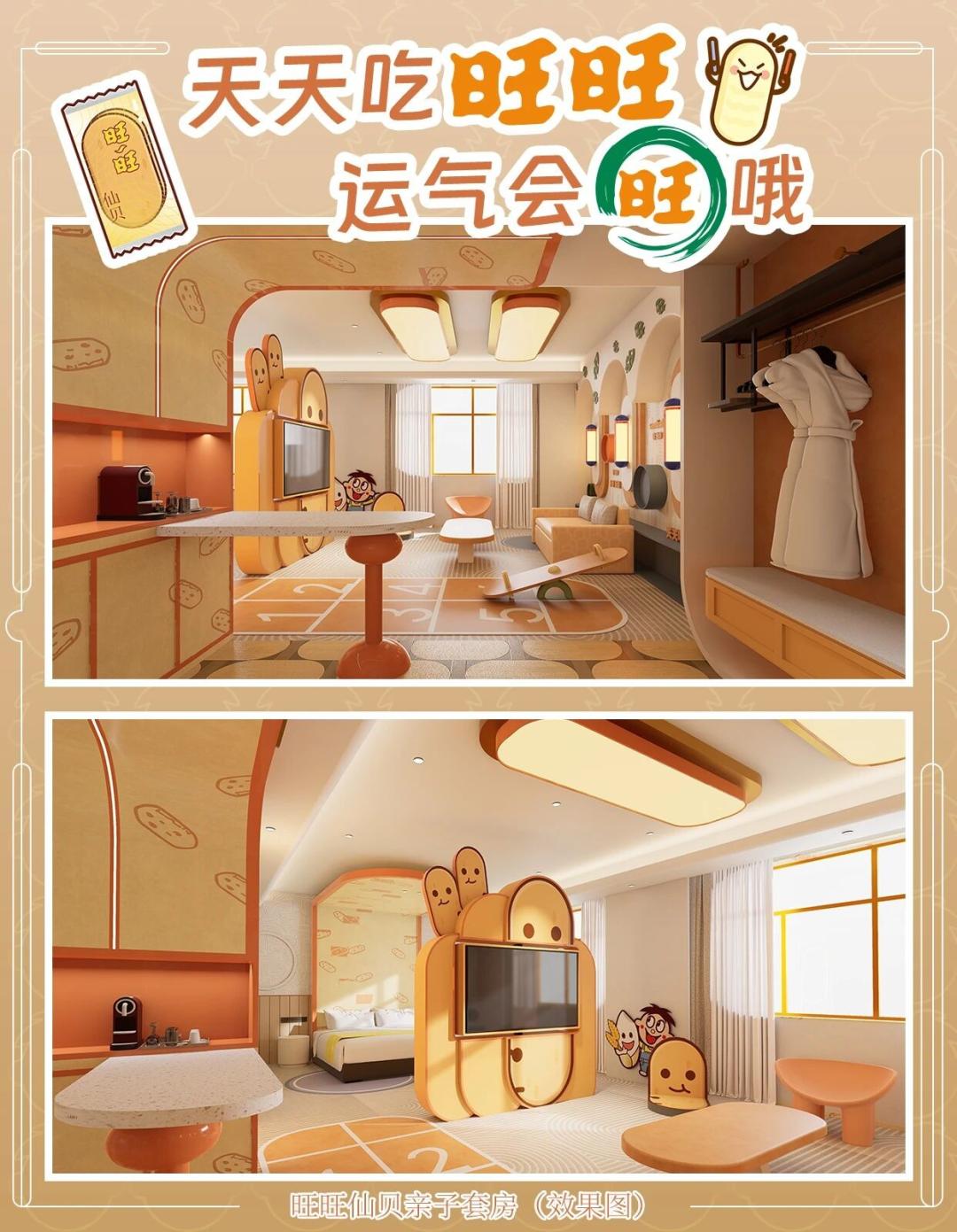
Source: Internet
Opening a hotel is to integrate these scattered brand assets into a space that can be touched, experienced and stayed in.
When parents stay in themed rooms with their children and eat customized food in the restaurant, the brand is no longer a logo printed on the packaging bag, but a close, accessible emotional connection.
This intergenerational brand imprint is difficult for traditional hotels to establish through decoration and services. For Want Want, the essence of opening a hotel is to build an offline super entry point where goodwill can continue to be monetized.
FILA's idea is more straightforward.
When traditional hotels set up sports supporting facilities, most of them just place a few treadmills to set up a "gym" area. FILA's hotel takes sports as a lifestyle from the root. Customers can not only stay, but also book professional sports courses, participate in brand activities, and experience new product launches.
The hotel is not just a supporting facility during travel, but the core scenario of the entire sports fashion lifestyle. In terms of customer operation, it changes from one-time consumption to long-term community connection.
Retail brands always need to find "partners" to highlight the brand tone and texture. In the past, it was coffee to create a lightweight brand experience, but now they directly open hotels, which not only has the symbolic value of a check-in landmark, but also completes a complete brand experience.
When the traffic of retail brands peaks and homogeneous competition becomes prominent, they look for new growth curves. Hotels naturally have the characteristics of long stay duration, high emotional investment and high repurchase potential, so they have become a promising scenario.
Essentially, opening a hotel is building an offline super flagship store of the brand.
03 Can traditional hotel practitioners learn from this practice?
As a business form very close to the hotel industry, retail brands running hotels is lively in the short term, diverts customer flow in the medium term, and forces the industry to upgrade in the long term, which will also bring new inspiration and fresh blood to the hotel industry.
As early as two years ago, Yu Donglai, the founder of Pang Donglai, released many Douyin videos to share experience for the hotel industry.

Source: Douyin
From a practical perspective, looking at the moves of these three brands together, from the investment perspective, they correspond to three familiar moves in the hotel circle: Pang Donglai adopts self-owned property, Want Want adopts stock property transformation, and FILA adopts light asset brand operation.
In terms of cross-border thinking, it may bring new inspiration to hotel investment.
The core logic of Pang Donglai is not to calculate the hotel as a "supporting facility", but to calculate it as a "project".
Judging from the local passenger flow in Xuchang, it is far from enough to support a high-end hotel. But the role of Pang Donglai is not just an independent profit unit, but to retain customers for the facilities of the complex and add value to the overall hotel assets. Therefore, the accounting logic changes from "how many years will it take to pay back the cost" to "how much has the overall asset appreciated".
The inspiration from Want Want is to rewrite the value of stock properties, not focusing on the location, but rewriting the "narrative".
The transformation and upgrading of traditional hotels is "renovation, upgrading and brand replacement". Want Want restarted the hotel that had been stranded for nearly 20 years, investing 1.2 billion yuan to build an 8-meter-tall Wangzai sculpture, a 3000-square-meter parent-child park, and 61 IP-themed rooms. The essence of its narrative is "making this plot of land carry content that no one else can support".
Hotel investors may not need to create IP by themselves, but they need to ask a question: apart from running a better hotel, what else can this property do that others cannot.
There is another reference from the cooperation mode of FILA Hotel. It is understood that the project is completed through the joint cooperation of three parties: Anta provides the property and hard decoration, Hyatt is responsible for operation, and FILA focuses on the brand and spatial concept, with each party giving full play to its own strengths.
The advantage of this model is that Hyatt guarantees the operation, FILA does not need to sacrifice the brand tone for the "professionalism of hotel operation", and Hyatt does not need to restrict the operation standards for "brand expression". This provides a clearer division of labor explanation for hotel brand franchise/entrusted investment.
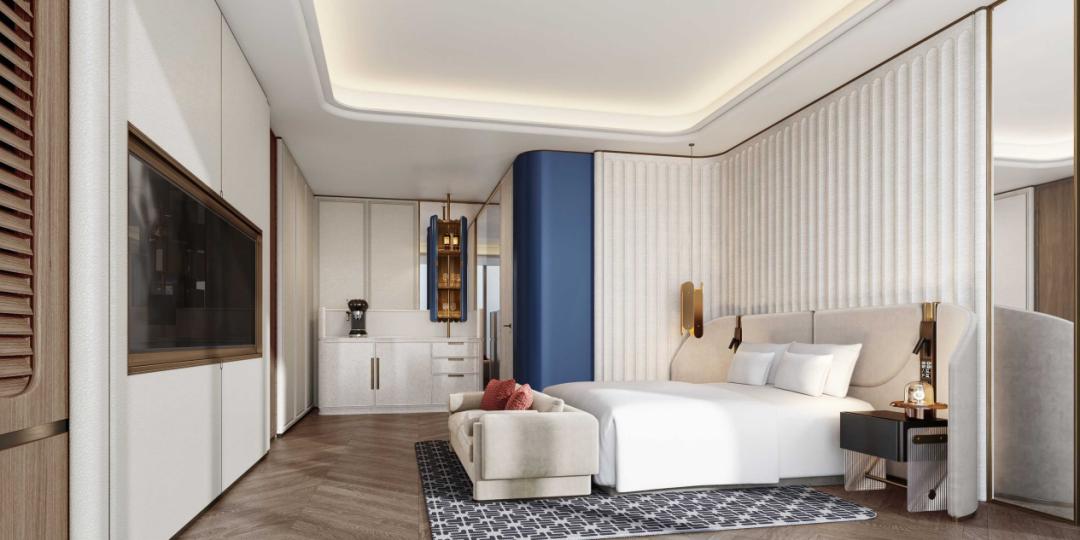
Source: Jiemian News
Another more distinct advantage of retail brands is their user base.
They do not need low-price drainage or excessive platform distribution. Customers are willing to place orders and try out of brand trust. This ability of "the brand comes with its own traffic" is a valuable asset for user operation now, and it is also scarce for traditional hotels at present.
This brings inspiration to hotel investors: jump out of the old mindset of "competing on decoration and price", strengthen unique brand memory points, focus on the interpersonal connection with consumers, and establish their own user trust.
With the transformation of new consumption patterns, the hotel industry is also facing transformation. Cross-border operation of hotels by retail brands may not subvert the traditional hotel industry, but it will definitely force the industry to rethink: what is the core product of a hotel?
Letting go of path dependence, and integrating the brand trust, emotional connection and experience innovation that retail brands are good at into products is a direction worthy of attention.
Because one direction is clear: the future competition in the hotel industry will not be about who has larger rooms or newer facilities, but about who can truly walk into the hearts of users.
This article is from the WeChat official account "Hotel Management Finance", written by Qian Li, and authorized for release by 36Kr.