The leading prefecture-level city in northern China is well-positioned to become the next nuclear power city.
On October 31, the nuclear island of Unit 5 at Shandong Haiyang Nuclear Power Plant of State Power Investment Corporation (SPIC) started pouring the first concrete (FCD), marking the official launch of the third phase of the Haiyang Nuclear Power Project.
At present, the global nuclear power industry has ushered in a new round of revival, and China's nuclear power sector has entered a peak period of large-scale construction. By 2025, China had 59 operational nuclear power units with a total installed capacity of 62.48 million kW, second only to the United States and France. According to the *15th Five-Year Plan for the Construction of a New Energy System*, China's operational nuclear power installed capacity will reach around 110 million kW by 2030, almost doubling the current figure.
In terms of provincial distribution, China's nuclear power units are located in 8 eastern coastal provinces, spanning from Liaoning, Shandong, Jiangsu, Zhejiang to Fujian, Guangdong, Guangxi and Hainan, connecting the entire coastline.
As a major economic province with huge energy consumption, Shandong's nuclear power installed capacity only accounts for about 2.2% and its power generation accounts for about 4.8% by 2025, ranking last among the 8 provinces, far lower than provinces such as Guangdong, Zhejiang and Jiangsu.
At the moment, Shandong is catching up at full speed, with Yantai as the absolute core.
Up to now, Yantai only has two operational nuclear power units, Unit 1 and Unit 2 of the Haiyang Nuclear Power Plant, which is not prominent on the national nuclear power map. However, if counting all operational, under-construction and approved but not yet started units, Yantai has a total of 10 units with a total installed capacity of 13.098 million kW, ranking in the first echelon nationwide.
According to the plan, during the 15th Five-Year Plan period, Yantai will build a modern new energy system relying on the "four ten-million-kW-level" bases of nuclear power, wind power, photovoltaic and LNG. Nuclear power ranks first among the four bases, which fully demonstrates its core role.
A key nuclear power city is rising at an accelerated pace.
01
The Major Carbon Reduction Test
Major economic provinces are collectively facing the major carbon reduction test.
The *15th Five-Year Plan for the Construction of a New Energy System* puts forward that a clean, low-carbon, safe and efficient new energy system will be initially built by 2030, the proportion of non-fossil energy consumption will reach 25%, and carbon dioxide emissions will peak. For major economic provinces with huge industrial foundations, the pressure is obviously not small.
Guangdong, Jiangsu and Shandong rank top 3 in GDP, and also form the first echelon of national power consumption. In 2025, the power consumption of Guangdong, Shandong and Jiangsu reached 959 billion kWh, 867.1 billion kWh and 889.5 billion kWh respectively, and the proportion of non-fossil energy consumption was 30.4%, 15.3% and 20.5% respectively.
Against the 25% standard line, Guangdong has already met the target in advance, Jiangsu is 4.5 percentage points short, and Shandong needs to increase its proportion by nearly 10 percentage points within 5 years.
Shandong has set a clear target in its outline of the 15th Five-Year Plan, that the province's non-fossil energy power generation installed capacity will reach about 200 million kW by 2030, and strive to make the annual newly added clean energy power generation cover the newly added power consumption of the whole society.
Looking further at Shandong's power generation structure, the non-fossil energy power generation reached 224.54 billion kWh in 2025, accounting for 32.3% of the total power generation.
Among them, the power generation of wind, solar, nuclear and biomass energy was 59.34 billion kWh, 106.55 billion kWh, 33.73 billion kWh and 19.49 billion kWh respectively, increasing by 2.3%, 29.7%, 59.3% and 2.1% respectively, accounting for 26.4%, 47.5%, 15.0% and 8.7% respectively.
That is to say, solar and wind power generation play the leading role, but nuclear power has the fastest growth, which is closely related to the explosive period of national nuclear power construction.
In August this year, the *2026 China Nuclear Power Development Report* (hereinafter referred to as the Report) released by the National Energy Administration showed that from 2021 to the end of 2025, the number of approved under-construction units in China increased from 20 to 53, and the corresponding installed capacity increased from 22.69 million kW to 62.93 million kW.
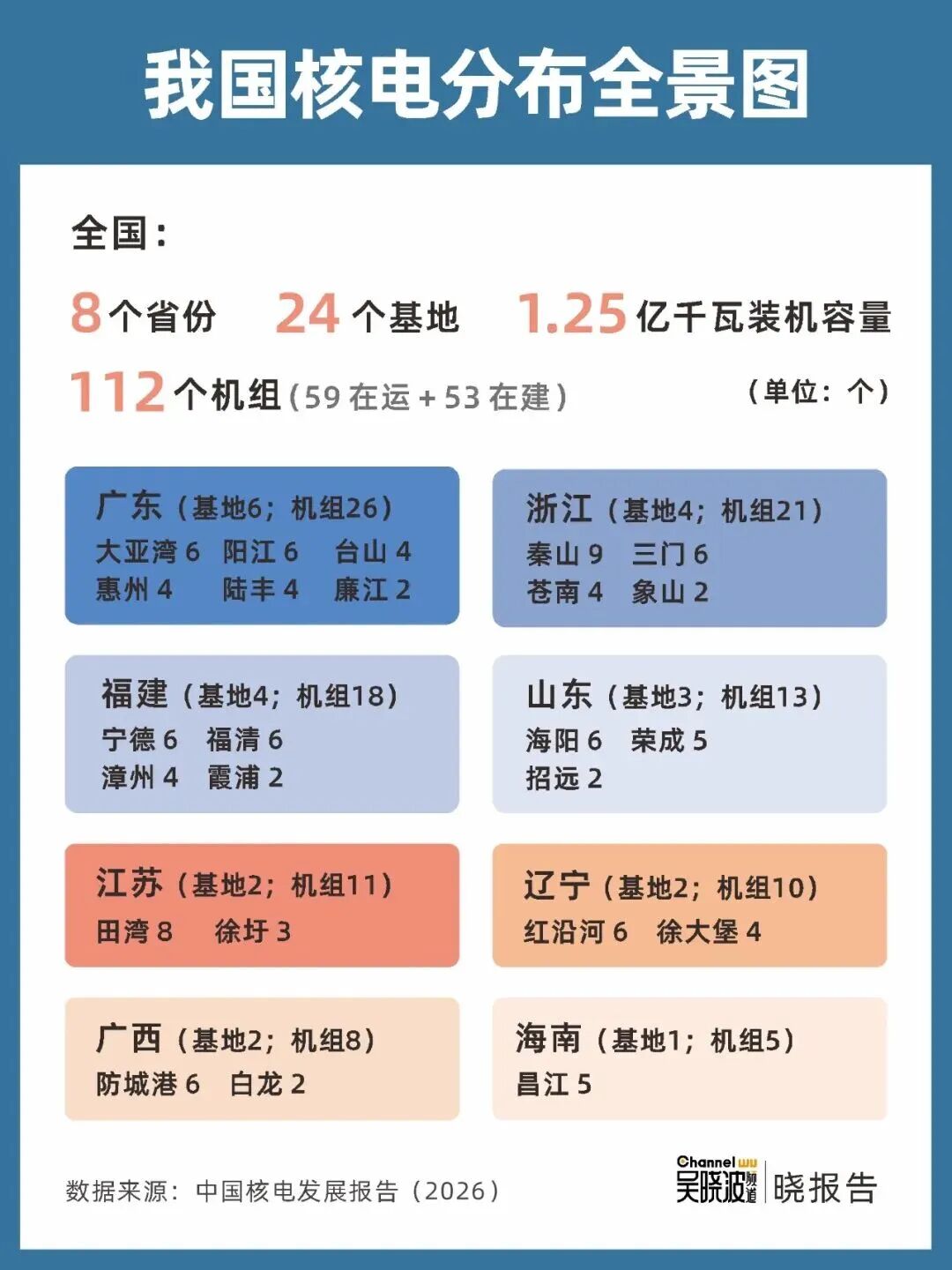
By the end of 2025, there were 24 nuclear power bases across the country, with a total of 112 operational, approved and under-construction nuclear power units, with an installed scale of 125 million kW, ranking first in the world in total scale.
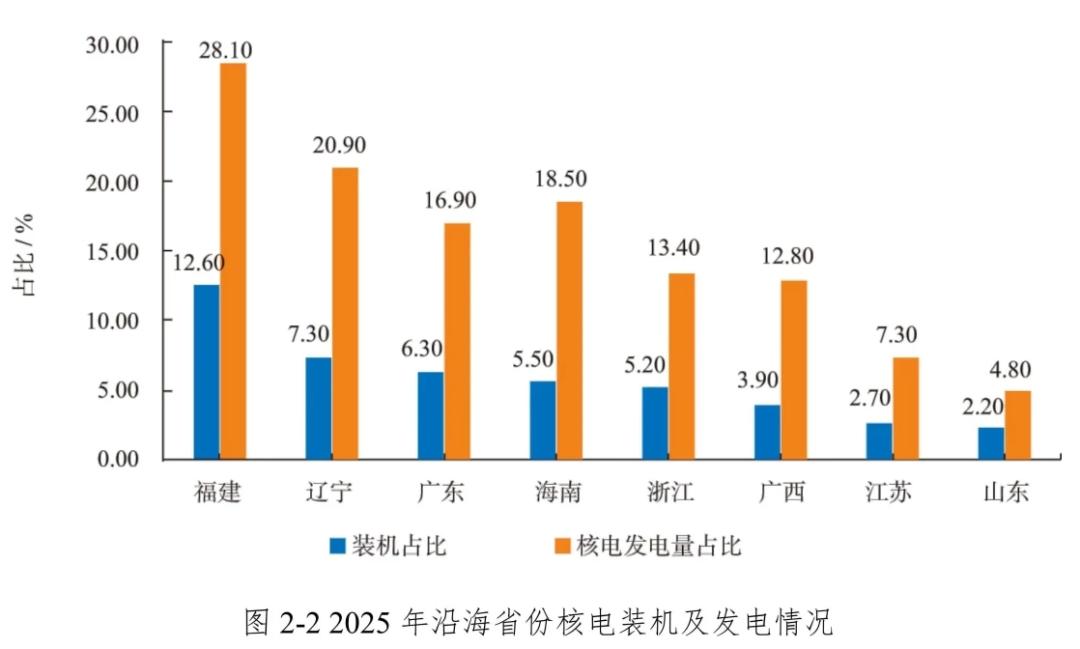
Image source: *2026 China Nuclear Power Development Report*
These nuclear power bases are mainly distributed in 8 coastal provinces including Liaoning, Shandong, Jiangsu, Zhejiang, Fujian, Guangdong, Guangxi and Hainan. Among them, Guangdong, Zhejiang and Fujian rank top in the number of nuclear power units and installed scale, with 26, 21 and 18 units respectively, and the installed scale is 30.782 million kW, 21.320 million kW and 20.636 million kW respectively.
For example, the nuclear power installed capacity in Fujian accounts for 12.6% of the province's total power generation installed capacity, and the power generation accounts for 28.1%, both ranking first. The proportion of nuclear power generation in Liaoning, Hainan and Guangdong is also above 16.9%. In comparison, the figure in Shandong is only about 4.8%, with an obvious gap.
But in the past two years, Shandong has been catching up at a speed visible to the naked eye. Entering the 15th Five-Year Plan period, Shandong has proposed to adhere to the coordinated development of wind, solar, nuclear and other energy sources, and build a unique advantage clean energy base with a level of over 100 billion kWh. Among them, the ten-million-kW-level nuclear power base in Jiaodong Peninsula is listed first.
According to previous plans, by 2030, Shandong's operational nuclear power installed capacity will reach more than 13 million kW, and the scale of the nuclear energy industry will exceed 500 billion yuan.
02
Nuclear Power City
Shandong's nuclear power story started not late.
In 1983, Shandong Province established a nuclear power engineering leading group, led by the main leaders of the provincial government. During the general survey of nuclear power plant sites across the province, the Haiyang Nuclear Power Plant site stood out from the coastline of more than 3,000 kilometers for its "no seismic zone and fault zone, sparse population within 80 kilometers, and good meteorological conditions", and was rated as the "first preferred" site by experts.
But at that time, the nuclear power boom was concentrated in Guangdong, Jiangsu and Zhejiang regions where the power demand was more urgent, and Shandong's idea failed to come true in the end. It was not until 2006 that Shandong Haiyang Nuclear Power Plant and Zhejiang Sanmen Nuclear Power Plant were selected as the landmark projects for the introduction, digestion, absorption and innovation of China's AP1000 third-generation nuclear power technology, marking the real turning point of the story.
In October 2018, Unit 1 of Haiyang Nuclear Power Plant was put into commercial operation, marking Shandong's first access to China's nuclear power map. A more landmark scene was that in May 2022, the nuclear energy headquarters of the central enterprise State Power Investment Corporation, SPIC Nuclear Power Co., Ltd., moved from Beijing to Yantai, which caused widespread discussion in the industry.
This is exactly the foundation for Shandong to enter the center of China's nuclear power map.
The Report shows that Shandong currently has 3 nuclear power bases in Haiyang, Rongcheng and Zhaoyuan, with a total of 13 units, ranking second only to Guangdong (26 units), Zhejiang (21 units) and Fujian (18 units) among the 8 coastal nuclear power provinces, and higher than Jiangsu (11 units), Liaoning (10 units), Guangxi (8 units) and Hainan (5 units).
The rise of Shandong's nuclear power status is driven by Yantai as its "core engine". In the past two years, Yantai has been making multi-pronged efforts to accelerate the building of a "nuclear power city" —
In January 2019, Units 1 and 2 of the first phase of SPIC Haiyang Nuclear Power Project were put into operation, and Units 3 and 4 of the second phase are expected to be fully operational in 2027;
In September 2026, the main project of Unit 2 of the CGN Zhaoyuan Nuclear Power Project officially started, marking that the first phase of the project has entered the comprehensive construction stage;
In July 2026, the first phase of SPIC Laiyang Nuclear Power Project was approved, and the site leveling construction of the project was fully launched in early September; in the same month, SPIC Nuclear Power (Laiyang) Nuclear Energy Co., Ltd. was registered and established in Laiyang with a registered capital of 10 billion yuan.
At the same time, although the CNNC Haiyang Xin'an Nuclear Power Project has not yet been approved, the supporting engineering construction has already started.
According to statistics, the total installed capacity of the 4 nuclear power projects including SPIC Haiyang Nuclear Power Project, CNNC Haiyang Nuclear Power Project, SPIC Laiyang Nuclear Power Project and CGN Zhaoyuan Nuclear Power Project exceeds 30 million kW, ranking first among all prefecture-level cities in China in terms of scale.
More importantly, Yantai is the first place in China to carry out nuclear energy heating. With the "Nuanhe No.1" in Haiyang as the core fulcrum, it realized zero-carbon heating across the whole area of Haiyang in 2021, and gradually opened up a new model of cross-city clean heating in Jiaodong.
That is to say, Yantai's nuclear power can not only be connected to the grid, but even become a zero-carbon heat source supply place radiating Jiaodong and even a larger region, bringing greater imagination space for the integrated development of nuclear energy and industries.
Shandong is also re-evaluating Yantai.
The outline of Shandong's 15th Five-Year Plan proposes to promote the integrated development of Jinan and Qingdao metropolitan areas through the integration of energy and industry, while Yantai is given the important task of "striving to build a northern clean energy center".
This also means that Yantai's urban status will usher in a rise.
03
Greater Breakthrough
In the first three quarters of this year, the GDP of Qingdao, Jinan and Yantai reached 1,416.83 billion yuan, 1,110.05 billion yuan and 883.218 billion yuan respectively, with a year-on-year growth of 5.5%, 5.5% and 5.7% respectively. Among them, Yantai's growth rate leads the "three core" cities, and also ranks in the first echelon of the top 30 GDP cities in China.
However, it cannot be ignored that the GDP gap between Yantai and Qingdao and Jinan is widening. Especially in the past two years, Yantai's fixed asset investment has fallen into negative growth, and the decline has expanded quarter by quarter since the beginning of this year. Data shows that in 2025, Yantai's fixed asset investment decreased by 18.8% year on year; in the first quarter, the first half of the year, and the first three quarters of this year, the growth rate of Yantai's fixed asset investment was -0.8%, -11.6% and -20.3% respectively.
This also reflects from the side that Yantai still has room for further optimization in the transformation of investment structure and even industrial structure.
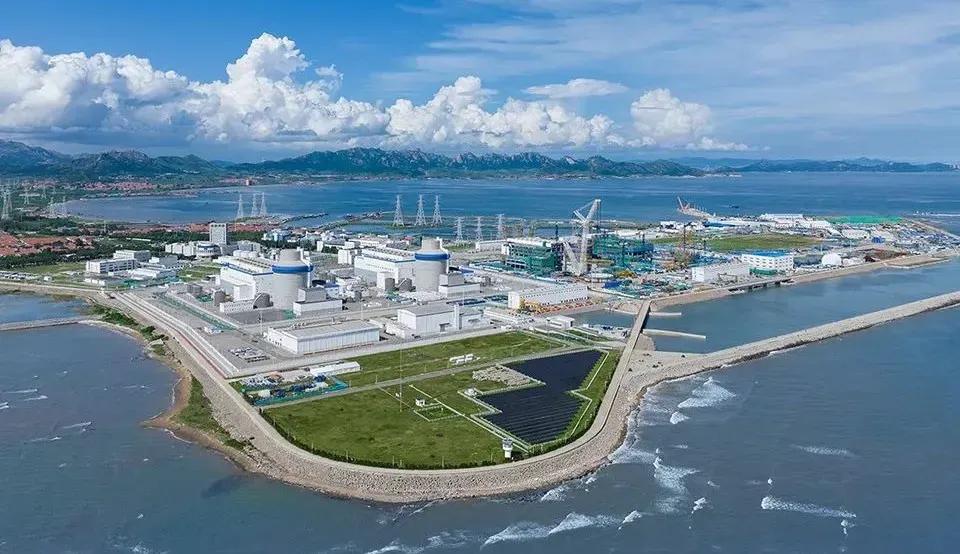
Haiyang Nuclear Power Plant Image source: State Power Investment Corporation
In the past, Yantai was significantly driven by large-scale projects such as heavy chemical industry and equipment manufacturing, but it lacked sufficient support from emerging industries and private capital, resulting in a "gap period" after large projects such as the first phase of Yulong Island Refining and Chemical Integration and Wanhua series projects were put into operation one after another.
The outline of Yantai's 15th Five-Year Plan proposes to foster and expand five emerging industrial clusters including electronic information manufacturing, advanced structural materials, biomedicine, clean energy and commercial aerospace.
It includes building a highland of clean energy industrial clusters. Relying on the new energy system of "nuclear, wind, solar, hydrogen, energy storage and LNG", it will build an industrial closed loop of "equipment manufacturing - scenario application - energy service". By 2030, the scale of the clean energy industry will exceed 70 billion yuan.
This will further strengthen Yantai's leading position. But nuclear power projects alone are obviously not enough. To achieve the rise of the value chain, Shandong and Yantai must make greater breakthroughs in nuclear power equipment R&D and manufacturing and producer services.
Sun Ning, deputy general manager of the Nuclear Energy Division of Shandong Electric Power Engineering Consulting Institute Co., Ltd., pointed out in his research paper that Shandong is located in the junction area between the north and the south. Expanding and strengthening the nuclear power producer service industry can effectively undertake the spillover demand of nuclear power services in the province and the north and south, and further consolidate its position as a strategic fulcrum.
Data shows that by October 2025, relying on the construction of nuclear power bases, with Jinan, Qingdao, Yantai and Weihai as the main regions, Shandong has introduced and cultivated a number of backbone enterprises through deepening strategic cooperation with central enterprises, gathering more than 100 nuclear power producer service enterprises.
For example, SPIC Nuclear Power Technology Service Co., Ltd. and State Nuclear Power Technology Service Co., Ltd. under SPIC are professional platforms for nuclear power commissioning and overhaul respectively, both of which are registered in Shandong.
Further focusing on the R&D field, according to the latest information, the comprehensive research building of the Rongcheng Advanced Nuclear Energy Technology Research Base project of Tsinghua University located in Weihai has been completed. After the whole project is completed, the scientific research focus of the Institute of Nuclear and New Energy Technology of Tsinghua University will gradually shift here, which is expected to drive more than 3,000 researchers to settle in in the future.
All these have injected impetus into the development of Shandong's nuclear power industry. But objectively speaking, regions such as Shanghai, Guangdong, Zhejiang and Sichuan have accumulated more than ten years of experience in the nuclear power industry including investment and operation, equipment manufacturing