Turning "buy one get one free" into a wordplay, what did Audi lose?
On the evening of October 11, Zheng Qinwen defeated Andreeva 2-0 in the women's singles final of the China Open, becoming the first local women's singles champion in the history of the China Open. Within a few hours, the official WeChat account of SAIC Audi released an article with the title: "Congratulations to Qinwen on winning the championship! Buy one get one free for all AUDI models."
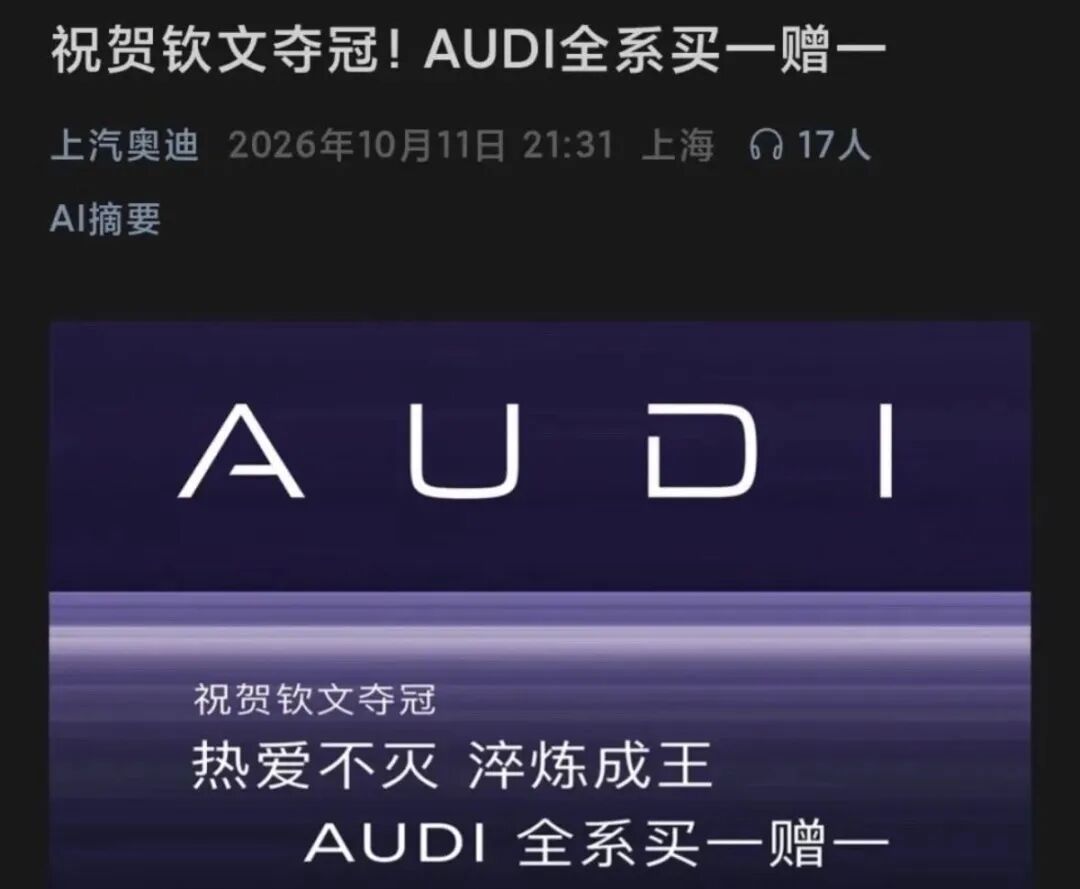
The public sentiment was ready, the traffic was ready, and the word "championship win" paired with "buy one get one free" in the headline was really exciting at first glance.
But consumers who clicked in found that the so-called "buy one get one free" offer gave away a 1:18 scale model of the same car. A salesperson later told reporters that the item was "worth less than about 1,000 yuan". The so-called "all models" did not refer to all Audi vehicles under the four-ring logo, but two pure electric vehicles under the sub-brand marked with the letters "AUDI" — the E5 and E7X.
On November 3, the Market Regulation Bureau of Jiading District, Shanghai confirmed that it has opened a case for investigation against Shanghai SAIC Volkswagen Automotive Sales Co., Ltd.
A 1:18 scale car model has sent a century-old brand into the procedure of case-filing investigation. This incident is worth breaking down and analyzing.
Draw in traffic first, then evade responsibilities
First, let's look at how this headline was designed.
"Congratulations to Qinwen on winning the championship" is the entry point for public sentiment, "buy one get one free" is the promotion exit, and the "all AUDI models" sandwiched in the middle holds all the tricks. When ordinary consumers see "AUDI", their first reaction is Audi; when they see "all models", their first reaction is all car models; when they see "buy one get one free", their first reaction is getting a free car. Every single one of these three words is guiding consumers to expect more than the actual offer.
And the truth is hidden in two "small" details.
The first small detail is the lettered "AUDI" logo. It is not the Audi brand with the four-ring logo, but a sub-brand that SAIC Audi specially set up for its new energy business — it is technically not wrong in literal terms, but it is misleading in communication.
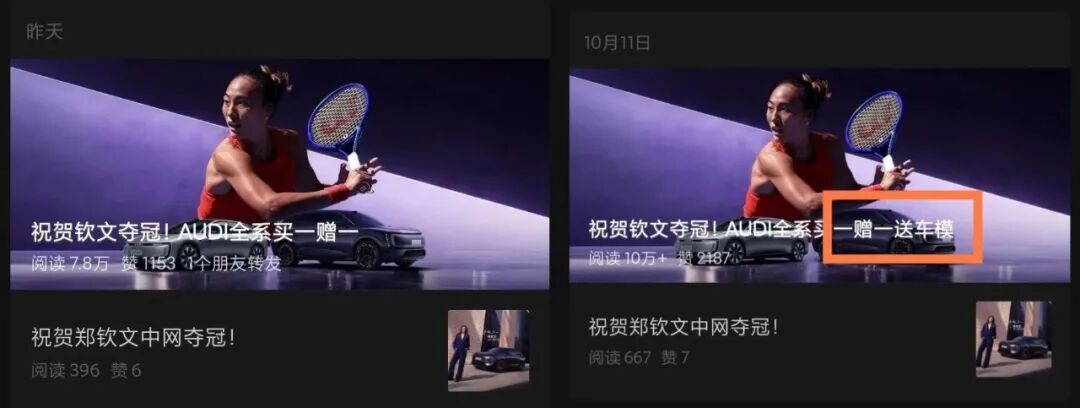
The second small detail is the free gift for "the one you get". The free item is a car model, not a real car. When was this truth added to the headline? Later on the same day of October 11, the headline was changed to "Congratulations to Qinwen on winning the championship! Buy one get one free for all AUDI models, with a free car model".
Notice this modification. It shows that the enterprise itself knew where the problem would arise, but it had already published the earlier version before realizing that. It first amplifies the attractive information, then adds the trivial explanatory detail later — this is not a negligence, but a deliberate rhythm arrangement.
The problem is not whether the gift is clearly marked as a car model, but whether the information is sufficient for consumers to accurately understand the offer before making a purchase decision.
In other words, draw in traffic first, then evade responsibilities. One part amplifies the appeal, the other narrows down the actual commitment. This is not a typesetting problem, but a deliberate information design.
Why did this happen precisely at this moment
What is more worth asking is: Why now?
The price war in the automotive industry has been going on for several years, driving profits to the bottom, and prices can hardly be cut any further. But brands still need to compete for traffic, ride on trending topics, and attract customers to physical stores. After there is no more room to cut prices, the industry has begun to play word games — shifting from competing on "direct price cuts of tens of thousands of yuan" to competing on wording of terms like "free gift" and "lifetime validity".
The cost of manipulating language is much lower than that of cutting prices, and the risk is also much smaller. Price reductions cost real money, while playing word games only requires modifying a headline.
Then look at the timing of leveraging the trending event. Zheng Qinwen's championship win was the highest point of cross-platform public sentiment that night, and everyone was in a state of excitement. The enterprise knew this very well: when consumers are at their most emotionally aroused, they are most likely to interpret "congratulations" as "welfare". Releasing a "buy one get one free" offer at this moment will definitely bring a higher conversion rate than usual.
So this is not an accidental mistake, but a precisely timed operation. It hits the peak of public sentiment, and also exploits the loopholes in regulations.
What best illustrates the situation is actually the enterprise's response: "Everyone has misunderstood this activity. For the scenario that caused misunderstanding, we have optimized the text expression on the promotional poster as soon as possible."
This sentence is worth reading on its own. The misunderstanding was not "generated" by consumers, but "created" by the enterprise. You carefully designed a scenario that leads to misunderstanding, then turned around and attributed this misunderstanding to consumers, and then casually said you would "optimize the text expression" — pretending to be completely innocent.
This set of tricks is not exclusive to Audi
If you only regard this incident as a marketing flop by Audi, you are underestimating the bigger picture.
This incident exposes an increasingly common trick: split a complete noun to get a narrower definition, then use the broad definition in marketing promotion while applying the narrow definition in legal terms.
Most of the "Porsche Design" products you see in daily life are not manufactured by the Porsche company; most of the "Nanjiren" thermal underwear are not produced by Nanjiren itself; various "joint limited editions", "limited editions" and "master series" products are mostly trademark authorized or OEM products when you look into their background. But all of these tricks have gained advantages in communication.
This set of tricks has extremely low cost and extremely high return. That is why the practice of "using large eye-catching characters to attract attention and small fine print to exempt responsibilities" has been rampant for so many years.
The case-filing by the Market Regulation Bureau of Jiading District, Shanghai this time is a signal. It means that all enterprises that make a living by relying on such tricks have to recalculate their accounts now.
What causes tens of thousands of people to have the same "misunderstanding" at the same time is never consumers' poor language proficiency, but the person who wrote that line of copy, who knows exactly how consumers will think.
This is the part of the incident that deserves the most attention — it is not about what the brand said wrong, but that it accurately predicted how you would think, and then wrote the copy based on that predicted "thought".
The poster can be modified overnight, and the wording can be "optimized" immediately, but that specific moment cannot be changed. It clearly tells everyone: in front of this promotion, you are not a respected customer, but a calculated target.
The investigation by the Market Regulation Bureau of Jiading District is still ongoing, and before the conclusion is released, it is inappropriate to make a final judgment. But one question does not need to wait for the investigation result:
For a brand that even nitpicks over the wording of "buy one get one free" with consumers, why should we believe that the content it says in other promotions is sincere enough?
Consumers are not stupid. Once or twice, they may really fail to notice the line of gray text at the bottom of the page. But when consumers start looking at your ads with a magnifying glass, your ads have already lost. Because what it loses is not just one conversion, but the default trust from consumers in every subsequent interaction.
This is the most regrettable part.
Audi is by no means a brand without solid foundation. Its four-ring logo has a history of more than a hundred years, with accumulated technical expertise, and deep roots in the Chinese market. Why would such a brand bother to play the word game of "buy one get one free" in its marketing?
In the final analysis, this lesson is not a simple marketing mistake, but the brand has gambled the long-accumulated brand credit on a 1:18 scale car model.
And credit is different from car models — car models are made in 1:18 scale, while credit is 1:1, with no room to shrink once it is broken.
This article is from the WeChat official account "Chinese and Foreign Management Media", the author is Dagu Qitan, and 36Kr publishes it with authorization.