Just now, OpenAI has acquired Pierre. Is Codex going to make a move on Git?
Just now, OpenAI officially announced that it will acquire Pierre Computer Company.
OpenAI stated that this acquisition is aimed at accelerating a vision of making Codex the place where teams build software together with AI, "from the initial idea to the final released version".
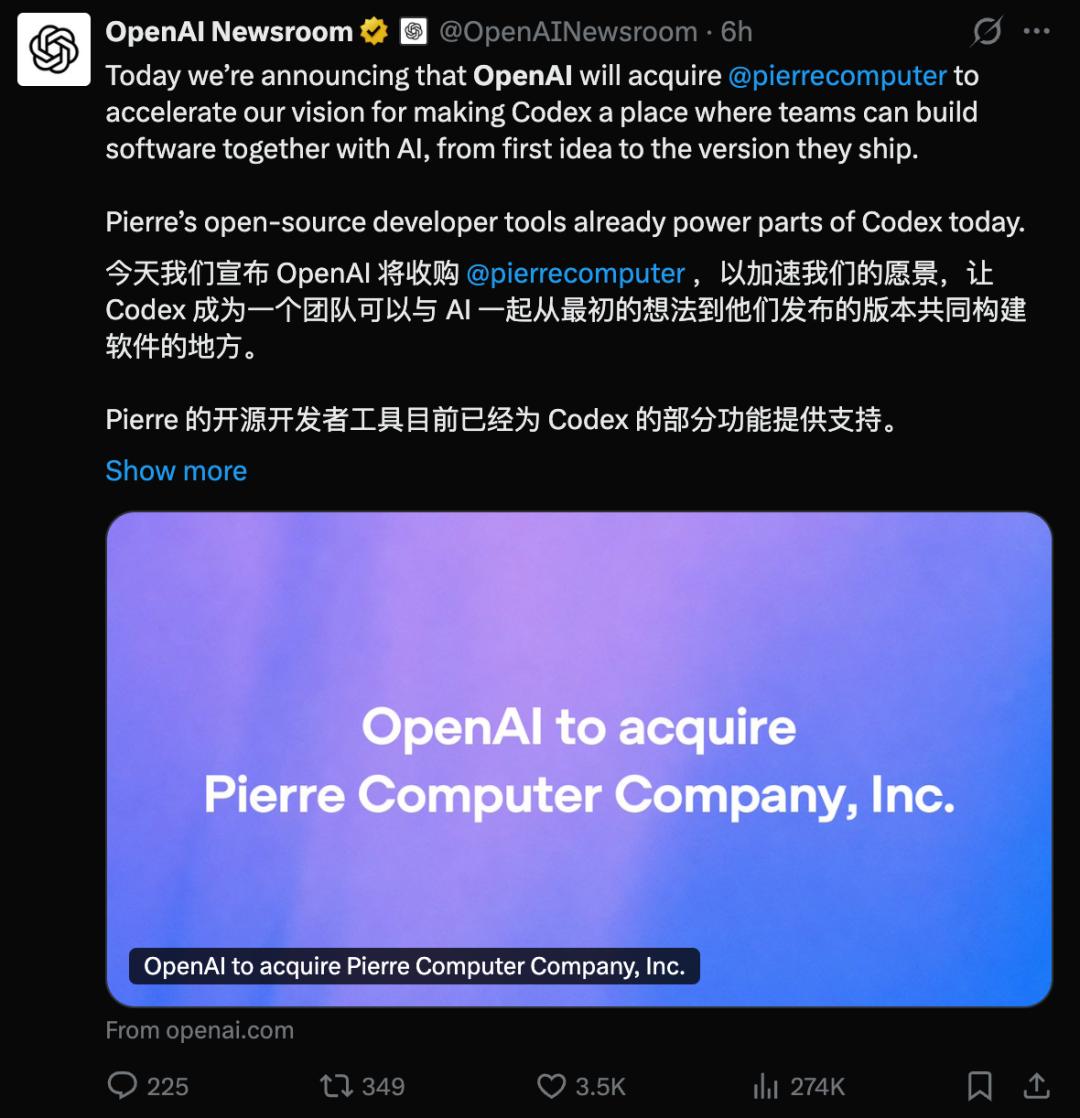
At the same time, Pierre's official account also released a video shot on a basketball court to announce the news of joining OpenAI. In the video, they said, "The good news is that we are still working on the products that everyone loves."
OpenAI hopes to work with Pierre to set standards for modern software development, covering the scope "from the moment the agent creates the first branch to the wonderful moment when the code is deployed and launched to the whole world". The announcement also mentioned that OpenAI hopes Codex can connect the code delivered by enterprises with the decisions made by employees.
According to the official announcement, Pierre previously built the code hosting service Code Storage and a series of open source developer tools, among which the two open source libraries Trees and Diffs have been used in the file browsing and code difference review interfaces of Codex applications.
This acquisition aims to further improve the Git workflow familiar to developers to better adapt to the new mode of collaboration between humans and AI programming agents.
OpenAI promised that Pierre's open source projects will remain open source, and existing customers can continue to use Code Storage, and relevant capabilities will be gradually integrated into Codex in the future. At present, the transaction still needs to meet closing conditions such as regulatory approval, and the two parties will continue to operate independently before the formal completion.
Who Exactly Is Pierre
Pierre's co-founder and CEO is Jacob Thornton. Front-end developers should be no stranger to him, as he is one of the co-authors of Bootstrap. This front-end framework, born inside Twitter, later became one of the most popular CSS frameworks in the world, and is almost an entry tool for a generation of Web developers.
The other co-founder is Ian Ownbey. According to information from venture capital databases such as Dealroom, Pierre was founded in 2023 with a team size of 11 to 50 people. According to the IA40 list disclosure, Pierre has raised a total of about 24 million US dollars in financing.
When you open Pierre's official website pierre.computer, you will see a minimalist retro-style page that looks like it traveled through from the 1990s. The company introduction on the page is only one sentence: Pierre builds "the underlying, composable product infrastructure built for machine work".
Yes, that's all the content on the official website.
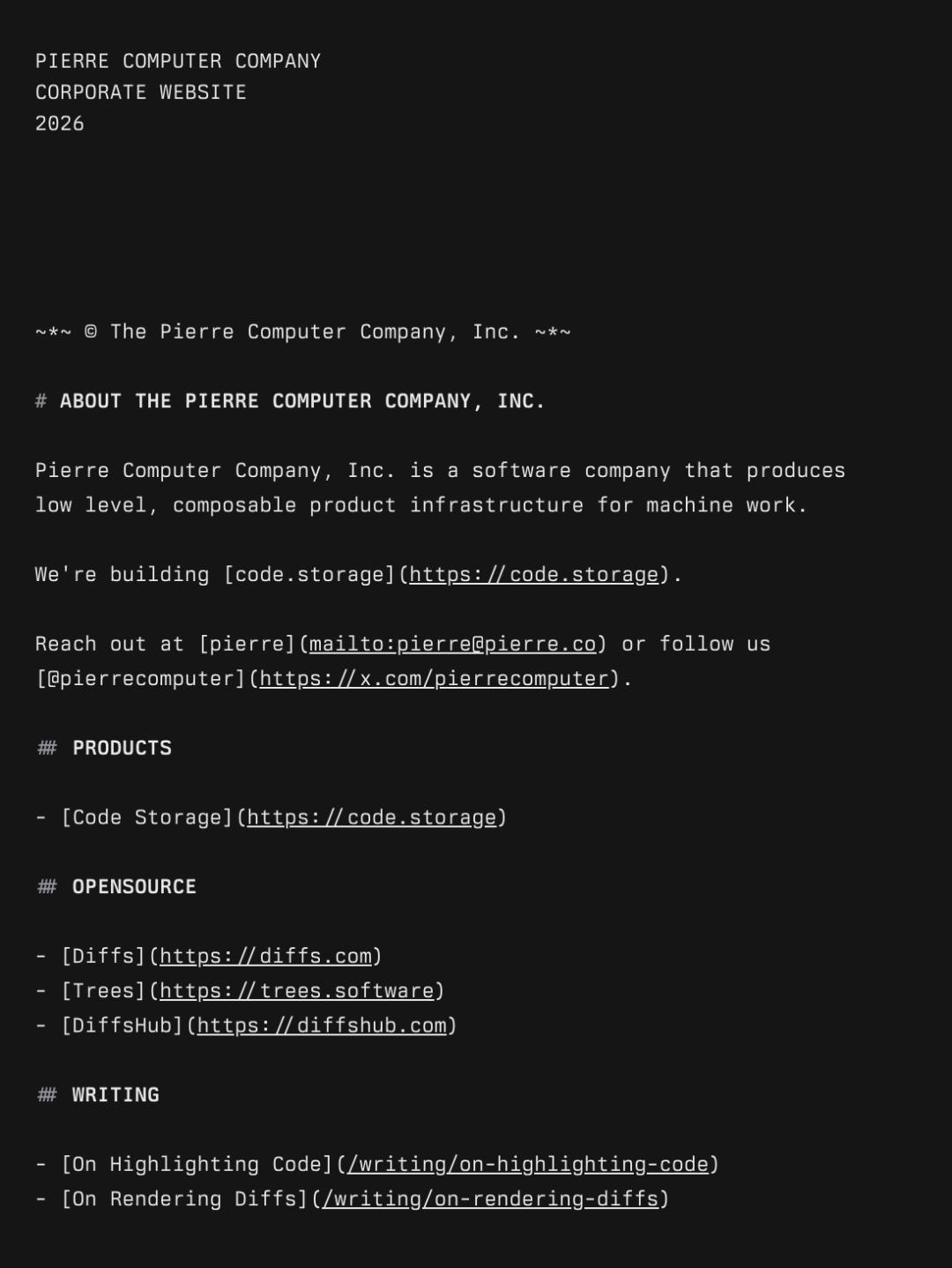
Pierre does not have many product lines, one commercial product plus three open source projects:
- Code Storage: The main commercial product, AI-oriented Git hosting infrastructure
- Diffs: Code difference rendering library
- Trees: Project file tree browsing library
- DiffsHub: Open source project based on Diffs
Code Storage is Pierre's core product, positioned to store code and other machine-generated artifacts for the largest-scale agent workloads in the industry.
It supports a maximum storage capacity of 32TB per repository, with no upper limit on the number of repositories and total storage space. There is no speed limit for Git requests and API requests. Actual measurement shows that a single repository can process more than 500 Git requests per second, with a peak of more than 15,000 API requests per second, supporting more than 30 concurrent writes at the same time, and providing a 99.99% availability SLA.
Behind these indicators is the fact that AI programming is changing the rhythm of code production. A human engineer may only submit code a few times a day, but an AI agent may create dozens of branches in one minute and initiate a large number of read and write requests at the same time. The current rate limiting mechanism and access control process of traditional Git hosting platforms are mainly designed around the usage habits of human developers. When programming agents become high-frequency users, the original infrastructure also needs to change accordingly.
Code Storage is built exactly for this purpose. Technically, it is based on Git's three-phase commit protocol, combined with a "spoke" quorum architecture, which supports high-concurrency read and write while ensuring data persistence and consistency. Developers can not only directly operate the repository through SDKs for TypeScript, Python and Go, but also use the native Git protocol for clone and push, and realize two-way synchronization with GitHub, GitLab and Bitbucket. This means that developers do not need to completely change their existing workflows to access the code storage service optimized for AI agents.
Even the pricing method takes into account the characteristics of AI programming. Hot data accessed within 7 days is charged at $0.005 per GB per hour; cold data that has not been accessed for more than 7 days drops to $0.0002, a 25-fold difference between the two.
In the AI programming scenario, agents may quickly generate a large amount of code, branches and intermediate artifacts, many of which will only be read or modified once or twice before being left idle for a long time. Through tiered billing for hot and cold data, Code Storage tries to make this code storage mode of high-frequency generation and low-frequency access more cost-sustainable.
If Code Storage solves the problem of "where to store the code", then Trees and Diffs solve the problem of "how people can understand the code".
Trees allow developers to quickly browse and locate project files, and Diffs make code changes clear at a glance. OpenAI specifically praised these two libraries in the announcement, saying that they "enable developers to easily review and browse a large amount of code while maintaining excellent performance".
Diffs also has a very practical editing mode. When reviewers find problems in the diff view, they can directly modify that line in place without switching back to the editor. The newly released Highlights can update syntax highlighting in real time when developers type or agents stream output code.
When AI-Generated Code Explodes
From what Pierre is doing, it is not difficult to find that behind OpenAI's acquisition, it actually points to an increasingly common anxiety.
AI has long been writing code faster than humans. But after the code is written, someone has to read it, review it, and take responsibility for it. When an engineer directs several agents to work in parallel at the same time, the diffs they need to review every day may be several times more than in the past.
The review and release links are becoming the real bottleneck in the era of AI programming.
OpenAI specially emphasized this point in the announcement, "There is another important part of using Git, which is how developers review code." Pierre's tools are favored largely because they have put in a lot of effort to "let people quickly understand a large amount of code".
Another noteworthy signal is what OpenAI mentioned, "connecting the code delivered by enterprises with the decisions made by employees". Git can record code changes, but it is difficult to record the discussions and trade-offs behind the changes. When more and more code is generated by AI, the reasons behind code changes will become more difficult to trace than ever, and more important.
Of course, the acquisition itself does not mean that Codex will become a brand new code platform tomorrow. The transaction still requires regulatory approval, and integration takes time. OpenAI's current commitment is that open source projects will remain open source and Code Storage customers can continue to use the service, and the specific new product form has not been announced.
Looking back, the competition of AI programming tools is sinking layer by layer. For more than a decade, code storage, traceability and management have been almost firmly occupied by platforms like GitHub. Now that OpenAI has acquired a company that builds Git infrastructure exclusively for AI, its intention is quite clear.
So here comes the question. If most of the code in the future is written by AI, reviewed by AI, and stored on the platform of an AI company, will developers still need today's GitHub? Is your team ready to let Codex take over the entire process from the first branch to launch?
This article is from the WeChat official account "Machine Heart", edited by Leng Mao, and published by 36Kr with authorization.