With leading tech giants such as Google and Tencent stepping into the sector, is the explosive growth of "AI games" currently underway?
AI has already occupied every segment of the entertainment and cultural industry. On trending search lists, only Mango and Red Fruit stand as equal rivals. Games produced with the help of AI have also seen a massive surge in quantity in the past one or two years, profoundly shaping the future direction of the industry.
During the Steam Next Fest a few days ago, the total number of playable demos on display reached 8,200, doubling the 4,200 figure from last year. According to incomplete statistics, over 30% of the games use "generative AI content". Previously, Huang Yimeng, CEO of TapTap, disclosed that in the first half of 2026, TapTap released 5,002 new playable games, a sharp 843.8% surge from 530 in the same period last year; of the more than 5,000 games, over 4,000 were made with the assistance of AI.
As of press time, *Sanxingdui: Past and Future*, the first AI theatrical film produced by Bona Film Group, grossed 1.697 million yuan at the box office. Compared with AI films, AI games that offer stronger entertainment and immersive experience are more likely to achieve outstanding revenue performance from users. With capital betting on the track and monthly active users soaring, the boom of AI games has only just begun.
Tech Giants Flock to Build AI Game Platforms
"Video games are the last mainstream form of entertainment that almost everyone consumes but almost no one creates. There are people shooting vlogs for films and TV, people playing with GarageBand for music, people writing scripts for coding, but in the game sector, the consumer end and the creation end are almost completely disconnected." This is a market with huge potential in both demand and supply, and it is also one of the hottest content tracks.
As the "shovel seller" side, AI game creation platforms boast relatively large profit potential, which have been bet on by many major tech players first, and integrated with their own social platforms and other channels, igniting the first spark for the era of universal creation where "everyone can make games".
Overseas AI game creation platform Astrocade is known as "the TikTok of the AI game industry", integrating content creation and commercial monetization. Users can comment on, like, favorite and repost mini-games just like scrolling through short video feeds. The threshold for creators to unlock commercial revenue is "100,000 valid game plays" and at least 3 published games. Every 1,000 valid game plays can earn UGC creators 0.1 US dollars, plus additional rewards.
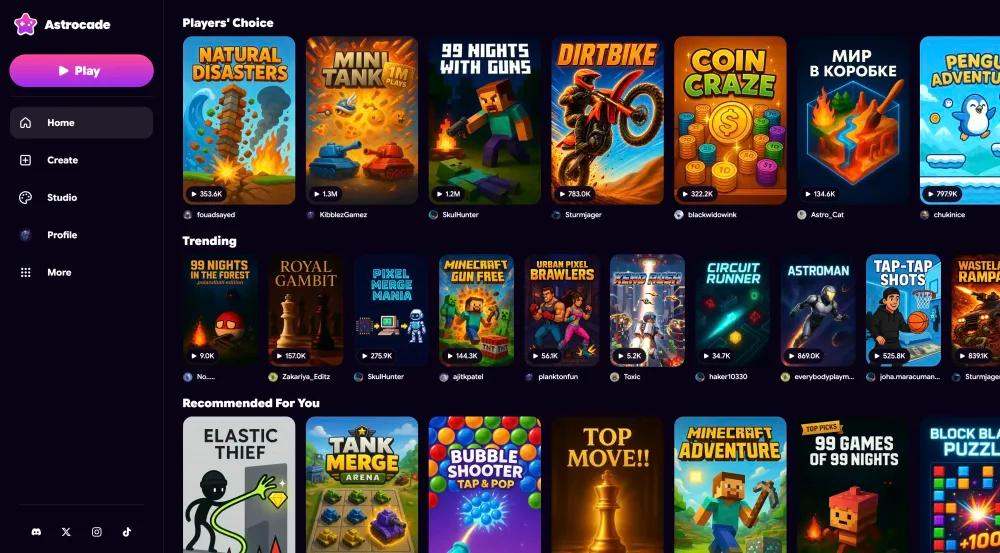
After raising 56 million US dollars in financing in May from investors including HSG, Sea, Google AI Future Fund, and NVIDIA, Astrocade recently officially announced that it has reached 10 million monthly active users, doubling the 5 million MAU figure four months ago. Similar products include ippy, Loopit, Yoroll, etc.
On November 1, Roblox, currently the largest UGC sandbox game creation platform, revealed in its Q3 2026 fiscal quarter report that the total number of AI games created with Build on the platform has exceeded 70,000. Among the top 100 games by playtime in September, over 80% were developed with AI assistance. According to the introduction, more than 500,000 Roblox users have used the Build tool.
Major players have already entered the market one after another. In June, Epic announced that it would integrate large language models such as Claude and Gemini into Unreal Engine 6; at the end of September, Meta released Horizon Create, a lighter product positioned as a mobile APP, and Horizon Studio, a more professional and refined product designed to run on browsers. After generating games through prompts, works can be connected to the Meta ecosystem with one click, launched on the Horizon platform, and simultaneously connected to the official distribution and recommendation channels of Facebook and Instagram.
In October, Google announced a partnership with Unity to launch Playground, an AI game R&D platform that will later be integrated with Unity Spark. It claims to be "an editor with generative capabilities" and is connected to Google Play to accelerate monetization.
Tencent has also made diverse layouts in the AI game platform sector. Youdianling, formerly codenamed Craft (CraftBuddy), is a conversational AI game creation platform launched by Tencent, focusing on fast generation of zero-code game prototypes. Tencent's Photon Studio Group launched "Creation Workshop" in May 2026, which is positioned as an AI interactive narrative game platform. Huya, in which Tencent holds a stake, launched BinkBink, which is compatible with all categories of casual interactive games including match-3 puzzle, tower defense survival, parkour level-breaking, simulation management, and interactive novels.
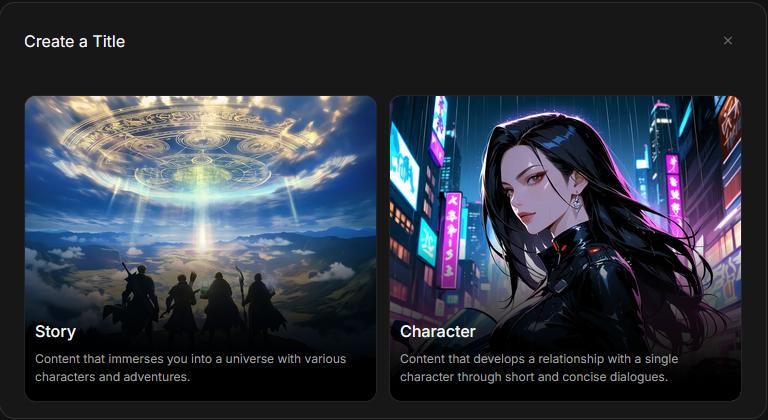
There are also companies that build AI interactive narrative games and AI interactive web novels into a large-scale platform.
*OOC: The Playable Anime* is launched by Wrtn from South Korea. This company is not a traditional game company, but an AI startup that entered the track. The product is positioned as "a playable anime". Users can choose themes and identities they are interested in, participate in the plot from the perspective of the protagonist, and UGC content is added. Different from the "fixed predetermined outcomes" of traditional interactive narrative games, the plot is generated in real time after every interaction.
The mobile version of OOC has generated nearly 26 million RMB in revenue in the past 30 days, about 80% of which comes from the Google Play platform, and more than 60% of OOC mobile version's revenue comes from the US market. According to a Reuters report in February, Wrtn's annualized revenue last year was 70 million US dollars, with a paying user retention rate of over 70%, and it is expected to achieve an annualized revenue of over 100 million US dollars in 2026.
It seems that in the era of fragmented consumption, with algorithms plus social interaction, AI interactive narrative games are likely to become a product at the "next short video" level.
At present, AI game creation platforms are still in the early stage of development. Referring to the precedent of AI film and television creation platforms, for traditional game development models, the future monetization paths are no more than the following: selling computing power, paid memberships, revenue sharing from distribution, value-added services, in-app purchases of props, advertisements, and so on. All of these first require expanding the overall market scale.
Hit Products Emerge, "Clone Games" Run Rampant
With major players placing bets, individual creators break through with "great ideas", and hit games made with AI have emerged, starting to draw attention from users and the industry.
A team of about 20 people burns hundreds of thousands of Tokens every month, completes development and launch in 9 months, with the cost reduced to 1/3 of that of traditional similar productions. The discounted launch price in the Chinese mainland region is only 19.89 yuan. Just three weeks after launch, it received an 87% positive rating on Steam, with estimated revenue of nearly 10 million yuan and more than 260,000 players: these are some data about *Free from Mortal Ties*. This ultra-realistic immersive AI cultivation game is developed by Jiangnan Studio under ByteDance Games.
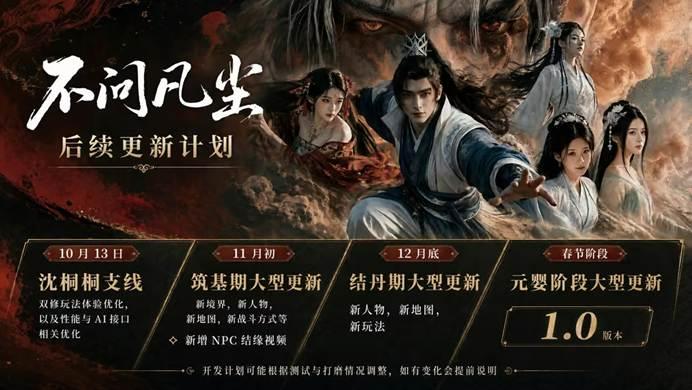
This game combines the mainstream structure of xianxia cultivation novels, with different growth routes such as orthodox sect path, demonic path, and loose cultivator travel, as well as gameplay including alchemy, artifact refining, exploration and treasure hunting. The freedom of NPCs is improved, and characters can develop various relationships. Although the game still needs improvement in immersion and character differentiation design, it is still a meaningful exploration of paid AI games.
Another phenomenal case is the life simulator *One in 8 Billion*, where players randomly experience the life of an ordinary person in 172 countries, including going to school, making friends, falling in love, immigrating, receiving medical treatment... Some players incarnate as a pregnant young mother in the countryside, some spend their whole life chasing their dreams, only to have their trajectories changed by accidents, wars and other events.
This game is independently developed by South Korean freelancer @Jin's Earth. The entire game is built based on the Claude Opus 5.5 model, completed in only four hours, and officially released on October 28, 2026. It refers to more than 100 indicators including life expectancy, infant mortality rate, per capita income distribution, average years of schooling, and incidence of early marriage from multiple institutions.
With its philosophical thinking and humanistic care, the game became a hit on social media, with the highest single piece of content exceeding 57 million views. Yuji Horii, producer of *Dragon Quest*, also participated in the discussion.

The above cases prove that AI can become a powerful tool for small teams to reduce costs and increase efficiency, making the inspiration and creativity of independent creators seen by the whole world.
On the contrary, when misused, AI promotes the production of more counterfeit and low-quality "electronic swill".
On October 16, *The Drunken Goddess's Wine Tricks*, an highly anticipated independent game, canceled its previously scheduled public release plan on the 19th of the same month, and switched to a closed online demo for limited participants. This measure is precisely to prevent people from using the demo resources to rush to make AI pirated counterfeits.
Such examples are already commonplace. With the help of AI, a large number of console games have been "ported" to mobile phones. The short video *Looking for a Needle in a Haystack Simulator* received 50 million views on Twitter. Less than a month after the short video was released, more than ten counterfeit and copycat works with highly similar game names and core gameplay appeared on Steam.
Amid criticism of "cyber garbage", just like AI comic dramas, the 80/20 effect is prominent in AI games. Among the 8,651 AI-disclosed games counted by SteamData.AI, their total revenue is about 397 million US dollars. *Red Desert*, the top grossing game, took 42.9% of the total revenue, the top 10 games took 65.9% in total, and the top 100 games took 86.6%.
In fact, the surge in quantity does not mean a simultaneous rise in quality. Most of the crudely produced content eventually fades away quietly. The lowered threshold and explosion in quantity mean that users' attention and playtime are distracted, and the innovation cost of independent games also rises accordingly.
At the same time, *Phantom Blade Zero*, known as "the second domestic master-level masterpiece", has sparked a carnival among action game players with its ultra-high reputation, and the domestic 3A game matrix is taking shape day by day. In this winter with three consecutive IP blockbusters, all players are waiting for the release of *The Legend of Zelda: Ocarina of Time* and *GTA6*. Innovative combat mechanisms, the fun of exploration, puzzle-solving and interaction, epic stories, unique worldviews and aesthetics... together constitute the most essential charm of games. No matter whether the AI label is attached or not, what players care most about is still "fun".
Just like "advertising, film and television, short video practitioners switching to AI comic dramas", people with relevant experience in game projects have more advantages when switching to AI game development. The former have audio-visual language expression logic that is more in line with public habits, rather than leaving everything to AI — just like a film crew without a director shooting on their own; the latter know better how to make good use of AI tools.
AI tools have eliminated most professional barriers, but the uniqueness of creativity has become the biggest threshold for creators. As the CEO of Unity said: Letting AI reproduce a game that has already been made will not make you Hideo Kojima, just like typing the first paragraph of *War and Peace* into a word processor will not make you Tolstoy.
This article is from the WeChat Official Account "Entertainment Unicorn" (ID: yuledujiaoshou), Author: Mia, Editor: Tangchao Shanzha, published with authorization from 36Kr.