Yangwang U9X chases extreme top speed, the facelifted SU7 Ultra sets a new lap record on the Nürburgring Nordschleife, what is the significance of electric vehicles competing for speed in the AI era?
A new round of speed competition among domestic high-performance vehicles has kicked off.
On November 2, Yangwang Auto officially announced that the U9X will restart its speed challenge in Abu Dhabi, aiming to break the 496.22km/h top speed record it set in 2025.
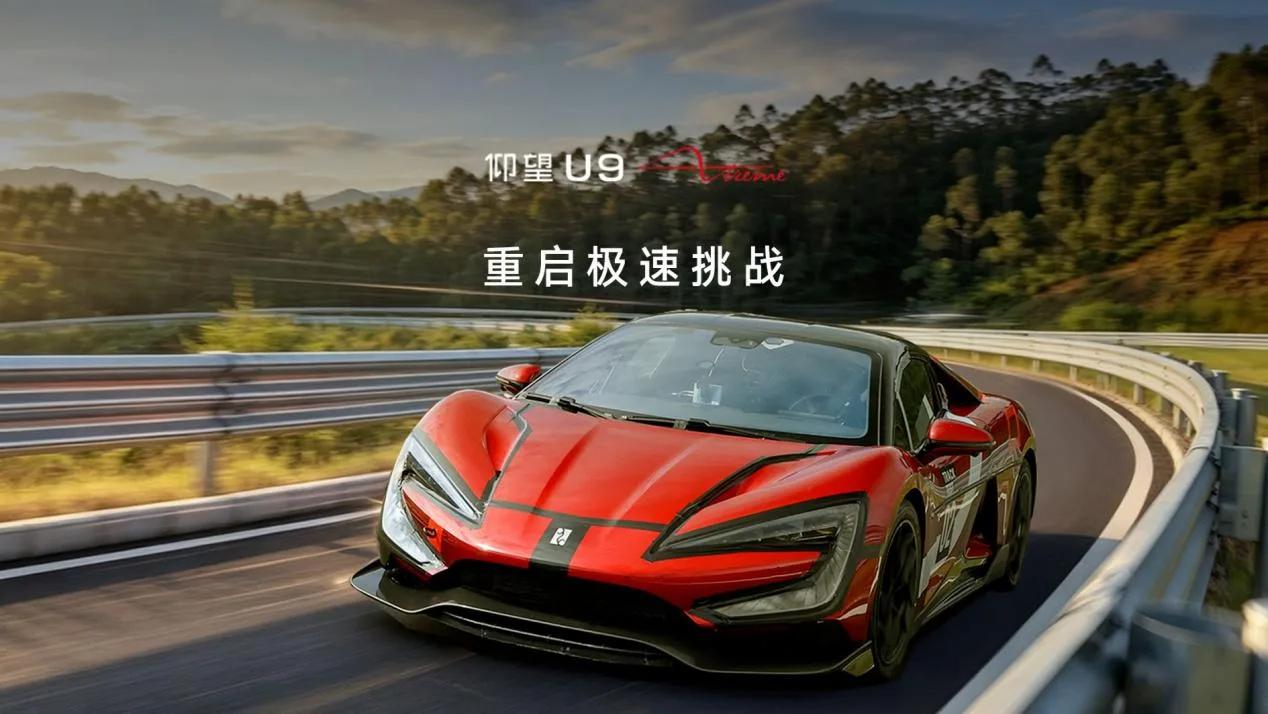
(Image source: Yangwang)
One day later on November 3, Xiaomi Auto also officially announced that it will return to the Nürburgring Nordschleife on November 4.
The two brands with different positioning set off again on two different tracks, with only one goal in mind: to achieve better results than ever before.
So for these Chinese automakers, what exactly are they pursuing by constantly breaking records? Now that the automotive industry is about to enter the L3 era, do we still need performance and handling in the future?
Today, Dianchetong (ID: dianchetong233) would like to take this opportunity to discuss this topic with you all.
Will Yangwang and Xiaomi set new records for Chinese automakers?
The moves by Xiaomi and Yangwang are not just announcements of new challenges on the surface, there are also a series of well-coordinated operations behind them.
On Yangwang's side, General Manager Hu Xiaoqing successively released videos of the collision accident that occurred during the U9X speed test after the official announcement, and invited the test driver who drove the car at that time to appear on camera to tell his experience.
In the video, the driver recalled that the instantaneous speed of the U9X at the first collision was 360km/h. The car bounced to the opposite side of the road and did not stop until the second collision. After two impacts, the vehicle was severely damaged, but the driver was unharmed, and he could even get out of the car to study the collision route at the scene.
From the perspective of Dianchetong (ID: dianchetong233), the purpose of Yangwang releasing this video is still to promote the safety of the U9X: even under a 360km/h collision, the carbon fiber body can withstand the impact, and the three-electric system has also withstood the test without catching fire or emitting smoke.
Although Xiaomi has not released more official information, its Nürburgring journey has already begun. At present, foreign netizens and media have captured test videos of the facelifted SU7 Ultra on the Nürburgring Nordschleife and made certain interpretations.
Judging from the currently exposed videos and pictures, the facelifted SU7 Ultra participating in the test on the Nürburgring this time is equipped with a more aggressive aerodynamic kit: the front splitter of the vehicle is wider than the current model, and it is also equipped with a larger rear wing to bring better aerodynamic performance.
It is worth mentioning that there are currently two facelifted SU7 Ultra test cars on the Nürburgring, with license plates M•SU7 645 E and M•SU7 650 E respectively. This has led many netizens to speculate that the target lap time of the facelifted SU7 Ultra is between 6 minutes 45 seconds and 6 minutes 50 seconds.
According to the analysis of the self-media @Keyboard Car God Religion, Ren Zhoucan, head of vehicle dynamic performance development and chief test driver of Xiaomi Auto, is suspected to have achieved a lap time of about 6 minutes 58 seconds on the Nürburgring, which may make him the first Chinese driver to break the 7-minute lap barrier. In addition, the blogger also speculated that the Nürburgring lap time of David Pittard, the contracted driver cooperating with Xiaomi Auto, may be around 6 minutes 52 seconds.
Looking back at the history of Nürburgring lap times in recent years: On April 1, 2025, the first-generation mass-produced SU7 Ultra equipped with the track professional kit refreshed the record for the fastest mass-produced electric vehicle on the Nürburgring with a time of 7 minutes 04.957 seconds; but in August of the same year, this record was rewritten by the Yangwang U9X with a time of 6 minutes 59.157 seconds.
On April 15 this year, the Porsche Taycan Turbo GT equipped with the Manthey kit set a new Nürburgring lap time record of 6 minutes 55.533 seconds, regaining the title of the fastest mass-produced electric vehicle on the Nürburgring.
In September this year, there were online rumors that the Denza Z achieved a lap time of 6 minutes 50.964 seconds on the Nürburgring, accompanied by a group photo of the driver, the vehicle and the lap time, but this result has not been officially certified, and neither the Nürburgring official nor Denza has disclosed it.
Combined with the fact that the Nürburgring mass-produced electric vehicle record has been changing hands in the past two years, Dianchetong (ID: dianchetong233) speculates that this time the facelifted SU7 Ultra returns to the Nürburgring, it will not only refresh its previous results, but also may impact the record for the fastest mass-produced electric vehicle on the Nürburgring again — which exactly echoes the "645" and "650" on the license plates of the two test cars.
However, it should be noted that although both Xiaomi and Yangwang have officially announced a new round of challenges, there is no tense atmosphere between the two companies.
On November 2, Hu Zhengnan, Vice President of Xiaomi Group and CTO of the Auto Department, reposted Yangwang's official announcement on Weibo, saying that the post was "very touching, I can feel the same way..." and stated that "I pay tribute to all the pioneers and peers who are still sticking to practical work!"
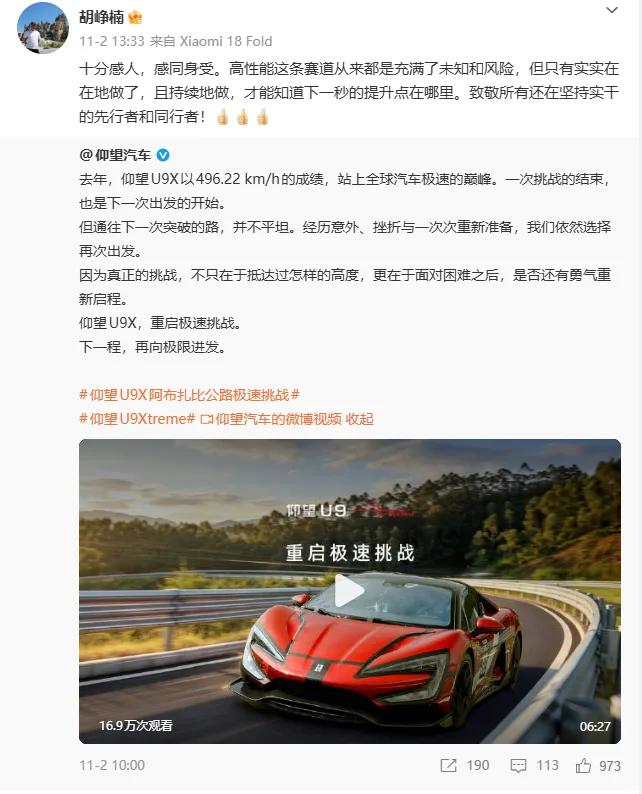
(Image source: Screenshot from Weibo)
So here comes the question: Why do some automakers keep focusing on lap times and insist on achieving better results? What exactly is this speed competition among Chinese automakers fighting for?
Users don't need such high speed, what are Chinese automakers pursuing by breaking records?
While Xiaomi and Yangwang are trying to break records again and again, they are also facing incomprehension and ridicule.
On the Internet, there are still quite a few voices arguing that it is meaningless for brands to pursue faster lap times and higher top speeds, and it is just marketing showmanship.
However, from the perspective of Dianchetong (ID: dianchetong233), such a view is obviously inconsistent with the reality and does not hold water.
When automakers conduct lap time tests or top speed tests, on the surface they are pursuing faster results and competing for the title of number one, but the efforts behind it will ultimately feed back to the vehicle itself.
Take the Yangwang U9X as an example, it proved through the top speed result of 496.22km/h that under such extreme working conditions, the core components such as the chassis, suspension and three-electric system all have no problems, which reflects that this car still performs reliably even in such extreme scenarios, so users naturally do not need to worry when driving daily or racing on the track.
The Nürburgring test of the Xiaomi SU7 Ultra is the same. The Nürburgring track is relatively complex, with various types of curves and undulations, which can not only prove the reliability of the vehicle, but also reflect the actual level of the vehicle's power and tuning.
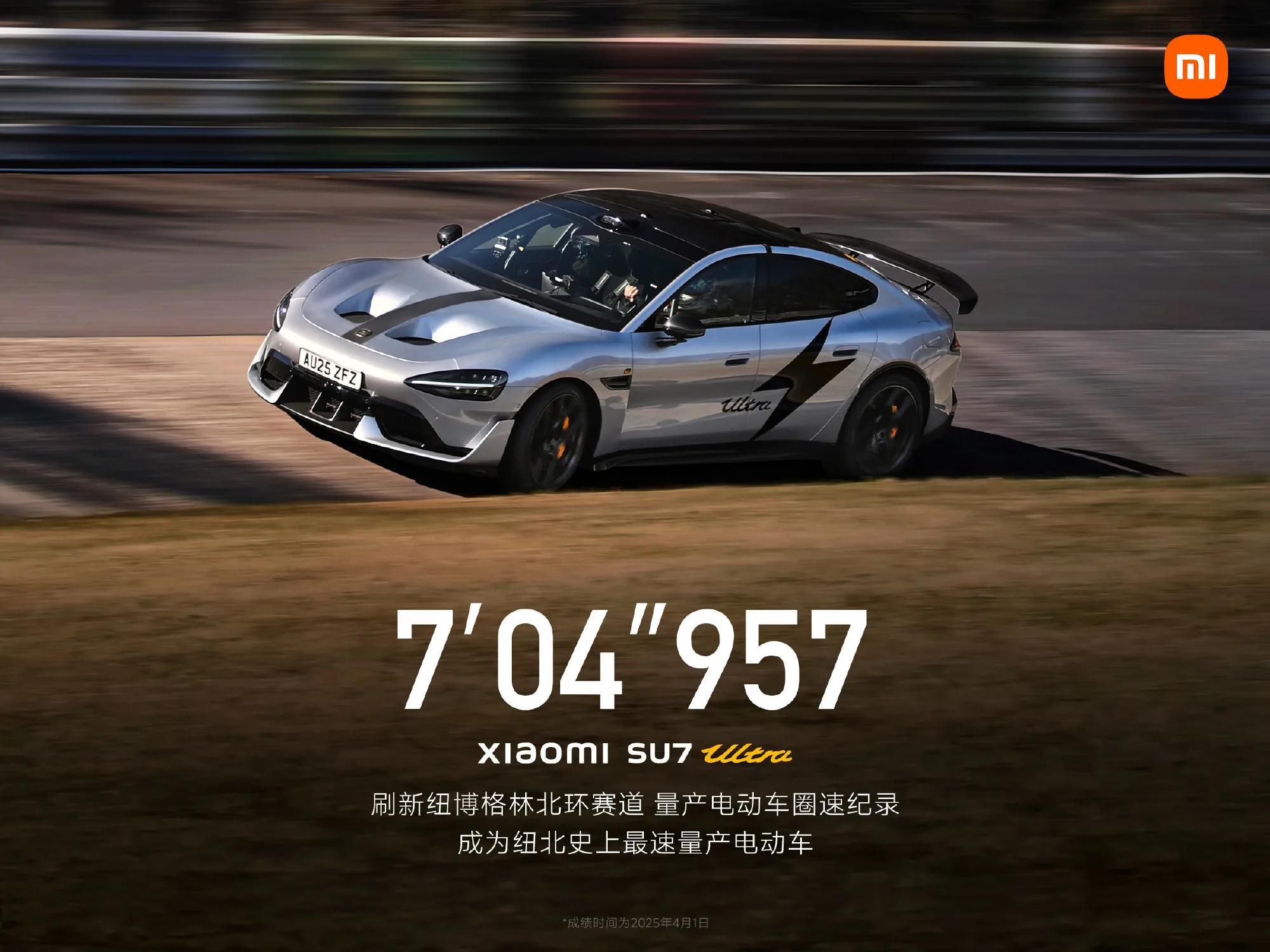
(Image source: Xiaomi Auto)
Therefore, whether it is Yangwang, Xiaomi, or other automakers who are keen on track testing, the experience accumulated on the track will eventually be deposited into regular models, so that the cars ordinary consumers buy can have better mechanical quality and more reliable quality.
In addition, such tests are also one of the most intuitive ways for automakers to prove their R&D strength and mechanical quality.
Compared with the major automakers that have long been famous in the fuel vehicle era, Chinese independent brands started late and developed step by step from the low-end market. Many consumers naturally look at independent brands and their models with a filter of "inferior to others". If automakers want to break this filter, it is obviously useless to just brag about how strong they are with words. Using objective results to speak is a more intuitive and more convincing way.
Yangwang and Xiaomi are exactly such examples.
BYD, behind Yangwang, started step by step from the F3, which imitated the Toyota Corolla, and gradually embarked on the road of high-end development until the new energy era. The million-yuan luxury car positioning of the Yangwang brand and the supercar performance of the Yangwang U9 inherently require results to prove themselves.
Xiaomi did not enter the automotive industry until 2021, and many consumers did not believe at first that it could build reliable cars. Therefore, Xiaomi also needs to use results to prove the reliability of its vehicles and its strength in mechanical quality, so that potential consumers can place orders with peace of mind.
To sum up, what automakers are pursuing by trying to break records again and again is not just the lap time that is a few seconds ahead and the top speed that is a few kilometers higher, but also the polishing of the vehicle's mechanical quality and the continuous strengthening of the brand image.
However, we are now on the eve of L3-level autonomous driving, and the automotive industry is accelerating towards the direction of automation and unmanned driving. Under this general trend, is it still meaningful for automakers to adhere to speed and performance?
In the AI era, do vehicle performance and speed still make sense?
From the perspective of Dianchetong (ID: dianchetong233), the general trend of the automotive industry is most likely autonomous driving and even driverless driving, but automobiles are essentially different from other physical carriers of AI and even AGI such as embodied intelligence and AI terminals. Even if they achieve a high degree of automation, they still need to drive on roads and have more close interactions with the physical world, so they naturally need stronger mechanical quality to protect the safety of passengers and themselves.
Therefore, the pursuit of performance, speed and handling by vehicles still has its meaning even in the autonomous driving era.
Moreover, at present, AI has begun to combine with motorsports. For example, Xiaomi has been exploring the use of autonomous driving to brush track lap times, and has achieved good results on the Nürburgring.
If autonomous driving can be more deeply involved in driver training and speed testing in the future, it may present a new picture for the automotive industry and motorsports — the scenes in the anime Future GPX Cyber Formula may really come into reality.
Therefore, instead of looking at it pessimistically, it is better to look forward positively. It is believed that the efforts of various automakers in performance and sports can go through cycles, and even in the AI era, they can inject new power into the automotive industry.
This article is from "Dianchetong", authorized for release by 36Kr.